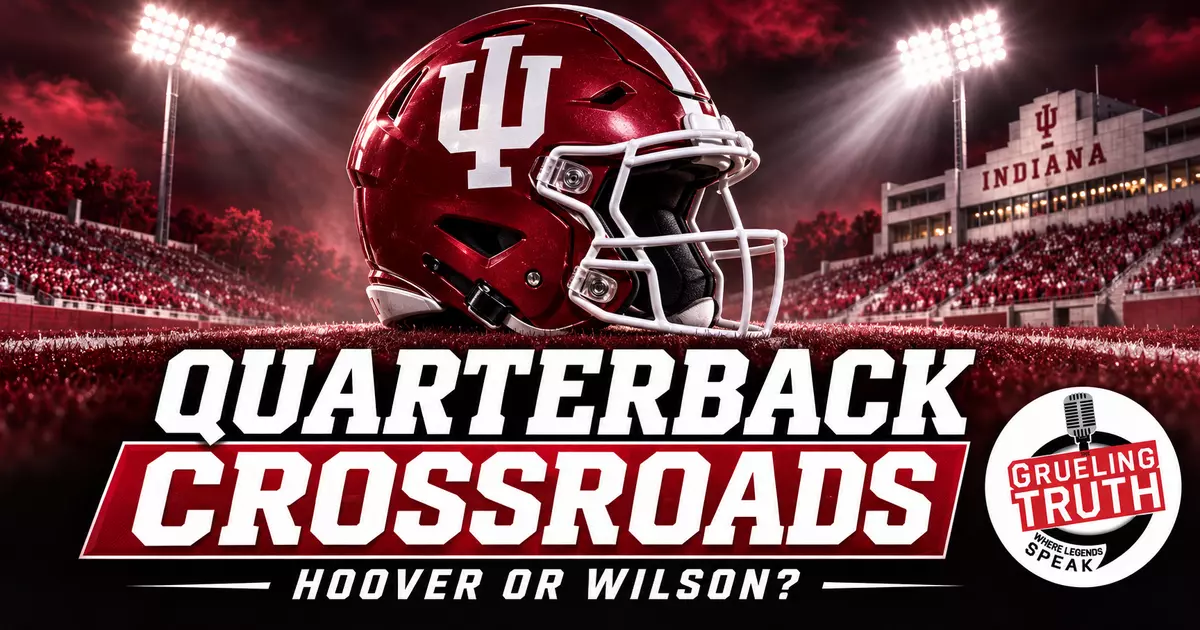
Indiana has reached November with an 8–1 record and a championship opportunity still in front of it. The most important question during its bye week is who gives the offense the best chance to protect that opportunity.
Indiana has reached November with an 8–1 record and a championship opportunity still in front of it. The most important question during its bye week is who gives the offense the best chance to protect that opportunity.
Josh Hoover entered the season as the starting quarterback. Grant Wilson finished Saturday’s 23–16 overtime victory against Minnesota as the quarterback making the decisive plays.
That creates a legitimate decision for Curt Cignetti. It does not establish that a permanent change has already been made.
In his initial postgame comments, Cignetti did not clearly separate the effect of Hoover’s injury from the effect of his performance. Hoover had been dealing with a throwing-arm injury suffered against Ohio State and took another hard hit late in the first half against Minnesota. Wilson took over after halftime with Indiana trailing 10–7.
The uncertainty matters. Any discussion about the next starter should begin with what Hoover can physically do before turning into a referendum on what he has done wrong.
Hoover’s health has to come first
A quarterback
can be available without being capable of executing every part of the offense at his usual level. That distinction belongs at the center of Indiana’s evaluation.
If Hoover cannot consistently make the throws the system requires, asking him to play through the problem may make the offense increasingly predictable. Defenses can crowd the portions of the field a quarterback still threatens and force him toward the throws he is struggling to complete.
That is a coaching question and a medical question. Neither can be answered by fans studying body language between plays.
Indiana needs to determine whether rest restores Hoover’s effectiveness and whether his practice work supports the responsibilities he would carry against USC on November 14.
Wilson earned a serious evaluation
Wilson completed nine of 17 passes for 156 yards and a touchdown against Minnesota. His 33-yard connection with Charlie Becker helped set up the tying field goal, and he found Becker again for the overtime touchdown.
Those were consequential plays under enormous pressure. Wilson gave the passing game the late production Indiana needed.
The next question is whether that success can become a dependable offensive performance over four quarters. A strong relief appearance deserves recognition, but preparing to start creates a different assignment. The opponent can study the quarterback’s tendencies and build a plan around making him uncomfortable.
Cignetti should evaluate whether Wilson can consistently identify pressure, deliver on time and keep the offense out of situations that require an exceptional final play.
The season totals offer useful perspective
Indiana’s official statistics through nine games list Hoover with 1,860 passing yards, 19 touchdowns and two interceptions. Wilson has 230 passing yards and three touchdowns on 22 attempts.
Those figures should prevent an overly simple argument in either direction. Hoover has supplied the overwhelming majority of the season’s passing production. Wilson’s sample is much smaller, even after his important contribution against Minnesota.
The decision should account for that history without becoming trapped by it. Earlier production deserves consideration; the quarterback’s current ability to execute deserves the final say.
Indiana needs an answer the entire offense can trust
The bye gives Cignetti time to examine the position without immediately forcing a rushed public verdict.
Who handles the core passing concepts most reliably? Who can punish a defense for crowding the line? Whose health allows the staff to call the offense with confidence?
Those questions should decide the assignment. The loudest reaction to the Minnesota game should not.
Indiana does not need a quarterback controversy to define November. It needs an offense that gives its defense more help. Cignetti’s responsibility is to choose the quarterback most capable of making that happen—and give him a plan he can execute.
New Users - Get $200 in Bonus Bets when you wager $5 for 4 days
T&Cs apply
4.6/5
Gambling Problem? Call 1-800-GAMBLER or 1-800-MY-RESET. Visit www.mdgamblinghelp.org (MD). 1-888-789-7777 or ccpg.org/chat (CT). Hope is here. GamblingHelpLineMA.org or (800) 327-5050 for 24/7 support (MA). 1-877-8-HOPENY or text HOPENY (467369) (NY). 21+ (18+ D.C., WY) and present in select states (for KS, in affiliation with Kansas Star Casino). First online real money wager only. Min $5 wager required for 4 consecutive days. $5 first deposit required. Bonus issued as nonwithdrawable bonus bets which expire 5 days after receipt. Restrictions apply. See terms at sportsbook.fanduel.com. Call 1-877-770-7867 (LA).
Get Up to $1,000 Back in Bonus Bets Over Your First 10 Days
T&Cs apply
4.5/5
Gambling problem? Call 1-800-GAMBLER or 1-800-MY-RESET (Available in the US) 877-8-HOPENY or text HOPENY (467369) (NY) 1-800-327-5050 (MA), 1-800-BETS-OFF (IA), 21+ only. Please Gamble Responsibly. Visit mdgamblinghelp.org (MD). See BetMGM.com for Terms. New Player Offer for new players only. Subject to eligibility requirements. Bonus bets are non-withdrawable. In partnership with Kansas Crossing Casino and Hotel. This promotional offer is not available in NJ, MA, MI, NV, NY, ON, PA, PR, and WV.
New DraftKings Customers: Bet $5, Get $200 + 3 Months of NBA League Pass
T&Cs apply
4.5/5
GAMBLING PROBLEM? CALL 1-800-GAMBLER or 1-800-MY-RESET, (800) 327-5050 or visit gamblinghelplinema.org (MA). Please Gamble Responsibly. 888-789-7777/visit ccpg.org (CT), or visit www.mdgamblinghelp.org (MD), 1-800-981-0023 (PR). 21+ and present in most states. (18+ DC/NH/PR/WY). Void in CAN. Eligibility restrictions apply. On behalf of Boot Hill Casino (KS). Pass-thru of per wager tax may apply in IL. 1 per new Sportsbook customer. $5+ first-time bet req. Max. $200 issued as non-withdrawable Bonus Bets. Stake removed from payout. Reward issued as $50 in Bonus Bets every 7 days via click-to-claim for 21 days. Bonus Bets and click-to-claims expire 7 days (168hrs) after issuance. Terms: dkng.co/offer. Get 1 promo code to redeem a 3-month NBA League Pass subscription, complimentary of DraftKings. Subscription auto-renews monthly at then-current price (currently $16.99/mo); cancel anytime. Terms, restrictions, and eligibility requirements apply. Redeem League Pass by 12/19/26 at 11:59 PM ET. Addt’l terms: support.watch.nba.com/hc/en-us/articles/9165532876183-League-Pass-Terms-of-Use_. Ends 11/29/26 at 11:59 PM ET. Sponsored by DK.
Must be 21+. GAMBLING PROBLEM? CALL 1-800-GAMBLER OR CALL 1-800-MY-RESET, www.mdgamblinghelp.org (MD), (800)-327-5050 or gamblinghelplinema.org (MA), Call (877)8-HOPENY or text HOPENY (467369) (NY), (888) 789-7777 or ccpg.org (CT), morethanagame.nc.gov (NC), 1800gambler.net (WV)
Bet $1 and get double the winnings up to $25 for your next 10 bets
T&Cs apply
4.4/5
21+ New users only. Must register using eligible promo code. First bet after registration must qualify. Max. Bonus Bet: $1,000. Bonus Bet expires 14 days after receipt. Void where prohibited. See Caesars.com/promos for full terms. Gambling Problem? 1-800-GAMBLER (1-800-426-2537)
21+ and present in OH. Gambling Problem? Call 1-800-GAMBLER.
This site is using
Cloudflare
and adheres to the
Google Safe Browsing Program. We adapted
Google's Privacy Guidelines
to keep your data safe at all times.
Close
Ready to Win Big? Join the Elite with Our Sports Betting Deals!
FanDuel Promo
New Users - Get $200 in Bonus Bets when you wager $5 for 4 days
Our Favorite
T&Cs and 21+ apply
Gambling Problem? Call 1-800-GAMBLER or 1-800-MY-RESET. Visit www.mdgamblinghelp.org (MD). 1-888-789-7777 or ccpg.org/chat (CT). Hope is here. GamblingHelpLineMA.org or (800) 327-5050 for 24/7 support (MA). 1-877-8-HOPENY or text HOPENY (467369) (NY). 21+ (18+ D.C., WY) and present in select states (for KS, in affiliation with Kansas Star Casino). First online real money wager only. Min $5 wager required for 4 consecutive days. $5 first deposit required. Bonus issued as nonwithdrawable bonus bets which expire 5 days after receipt. Restrictions apply. See terms at sportsbook.fanduel.com. Call 1-877-770-7867 (LA).
Code:
Open FanDuel
Get Bonus
BetMGM Promo
Get Up to $1,000 Back in Bonus Bets Over Your First 10 Days
Best Slots
T&Cs and 21+ apply
Gambling problem? Call 1-800-GAMBLER or 1-800-MY-RESET (Available in the US) 877-8-HOPENY or text HOPENY (467369) (NY) 1-800-327-5050 (MA), 1-800-BETS-OFF (IA), 21+ only. Please Gamble Responsibly. Visit mdgamblinghelp.org (MD). See BetMGM.com for Terms. New Player Offer for new players only. Subject to eligibility requirements. Bonus bets are non-withdrawable. In partnership with Kansas Crossing Casino and Hotel. This promotional offer is not available in NJ, MA, MI, NV, NY, ON, PA, PR, and WV.
Code:
Open BetMGM
Get Bonus
DraftKings Promo
New DraftKings Customers: Bet $5, Get $200 + 3 Months of NBA League Pass
Newcomer
T&Cs and 21+ apply
GAMBLING PROBLEM? CALL 1-800-GAMBLER or 1-800-MY-RESET, (800) 327-5050 or visit gamblinghelplinema.org (MA). Please Gamble Responsibly. 888-789-7777/visit ccpg.org (CT), or visit www.mdgamblinghelp.org (MD), 1-800-981-0023 (PR). 21+ and present in most states. (18+ DC/NH/PR/WY). Void in CAN. Eligibility restrictions apply. On behalf of Boot Hill Casino (KS). Pass-thru of per wager tax may apply in IL. 1 per new Sportsbook customer. $5+ first-time bet req. Max. $200 issued as non-withdrawable Bonus Bets. Stake removed from payout. Reward issued as $50 in Bonus Bets every 7 days via click-to-claim for 21 days. Bonus Bets and click-to-claims expire 7 days (168hrs) after issuance. Terms: dkng.co/offer. Get 1 promo code to redeem a 3-month NBA League Pass subscription, complimentary of DraftKings. Subscription auto-renews monthly at then-current price (currently $16.99/mo); cancel anytime. Terms, restrictions, and eligibility requirements apply. Redeem League Pass by 12/19/26 at 11:59 PM ET. Addt’l terms: support.watch.nba.com/hc/en-us/articles/9165532876183-League-Pass-Terms-of-Use_. Ends 11/29/26 at 11:59 PM ET. Sponsored by DK.
Code:
Open DraftKings
Get Bonus
Find out what the legends have to say about sports this week....
New Users - Get $200 in Bonus Bets when you wager $5 for 4 days
Gambling Problem? Call 1-800-GAMBLER or 1-800-MY-RESET. Visit www.mdgamblinghelp.org (MD). 1-888-789-7777 or ccpg.org/chat (CT). Hope is here. GamblingHelpLineMA.org or (800) 327-5050 for 24/7 support (MA). 1-877-8-HOPENY or text HOPENY (467369) (NY). 21+ (18+ D.C., WY) and present in select states (for KS, in affiliation with Kansas Star Casino). First online real money wager only. Min $5 wager required for 4 consecutive days. $5 first deposit required. Bonus issued as nonwithdrawable bonus bets which expire 5 days after receipt. Restrictions apply. See terms at sportsbook.fanduel.com. Call 1-877-770-7867 (LA).