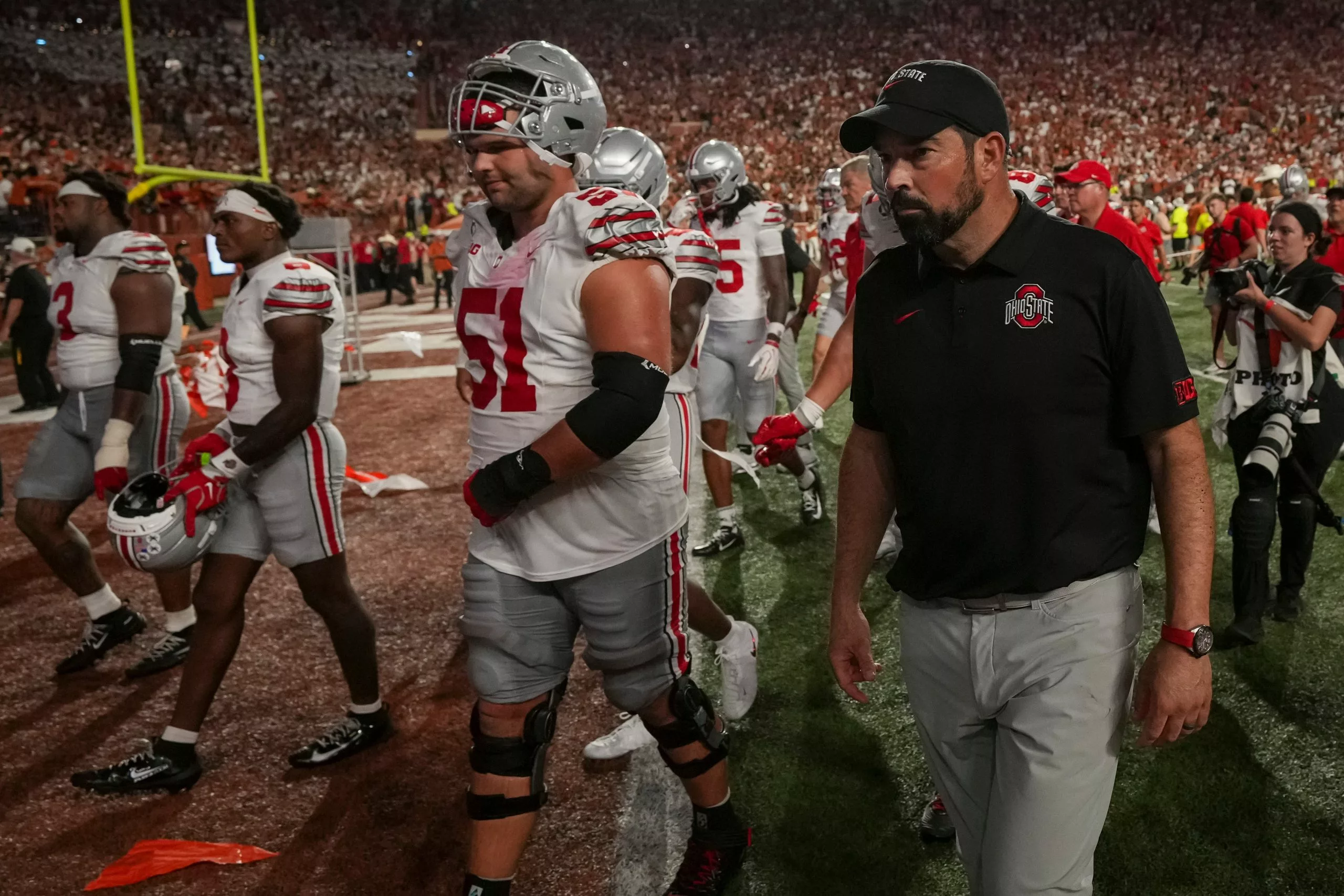
Ohio State Buckeyes head coach Ryan Day watches his players leave the field following the NCAA football game against the Texas Longhorns at Darrell K RoyalTexas Memorial Stadium in Austin, Texas on Sept. 12, 2026.
Big Ten Football entered Week 2 carrying three straight national championships and seven ranked teams. By Saturday night, the conference had gone 2-6 in Power Four nonconference games, a rough enough record to turn one September weekend into a national argument about the league’s depth.
The headline losses were easy to find. No. 6 Oregon gave up 554 yards in a 39-31 loss at Oklahoma State, while No. 1 Ohio State carried a 23-3 lead into the Fourth quarter at Texas and lost 24-23. The next AP poll dropped Oregon to No. 21 and Ohio State to No. 6. The damage also reached teams that were supposed to show how deep the conference had become.
Big Ten Football Lost Across the Top and Middle
Rutgers started the trouble Friday with a 28-21 loss at Boston College. Purdue lost 38-36 to Wake Forest, Minnesota was beaten 38-13 at home by Mississippi State, and Illinois lost 31-27 at home to Duke. Michigan beat Oklahoma 17-10, and Iowa edged Iowa State 16-13, giving the league its only two wins in eight games against Power Four opponents.
Those games carry extra weight because they offer direct comparisons before conference play takes over the schedule. Once Big Ten teams start beating each other, every league win also creates a league loss. September is when a conference can collect outside evidence, and Week 2 handed most of that evidence to the ACC, Big 12 and SEC.
Minnesota supplied the harshest middle-of-the-league example. Mississippi State scored touchdowns on its first four possessions and led 28-6 by halftime. Golden Gophers coach P.J. Fleck gave the visitors a blunt review afterward.
“They dominated in all three phases. You’ve got to give them all the credit in the world because they dictated the terms of the fight.”
Fleck could not blame one strange bounce or a late turnover. Mississippi State controlled the game from the opening drive. Illinois and Purdue had closer finishes, but their losses added to the same problem. The Big Ten had several chances to collect useful wins outside the league and kept leaving them on the table.
Ohio State and Oregon Made the Damage Visible
Oregon paid the biggest ranking price.
Oklahoma State’s 39-31 upset of Oregon
came with a 554-281 yardage gap, which made the result harder to dismiss as one bad break. Dan Lanning accepted his share of the performance afterward.
“I didn’t prepare our guys well enough to play.”
Ohio State lost differently and ended in the same uncomfortable place. The Buckeyes controlled Texas for three quarters before allowing 21 unanswered points in the fourth. When the two highest-profile Big Ten teams lose on the same Saturday, every result underneath them receives more attention too.
Recent history gives the conference a fair counterargument. Michigan, Ohio State and Indiana won the last three national titles, so one September weekend cannot erase the strongest postseason run any league currently owns. Current teams still have to create current evidence, and Week 2 left the Big Ten with less of it.
Week 3 Offers Fewer Chances Outside the League
The next schedule offers fewer major nonconference opportunities. Michigan State visits No.3 Notre Dame, Maryland hosts Virginia Tech, and Northwestern faces Colorado. Those games offer the clearest chances to improve the cross-conference record before league play fills most Saturdays.
The latest AP poll still includes seven Big Ten teams, while the SEC has nine and six of them sit in the top 10. Big Ten football still has contenders, but Week 2 changed the burden of proof. Fleck’s description of Mississippi State was uncomfortable because it required no projection. One visitor came into Big Ten country, controlled all three phases, and left with the kind of evidence September remembers.
Up To $1500 in Bonus Bets Paid Back if your First Bet Does Not Win
T&Cs apply
4.5/5
Gambling problem? Call 1-800-GAMBLER or 1-800-MY-RESET (Available in the US) 877-8-HOPENY or text HOPENY (467369) (NY) 1-800-327-5050 (MA), 1-800-BETS-OFF (IA), 1-800-981-0023 (PR). 21+ only. Please Gamble Responsibly. See BetMGM.com for Terms. First Bet Offer for new customers only (if applicable). Subject to eligibility requirements. Bonus bets are non-withdrawable. In partnership with Kansas Crossing Casino and Hotel. Promotional offers not available in Mississippi, Massachusetts, New York, Ontario, or Puerto Rico.
New DraftKings Customers: Spend $5+ Get $150 in Bonuses
T&Cs apply
4.5/5
GAMBLING PROBLEM? CALL 1-800-GAMBLER or 1-800-MY-RESET, (800) 327-5050 or visit gamblinghelplinema.org (MA). Please Gamble Responsibly. 888-789-7777/visit ccpg.org (CT), or visit www.mdgamblinghelp.org (MD), 1-800-981-0023 (PR). 21+ and present in most states. (18+ DC/NH/PR/WY). Void in CAN. Eligibility restrictions apply. On behalf of Boot Hill Casino (KS). Pass-thru of per wager tax may apply in IL. 1 per new DraftKings customer. $5+ first-time bet req. Max. $150 issued as non-withdrawable Bonus Bets. Stake removed from payout. Reward issued as $50 in Bonus Bets every 7 days via click-to-claim for 14 days. Bonus Bets and click-to-claims expire 7 days (168hrs) after issuance. Terms: sportsbook.draftkings.com/promos. Ends 10/11/26 at 11:59 PM ET. Sponsored by DK.
Must be 21+. GAMBLING PROBLEM? CALL 1-800-GAMBLER OR CALL 1-800-MY-RESET, www.mdgamblinghelp.org (MD), (800)-327-5050 or gamblinghelplinema.org (MA), Call (877)8-HOPENY or text HOPENY (467369) (NY), (888) 789-7777 or ccpg.org (CT), morethanagame.nc.gov (NC), 1800gambler.net (WV)
Bet $1 and get double the winnings up to $25 for your next 10 bets
T&Cs apply
4.4/5
21+ New users only. Must register using eligible promo code. First bet after registration must qualify. Max. Bonus Bet: $1,000. Bonus Bet expires 14 days after receipt. Void where prohibited. See Caesars.com/promos for full terms. Gambling Problem? 1-800-GAMBLER (1-800-426-2537)
21+ and present in OH. Gambling Problem? Call 1-800-GAMBLER.
This site is using
Cloudflare
and adheres to the
Google Safe Browsing Program. We adapted
Google's Privacy Guidelines
to keep your data safe at all times.
Close
Ready to Win Big? Join the Elite with Our Sports Betting Deals!
FanDuel Promo
New Users – Get $250 in Bonus Bets when you wager $5 for 5 days
Up To $1500 in Bonus Bets Paid Back if your First Bet Does Not Win
Best Slots
T&Cs and 21+ apply
Gambling problem? Call 1-800-GAMBLER or 1-800-MY-RESET (Available in the US) 877-8-HOPENY or text HOPENY (467369) (NY) 1-800-327-5050 (MA), 1-800-BETS-OFF (IA), 1-800-981-0023 (PR). 21+ only. Please Gamble Responsibly. See BetMGM.com for Terms. First Bet Offer for new customers only (if applicable). Subject to eligibility requirements. Bonus bets are non-withdrawable. In partnership with Kansas Crossing Casino and Hotel. Promotional offers not available in Mississippi, Massachusetts, New York, Ontario, or Puerto Rico.
Code:
Open BetMGM
Get Bonus
DraftKings Promo
New DraftKings Customers: Spend $5+ Get $150 in Bonuses
Newcomer
T&Cs and 21+ apply
GAMBLING PROBLEM? CALL 1-800-GAMBLER or 1-800-MY-RESET, (800) 327-5050 or visit gamblinghelplinema.org (MA). Please Gamble Responsibly. 888-789-7777/visit ccpg.org (CT), or visit www.mdgamblinghelp.org (MD), 1-800-981-0023 (PR). 21+ and present in most states. (18+ DC/NH/PR/WY). Void in CAN. Eligibility restrictions apply. On behalf of Boot Hill Casino (KS). Pass-thru of per wager tax may apply in IL. 1 per new DraftKings customer. $5+ first-time bet req. Max. $150 issued as non-withdrawable Bonus Bets. Stake removed from payout. Reward issued as $50 in Bonus Bets every 7 days via click-to-claim for 14 days. Bonus Bets and click-to-claims expire 7 days (168hrs) after issuance. Terms: sportsbook.draftkings.com/promos. Ends 10/11/26 at 11:59 PM ET. Sponsored by DK.
Code:
Open DraftKings
Get Bonus
Find out what the legends have to say about sports this week....