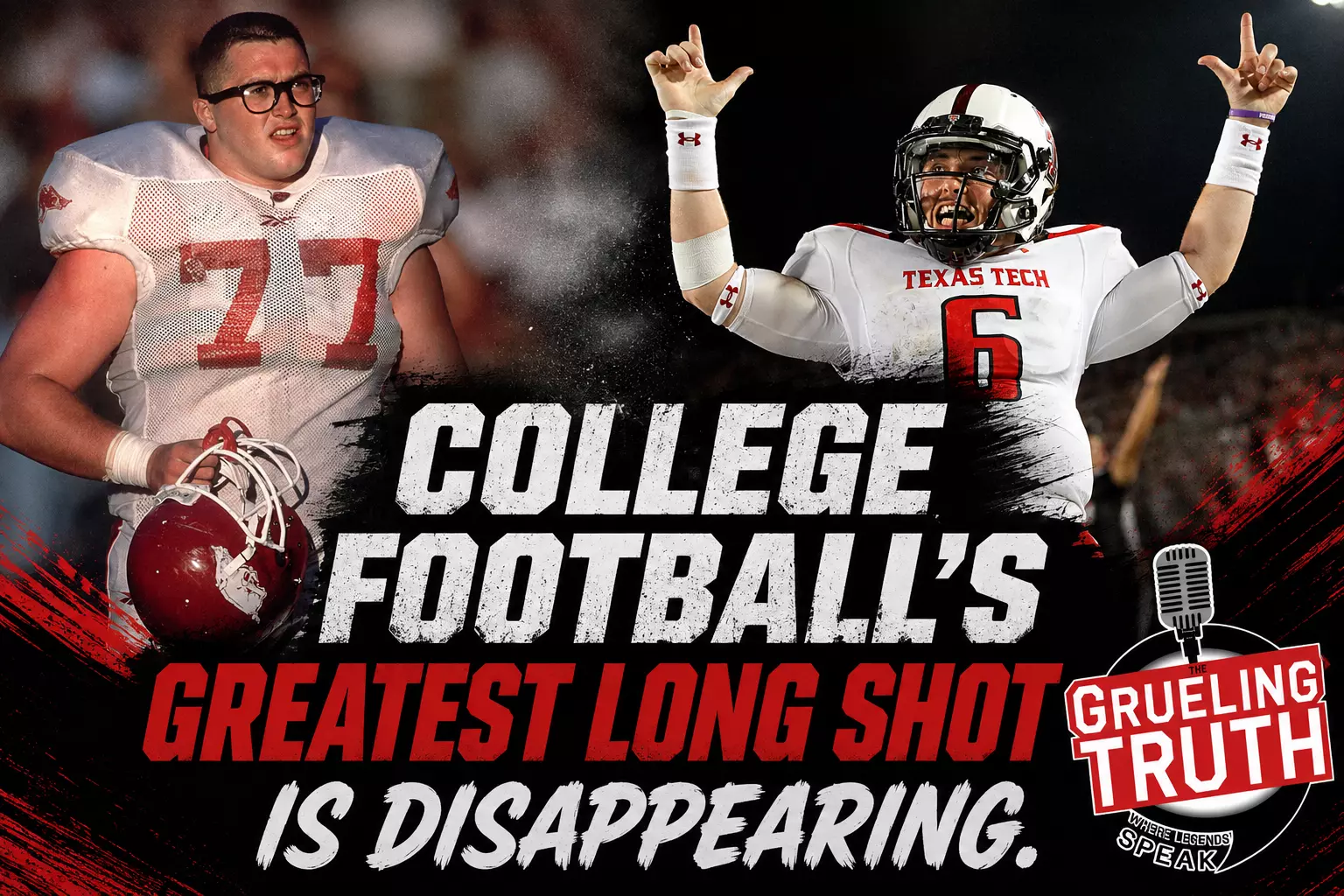
College football walk-ons produced legends like Baker Mayfield and J.J. Watt. New roster rules are making those long-shot journeys harder.
Heading into the 2026 college football season, the walk-on is closer to extinction than it has ever been. For most of the sport’s history, every roster carried a handful of players no one recruited, as kids who paid their own tuition for the privilege of getting hit by scholarship athletes on the scout team all week. They had the earliest alarms and no promise that they would ever dress on a Saturday. The walk-on was the purest character the sport ever produced, and the rare ones who fought from a tryout to an NFL paycheck gave the game its favorite stories about itself.
The Ones Who Beat The Odds
Start with the names that turned the long shot into a blueprint. Baker Mayfield is the modern measuring stick, since he did it twice. He walked on at Texas Tech and started as a true freshman, then walked on again at Oklahoma, and in 2017 became the first former walk-on to win the
Heisman Trophy
before going first overall in the draft. J.J. Watt took a strange road, giving up his scholarship at Central Michigan, delivering pizzas while he trained, and walking on at Wisconsin, a gamble that produced three Defensive Player of the Year awards.
The story that still stings belongs to Brandon Burlsworth, the Arkansas walk-on who willed himself into an All-American guard and a third-round pick, then died in a car accident eleven days later. The award for the nation’s best former walk-on now carries his name. According to CBS Sports, Burlsworth Trophy chairman Marty Burlsworth called walk-ons “the fabric of college football.” The list behind him runs long. Clay Matthews walked on at USC and became a six-time Pro Bowl linebacker, Jordy Nelson arrived at Kansas State unrequited and left an All-American, Stetson Bennett quarterbacked Georgia to back-to-back national titles, and Dabo Swinney, who cleaned gutters to pay his way as an Alabama walk-on, grew up to win two national titles as a head coach.
Why the Door Is Closing
That entire path is narrowing fast, and the reason is the House settlement. It capped football rosters at 105 players, with every one of them eligible for a scholarship, which scrapped the old model of 85 scholarships plus a deep bench of walk-ons. Since FBS programs had been averaging more than 146 players, the squeeze hit the unpaid hardest. By one count, the change wiped out nearly 2,000 walk-on opportunities at the top level. Of course, grandfather rules let current players keep their spots until their eligibility runs out, so the effect is arriving in waves rather than all at once. Even so, the kid showing up to an open tryout with cleats in a backpack is mostly finished where the cameras are.
What College Football Is Trading Away
There is no villain in any of this, and that is the honest part. The new system pays players what the old one never did, and nobody should mourn an arrangement that asked teenagers to take on the sport’s hardest work for free. That being said, it is worth noting what got traded away. The walk-on was living proof that evaluators miss, and that somebody nobody wanted might quietly turn out to be the best player in the country.
So the next time a Mayfield highlight crosses your feed, or the Burlworth Trophy gets handed out in December, remember those careers began with a kid asking permission to take the field at all. College football is richer than ever, and a good deal of that wealth was built on Saturdays shaped by players who started with nothing. The least the rest of us can do is keep telling friends their stories now that the door behind them has shut.
Up To $1500 in Bonus Bets Paid Back if your First Bet Does Not Win
T&Cs apply
4.5/5
Gambling problem? Call 1-800-GAMBLER or 1-800-MY-RESET (Available in the US) 877-8-HOPENY or text HOPENY (467369) (NY) 1-800-327-5050 (MA), 1-800-BETS-OFF (IA), 1-800-981-0023 (PR). 21+ only. Please Gamble Responsibly. See BetMGM.com for Terms. First Bet Offer for new customers only (if applicable). Subject to eligibility requirements. Bonus bets are non-withdrawable. In partnership with Kansas Crossing Casino and Hotel. Promotional offers not available in Mississippi, Massachusetts, New York, Ontario, or Puerto Rico.
New DraftKings Customers: Spend $5+ Get $150 in Bonuses
T&Cs apply
4.5/5
GAMBLING PROBLEM? CALL 1-800-GAMBLER or 1-800-MY-RESET, (800) 327-5050 or visit gamblinghelplinema.org (MA). Please Gamble Responsibly. 888-789-7777/visit ccpg.org (CT), or visit www.mdgamblinghelp.org (MD), 1-800-981-0023 (PR). 21+ and present in most states. (18+ DC/NH/PR/WY). Void in CAN. Eligibility restrictions apply. On behalf of Boot Hill Casino (KS). Pass-thru of per wager tax may apply in IL. 1 per new DraftKings customer. $5+ first-time bet req. Max. $150 issued as non-withdrawable Bonus Bets. Stake removed from payout. Reward issued as $50 in Bonus Bets every 7 days via click-to-claim for 14 days. Bonus Bets and click-to-claims expire 7 days (168hrs) after issuance. Terms: sportsbook.draftkings.com/promos. Ends 10/11/26 at 11:59 PM ET. Sponsored by DK.
Must be 21+. GAMBLING PROBLEM? CALL 1-800-GAMBLER OR CALL 1-800-MY-RESET, www.mdgamblinghelp.org (MD), (800)-327-5050 or gamblinghelplinema.org (MA), Call (877)8-HOPENY or text HOPENY (467369) (NY), (888) 789-7777 or ccpg.org (CT), morethanagame.nc.gov (NC), 1800gambler.net (WV)
Bet $1 and get double the winnings up to $25 for your next 10 bets
T&Cs apply
4.4/5
21+ New users only. Must register using eligible promo code. First bet after registration must qualify. Max. Bonus Bet: $1,000. Bonus Bet expires 14 days after receipt. Void where prohibited. See Caesars.com/promos for full terms. Gambling Problem? 1-800-GAMBLER (1-800-426-2537)
21+ and present in OH. Gambling Problem? Call 1-800-GAMBLER.
This site is using
Cloudflare
and adheres to the
Google Safe Browsing Program. We adapted
Google's Privacy Guidelines
to keep your data safe at all times.
Close
Ready to Win Big? Join the Elite with Our Sports Betting Deals!
FanDuel Promo
New Users – Get $250 in Bonus Bets when you wager $5 for 5 days
Up To $1500 in Bonus Bets Paid Back if your First Bet Does Not Win
Best Slots
T&Cs and 21+ apply
Gambling problem? Call 1-800-GAMBLER or 1-800-MY-RESET (Available in the US) 877-8-HOPENY or text HOPENY (467369) (NY) 1-800-327-5050 (MA), 1-800-BETS-OFF (IA), 1-800-981-0023 (PR). 21+ only. Please Gamble Responsibly. See BetMGM.com for Terms. First Bet Offer for new customers only (if applicable). Subject to eligibility requirements. Bonus bets are non-withdrawable. In partnership with Kansas Crossing Casino and Hotel. Promotional offers not available in Mississippi, Massachusetts, New York, Ontario, or Puerto Rico.
Code:
Open BetMGM
Get Bonus
DraftKings Promo
New DraftKings Customers: Spend $5+ Get $150 in Bonuses
Newcomer
T&Cs and 21+ apply
GAMBLING PROBLEM? CALL 1-800-GAMBLER or 1-800-MY-RESET, (800) 327-5050 or visit gamblinghelplinema.org (MA). Please Gamble Responsibly. 888-789-7777/visit ccpg.org (CT), or visit www.mdgamblinghelp.org (MD), 1-800-981-0023 (PR). 21+ and present in most states. (18+ DC/NH/PR/WY). Void in CAN. Eligibility restrictions apply. On behalf of Boot Hill Casino (KS). Pass-thru of per wager tax may apply in IL. 1 per new DraftKings customer. $5+ first-time bet req. Max. $150 issued as non-withdrawable Bonus Bets. Stake removed from payout. Reward issued as $50 in Bonus Bets every 7 days via click-to-claim for 14 days. Bonus Bets and click-to-claims expire 7 days (168hrs) after issuance. Terms: sportsbook.draftkings.com/promos. Ends 10/11/26 at 11:59 PM ET. Sponsored by DK.
Code:
Open DraftKings
Get Bonus
Find out what the legends have to say about sports this week....