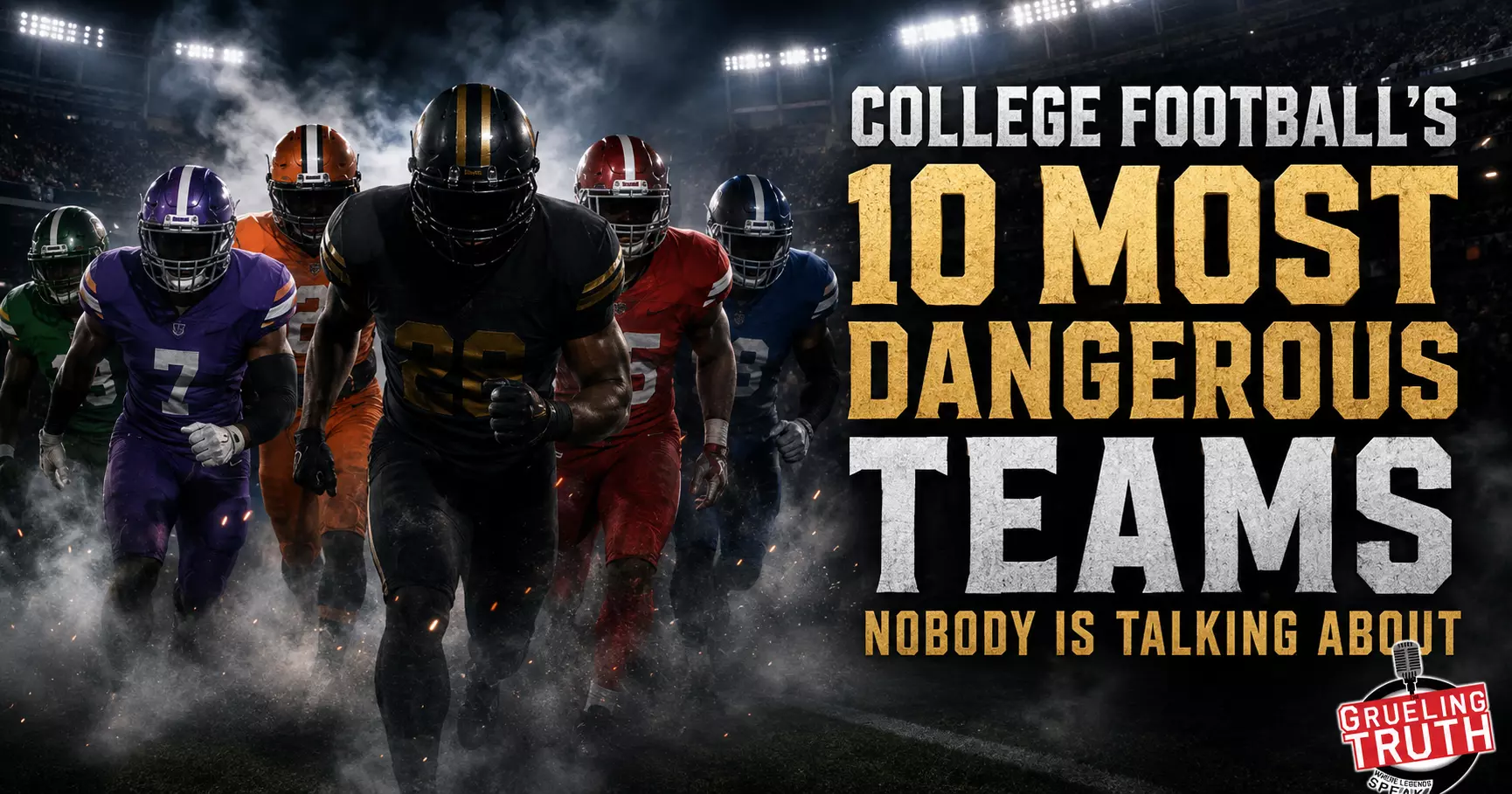
The teams at the top of the preseason rankings receive most of the attention, but college football rarely follows the script
The teams at the top of the preseason rankings receive most of the attention, but college football rarely follows the script. Indiana’s stunning championship run last season demonstrated how rapidly a program can move from intriguing outsider to national champion.
A dangerous team does not necessarily have to win the national championship. It can wreck somebody else’s season, emerge unexpectedly in a conference race or force the College Football Playoff committee to make an uncomfortable decision.
These ten programs enter 2026 without the attention surrounding Ohio State, Oregon, Georgia, Texas, Notre Dame, Indiana and Miami. Each possesses enough talent, coaching or opportunity to become a serious problem.
10. Oregon State Beavers
The rebuilding Pac-12 gives
Oregon State
something it lacked during the previous two seasons: a realistic path to a conference championship. The Beavers will begin that journey under new head coach JaMarcus Shephard, whose experience developing receivers and coordinating Alabama’s offense should immediately modernize the program.
The most interesting development is the selection of Braden Atkinson as the starting quarterback. Atkinson won the Jerry Rice Award as the nation’s top FCS freshman at Mercer after completing 66% of his passes for 3,596 yards and 34 touchdowns. He beat out the more recognizable Maalik Murphy for the job, indicating Shephard is willing to prioritize production over reputation.
Oregon State remains a work in progress, but it now has an explosive quarterback, a fresh offensive identity and renewed conference relevance. An opening game against Houston will tell us plenty. The Beavers might not win the Pac-12, but nobody should treat a trip to Corvallis like an automatic victory.
9. UCF Knights
Scott Frost’s return to UCF did not produce an immediate revival, but the second season could look significantly different. The Knights finished 5–7 in 2025, yet their defense showed encouraging signs—especially in the secondary—and Frost retained all three coordinators.
The arrival of quarterback Alonza Barnett III gives the offense a potentially transformative player. Barnett was the 2025 Sun Belt Player of the Year and brings the mobility needed to make Frost’s system dangerous. UCF still must prove that its transfer-built offensive line can protect him, but a quarterback capable of creating outside the structure can cover plenty of weaknesses.
Linebacker Lewis Carter returns as the defense’s leading tackler, and the Knights have enough speed in the secondary to survive against the Big 12’s pass-heavy offenses. UCF is not the most complete team in the conference, but it has a favorable schedule and a quarterback who can take over games. That makes the Knights a dangerous opponent in a league with little separation beneath Texas Tech and BYU.
8. East Carolina Pirates
East Carolina won nine games last season, including a bowl victory over Pitt, yet the Pirates are receiving surprisingly little national attention.
There are legitimate concerns. ECU lost its starting quarterback and several all-conference performers, while an offense that averaged nearly 33 points and 449 yards per game must replace almost its entire starting lineup. That normally would be enough to eliminate a team from consideration.
However, Blake Harrell has established a winning foundation, and the Pirates aggressively used the transfer portal to rebuild the offense. New coordinator Jordan Davis arrives from North Texas and should maintain the up-tempo, aggressive style that made ECU difficult to defend.
The schedule also matters. East Carolina avoids Navy, Tulane and UTSA in conference play, creating an attainable route to the American championship game. ESPN’s preseason FPI gave the Pirates a 15.9% chance to win the conference and an 88.2% chance to reach a bowl. If the reconstructed offense comes together quickly, ECU could become a legitimate Group of Six playoff threat.
7. Iowa Hawkeyes
Iowa is rarely exciting, but exciting and dangerous are not the same thing.
The Hawkeyes remain the kind of opponent capable of dragging a more talented team into a four-quarter fight built around defense, field position and mistakes. Their formula becomes particularly effective in Kinnick Stadium, where highly ranked opponents have repeatedly discovered that nothing comes easily.
The defense must replace some important pieces, but Iowa’s developmental system has consistently produced dependable linebackers, disciplined defensive backs and disruptive linemen. Reece Vander Zee gives the passing game a proven target, while the Hawkeyes return unusual depth at tight end.
Quarterback remains the obvious question. Hank Brown, Jeremy Hecklinski and several younger options entered the season competing to stabilize an offense that cannot afford another year of being among the country’s least threatening units. Iowa does not need to become explosive. If the Hawkeyes can merely become competent offensively, their defense and special teams can carry them into the Big Ten race. Nobody wants to play Iowa in a one-score game.
6. Arizona Wildcats
Arizona is being overlooked because the Big 12 conversation has centered on Texas Tech, BYU, Kansas State and Utah. That could prove to be a mistake.
Quarterback Noah Fifita gives the Wildcats something many teams lack: an experienced starter who has already demonstrated that he can play at a high level. Fifita’s career has included inconsistency, but he possesses the accuracy, anticipation and confidence to punish defenses when protected.
Brent Brennan’s challenge has been building a strong enough roster around his quarterback. Arizona’s ceiling will depend heavily on improved line play and whether the defense can create more negative plays. The Wildcats do not need to dominate opponents physically if Fifita consistently keeps them ahead of the chains and avoids the turnovers that have hurt the offense.
The Big 12’s depth also creates opportunity. Most conference contenders have weaknesses, and there is no unbeatable team standing between Arizona and Arlington. If the Wildcats start well and regain their confidence, they could quickly become the team nobody wants to encounter in a high-scoring game.
5. Boise State Broncos
Boise State is not being ignored within the new Pac-12. The Broncos received 14 of 16 first-place votes in the conference’s preseason media poll. Nationally, however, they remain largely outside the playoff discussion.
That is dangerous.
Boise State enters the rebuilt conference after winning three consecutive Mountain West championships. The logo on the schedule has changed, but the program’s expectations have not. The Broncos know how to win conference games, handle pressure and produce at the running back position.
The new Pac-12 will be more competitive than some assume. Washington State, Oregon State, San Diego State, Fresno State and Colorado State all have enough talent to cause problems. Boise State, however, begins the season with the clearest identity and strongest recent history.
The question is whether the conference schedule will give the Broncos enough opportunities to impress the playoff committee. If Boise State wins the league with one loss—or finishes undefeated—it could become the first champion of the resurrected Pac-12 to reach the expanded playoff.
4. Louisville Cardinals
Jeff Brohm has quietly built one of the ACC’s most consistent programs. Louisville is 28–12 during his first three seasons and finished 9–4 last year, yet the Cardinals remain in the background while Miami and Clemson command most of the conference attention.
Running back Isaac Brown gives Louisville an established offensive centerpiece. His vision, acceleration and receiving ability make him one of the most dangerous backs in the country. Brohm understands how to create favorable matchups, and Brown’s presence should make life easier for new quarterback Lincoln Kienholz.
Kienholz is the variable that could change Louisville’s season. If he provides steady decision-making and enough downfield production, the Cardinals have the supporting cast to challenge for the ACC championship. Edge defender Clev Lubin leads a defense that should be disruptive, while veteran defensive back Tayon Holloway provides leadership in the secondary.
Louisville’s worst-case scenario is another respectable bowl season. Its best-case scenario is considerably more interesting. Brohm has already taken the Cardinals to one ACC Championship Game. He has enough talent to do it again.
3. Florida Gators
Florida went 4–8 last season, fired Billy Napier and watched quarterback DJ Lagway transfer to Baylor. Those facts explain why the Gators are not receiving much national respect.
They also obscure how quickly Florida could improve under
Jon Sumrall.
Sumrall has won everywhere he has coached and brings the toughness, defensive organization and accountability Florida frequently lacked during Napier’s tenure. Offensive coordinator Buster Faulkner followed him to Gainesville and will work with Georgia Tech transfer Aaron Philo, who won the starting quarterback job over Tramell Jones Jr.
Philo is inexperienced, but he does not have to carry the offense alone. Running back Jadan Baugh gives Florida a physical, dependable foundation, while the roster still contains the speed and recruiting talent expected in Gainesville.
The schedule will prevent any easy rebuild, but Florida is too talented to remain irrelevant. The Gators may not win the SEC in Sumrall’s first season, but they are capable of beating a contender that arrives expecting to face last year’s team. This will be a much more disciplined opponent.
2. Utah Utes
Utah is never a comfortable opponent, regardless of its record or conference.
Kyle Whittingham’s departure for Michigan changed the face of the program, but the foundation he built did not disappear. Utah still expects to play physical defense, control the line of scrimmage and force opponents to remain patient for four quarters.
Quarterback Devon Dampier gives the Utes an additional dimension. Dampier rushed for 835 yards and 10 touchdowns last season, making him one of the country’s most dangerous runners at the position. He can transform broken plays into first downs and force defenses to account for him in the designed running game.
The arrival of running back Wayshawn Parker adds another physical option, while Utah’s defense should continue to make opponents earn every possession. The concern is whether the passing game can produce when teams load the box.
Utah’s style travels. The Utes do not need ideal conditions or a shootout to win. They need the game to become physical, uncomfortable and close in the fourth quarter. In a wide-open Big 12, that formula could take them all the way to the conference championship.
1. Virginia Tech Hokies
No team combines low expectations, proven coaching and immediate roster transformation better than Virginia Tech.
James Franklin
did not arrive in Blacksburg to begin a slow rebuild. He brought 23 former Penn State players with him, giving the Hokies an instant injection of Power Four experience and familiarity with his system. Tight end Luke Reynolds is among the most important additions, but the value of the group goes beyond individual statistics. Franklin brought players who already understand his standards and terminology.
Former Virginia Tech head coach Brent Pry’s presence as defensive coordinator provides continuity on that side of the ball. It is an unusual arrangement, but it gives Franklin an assistant who knows the roster, the school and the ACC.
The schedule creates a legitimate path. Virginia Tech’s most difficult conference games are at Clemson and Miami. Splitting those two could put the Hokies in position to reach the ACC Championship Game.
Franklin’s inability to defeat elite opponents consistently became the defining criticism of his Penn State tenure. Virginia Tech does not need him to beat a top-five team every month. It needs him to restore competence, recruit effectively and win games the Hokies are supposed to win. He has done all three throughout his career.
Virginia Tech might be one year away from becoming a true playoff contender. With Franklin’s experience, the transfer influx and a manageable schedule, however, the Hokies could arrive ahead of schedule.
Conclusion
Not every team on this list will become a championship contender. Some will be eliminated by quarterback problems, insufficient depth or difficult schedules. That is the nature of preseason projections.
However, overlooking these programs would be a mistake. Virginia Tech and Louisville can disrupt the ACC race. Utah and UCF could create chaos in the Big 12. Florida has enough talent to ruin an SEC contender’s season. Boise State and East Carolina have realistic paths toward the Group of Six playoff bid.
The preseason rankings tell us which teams are expected to matter. Once the games begin, dangerous teams have a habit of introducing themselves.
New Users – Get $350 in Bonus Bets when you wager $5 for 7 days
T&Cs apply
4.6/5
Gambling Problem? Call 1-800-GAMBLER or 1-800-MY-RESET. Call 1-888-789-7777 or visit ccpgg.org/chat (CT). Hope is here. GamblingHelpLineMA.org or call (800) 327-5050 for 24/7 support (MA). Visit www.mdgamblinghelp.org (MD). Call 1-877-8HOPE-NY or text HOPENY (NY). 21+ (18+ DC, WY) and present in select states (for KS, in affiliation with Kansas Star Casino). Find online real money wagering only. Min $5 wager required for 7 consecutive days. $5 free play credit. Bonus issued as non-withdrawable bonus with cash withdrawable bonus with cash withdrawable. Bonus bets which expire 7 days after receipt. Restrictions apply. See terms at sportsbook.fanduel.com. Call 1-877-770-7867 (LA).
Up To $1500 in Bonus Bets Paid Back if your First Bet Does Not Win
T&Cs apply
4.5/5
Gambling problem? Call 1-800-GAMBLER or 1-800-MY-RESET (Available in the US) 877-8-HOPENY or text HOPENY (467369) (NY) 1-800-327-5050 (MA), 1-800-BETS-OFF (IA), 1-800-981-0023 (PR). 21+ only. Please Gamble Responsibly. See BetMGM.com for Terms. First Bet Offer for new customers only (if applicable). Subject to eligibility requirements. Bonus bets are non-withdrawable. In partnership with Kansas Crossing Casino and Hotel. Promotional offers not available in Mississippi, Massachusetts, New York, Ontario, or Puerto Rico.
New DraftKings Customers: Bet $5, Get $200 + 3 Months of NBA League Pass!
T&Cs apply
4.5/5
GAMBLING PROBLEM? CALL 1-800-GAMBLER or 1-800-MY-RESET, (800) 327-5050 or visit gamblinghelplinema.org (MA). Please Gamble Responsibly. 888-789-7777/visit ccpg.org (CT), or visit www.mdgamblinghelp.org (MD), 1-800-981-0023 (PR). 21+ and present in most states. (18+ DC/NH/PR/WY). Void in CAN. Eligibility restrictions apply. On behalf of Boot Hill Casino (KS). Pass-thru of per wager tax may apply in IL. 1 per new Sportsbook customer. $5+ first-time bet req. Max. $200 issued as non-withdrawable Bonus Bets. Stake removed from payout. Reward issued as $50 in Bonus Bets every 7 days via click-to-claim for 21 days. Bonus Bets and click-to-claims expire 7 days (168hrs) after issuance. Terms: dkng.co/offer. Get 1 promo code to redeem a 3-month NBA League Pass subscription, complimentary of DraftKings. Subscription auto-renews monthly at then-current price (currently $16.99/mo); cancel anytime. Terms, restrictions, and eligibility requirements apply. Redeem League Pass by 12/19/26 at 11:59 PM ET. Addt’l terms: support.watch.nba.com/hc/en-us/articles/9165532876183-League-Pass-Terms-of-Use_. Ends 11/29/26 at 11:59 PM ET. Sponsored by DK.
Must be 21+. GAMBLING PROBLEM? CALL 1-800-GAMBLER OR CALL 1-800-MY-RESET, www.mdgamblinghelp.org (MD), (800)-327-5050 or gamblinghelplinema.org (MA), Call (877)8-HOPENY or text HOPENY (467369) (NY), (888) 789-7777 or ccpg.org (CT), morethanagame.nc.gov (NC), 1800gambler.net (WV)
Bet $1 and get double the winnings up to $25 for your next 10 bets
T&Cs apply
4.4/5
21+ New users only. Must register using eligible promo code. First bet after registration must qualify. Max. Bonus Bet: $1,000. Bonus Bet expires 14 days after receipt. Void where prohibited. See Caesars.com/promos for full terms. Gambling Problem? 1-800-GAMBLER (1-800-426-2537)
21+ and present in OH. Gambling Problem? Call 1-800-GAMBLER.
This site is using
Cloudflare
and adheres to the
Google Safe Browsing Program. We adapted
Google's Privacy Guidelines
to keep your data safe at all times.
Close
Ready to Win Big? Join the Elite with Our Sports Betting Deals!
FanDuel Promo
New Users – Get $350 in Bonus Bets when you wager $5 for 7 days
Our Favorite
T&Cs and 21+ apply
Gambling Problem? Call 1-800-GAMBLER or 1-800-MY-RESET. Call 1-888-789-7777 or visit ccpgg.org/chat (CT). Hope is here. GamblingHelpLineMA.org or call (800) 327-5050 for 24/7 support (MA). Visit www.mdgamblinghelp.org (MD). Call 1-877-8HOPE-NY or text HOPENY (NY). 21+ (18+ DC, WY) and present in select states (for KS, in affiliation with Kansas Star Casino). Find online real money wagering only. Min $5 wager required for 7 consecutive days. $5 free play credit. Bonus issued as non-withdrawable bonus with cash withdrawable bonus with cash withdrawable. Bonus bets which expire 7 days after receipt. Restrictions apply. See terms at sportsbook.fanduel.com. Call 1-877-770-7867 (LA).
Code:
Open FanDuel
Get Bonus
BetMGM Promo
Up To $1500 in Bonus Bets Paid Back if your First Bet Does Not Win
Best Slots
T&Cs and 21+ apply
Gambling problem? Call 1-800-GAMBLER or 1-800-MY-RESET (Available in the US) 877-8-HOPENY or text HOPENY (467369) (NY) 1-800-327-5050 (MA), 1-800-BETS-OFF (IA), 1-800-981-0023 (PR). 21+ only. Please Gamble Responsibly. See BetMGM.com for Terms. First Bet Offer for new customers only (if applicable). Subject to eligibility requirements. Bonus bets are non-withdrawable. In partnership with Kansas Crossing Casino and Hotel. Promotional offers not available in Mississippi, Massachusetts, New York, Ontario, or Puerto Rico.
Code:
Open BetMGM
Get Bonus
DraftKings Promo
New DraftKings Customers: Bet $5, Get $200 + 3 Months of NBA League Pass!
Newcomer
T&Cs and 21+ apply
GAMBLING PROBLEM? CALL 1-800-GAMBLER or 1-800-MY-RESET, (800) 327-5050 or visit gamblinghelplinema.org (MA). Please Gamble Responsibly. 888-789-7777/visit ccpg.org (CT), or visit www.mdgamblinghelp.org (MD), 1-800-981-0023 (PR). 21+ and present in most states. (18+ DC/NH/PR/WY). Void in CAN. Eligibility restrictions apply. On behalf of Boot Hill Casino (KS). Pass-thru of per wager tax may apply in IL. 1 per new Sportsbook customer. $5+ first-time bet req. Max. $200 issued as non-withdrawable Bonus Bets. Stake removed from payout. Reward issued as $50 in Bonus Bets every 7 days via click-to-claim for 21 days. Bonus Bets and click-to-claims expire 7 days (168hrs) after issuance. Terms: dkng.co/offer. Get 1 promo code to redeem a 3-month NBA League Pass subscription, complimentary of DraftKings. Subscription auto-renews monthly at then-current price (currently $16.99/mo); cancel anytime. Terms, restrictions, and eligibility requirements apply. Redeem League Pass by 12/19/26 at 11:59 PM ET. Addt’l terms: support.watch.nba.com/hc/en-us/articles/9165532876183-League-Pass-Terms-of-Use_. Ends 11/29/26 at 11:59 PM ET. Sponsored by DK.
Code:
Open DraftKings
Get Bonus
Find out what the legends have to say about sports this week....
New Users – Get $350 in Bonus Bets when you wager $5 for 7 days
Gambling Problem? Call 1-800-GAMBLER or 1-800-MY-RESET. Call 1-888-789-7777 or visit ccpgg.org/chat (CT). Hope is here. GamblingHelpLineMA.org or call (800) 327-5050 for 24/7 support (MA). Visit www.mdgamblinghelp.org (MD). Call 1-877-8HOPE-NY or text HOPENY (NY). 21+ (18+ DC, WY) and present in select states (for KS, in affiliation with Kansas Star Casino). Find online real money wagering only. Min $5 wager required for 7 consecutive days. $5 free play credit. Bonus issued as non-withdrawable bonus with cash withdrawable bonus with cash withdrawable. Bonus bets which expire 7 days after receipt. Restrictions apply. See terms at sportsbook.fanduel.com. Call 1-877-770-7867 (LA).