College football’s 2026 opening weekend did not deliver a loaded schedule, but it gave us plenty to discuss.
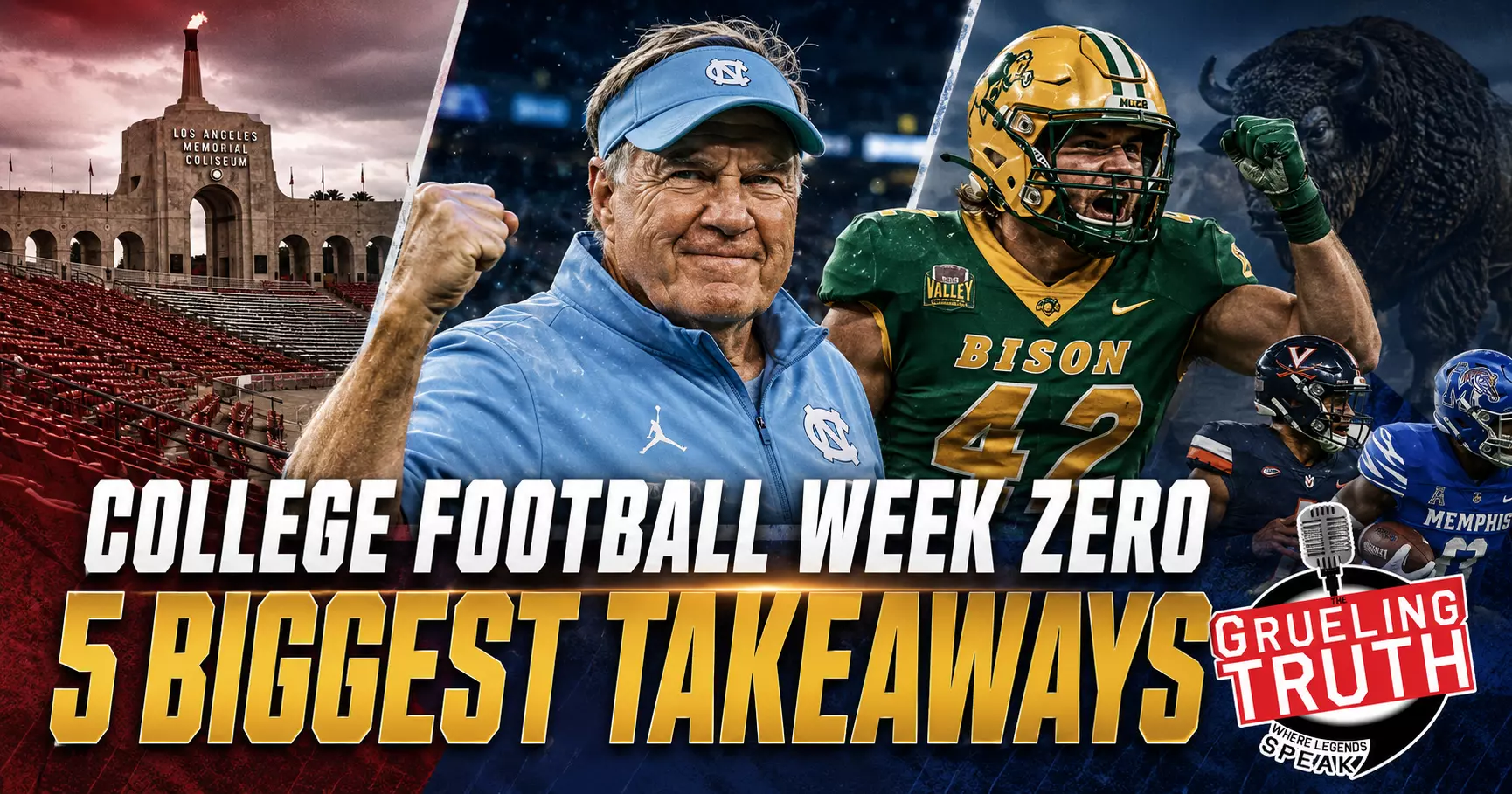
College football’s 2026 opening weekend did not deliver a loaded schedule, but it gave us plenty to discuss. Bill Belichick earned the biggest victory of his brief college career, North Dakota State announced its arrival in the FBS, and Virginia produced the weekend’s most complete performance. Meanwhile, USC reminded everyone that winning games does not necessarily mean a program is healthy.
Here are the five biggest takeaways from Week Zero.
1. USC’s Pathetic Crowd Should Embarrass the Entire Program
USC defeated San José State 42–26, but the final score was almost secondary to the depressing scene inside the Los Angeles Memorial Coliseum. The Trojans announced an attendance of 51,144—the program’s lowest under Lincoln Riley—but television cameras revealed huge sections of empty seats. The actual number of people in the stadium appeared significantly smaller.
The excuses arrived immediately. It was hot, the opponent was San José State, and the game began at noon on the West Coast. Those factors undoubtedly contributed, but none of them completely explains what happened.
This is USC, one of the most recognizable brands in
college football. The Trojans entered the season ranked No. 14, possess a roster loaded with highly recruited players and play in the nation’s second-largest media market. Tickets were reportedly available for less than $10 on the secondary market, yet the program still could not generate anything resembling a major-college atmosphere.
USC averaged 67,782 fans during the 2025 season and drew 62,841 for last year’s home opener against Missouri State. The announced crowd Saturday was more than 11,000 below that Missouri State game. USC’s official statistics list Saturday’s attendance at 51,144.
The Trojans played well enough to build a 35–3 lead, but San José State scored 23 points afterward and made the final score look respectable. Quarterback Jayden Maiava threw for 286 yards and two touchdowns while adding another score on the ground. There were positive developments on the field, but the empty seats were the lasting image.
If USC wants to present itself as a national powerhouse, its fans need to start treating it like one.
2. Bill Belichick Finally Earned His Signature College Victory
Bill Belichick’s first season at North Carolina was a disaster. The Tar Heels finished 4–8, and their season began with an embarrassing 48–14 home loss to TCU. One year later, Belichick and North Carolina traveled to Dublin and earned a measure of revenge with a gritty 15–10 victory over the Horned Frogs.
This was not an offensive masterpiece. It was an ugly, physical game played in difficult conditions, which made it feel like the perfect Belichick victory.
North Carolina surrendered 10 points on TCU’s first two possessions but did not allow another point. The Tar Heels repeatedly stopped the Horned Frogs in critical situations, including two fourth-and-short attempts in North Carolina territory during the fourth quarter. Sophomore Xavier Lewis led the defense with seven tackles, 4.5 tackles for loss and two sacks.
TCU helped North Carolina by committing 11 penalties and snapping the ball through the end zone for a safety. However, taking advantage of an opponent’s mistakes is part of winning football. The Tar Heels were more disciplined, more composed and better prepared when the game reached its decisive moments.
Quarterback Billy Edwards Jr. threw for 232 yards, while tight end Jelani Thurman caught four passes for 94 yards. North Carolina did just enough offensively and allowed its defense to finish the job. The Tar Heels held TCU scoreless over its final eight possessions.
One victory does not erase a 4–8 season, but this is precisely the kind of win Belichick needed. North Carolina defeated a favored opponent, avenged last season’s humiliation and demonstrated that the program may finally be developing the toughness associated with its legendary coach.
3. North Dakota State Is Already an FBS Problem
North Dakota State did not cautiously enter the Football Bowl Subdivision. The Bison kicked down the door.
Playing their first game as an FBS program, North Dakota State demolished Jacksonville State 33–7 before 18,573 fans inside the Fargodome. The Bison scored on an eight-play, 75-yard opening drive and controlled the game from there.
Quarterback Nathan Hayes threw a six-yard touchdown pass to Reis Kessel on that first possession and later connected with Jordan McCants for a 44-yard score. North Dakota State took a 17–7 lead into halftime and shut out Jacksonville State in the second half. The Bison’s official recap characterized the victory as an emphatic beginning to their FBS era.
Nobody should be shocked.
North Dakota State
won multiple national championships at the FCS level and consistently operated like a program belonging at a higher classification. The Bison already possessed the culture, fan support, physicality and organizational stability required to succeed. The only question was how quickly those advantages would translate against a full FBS schedule.
We received the answer immediately.
North Dakota State will eventually experience growing pains, especially as it builds the roster depth needed to survive an entire season. But the Bison are not interested in spending five years becoming competitive. They expect to win now, and Jacksonville State became the first FBS opponent to discover that the old formula—running the ball, controlling the line of scrimmage and playing disciplined defense—still travels.
4. Virginia May Be a Serious ACC Contender
Virginia delivered Week Zero’s most complete performance, destroying NC State 34–8 in front of the program’s first sellout crowd at Scott Stadium since 2008.
The Cavaliers scored the game’s first 24 points and dominated all three phases. NC State entered the season expecting to compete in the ACC, but Virginia made the Wolfpack look unprepared and overmatched.
Tailback Xavier Brown scored two touchdowns, and the Cavaliers consistently dictated the physical tone. More importantly, Virginia’s defense never allowed NC State to develop any offensive rhythm. The Wolfpack did not score until the game was already effectively over.
Virginia has spent much of Tony Elliott’s tenure searching for stability and an identity. Saturday’s performance suggested that the Cavaliers may finally possess both. They were fast, disciplined and confident. They did not merely survive an early conference test; they overwhelmed an opponent expected to be competitive.
Virginia’s 34–8 victory also carried additional importance because it counted as an ACC game. The Cavaliers left Week Zero with both a season-opening victory and an early advantage in the conference race. Virginia scored the first 24 points and recorded its first Scott Stadium sellout in 18 years.
It is far too early to declare Virginia a championship team, but the Cavaliers deserve to be taken seriously.
5. Memphis Exposed UNLV’s Biggest Weakness
Memphis traveled to Las Vegas and defeated UNLV 27–21 after trailing at halftime. The Tigers did it by attacking the most vulnerable part of the Rebels’ roster: the offensive line.
UNLV quarterback Jackson Arnold threw for 291 yards and two touchdowns, but he was constantly pressured and sacked six times. Once offensive lineman Austin Boyd left with an injury, the Rebels struggled to protect Arnold or sustain drives. Memphis increased the pressure, controlled the second half and erased UNLV’s early advantage.
This was an important road victory for a Memphis program that continues to operate as one of the most dangerous teams outside the traditional power conferences. The Tigers demonstrated resilience, defensive depth and the ability to make meaningful halftime adjustments.
For UNLV, the loss was a warning. The Rebels have enough skill-position talent to score points, but none of that matters if Arnold is forced to spend the season running for his life. The offensive line must improve quickly or every capable defensive front on the schedule will follow Memphis’ blueprint.
Week Zero did not settle the
national championship race, but it exposed weaknesses and introduced potential contenders. USC has an enthusiasm problem, Belichick may finally have North Carolina moving forward, North Dakota State belongs, Virginia looks dangerous, and Memphis remains a program nobody should overlook.
Up To $1500 in Bonus Bets Paid Back if your First Bet Does Not Win
T&Cs apply
4.5/5
Gambling problem? Call 1-800-GAMBLER or 1-800-MY-RESET (Available in the US) 877-8-HOPENY or text HOPENY (467369) (NY) 1-800-327-5050 (MA), 1-800-BETS-OFF (IA), 1-800-981-0023 (PR). 21+ only. Please Gamble Responsibly. See BetMGM.com for Terms. First Bet Offer for new customers only (if applicable). Subject to eligibility requirements. Bonus bets are non-withdrawable. In partnership with Kansas Crossing Casino and Hotel. Promotional offers not available in Mississippi, Massachusetts, New York, Ontario, or Puerto Rico.
New DraftKings Customers: Spend $5+ Get $150 in Bonuses
T&Cs apply
4.5/5
GAMBLING PROBLEM? CALL 1-800-GAMBLER or 1-800-MY-RESET, (800) 327-5050 or visit gamblinghelplinema.org (MA). Please Gamble Responsibly. 888-789-7777/visit ccpg.org (CT), or visit www.mdgamblinghelp.org (MD), 1-800-981-0023 (PR). 21+ and present in most states. (18+ DC/NH/PR/WY). Void in CAN. Eligibility restrictions apply. On behalf of Boot Hill Casino (KS). Pass-thru of per wager tax may apply in IL. 1 per new DraftKings customer. $5+ first-time bet req. Max. $150 issued as non-withdrawable Bonus Bets. Stake removed from payout. Reward issued as $50 in Bonus Bets every 7 days via click-to-claim for 14 days. Bonus Bets and click-to-claims expire 7 days (168hrs) after issuance. Terms: sportsbook.draftkings.com/promos. Ends 10/11/26 at 11:59 PM ET. Sponsored by DK.
Must be 21+. GAMBLING PROBLEM? CALL 1-800-GAMBLER OR CALL 1-800-MY-RESET, www.mdgamblinghelp.org (MD), (800)-327-5050 or gamblinghelplinema.org (MA), Call (877)8-HOPENY or text HOPENY (467369) (NY), (888) 789-7777 or ccpg.org (CT), morethanagame.nc.gov (NC), 1800gambler.net (WV)
Bet $1 and get double the winnings up to $25 for your next 10 bets
T&Cs apply
4.4/5
21+ New users only. Must register using eligible promo code. First bet after registration must qualify. Max. Bonus Bet: $1,000. Bonus Bet expires 14 days after receipt. Void where prohibited. See Caesars.com/promos for full terms. Gambling Problem? 1-800-GAMBLER (1-800-426-2537)
21+ and present in OH. Gambling Problem? Call 1-800-GAMBLER.
This site is using
Cloudflare
and adheres to the
Google Safe Browsing Program. We adapted
Google's Privacy Guidelines
to keep your data safe at all times.
Close
Ready to Win Big? Join the Elite with Our Sports Betting Deals!
FanDuel Promo
New Users – Get $250 in Bonus Bets when you wager $5 for 5 days
Up To $1500 in Bonus Bets Paid Back if your First Bet Does Not Win
Best Slots
T&Cs and 21+ apply
Gambling problem? Call 1-800-GAMBLER or 1-800-MY-RESET (Available in the US) 877-8-HOPENY or text HOPENY (467369) (NY) 1-800-327-5050 (MA), 1-800-BETS-OFF (IA), 1-800-981-0023 (PR). 21+ only. Please Gamble Responsibly. See BetMGM.com for Terms. First Bet Offer for new customers only (if applicable). Subject to eligibility requirements. Bonus bets are non-withdrawable. In partnership with Kansas Crossing Casino and Hotel. Promotional offers not available in Mississippi, Massachusetts, New York, Ontario, or Puerto Rico.
Code:
Open BetMGM
Get Bonus
DraftKings Promo
New DraftKings Customers: Spend $5+ Get $150 in Bonuses
Newcomer
T&Cs and 21+ apply
GAMBLING PROBLEM? CALL 1-800-GAMBLER or 1-800-MY-RESET, (800) 327-5050 or visit gamblinghelplinema.org (MA). Please Gamble Responsibly. 888-789-7777/visit ccpg.org (CT), or visit www.mdgamblinghelp.org (MD), 1-800-981-0023 (PR). 21+ and present in most states. (18+ DC/NH/PR/WY). Void in CAN. Eligibility restrictions apply. On behalf of Boot Hill Casino (KS). Pass-thru of per wager tax may apply in IL. 1 per new DraftKings customer. $5+ first-time bet req. Max. $150 issued as non-withdrawable Bonus Bets. Stake removed from payout. Reward issued as $50 in Bonus Bets every 7 days via click-to-claim for 14 days. Bonus Bets and click-to-claims expire 7 days (168hrs) after issuance. Terms: sportsbook.draftkings.com/promos. Ends 10/11/26 at 11:59 PM ET. Sponsored by DK.
Code:
Open DraftKings
Get Bonus
Find out what the legends have to say about sports this week....