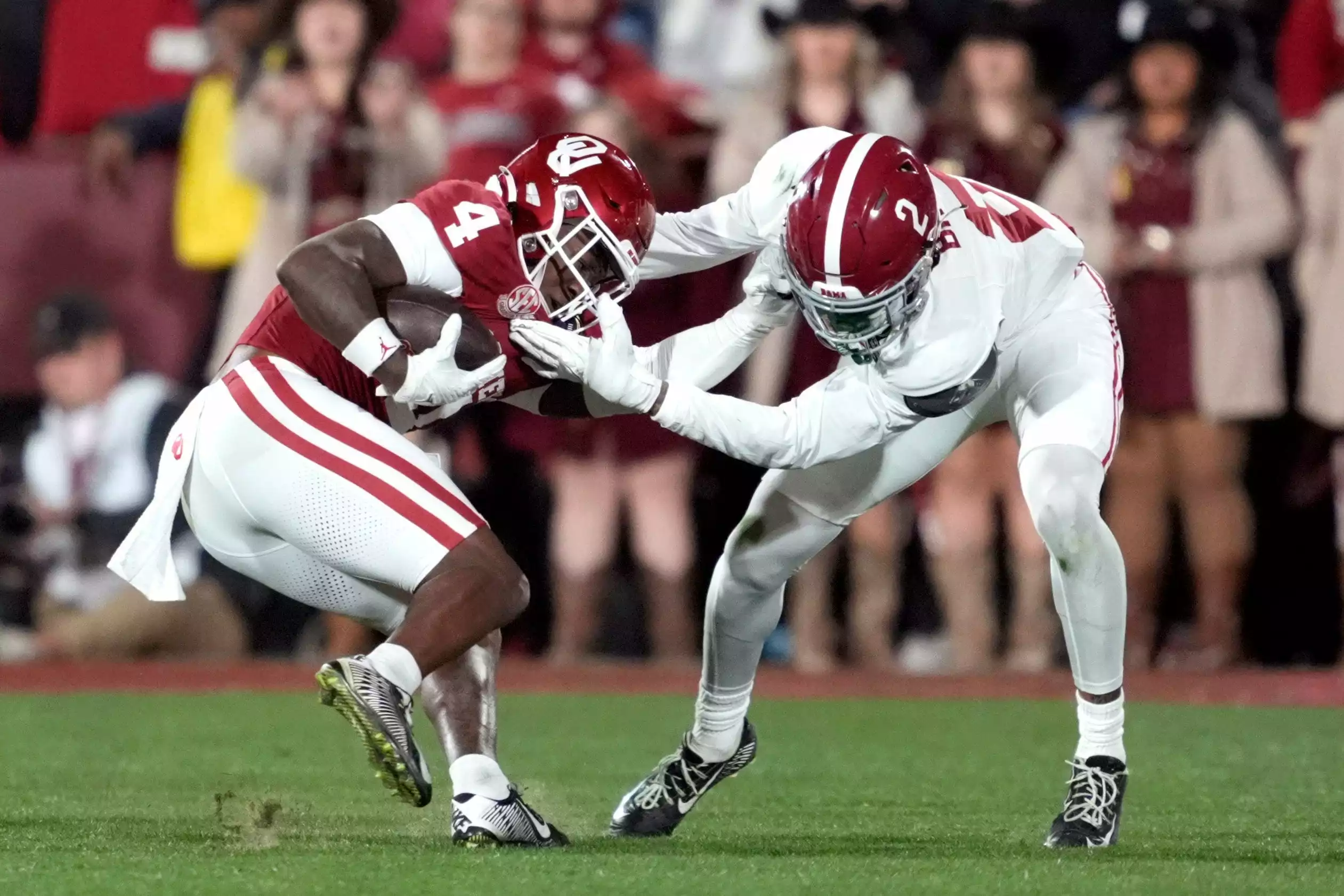
Oklahoma Sooners wide receiver Deion Burks (4) tries to get past Alabama Crimson Tide defensive back Zabien Brown (2) after a reception during a first-round College Football Playoff game between the University of Oklahoma Sooners (OU) and the Alabama Crimson Tide at Gaylord Family - Oklahoma Memorial Stadium in Norman, Okla., Friday, Dec. 19, 2025. Alabama won 34-24.
The second year of college football’s pay era began this week, and almost nobody stopped to mark the moment. That fits, because no one really noticed the first one either.
There was no vote, no grand announcement, no single day the amateur era officially ended. College football crossed the line quietly, one court settlement and one payroll at a time, and now it runs on the same math as any professional league.
The push never came from the NCAA or the schools, deciding it was finally time. It came from the courts, which forced the sport to stop treating a booming business like a charity.
The house settlement ended the amateur era
The turning point was the House settlement, a $2.8 billion antitrust deal that a federal judge approved in June 2025 and that took effect that July. It ended decades of fighting over paying players by simply letting schools cut the checks directly.
Oddly enough, the athletes who won that lawsuit are still waiting. The $2.8 billion in back pay owed to roughly 184,000 former players remains frozen while appeals play out in federal court. The generation that broke the system open has yet to see a dime, while the current one gets paid every month.
Each school can share revenue with its athletes from a pool worth 22 percent of the average Power Five program’s media, ticket, and sponsorship revenue. That pool started at $20.5 million per school and reset to roughly $21.3 million when the new year opened July 1. It is projected to climb past $32 million within a decade.
Schools decide how to allocate the money, and they do so exactly as a pro franchise would. At Texas Tech, 74 percent of the pool went to football, and most of the rest to men’s basketball. Around 82 percent of Division I programs opted in.
Collectives are payrolls, and rosters are contracts
The direct money is only part of the picture. NIL collectives, once sold to fans as booster clubs, now function as payrolls that stack on top of what the school pays.
The players sign agreements with payment schedules, transfer restrictions, and roster guarantees. Those are contracts in everything but name. Programs now carry general managers to manage a salary cap, which is exactly why Florida hired a former NFL executive to run its roster this offseason.
Come to think of it, even the rosters look professional. The old scholarship limits are gone, swapped for hard roster caps, with football set at 105 players. Take away the fight songs, and this is a league of salaried teams with front offices.
So why still keep the amateur label then?
Because the label is still worth a fortune. The phrase student-athlete protects the tax treatment, the branding, and the legal cover, even as everyone inside the building runs the place like a business. The money even gets taxed like a job, reported as self-employment income.
The distance between the language and the reality is staggering. Schools paid out well over a billion dollars in direct revenue sharing in one year alone, and that does not even count NIL money, which is largely funded by boosters and only loosely tracked. As things stand, the sport’s clearinghouse has approved just $242 million in third-party deals, a small slice of a market believed to be several times larger. On the field, a starting
quarterback can outearn his own professors, hire an agent, and negotiate a buyout, while the paperwork still lists him as a student on aid.
None of this is hidden from the people who run the sport. They write the contract, manage the caps, and sign the checks every month.
The only fiction left is the word amateur. College football is a multi-billion-dollar professional league that happens to hold classes, and it got there without anyone standing up to announce it. Year two is already underway. The paychecks have been cleared, and the paperwork still has not caught up.
Up To $1500 in Bonus Bets Paid Back if your First Bet Does Not Win
T&Cs apply
4.5/5
Gambling problem? Call 1-800-GAMBLER or 1-800-MY-RESET (Available in the US) 877-8-HOPENY or text HOPENY (467369) (NY) 1-800-327-5050 (MA), 1-800-BETS-OFF (IA), 1-800-981-0023 (PR). 21+ only. Please Gamble Responsibly. See BetMGM.com for Terms. First Bet Offer for new customers only (if applicable). Subject to eligibility requirements. Bonus bets are non-withdrawable. In partnership with Kansas Crossing Casino and Hotel. Promotional offers not available in Mississippi, Massachusetts, New York, Ontario, or Puerto Rico.
New DraftKings Customers: Spend $5+ Get $150 in Bonuses
T&Cs apply
4.5/5
GAMBLING PROBLEM? CALL 1-800-GAMBLER or 1-800-MY-RESET, (800) 327-5050 or visit gamblinghelplinema.org (MA). Please Gamble Responsibly. 888-789-7777/visit ccpg.org (CT), or visit www.mdgamblinghelp.org (MD), 1-800-981-0023 (PR). 21+ and present in most states. (18+ DC/NH/PR/WY). Void in CAN. Eligibility restrictions apply. On behalf of Boot Hill Casino (KS). Pass-thru of per wager tax may apply in IL. 1 per new DraftKings customer. $5+ first-time bet req. Max. $150 issued as non-withdrawable Bonus Bets. Stake removed from payout. Reward issued as $50 in Bonus Bets every 7 days via click-to-claim for 14 days. Bonus Bets and click-to-claims expire 7 days (168hrs) after issuance. Terms: sportsbook.draftkings.com/promos. Ends 10/11/26 at 11:59 PM ET. Sponsored by DK.
Must be 21+. GAMBLING PROBLEM? CALL 1-800-GAMBLER OR CALL 1-800-MY-RESET, www.mdgamblinghelp.org (MD), (800)-327-5050 or gamblinghelplinema.org (MA), Call (877)8-HOPENY or text HOPENY (467369) (NY), (888) 789-7777 or ccpg.org (CT), morethanagame.nc.gov (NC), 1800gambler.net (WV)
Bet $1 and get double the winnings up to $25 for your next 10 bets
T&Cs apply
4.4/5
21+ New users only. Must register using eligible promo code. First bet after registration must qualify. Max. Bonus Bet: $1,000. Bonus Bet expires 14 days after receipt. Void where prohibited. See Caesars.com/promos for full terms. Gambling Problem? 1-800-GAMBLER (1-800-426-2537)
21+ and present in OH. Gambling Problem? Call 1-800-GAMBLER.
This site is using
Cloudflare
and adheres to the
Google Safe Browsing Program. We adapted
Google's Privacy Guidelines
to keep your data safe at all times.
Close
Ready to Win Big? Join the Elite with Our Sports Betting Deals!
FanDuel Promo
New Users – Get $250 in Bonus Bets when you wager $5 for 5 days
Up To $1500 in Bonus Bets Paid Back if your First Bet Does Not Win
Best Slots
T&Cs and 21+ apply
Gambling problem? Call 1-800-GAMBLER or 1-800-MY-RESET (Available in the US) 877-8-HOPENY or text HOPENY (467369) (NY) 1-800-327-5050 (MA), 1-800-BETS-OFF (IA), 1-800-981-0023 (PR). 21+ only. Please Gamble Responsibly. See BetMGM.com for Terms. First Bet Offer for new customers only (if applicable). Subject to eligibility requirements. Bonus bets are non-withdrawable. In partnership with Kansas Crossing Casino and Hotel. Promotional offers not available in Mississippi, Massachusetts, New York, Ontario, or Puerto Rico.
Code:
Open BetMGM
Get Bonus
DraftKings Promo
New DraftKings Customers: Spend $5+ Get $150 in Bonuses
Newcomer
T&Cs and 21+ apply
GAMBLING PROBLEM? CALL 1-800-GAMBLER or 1-800-MY-RESET, (800) 327-5050 or visit gamblinghelplinema.org (MA). Please Gamble Responsibly. 888-789-7777/visit ccpg.org (CT), or visit www.mdgamblinghelp.org (MD), 1-800-981-0023 (PR). 21+ and present in most states. (18+ DC/NH/PR/WY). Void in CAN. Eligibility restrictions apply. On behalf of Boot Hill Casino (KS). Pass-thru of per wager tax may apply in IL. 1 per new DraftKings customer. $5+ first-time bet req. Max. $150 issued as non-withdrawable Bonus Bets. Stake removed from payout. Reward issued as $50 in Bonus Bets every 7 days via click-to-claim for 14 days. Bonus Bets and click-to-claims expire 7 days (168hrs) after issuance. Terms: sportsbook.draftkings.com/promos. Ends 10/11/26 at 11:59 PM ET. Sponsored by DK.
Code:
Open DraftKings
Get Bonus
Find out what the legends have to say about sports this week....