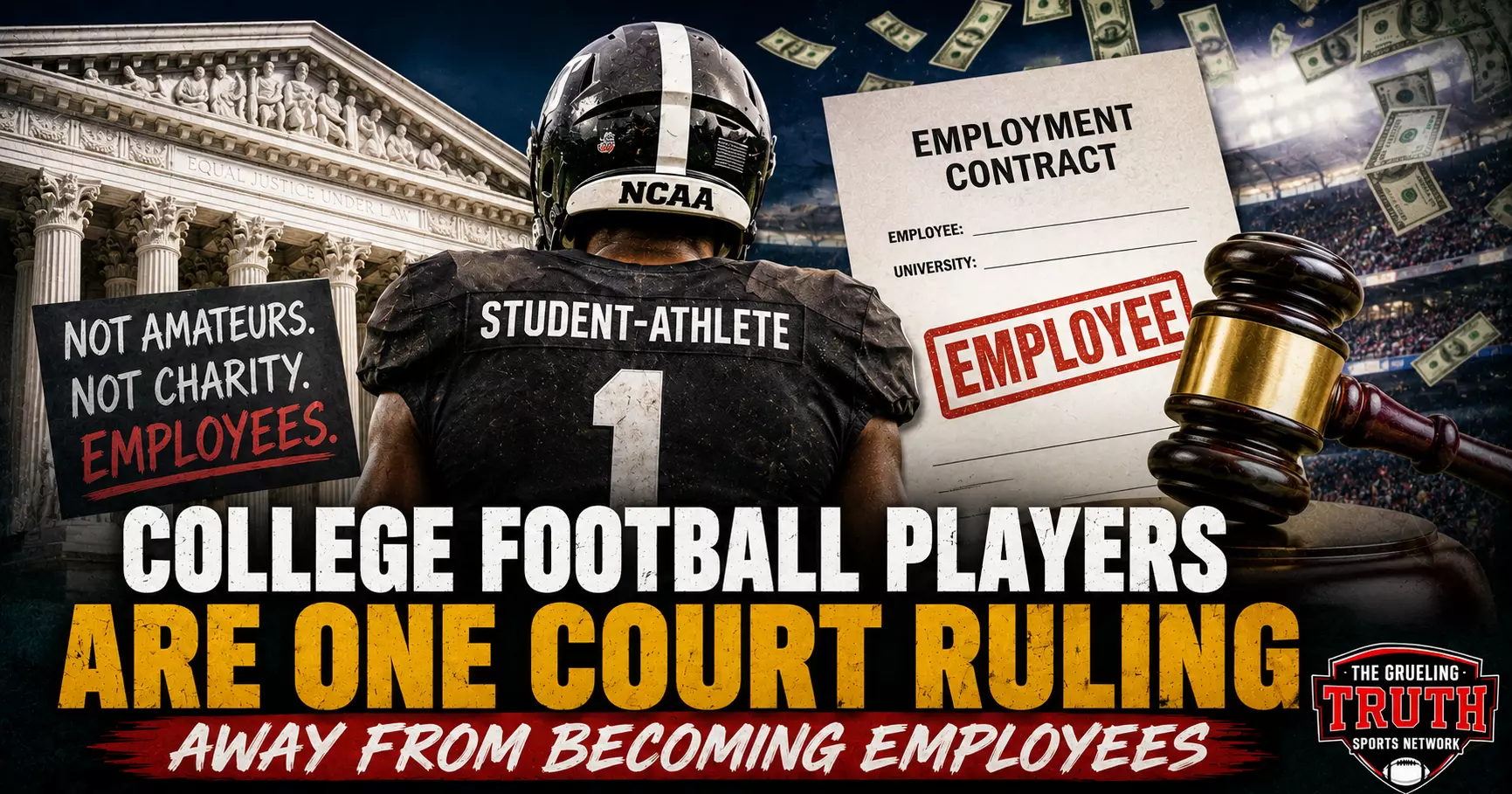
College football players employees could soon become a legal reality as a landmark lawsuit threatens to reshape the NCAA and college sports.
The most important person in college football this fall might be a former Villanova defensive back most fans have never heard of. His name is Trey Johnson, and back in 2019, he filed a lawsuit arguing something simple and radical at the same time, which is that college athletes are employees and deserve to be paid like the work-study students who scan IDs at the rec center.
That case has been crawling through the federal courts ever since, and it is now closer than it has ever been to blowing up the entire structure of college sports. The schools know it too, and behind closed doors, they are bracing for a ruling that could rewrite everything.
The lawsuit the NCAA cannot shake
Johnson’s argument got its biggest boost in July 2024, when a federal appeals court refused to throw the case out and rejected the NCAA’s amateurism defense, with one judge calling amateurism a frayed tradition with dubious history. Rather than declare every athlete an employee, the court handed down a four-part test to decide it on a case-by-case basis.
The test asks whether an athlete performs services for the school, mainly for the school’s benefit, under the school’s control, in exchange for pay or scholarship. Read that list and think about a starting quarterback, and you start to see why the NCAA is nervous. As of early 2026, the case sits back in district court, where a judge has ordered both sides to report on settlement talks while the clock keeps ticking.
What makes this case so dangerous for the NCAA is that other appeal courts have ruled the opposite way, which sets up a split that the Supreme Court may eventually have to settle. The plaintiffs are not even asking for million-dollar salaries. They simply want athletes treated like the classmates who get paid to work the concession stand, and that modest framing is exactly what makes the argument so hard to knock down.
Why this terrifies athletic departments
If a court decides these players are employees, the amateur shield that has protected college sports for a century simply disappears, and the money problems show up overnight. Football players already report spending more than 40 hours a week on their sport, which looks a lot like a full-time job once a judge starts to count hours.
Employee status would open the door to minimum wage, overtime, workers’ compensation, and the biggest domino of all, which is collective bargaining and real union contracts. The revenue exists to imagine it, since the University of Texas alone reported $271 million in athletic revenue in one year, more than any team in the NHL. The catch is that most of that money is spent, and athletes as employees blow a crater in every budget in the country. A fight with no clean ending
The wrinkle nobody has solved is fairness across the whole athletic department. If the football team becomes paid employees, Title IX raises hard questions about whether
women’s teams and non-revenue sports
must be paid the same, and since football funds nearly everything else, those smaller programs could be the ones that get cut to balance the math.
There is also a faster route waiting in the wings, because athletes at a private school in a union-friendly state could try to organize the way Dartmouth’s basketball players once did before they withdrew their case after the 2024 election changed the political winds. For a student sitting in a lecture hall next to a starting linebacker, this is not some distant legal footnote. It is a labor fight playing out in real time, and the teammate two rows over might soon punch a clock for the university. The ground is already shifting, and nobody inside the sport can say for sure where it stops.
Up To $1500 in Bonus Bets Paid Back if your First Bet Does Not Win
T&Cs apply
4.5/5
Gambling problem? Call 1-800-GAMBLER or 1-800-MY-RESET (Available in the US) 877-8-HOPENY or text HOPENY (467369) (NY) 1-800-327-5050 (MA), 1-800-BETS-OFF (IA), 1-800-981-0023 (PR). 21+ only. Please Gamble Responsibly. See BetMGM.com for Terms. First Bet Offer for new customers only (if applicable). Subject to eligibility requirements. Bonus bets are non-withdrawable. In partnership with Kansas Crossing Casino and Hotel. Promotional offers not available in Mississippi, Massachusetts, New York, Ontario, or Puerto Rico.
New DraftKings Customers: Spend $5+ Get $150 in Bonuses
T&Cs apply
4.5/5
GAMBLING PROBLEM? CALL 1-800-GAMBLER or 1-800-MY-RESET, (800) 327-5050 or visit gamblinghelplinema.org (MA). Please Gamble Responsibly. 888-789-7777/visit ccpg.org (CT), or visit www.mdgamblinghelp.org (MD), 1-800-981-0023 (PR). 21+ and present in most states. (18+ DC/NH/PR/WY). Void in CAN. Eligibility restrictions apply. On behalf of Boot Hill Casino (KS). Pass-thru of per wager tax may apply in IL. 1 per new DraftKings customer. $5+ first-time bet req. Max. $150 issued as non-withdrawable Bonus Bets. Stake removed from payout. Reward issued as $50 in Bonus Bets every 7 days via click-to-claim for 14 days. Bonus Bets and click-to-claims expire 7 days (168hrs) after issuance. Terms: sportsbook.draftkings.com/promos. Ends 10/11/26 at 11:59 PM ET. Sponsored by DK.
Must be 21+. GAMBLING PROBLEM? CALL 1-800-GAMBLER OR CALL 1-800-MY-RESET, www.mdgamblinghelp.org (MD), (800)-327-5050 or gamblinghelplinema.org (MA), Call (877)8-HOPENY or text HOPENY (467369) (NY), (888) 789-7777 or ccpg.org (CT), morethanagame.nc.gov (NC), 1800gambler.net (WV)
Bet $1 and get double the winnings up to $25 for your next 10 bets
T&Cs apply
4.4/5
21+ New users only. Must register using eligible promo code. First bet after registration must qualify. Max. Bonus Bet: $1,000. Bonus Bet expires 14 days after receipt. Void where prohibited. See Caesars.com/promos for full terms. Gambling Problem? 1-800-GAMBLER (1-800-426-2537)
21+ and present in OH. Gambling Problem? Call 1-800-GAMBLER.
This site is using
Cloudflare
and adheres to the
Google Safe Browsing Program. We adapted
Google's Privacy Guidelines
to keep your data safe at all times.
Close
Ready to Win Big? Join the Elite with Our Sports Betting Deals!
FanDuel Promo
New Users – Get $250 in Bonus Bets when you wager $5 for 5 days
Up To $1500 in Bonus Bets Paid Back if your First Bet Does Not Win
Best Slots
T&Cs and 21+ apply
Gambling problem? Call 1-800-GAMBLER or 1-800-MY-RESET (Available in the US) 877-8-HOPENY or text HOPENY (467369) (NY) 1-800-327-5050 (MA), 1-800-BETS-OFF (IA), 1-800-981-0023 (PR). 21+ only. Please Gamble Responsibly. See BetMGM.com for Terms. First Bet Offer for new customers only (if applicable). Subject to eligibility requirements. Bonus bets are non-withdrawable. In partnership with Kansas Crossing Casino and Hotel. Promotional offers not available in Mississippi, Massachusetts, New York, Ontario, or Puerto Rico.
Code:
Open BetMGM
Get Bonus
DraftKings Promo
New DraftKings Customers: Spend $5+ Get $150 in Bonuses
Newcomer
T&Cs and 21+ apply
GAMBLING PROBLEM? CALL 1-800-GAMBLER or 1-800-MY-RESET, (800) 327-5050 or visit gamblinghelplinema.org (MA). Please Gamble Responsibly. 888-789-7777/visit ccpg.org (CT), or visit www.mdgamblinghelp.org (MD), 1-800-981-0023 (PR). 21+ and present in most states. (18+ DC/NH/PR/WY). Void in CAN. Eligibility restrictions apply. On behalf of Boot Hill Casino (KS). Pass-thru of per wager tax may apply in IL. 1 per new DraftKings customer. $5+ first-time bet req. Max. $150 issued as non-withdrawable Bonus Bets. Stake removed from payout. Reward issued as $50 in Bonus Bets every 7 days via click-to-claim for 14 days. Bonus Bets and click-to-claims expire 7 days (168hrs) after issuance. Terms: sportsbook.draftkings.com/promos. Ends 10/11/26 at 11:59 PM ET. Sponsored by DK.
Code:
Open DraftKings
Get Bonus
Find out what the legends have to say about sports this week....