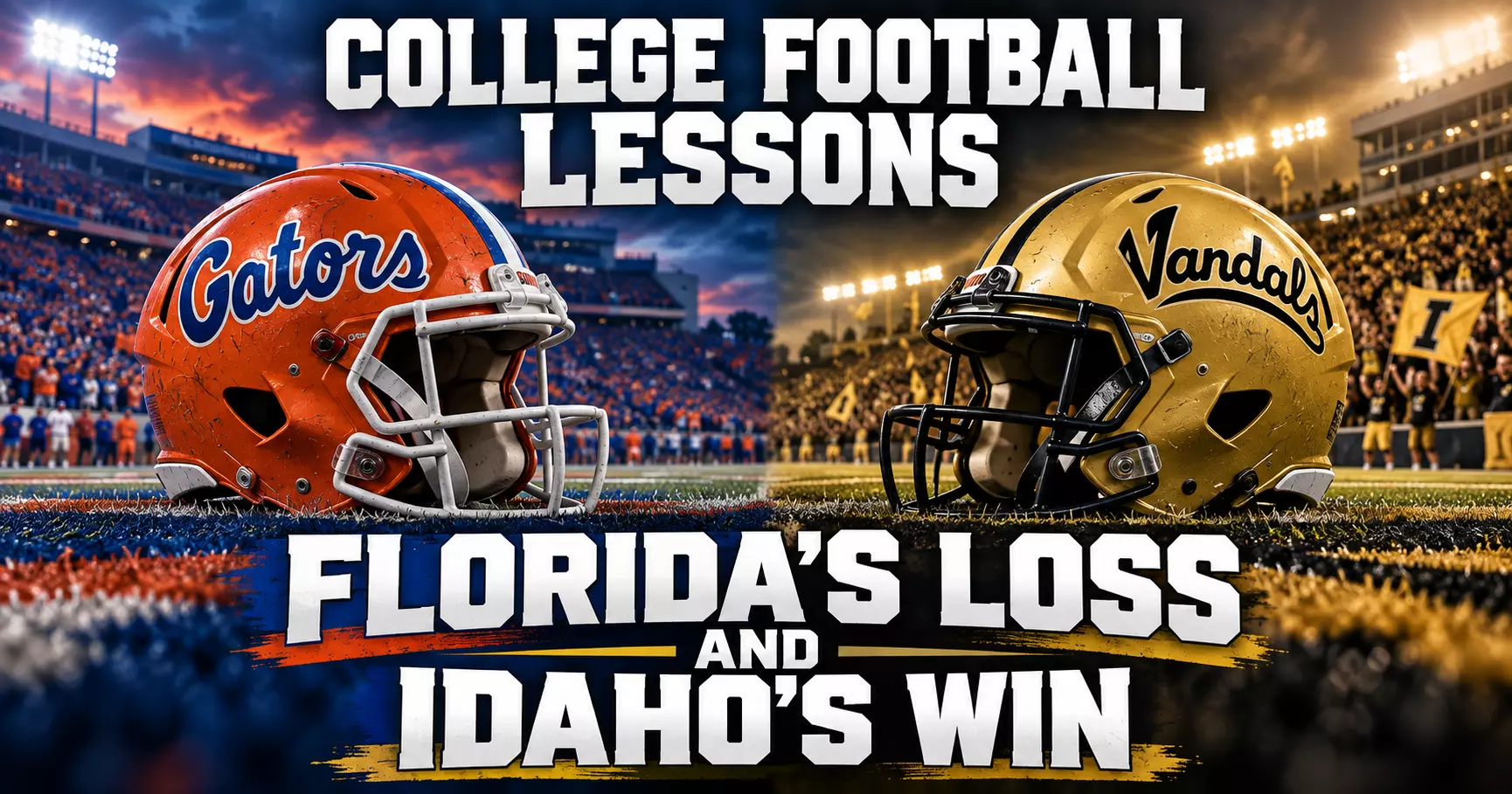
College football lessons from Florida's loss, Miami's supporting cast and Idaho's late comeback reveal what teams can build on during October.
Florida learned the hard way how quickly college football can turn a breakthrough into another round of uncomfortable questions. A week after beating Ole Miss 52-28, the Gators lost 45-17 at Missouri, with their best offensive weapon barely moving the chains.
The October 2-3 weekend rewarded teams that could do more than repeat September’s sales pitch. Miami and Alabama delivered convincing wins, while Idaho reminded everyone that a winless team can still have a winning plan. Three lessons deserve attention beyond the highlights.
College football rankings cannot open running lanes
Florida’s rise in the
rankings entering October
reflected a real achievement against Ole Miss. But Missouri provided a different examination, holding Gators running back Jadan Baugh to 13 yards on 12 carries. Twelve of those yards came on his first attempt.
Calling the loss a hangover skips the work Missouri did. Tigers coach Eli Drinkwitz explained after the game in Columbia that additional film had helped his defense recognize Florida’s habits.
“The more that this coordinator is on tape, there’s more tendencies that show up,”
he said. Familiar formations gave defenders clues they could act on before the play developed.
And Missouri punished Florida at the other end. Tigers quarterback Austin Simmons threw for 340 yards, while running back Jamal Roberts gained 211 on the ground. The Gators had problems far beyond an offense that could not keep pace.
Missouri also stopped Florida quarterback Aaron Philo on consecutive sneaks in the second quarter. The problem reached the short-yardage package, where an offense expects its blocking to hold up even when an opponent anticipates the call.
One defeat does not erase a 4-1 start. However, Florida coach Jon Sumrall now needs answers opponents cannot find so easily on film, plus better resistance when his own running game stalls.
The quarterbacks had help worth noticing
Alabama quarterback Keelon Russell threw three touchdown passes and ran for another in a 56-23 victory at Mississippi State. His performance strengthened the case for Alabama’s offense, but the defense supplied four takeaways that produced 21 points. Assigning the entire score to the quarterback misses a substantial part of the afternoon.
Miami offered a similar lesson in its 41-13 win at Clemson. Hurricanes quarterback Darian Mensah threw for 227 yards, fewer than Clemson managed through the air. Miami still pulled away because its scoring options extended beyond a passing contest.
On the Hurricanes’ first offensive play, receiver Cooper Barkate took a short screen pass 61 yards for a touchdown. Explaining the play afterward at Memorial Stadium, Barkate credited the blockers who cleared his route.
“Really, the 0-line is what it was,”
he said.
“It parted the Red Sea for me.”
Mensah’s simplest throw became a scoring play because teammates finished their assignments.
Later, running back Mark Fletcher Jr. scored twice, and defensive back JJ Dunnigan returned an interception for a touchdown. Miami reached its bye at 5-0 with ways to win while managing offensive-line injuries. Quarterback awards will attract attention, but those alternatives give a contender something useful when its favorite play stops working.
Idaho had a decision ready for the final snap
The weekend’s sharpest correction to September expectations came from Idaho, which entered winless and beat defending Football Championship Subdivision champion Montana State 35-34. The victory ended the Bobcats’ 19-game winning streak. College football’s subdivisions offered different scoreboards, but the Vandals supplied an example of preparation surviving pressure.
The comeback required defensive help, too. Trailing 34-20 early in the fourth quarter, Idaho scored and then kept Montana State from finishing with the ball. The final scoring drive existed because the defense forced another punt.
Idaho quarterback Joshua Wood took over with 49 seconds remaining and no timeouts for an 80-yard drive. A completion to tight end Noah West-Baranco put the ball at Montana State’s 25, with one second available for another play. Wood then found receiver Ryan Jezioro for the touchdown.
Idaho coach Thomas Ford Jr. had settled the next decision before the touchdown arrived. Recounting his message to Wood after the game in Moscow, Ford said,
“When we score a touchdown, we’re going for two.”
The instruction gave the offense a clear assignment while the finish remained uncertain.
Wood followed West-Baranco’s block into the end zone on the conversion. After four losses, Idaho had its first win, secured with the ball in its quarterback’s hands.
New Users – Get $350 in Bonus Bets when you wager $5 for 7 days
T&Cs apply
4.6/5
Gambling Problem? Call 1-800-GAMBLER or 1-800-MY-RESET. Call 1-888-789-7777 or visit ccpgg.org/chat (CT). Hope is here. GamblingHelpLineMA.org or call (800) 327-5050 for 24/7 support (MA). Visit www.mdgamblinghelp.org (MD). Call 1-877-8HOPE-NY or text HOPENY (NY). 21+ (18+ DC, WY) and present in select states (for KS, in affiliation with Kansas Star Casino). Find online real money wagering only. Min $5 wager required for 7 consecutive days. $5 free play credit. Bonus issued as non-withdrawable bonus with cash withdrawable bonus with cash withdrawable. Bonus bets which expire 7 days after receipt. Restrictions apply. See terms at sportsbook.fanduel.com. Call 1-877-770-7867 (LA).
Up To $1500 in Bonus Bets Paid Back if your First Bet Does Not Win
T&Cs apply
4.5/5
Gambling problem? Call 1-800-GAMBLER or 1-800-MY-RESET (Available in the US) 877-8-HOPENY or text HOPENY (467369) (NY) 1-800-327-5050 (MA), 1-800-BETS-OFF (IA), 1-800-981-0023 (PR). 21+ only. Please Gamble Responsibly. See BetMGM.com for Terms. First Bet Offer for new customers only (if applicable). Subject to eligibility requirements. Bonus bets are non-withdrawable. In partnership with Kansas Crossing Casino and Hotel. Promotional offers not available in Mississippi, Massachusetts, New York, Ontario, or Puerto Rico.
New DraftKings Customers: Bet $5, Get $200 + 3 Months of NBA League Pass!
T&Cs apply
4.5/5
GAMBLING PROBLEM? CALL 1-800-GAMBLER or 1-800-MY-RESET, (800) 327-5050 or visit gamblinghelplinema.org (MA). Please Gamble Responsibly. 888-789-7777/visit ccpg.org (CT), or visit www.mdgamblinghelp.org (MD), 1-800-981-0023 (PR). 21+ and present in most states. (18+ DC/NH/PR/WY). Void in CAN. Eligibility restrictions apply. On behalf of Boot Hill Casino (KS). Pass-thru of per wager tax may apply in IL. 1 per new Sportsbook customer. $5+ first-time bet req. Max. $200 issued as non-withdrawable Bonus Bets. Stake removed from payout. Reward issued as $50 in Bonus Bets every 7 days via click-to-claim for 21 days. Bonus Bets and click-to-claims expire 7 days (168hrs) after issuance. Terms: dkng.co/offer. Get 1 promo code to redeem a 3-month NBA League Pass subscription, complimentary of DraftKings. Subscription auto-renews monthly at then-current price (currently $16.99/mo); cancel anytime. Terms, restrictions, and eligibility requirements apply. Redeem League Pass by 12/19/26 at 11:59 PM ET. Addt’l terms: support.watch.nba.com/hc/en-us/articles/9165532876183-League-Pass-Terms-of-Use_. Ends 11/29/26 at 11:59 PM ET. Sponsored by DK.
Must be 21+. GAMBLING PROBLEM? CALL 1-800-GAMBLER OR CALL 1-800-MY-RESET, www.mdgamblinghelp.org (MD), (800)-327-5050 or gamblinghelplinema.org (MA), Call (877)8-HOPENY or text HOPENY (467369) (NY), (888) 789-7777 or ccpg.org (CT), morethanagame.nc.gov (NC), 1800gambler.net (WV)
Bet $1 and get double the winnings up to $25 for your next 10 bets
T&Cs apply
4.4/5
21+ New users only. Must register using eligible promo code. First bet after registration must qualify. Max. Bonus Bet: $1,000. Bonus Bet expires 14 days after receipt. Void where prohibited. See Caesars.com/promos for full terms. Gambling Problem? 1-800-GAMBLER (1-800-426-2537)
21+ and present in OH. Gambling Problem? Call 1-800-GAMBLER.
This site is using
Cloudflare
and adheres to the
Google Safe Browsing Program. We adapted
Google's Privacy Guidelines
to keep your data safe at all times.
Close
Ready to Win Big? Join the Elite with Our Sports Betting Deals!
FanDuel Promo
New Users – Get $350 in Bonus Bets when you wager $5 for 7 days
Our Favorite
T&Cs and 21+ apply
Gambling Problem? Call 1-800-GAMBLER or 1-800-MY-RESET. Call 1-888-789-7777 or visit ccpgg.org/chat (CT). Hope is here. GamblingHelpLineMA.org or call (800) 327-5050 for 24/7 support (MA). Visit www.mdgamblinghelp.org (MD). Call 1-877-8HOPE-NY or text HOPENY (NY). 21+ (18+ DC, WY) and present in select states (for KS, in affiliation with Kansas Star Casino). Find online real money wagering only. Min $5 wager required for 7 consecutive days. $5 free play credit. Bonus issued as non-withdrawable bonus with cash withdrawable bonus with cash withdrawable. Bonus bets which expire 7 days after receipt. Restrictions apply. See terms at sportsbook.fanduel.com. Call 1-877-770-7867 (LA).
Code:
Open FanDuel
Get Bonus
BetMGM Promo
Up To $1500 in Bonus Bets Paid Back if your First Bet Does Not Win
Best Slots
T&Cs and 21+ apply
Gambling problem? Call 1-800-GAMBLER or 1-800-MY-RESET (Available in the US) 877-8-HOPENY or text HOPENY (467369) (NY) 1-800-327-5050 (MA), 1-800-BETS-OFF (IA), 1-800-981-0023 (PR). 21+ only. Please Gamble Responsibly. See BetMGM.com for Terms. First Bet Offer for new customers only (if applicable). Subject to eligibility requirements. Bonus bets are non-withdrawable. In partnership with Kansas Crossing Casino and Hotel. Promotional offers not available in Mississippi, Massachusetts, New York, Ontario, or Puerto Rico.
Code:
Open BetMGM
Get Bonus
DraftKings Promo
New DraftKings Customers: Bet $5, Get $200 + 3 Months of NBA League Pass!
Newcomer
T&Cs and 21+ apply
GAMBLING PROBLEM? CALL 1-800-GAMBLER or 1-800-MY-RESET, (800) 327-5050 or visit gamblinghelplinema.org (MA). Please Gamble Responsibly. 888-789-7777/visit ccpg.org (CT), or visit www.mdgamblinghelp.org (MD), 1-800-981-0023 (PR). 21+ and present in most states. (18+ DC/NH/PR/WY). Void in CAN. Eligibility restrictions apply. On behalf of Boot Hill Casino (KS). Pass-thru of per wager tax may apply in IL. 1 per new Sportsbook customer. $5+ first-time bet req. Max. $200 issued as non-withdrawable Bonus Bets. Stake removed from payout. Reward issued as $50 in Bonus Bets every 7 days via click-to-claim for 21 days. Bonus Bets and click-to-claims expire 7 days (168hrs) after issuance. Terms: dkng.co/offer. Get 1 promo code to redeem a 3-month NBA League Pass subscription, complimentary of DraftKings. Subscription auto-renews monthly at then-current price (currently $16.99/mo); cancel anytime. Terms, restrictions, and eligibility requirements apply. Redeem League Pass by 12/19/26 at 11:59 PM ET. Addt’l terms: support.watch.nba.com/hc/en-us/articles/9165532876183-League-Pass-Terms-of-Use_. Ends 11/29/26 at 11:59 PM ET. Sponsored by DK.
Code:
Open DraftKings
Get Bonus
Find out what the legends have to say about sports this week....
New Users – Get $350 in Bonus Bets when you wager $5 for 7 days
Gambling Problem? Call 1-800-GAMBLER or 1-800-MY-RESET. Call 1-888-789-7777 or visit ccpgg.org/chat (CT). Hope is here. GamblingHelpLineMA.org or call (800) 327-5050 for 24/7 support (MA). Visit www.mdgamblinghelp.org (MD). Call 1-877-8HOPE-NY or text HOPENY (NY). 21+ (18+ DC, WY) and present in select states (for KS, in affiliation with Kansas Star Casino). Find online real money wagering only. Min $5 wager required for 7 consecutive days. $5 free play credit. Bonus issued as non-withdrawable bonus with cash withdrawable bonus with cash withdrawable. Bonus bets which expire 7 days after receipt. Restrictions apply. See terms at sportsbook.fanduel.com. Call 1-877-770-7867 (LA).