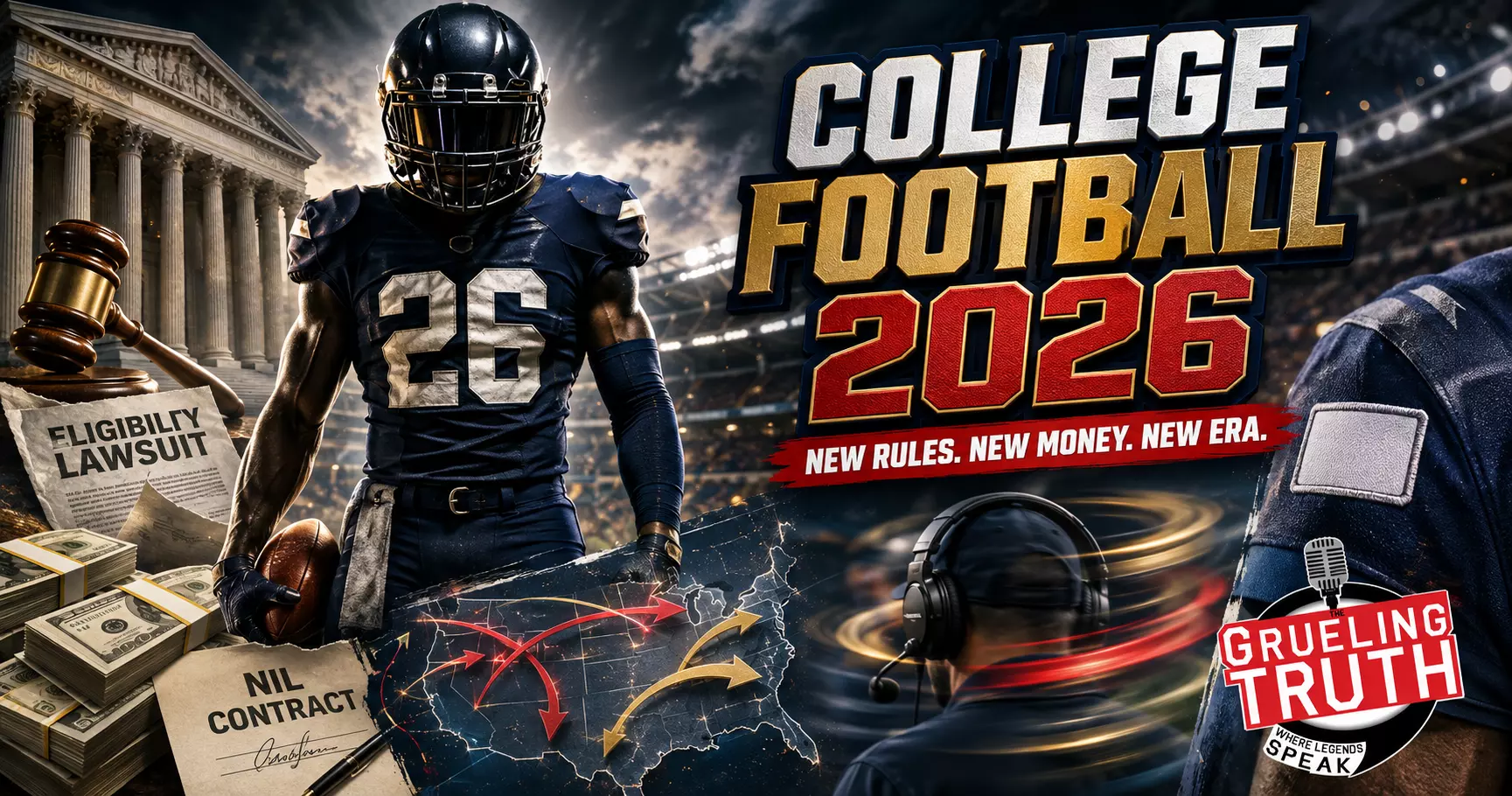
College football has always evolved, but rarely has the sport entered a season with so many fundamental parts changing simultaneously.
College football has always evolved, but rarely has the sport entered a season with so many fundamental parts changing simultaneously.
As the 2026 season approaches, programs are dealing with eligibility decisions made in courtrooms, escalating roster expenses, corporate logos appearing on uniforms, a reconstructed Pac-12 and one of the most disruptive coaching carousels in recent history. The games may still be played on 100-yard fields, but almost everything surrounding them looks different.
Some changes are intended to create stability. Others are schools’ attempts to keep pace financially. Almost all of them have produced additional questions.
Here are the five major developments defining college football as Week Zero approaches.
1. Eligibility Is Being Determined in Court
The NCAA hoped its new
age-based eligibility model
would simplify one of college sports’ most complicated issues. Instead, the transition has created another legal battle involving thousands of athletes.
Under the new system, athletes receive a continuous five-year eligibility window beginning after they graduate from high school, turn 19 or initially enroll in college, depending on their circumstances. The model eliminates traditional redshirts, seasons-of-competition tracking and several waiver categories.
The NCAA’s goal was to replace a complicated collection of exceptions with a more predictable standard. The problem involved athletes from the high school Class of 2022 who had already completed four seasons but were not automatically granted a fifth.
In
Wisne v. NCAA, a federal district judge initially issued a nationwide preliminary injunction that protected eligible Division I athletes from that class and opened the door for them to return. Programs began adding players whom they had previously believed were finished with college athletics.
That protection did not last.
On August 21, the U.S. Court of Appeals for the Tenth Circuit granted the NCAA’s request to stay the injunction. The ruling returned the national policy to its previous status and made athletes who relied exclusively on the
Wisne
order ineligible again.
The appellate ruling was an important victory for the NCAA, but it did not resolve the larger dispute. Athletes in several states have obtained individual or group injunctions, creating a situation in which a player’s eligibility may depend on where a lawsuit was filed.
That is the opposite of a uniform national system.
Programs that believed they had added veteran starters must now reconsider their depth charts. Athletes who spent months preparing for another season could lose that opportunity days before competition begins. Additional lawsuits are likely, meaning the eligibility of some players could change even after the season starts.
The NCAA has regained some authority, but the underlying problem remains: Its rules are only as reliable as the next court decision.
2. The Revenue-Sharing Cap Is Not Controlling Roster Costs
The 2026 season will be the second under the revenue-sharing model created by the
House v. NCAA
settlement.
Participating athletic departments may distribute approximately $21.3 million directly to athletes during the 2026–27 academic year, an increase from the $20.5 million limit during the model’s first year. That amount must be shared across all sports, although football commands the largest portion at most major programs.
On paper, the system resembles a salary cap. In practice, it is only one part of the money available to athletes.
Players can also sign legitimate third-party name, image and likeness agreements. Those deals are supposed to reflect reasonable market value for services such as appearances, advertising, endorsements and promotional work. The College Sports Commission was created to review agreements and prevent outside NIL payments from becoming unrestricted recruiting inducements.
Enforcement, however, remains extremely difficult.
The commission does not have the legal protection that professional sports leagues receive through collective bargaining. Every rejected deal or attempted penalty carries the possibility of another lawsuit. Schools, collectives and donors continue searching for ways to construct agreements that survive the review process while providing more money to coveted players.
The result is a system containing a formal revenue-sharing limit without a firm ceiling on total compensation.
At the power-conference level, some football rosters are reportedly costing approximately $40 million when institutional revenue sharing and outside NIL payments are combined. The most aggressive programs are spending whatever they believe is necessary to sign quarterbacks, retain starters and construct playoff-caliber depth.
This financial race will not slow down voluntarily. Schools know that refusing to spend could mean losing their best players to the transfer portal. Coaches know that one bad roster can cost them jobs worth millions of dollars.
Congressional protection, collective bargaining or another national agreement could eventually create greater stability. Until then, college football’s compensation system will remain a cap in name more than in reality.
3. Corporate Advertising Has Reached the Uniform
College football’s uniforms have traditionally represented a school, its apparel provider and little else. Beginning in 2026, they will also become advertising space.
The NCAA Division I Cabinet approved a policy permitting schools to place as many as two commercial logos on uniforms and apparel during the preseason and regular season. Each logo can occupy up to four square inches. Programs may also place an additional commercial logo on equipment, with another uniform opportunity available during conference championship competition.
Schools did not need much time to begin selling the new inventory.
Athletic departments have reached agreements with companies representing technology, cryptocurrency, media, financial services and other industries. The trend has not been limited to the wealthiest programs. Army, Memphis, UNLV and other schools outside the power conferences have also pursued uniform sponsorships.
The most aggressive move came from the Big 12.
The conference reached a league-wide agreement with Monster Energy reportedly worth approximately $20 million annually. The arrangement includes jersey patches, playing-surface branding and additional sponsorship assets across the conference. It represents one of the clearest examples of college sports borrowing a revenue model long used by professional leagues.
For administrators, the reasoning is obvious.
Revenue sharing, coaching contracts, facility expenses and buyouts have all increased. A jersey patch can generate money without adding games, raising ticket prices or requiring another media-rights negotiation.
For fans, the change may be harder to accept.
College uniforms carry history. Many supporters do not want traditional designs turned into moving billboards. Schools will have to balance the value of sponsorship agreements against the possibility of damaging one of the strongest visual connections between teams and their supporters.
Regardless of the reaction, uniform advertising is here. Once one school monetizes an asset, its competitors rarely leave the same money untouched.
4. The Pac-12 Is Back, but the Western Map Has Changed
When ten schools departed the Pac-12 during the previous realignment cycle, many assumed the conference was finished. Oregon State and Washington State were left behind in what appeared to be a two-school shell of a once-powerful league.
The Pac-12 survived—and officially relaunched in July 2026.
Boise State, Colorado State, Fresno State, San Diego State and Utah State joined from the Mountain West. Texas State arrived from the Sun Belt, while Gonzaga became a full member without adding football. Combined with Oregon State and Washington State, the rebuilt Pac-12 now has nine full members and eight football-playing schools.
It is not the same conference that once included USC, UCLA, Oregon, Washington and Stanford. It is, however, a viable FBS league with several recognizable football programs and one of the country’s premier basketball brands in Gonzaga.
Boise State immediately supplies national football credibility. Oregon State and Washington State retain their established identities, while San Diego State, Fresno State and Colorado State provide important western markets and histories. Texas State gives the league access to the football-rich state of Texas.
The College Football Playoff will treat the new Pac-12 as part of the Group of Six rather than restoring its former power-conference status. That means its champion will compete with the American, Mountain West, Sun Belt, Conference USA and Mid-American champions for playoff access.
The Mountain West also had to rebuild after losing five members.
Its football lineup now includes Air Force, Hawaii, Nevada, New Mexico, San Jose State, UNLV, UTEP and Wyoming. Northern Illinois joined as a football affiliate, and North Dakota State made the significant jump from the FCS as a football-only member.
Adding North Dakota State was a particularly aggressive move. The Bison bring a national following and one of the most accomplished FCS programs in history. Their transition to the FBS gives the reconfigured Mountain West another recognizable football brand.
The Pac-12 and Mountain West spent much of the realignment process fighting over exit fees, poaching penalties and contractual obligations. A comprehensive settlement reached shortly before the season finally ended that litigation.
The legal battle may be over, but the competition has just begun. Both conferences must now prove their rebuilt memberships can produce national relevance, television value and consistent playoff contenders.
5. The Coaching Carousel Rewrote the Sidelines
The
2025 coaching carousel
was not a routine collection of hirings and firings. It redistributed some of the sport’s most recognizable coaches and produced more than $100 million in reported buyout obligations.
James Franklin’s dismissal at Penn State was one of the first major developments. The school reportedly owed him nearly $50 million, but Penn State decided that maintaining the status quo was more expensive than making a change.
Franklin did not remain unemployed for long. He accepted the job at Virginia Tech, giving the Hokies a proven Power Four coach tasked with restoring a program that has spent years searching for its former identity.
Penn State replaced Franklin with Matt Campbell, who left Iowa State after building the Cyclones into one of the country’s most consistently competitive programs. Campbell now inherits far greater resources—and far greater expectations. Winning nine games will not satisfy Penn State if those victories do not include playoff appearances and championship contention.
The biggest move occurred at LSU.
The Tigers fired Brian Kelly and hired Lane Kiffin away from Ole Miss during the Rebels’ historic playoff run. Kiffin’s departure created anger in Oxford, but LSU offered him the resources and roster access necessary to compete immediately for a national championship.
Former Ole Miss defensive coordinator Pete Golding now leads the Rebels, meaning Kiffin’s move did not simply alter two programs. It created one of the most emotionally charged coaching storylines in the SEC.
The changes extended throughout the country.
Bob Chesney left James Madison for UCLA. Florida hired Jon Sumrall from Tulane. Former Florida coach Billy Napier resurfaced at James Madison. Michigan turned to longtime Utah coach Kyle Whittingham after Sherrone Moore was fired for cause following an inappropriate relationship with a staff member and subsequent legal trouble.
Each coach arrives with a different definition of success.
Kiffin is expected to contend immediately at LSU. Campbell will be judged by Penn State’s postseason performance. Franklin must show that Virginia Tech can become nationally relevant again. Whittingham has been asked to bring stability to Michigan, while Sumrall and Chesney must prove their Group of Five success can translate to more demanding jobs.
The carousel transferred pressure as much as it transferred coaches. Several programs paid enormous sums to change direction, and none will demonstrate much patience if the early results are disappointing.
College Football Enters Another Unsettled Season
The most remarkable thing about college football’s transformation is that none of these developments exists independently.
Rising player expenses encourage schools to sell jersey sponsorships. Increased roster costs place more pressure on coaches to win immediately. The transfer portal and eligibility lawsuits complicate roster construction. Realignment changes schedules, travel demands and playoff opportunities.
Everything connects to money, control and competitive survival.
Once Week Zero begins, fans will naturally focus on quarterbacks, rankings and championship predictions. Away from the field, however, the sport will continue fighting over who creates the rules, how athletes are compensated and which institutions can afford to remain competitive.
College football remains enormously popular, but popularity should not be confused with stability. The 2026 season will begin with packed stadiums, massive television audiences and more money moving through the sport than ever before.
It will also begin without clear answers to some of its most important questions.
New Users – Get $350 in Bonus Bets when you wager $5 for 7 days
T&Cs apply
4.6/5
Gambling Problem? Call 1-800-GAMBLER or 1-800-MY-RESET. Call 1-888-789-7777 or visit ccpgg.org/chat (CT). Hope is here. GamblingHelpLineMA.org or call (800) 327-5050 for 24/7 support (MA). Visit www.mdgamblinghelp.org (MD). Call 1-877-8HOPE-NY or text HOPENY (NY). 21+ (18+ DC, WY) and present in select states (for KS, in affiliation with Kansas Star Casino). Find online real money wagering only. Min $5 wager required for 7 consecutive days. $5 free play credit. Bonus issued as non-withdrawable bonus with cash withdrawable bonus with cash withdrawable. Bonus bets which expire 7 days after receipt. Restrictions apply. See terms at sportsbook.fanduel.com. Call 1-877-770-7867 (LA).
Up To $1500 in Bonus Bets Paid Back if your First Bet Does Not Win
T&Cs apply
4.5/5
Gambling problem? Call 1-800-GAMBLER or 1-800-MY-RESET (Available in the US) 877-8-HOPENY or text HOPENY (467369) (NY) 1-800-327-5050 (MA), 1-800-BETS-OFF (IA), 1-800-981-0023 (PR). 21+ only. Please Gamble Responsibly. See BetMGM.com for Terms. First Bet Offer for new customers only (if applicable). Subject to eligibility requirements. Bonus bets are non-withdrawable. In partnership with Kansas Crossing Casino and Hotel. Promotional offers not available in Mississippi, Massachusetts, New York, Ontario, or Puerto Rico.
New DraftKings Customers: Bet $5, Get $200 + 3 Months of NBA League Pass!
T&Cs apply
4.5/5
GAMBLING PROBLEM? CALL 1-800-GAMBLER or 1-800-MY-RESET, (800) 327-5050 or visit gamblinghelplinema.org (MA). Please Gamble Responsibly. 888-789-7777/visit ccpg.org (CT), or visit www.mdgamblinghelp.org (MD), 1-800-981-0023 (PR). 21+ and present in most states. (18+ DC/NH/PR/WY). Void in CAN. Eligibility restrictions apply. On behalf of Boot Hill Casino (KS). Pass-thru of per wager tax may apply in IL. 1 per new Sportsbook customer. $5+ first-time bet req. Max. $200 issued as non-withdrawable Bonus Bets. Stake removed from payout. Reward issued as $50 in Bonus Bets every 7 days via click-to-claim for 21 days. Bonus Bets and click-to-claims expire 7 days (168hrs) after issuance. Terms: dkng.co/offer. Get 1 promo code to redeem a 3-month NBA League Pass subscription, complimentary of DraftKings. Subscription auto-renews monthly at then-current price (currently $16.99/mo); cancel anytime. Terms, restrictions, and eligibility requirements apply. Redeem League Pass by 12/19/26 at 11:59 PM ET. Addt’l terms: support.watch.nba.com/hc/en-us/articles/9165532876183-League-Pass-Terms-of-Use_. Ends 11/29/26 at 11:59 PM ET. Sponsored by DK.
Must be 21+. GAMBLING PROBLEM? CALL 1-800-GAMBLER OR CALL 1-800-MY-RESET, www.mdgamblinghelp.org (MD), (800)-327-5050 or gamblinghelplinema.org (MA), Call (877)8-HOPENY or text HOPENY (467369) (NY), (888) 789-7777 or ccpg.org (CT), morethanagame.nc.gov (NC), 1800gambler.net (WV)
Bet $1 and get double the winnings up to $25 for your next 10 bets
T&Cs apply
4.4/5
21+ New users only. Must register using eligible promo code. First bet after registration must qualify. Max. Bonus Bet: $1,000. Bonus Bet expires 14 days after receipt. Void where prohibited. See Caesars.com/promos for full terms. Gambling Problem? 1-800-GAMBLER (1-800-426-2537)
21+ and present in OH. Gambling Problem? Call 1-800-GAMBLER.
This site is using
Cloudflare
and adheres to the
Google Safe Browsing Program. We adapted
Google's Privacy Guidelines
to keep your data safe at all times.
Close
Ready to Win Big? Join the Elite with Our Sports Betting Deals!
FanDuel Promo
New Users – Get $350 in Bonus Bets when you wager $5 for 7 days
Our Favorite
T&Cs and 21+ apply
Gambling Problem? Call 1-800-GAMBLER or 1-800-MY-RESET. Call 1-888-789-7777 or visit ccpgg.org/chat (CT). Hope is here. GamblingHelpLineMA.org or call (800) 327-5050 for 24/7 support (MA). Visit www.mdgamblinghelp.org (MD). Call 1-877-8HOPE-NY or text HOPENY (NY). 21+ (18+ DC, WY) and present in select states (for KS, in affiliation with Kansas Star Casino). Find online real money wagering only. Min $5 wager required for 7 consecutive days. $5 free play credit. Bonus issued as non-withdrawable bonus with cash withdrawable bonus with cash withdrawable. Bonus bets which expire 7 days after receipt. Restrictions apply. See terms at sportsbook.fanduel.com. Call 1-877-770-7867 (LA).
Code:
Open FanDuel
Get Bonus
BetMGM Promo
Up To $1500 in Bonus Bets Paid Back if your First Bet Does Not Win
Best Slots
T&Cs and 21+ apply
Gambling problem? Call 1-800-GAMBLER or 1-800-MY-RESET (Available in the US) 877-8-HOPENY or text HOPENY (467369) (NY) 1-800-327-5050 (MA), 1-800-BETS-OFF (IA), 1-800-981-0023 (PR). 21+ only. Please Gamble Responsibly. See BetMGM.com for Terms. First Bet Offer for new customers only (if applicable). Subject to eligibility requirements. Bonus bets are non-withdrawable. In partnership with Kansas Crossing Casino and Hotel. Promotional offers not available in Mississippi, Massachusetts, New York, Ontario, or Puerto Rico.
Code:
Open BetMGM
Get Bonus
DraftKings Promo
New DraftKings Customers: Bet $5, Get $200 + 3 Months of NBA League Pass!
Newcomer
T&Cs and 21+ apply
GAMBLING PROBLEM? CALL 1-800-GAMBLER or 1-800-MY-RESET, (800) 327-5050 or visit gamblinghelplinema.org (MA). Please Gamble Responsibly. 888-789-7777/visit ccpg.org (CT), or visit www.mdgamblinghelp.org (MD), 1-800-981-0023 (PR). 21+ and present in most states. (18+ DC/NH/PR/WY). Void in CAN. Eligibility restrictions apply. On behalf of Boot Hill Casino (KS). Pass-thru of per wager tax may apply in IL. 1 per new Sportsbook customer. $5+ first-time bet req. Max. $200 issued as non-withdrawable Bonus Bets. Stake removed from payout. Reward issued as $50 in Bonus Bets every 7 days via click-to-claim for 21 days. Bonus Bets and click-to-claims expire 7 days (168hrs) after issuance. Terms: dkng.co/offer. Get 1 promo code to redeem a 3-month NBA League Pass subscription, complimentary of DraftKings. Subscription auto-renews monthly at then-current price (currently $16.99/mo); cancel anytime. Terms, restrictions, and eligibility requirements apply. Redeem League Pass by 12/19/26 at 11:59 PM ET. Addt’l terms: support.watch.nba.com/hc/en-us/articles/9165532876183-League-Pass-Terms-of-Use_. Ends 11/29/26 at 11:59 PM ET. Sponsored by DK.
Code:
Open DraftKings
Get Bonus
Find out what the legends have to say about sports this week....
New Users – Get $350 in Bonus Bets when you wager $5 for 7 days
Gambling Problem? Call 1-800-GAMBLER or 1-800-MY-RESET. Call 1-888-789-7777 or visit ccpgg.org/chat (CT). Hope is here. GamblingHelpLineMA.org or call (800) 327-5050 for 24/7 support (MA). Visit www.mdgamblinghelp.org (MD). Call 1-877-8HOPE-NY or text HOPENY (NY). 21+ (18+ DC, WY) and present in select states (for KS, in affiliation with Kansas Star Casino). Find online real money wagering only. Min $5 wager required for 7 consecutive days. $5 free play credit. Bonus issued as non-withdrawable bonus with cash withdrawable bonus with cash withdrawable. Bonus bets which expire 7 days after receipt. Restrictions apply. See terms at sportsbook.fanduel.com. Call 1-877-770-7867 (LA).