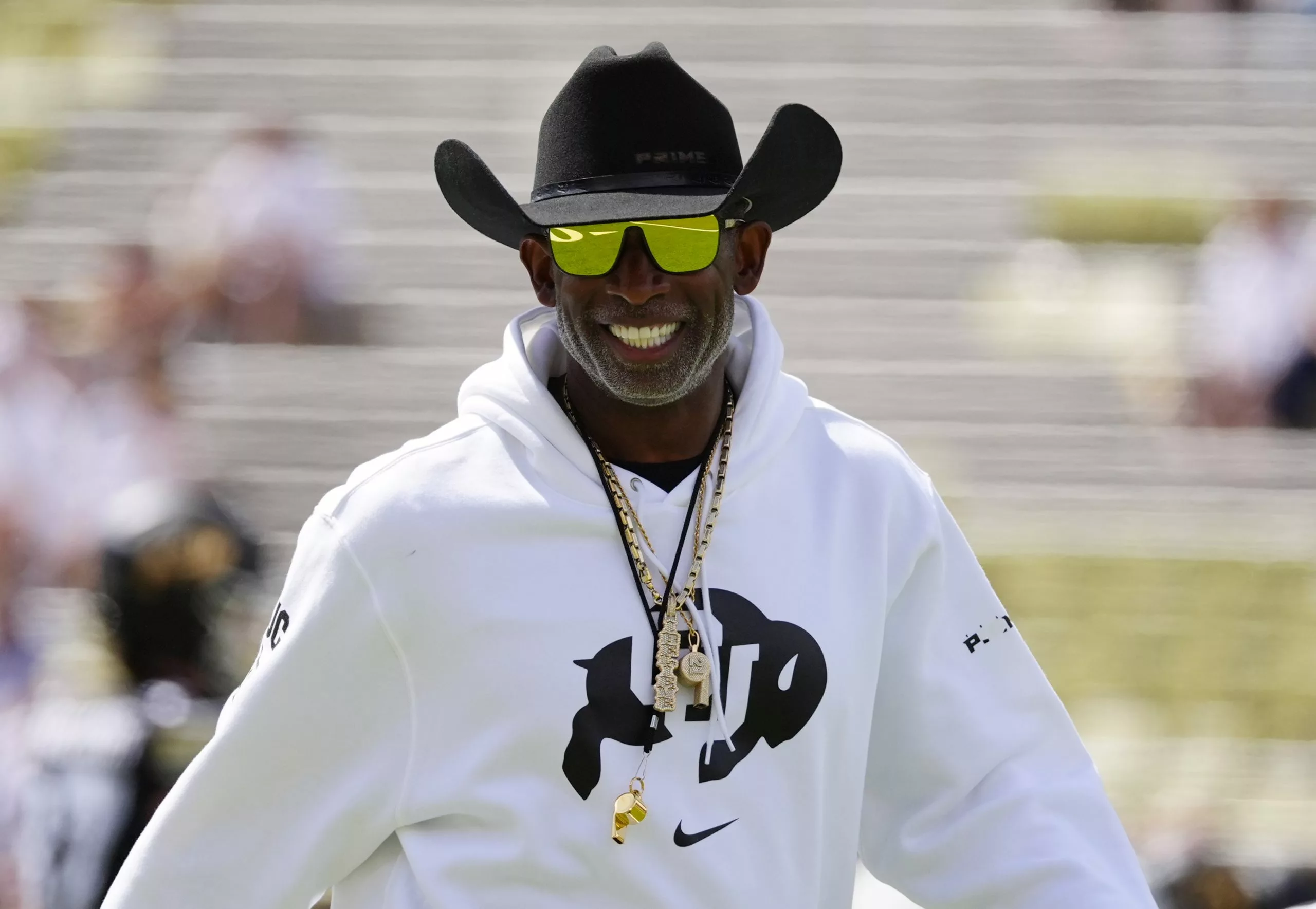
Sep 12, 2026; Boulder, Colorado, USA; Colorado Buffaloes head coach Deion Sanders before the game against Weber State at Folsom Field. Mandatory Credit: Ron Chenoy-Imagn Images
Colorado entered Saturday’s game against Northwestern with an opportunity to prove that the program was finally moving forward again under Deion Sanders.
The Buffaloes were 2–0. They had already earned a road victory over Georgia Tech and followed it with a 52–21 win over Weber State. After collapsing to 3–9 last season, Colorado appeared to have rediscovered some momentum.
Then Northwestern dismantled the Buffaloes 41–7.
This was not a close game decided by one unfortunate turnover or a controversial officiating decision. Colorado was thoroughly embarrassed by a Northwestern team that entered the afternoon with few national expectations. The Buffaloes turned the ball over, failed on fourth down, wasted scoring opportunities and repeatedly left their defense in impossible situations.
Sanders has brought attention, recruiting excitement and enormous expectations to Colorado. But four years into the Coach Prime experiment, the Buffaloes still look capable of falling apart the moment a game begins moving against them.
That is the real concern coming out of Evanston.
Colorado Was Not Prepared to Play
Northwestern did not need a complicated strategy to defeat Colorado. The Wildcats simply played smarter, cleaner and more disciplined football.
Colorado committed three first-half turnovers and watched the game escape before its offense ever established a consistent rhythm. Northwestern turned those mistakes into points, built a commanding lead and forced the Buffaloes into an increasingly desperate style of play.
The final statistics make the result even more troubling.
Colorado accumulated 348 yards of offense, including 180 rushing yards. Northwestern did not overwhelm the Buffaloes statistically in every category. The Wildcats won 41–7 because they dominated the portions of the game that reveal preparation, discipline and situational awareness.
Colorado committed turnovers. Northwestern protected the football.
Colorado failed on fourth down. Northwestern finished drives.
Colorado moved the ball between the 20-yard lines. Northwestern scored touchdowns.
Colorado looked like a team capable of producing yardage. Northwestern looked like a team that understood how to win a
football game.
That difference reflects poorly on Sanders and his coaching staff.
Turnovers Destroyed Any Chance Colorado Had
Quarterback Julian Lewis experienced the kind of afternoon that young quarterbacks inevitably encounter. He completed passes, showed flashes and finished with 168 yards and one touchdown, but he also threw two interceptions.
Lewis was not Colorado’s only problem, and it would be unfair to make him the primary target of criticism. The Buffaloes also lost fumbles and failed on three fourth-down attempts. Practically every time Colorado had an opportunity to make the game competitive, another mistake followed.
The Buffaloes gave Northwestern short fields and repeatedly placed their defense in losing situations. Once Colorado fell behind, Lewis was asked to throw against a defense that no longer had to respect the entire playbook.
Northwestern knew the pass was coming. Its defenders could attack rather than react, and Lewis was left trying to rescue a game that had already been damaged by mistakes throughout the roster.
Sanders has always demanded accountability from his players. After a performance like this, that accountability must extend to the coaching staff. A team does not commit this many damaging errors in one game simply because its quarterback had a difficult afternoon.
Colorado looked unprepared for the conditions, Northwestern’s defensive pressure and the possibility of falling behind.
Aidan Chiles Made Colorado Pay
While Colorado wasted its opportunities, Northwestern quarterback Aidan Chiles took advantage of nearly every opening.
Chiles completed 17 of 22 passes for 241 yards and three touchdowns. He also added two rushing scores, accounting for all five of Northwestern’s touchdowns.
Joseph Himon II became the unlikely star of the afternoon. Himon caught only three passes, but all three went for touchdowns. He finished with 74 receiving yards as Colorado repeatedly lost him in critical situations.
Northwestern did not ask Chiles to perform miracles. The Wildcats gave him advantageous field position, protected the football and allowed him to attack a Colorado defense that spent too much time trying to clean up the offense’s mistakes.
Chiles delivered an efficient, controlled performance. Lewis and the Buffaloes produced chaos.
That contrast defined the game.
Northwestern did not enter the season as a national championship contender. The Wildcats did not possess an overwhelming talent advantage. They simply executed their assignments and punished Colorado every time the Buffaloes made a mistake.
By the fourth quarter, Northwestern’s backup quarterback was playing and the result had become a celebration for the home crowd. The Wildcats completed a 41–7 rout behind Chiles’ five touchdowns and a defense that continually created opportunities.
The 2–0 Start Now Looks Much Different
Colorado’s opening victory over Georgia Tech initially appeared to be evidence that Sanders had turned the program around after last season’s 3–9 collapse.
The Buffaloes then handled Weber State and entered the Northwestern game undefeated. The optimism was understandable. Colorado looked more physical, its defense appeared improved and Lewis provided hope that the program had found its next quarterback.
Northwestern changed the conversation in one afternoon.
A legitimate contender does not lose 41–7 to a team of comparable or lesser talent. A well-coached team may lose on the road, but it should not repeatedly hand its opponent the football and fail to respond when the game becomes difficult.
Colorado’s first two victories now require reevaluation. Were they evidence of real improvement, or did they simply delay the exposure of the same weaknesses that plagued the Buffaloes last season?
The answer will come during conference play, but Colorado no longer deserves the benefit of the doubt.
The Buffaloes must prove the
Northwestern game
was an aberration. Until they do, the 2–0 start looks more like another temporary wave of Coach Prime excitement than the beginning of a meaningful turnaround.
Life Without Shedeur Sanders and Travis Hunter Is Different
Sanders transformed Colorado immediately when he arrived, but much of the program’s national relevance was connected to two exceptional players: Shedeur Sanders and Travis Hunter.
Shedeur gave the Buffaloes an experienced quarterback who understood his father’s expectations and could create offense when protection broke down. Hunter was a generational two-way player capable of changing a game on either side of the ball.
Those players are gone, and Colorado can no longer expect individual brilliance to cover the program’s weaknesses.
That does not mean Lewis cannot become an excellent quarterback. He has significant talent and a promising future. But he is not yet ready to carry an undisciplined team through four turnovers, failed fourth downs and repeated defensive breakdowns.
The responsibility now belongs to Deion Sanders to demonstrate that Colorado is an actual program rather than a collection of personalities built around a few stars.
That requires player development, depth, consistent preparation and the ability to win when the quarterback is not spectacular.
Northwestern exposed how far Colorado still has to go.
This Was Bigger Than One Bad Performance
Every college football team eventually has a bad game. Turnovers happen. Young quarterbacks struggle. Road environments and poor weather can create unexpected problems.
But Colorado does not have enough recent success to dismiss a 34-point loss as an isolated event.
The Buffaloes followed a promising 9–4 campaign with a 3–9 season in 2025. Sanders entered 2026 with a 16–21 record over his first three seasons at Colorado and only one bowl appearance. The opening victories improved the mood surrounding the program, but they did not erase the need for sustained progress.
Colorado cannot continue alternating between attention-grabbing victories and inexplicable collapses.
Sanders was not hired merely to make Colorado interesting. He was hired to make the Buffaloes relevant on the field. By the fourth season, relevance should include winning records, bowl victories and consistent performances against Power Four opponents.
A 41–7 loss to Northwestern represents the opposite of that progress.
Coach Prime Must Provide Answers
Sanders does not need to abandon his approach or make dramatic changes because of one loss. He does, however, need to take responsibility for how poorly Colorado performed.
The Buffaloes were careless with the football. They could not finish drives. They failed repeatedly on fourth down, allowed five touchdowns from the opposing quarterback and never mounted a meaningful response.
Those are coaching problems as much as personnel problems.
Colorado’s next response will reveal far more about the program than its 2–0 start did. Good teams can be embarrassed and recover. Poorly constructed teams allow one defeat to expose problems that continue throughout the season.
Sanders now faces the most important question of his fourth year in Boulder: Can he build a complete football team without relying on Shedeur Sanders and Travis Hunter to rescue it?
Northwestern provided a brutal initial answer.
The Wildcats did not merely defeat Colorado. They stripped away the hype, exposed the Buffaloes’ lack of discipline and forced everyone to reconsider whether the program has made meaningful progress.
Coach Prime remains one of the biggest personalities in college football. Colorado still receives attention that most programs would love to have.
But attention is not development. Hype is not discipline. Celebrity is not preparation.
And after getting embarrassed 41–7 by Northwestern, Colorado has a much more serious problem than one loss. The Buffaloes must prove that the Coach Prime era is building toward something—or accept that the spectacle has once again become more impressive than the football.
Up To $1500 in Bonus Bets Paid Back if your First Bet Does Not Win
T&Cs apply
4.5/5
Gambling problem? Call 1-800-GAMBLER or 1-800-MY-RESET (Available in the US) 877-8-HOPENY or text HOPENY (467369) (NY) 1-800-327-5050 (MA), 1-800-BETS-OFF (IA), 1-800-981-0023 (PR). 21+ only. Please Gamble Responsibly. See BetMGM.com for Terms. First Bet Offer for new customers only (if applicable). Subject to eligibility requirements. Bonus bets are non-withdrawable. In partnership with Kansas Crossing Casino and Hotel. Promotional offers not available in Mississippi, Massachusetts, New York, Ontario, or Puerto Rico.
New DraftKings Customers: Spend $5+ Get $150 in Bonuses
T&Cs apply
4.5/5
GAMBLING PROBLEM? CALL 1-800-GAMBLER or 1-800-MY-RESET, (800) 327-5050 or visit gamblinghelplinema.org (MA). Please Gamble Responsibly. 888-789-7777/visit ccpg.org (CT), or visit www.mdgamblinghelp.org (MD), 1-800-981-0023 (PR). 21+ and present in most states. (18+ DC/NH/PR/WY). Void in CAN. Eligibility restrictions apply. On behalf of Boot Hill Casino (KS). Pass-thru of per wager tax may apply in IL. 1 per new DraftKings customer. $5+ first-time bet req. Max. $150 issued as non-withdrawable Bonus Bets. Stake removed from payout. Reward issued as $50 in Bonus Bets every 7 days via click-to-claim for 14 days. Bonus Bets and click-to-claims expire 7 days (168hrs) after issuance. Terms: sportsbook.draftkings.com/promos. Ends 10/11/26 at 11:59 PM ET. Sponsored by DK.
Must be 21+. GAMBLING PROBLEM? CALL 1-800-GAMBLER OR CALL 1-800-MY-RESET, www.mdgamblinghelp.org (MD), (800)-327-5050 or gamblinghelplinema.org (MA), Call (877)8-HOPENY or text HOPENY (467369) (NY), (888) 789-7777 or ccpg.org (CT), morethanagame.nc.gov (NC), 1800gambler.net (WV)
Bet $1 and get double the winnings up to $25 for your next 10 bets
T&Cs apply
4.4/5
21+ New users only. Must register using eligible promo code. First bet after registration must qualify. Max. Bonus Bet: $1,000. Bonus Bet expires 14 days after receipt. Void where prohibited. See Caesars.com/promos for full terms. Gambling Problem? 1-800-GAMBLER (1-800-426-2537)
21+ and present in OH. Gambling Problem? Call 1-800-GAMBLER.
This site is using
Cloudflare
and adheres to the
Google Safe Browsing Program. We adapted
Google's Privacy Guidelines
to keep your data safe at all times.
Close
Ready to Win Big? Join the Elite with Our Sports Betting Deals!
FanDuel Promo
New Users – Get $250 in Bonus Bets when you wager $5 for 5 days
Up To $1500 in Bonus Bets Paid Back if your First Bet Does Not Win
Best Slots
T&Cs and 21+ apply
Gambling problem? Call 1-800-GAMBLER or 1-800-MY-RESET (Available in the US) 877-8-HOPENY or text HOPENY (467369) (NY) 1-800-327-5050 (MA), 1-800-BETS-OFF (IA), 1-800-981-0023 (PR). 21+ only. Please Gamble Responsibly. See BetMGM.com for Terms. First Bet Offer for new customers only (if applicable). Subject to eligibility requirements. Bonus bets are non-withdrawable. In partnership with Kansas Crossing Casino and Hotel. Promotional offers not available in Mississippi, Massachusetts, New York, Ontario, or Puerto Rico.
Code:
Open BetMGM
Get Bonus
DraftKings Promo
New DraftKings Customers: Spend $5+ Get $150 in Bonuses
Newcomer
T&Cs and 21+ apply
GAMBLING PROBLEM? CALL 1-800-GAMBLER or 1-800-MY-RESET, (800) 327-5050 or visit gamblinghelplinema.org (MA). Please Gamble Responsibly. 888-789-7777/visit ccpg.org (CT), or visit www.mdgamblinghelp.org (MD), 1-800-981-0023 (PR). 21+ and present in most states. (18+ DC/NH/PR/WY). Void in CAN. Eligibility restrictions apply. On behalf of Boot Hill Casino (KS). Pass-thru of per wager tax may apply in IL. 1 per new DraftKings customer. $5+ first-time bet req. Max. $150 issued as non-withdrawable Bonus Bets. Stake removed from payout. Reward issued as $50 in Bonus Bets every 7 days via click-to-claim for 14 days. Bonus Bets and click-to-claims expire 7 days (168hrs) after issuance. Terms: sportsbook.draftkings.com/promos. Ends 10/11/26 at 11:59 PM ET. Sponsored by DK.
Code:
Open DraftKings
Get Bonus
Find out what the legends have to say about sports this week....