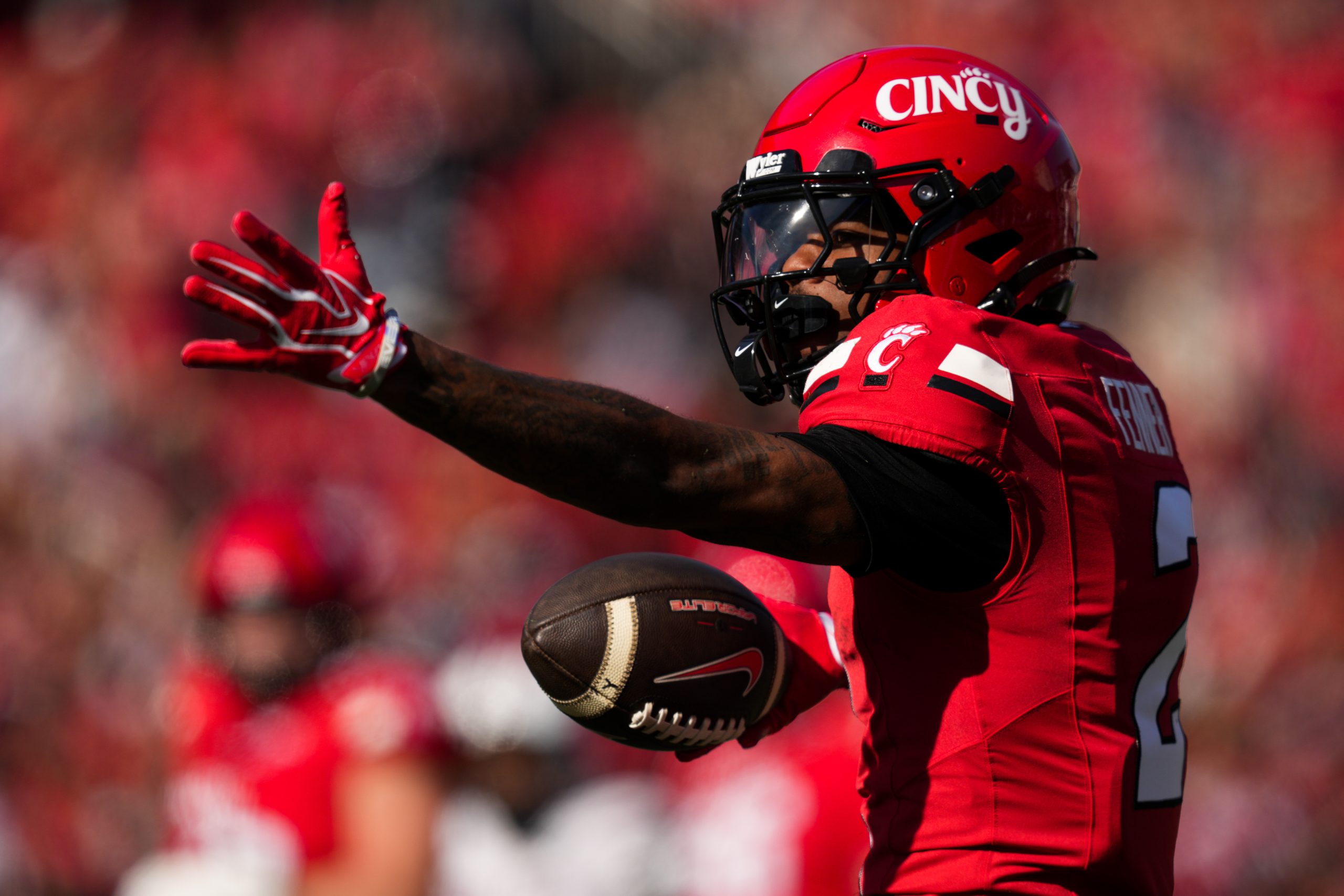
Oct 24, 2026; Cincinnati, Ohio, USA; Cincinnati Bearcats wide receiver Larenzo Fenner (2) gestures a first down after making a catch against the Texas Tech Red Raiders in the second half at Nippert Stadium. Mandatory Credit: Aaron Doster-Imagn Images
Cincinnati did more than end Texas Tech’s perfect season Saturday. The Bearcats established control, absorbed a second-half challenge and finished a game that could change the way their season is viewed.
The 37–24 victory over No. 8 Texas Tech
moved Cincinnati to 5–2 overall and 2–2 in Big 12 play. The Red Raiders fell to 6–1 and 3–1, leaving Nippert Stadium with their championship ambitions intact but significant problems to correct.
For Scott Satterfield, this was a signature result because of what Cincinnati contributed. The Bearcats defended scoring territory, generated explosive rushing plays, and delivered touchdown passes when opportunities appeared.
Texas Tech made mistakes. Cincinnati created difficult situations—and took advantage.
Cincinnati Made Texas Tech Settle
The most revealing detail was how long the Bearcats kept Texas Tech’s offense out of the end zone.
The Red Raiders finished with four field goals and one offensive touchdown, which came with less than a minute remaining. Their other touchdown came on an interception return.
That distinction matters when assessing the final score.
Cincinnati
repeatedly allowed itself to defend another possession without surrendering the kind of damage Texas Tech needed. Moving the ball did not become the same thing as controlling the game.
For an underdog, forcing field goals can preserve an opportunity. For a team building a lead, it can prevent the opponent from recovering quickly enough.
The Bearcats accomplished both.
Their defensive performance gave the offense time to establish itself, then made the advantage increasingly difficult for Texas Tech to erase.
The Second Quarter Changed Everything
Texas Tech led 6–3 after the first quarter. Cincinnati answered with
21 consecutive second-quarter points, taking a
24–6 lead into halftime.
JC French IV supplied the finishing throws.
He connected with Cole Tabb, Malachi Henry and Lyviel Waters for touchdowns during the quarter. The final scoring possession followed an MJ Cannon interception and covered 75 yards in just 26 seconds.
That sequence demonstrated several ways Cincinnati could hurt the Red Raiders.
The Bearcats could sustain a drive. They could capitalize after a takeaway. They could generate enough explosive yardage to score quickly before halftime.
Texas Tech never stabilized the game during that stretch.
A manageable deficit became an 18-point problem, changing the requirements for the entire second half. The Red Raiders now needed touchdowns while also limiting a Cincinnati offense that had found its confidence.
Cole Tabb Gave Cincinnati a Dependable Advantage
Tabb rushed for a
career-high 173 yards on 16 carries
and added a receiving touchdown. His
58-yard touchdown run with 6:06 remaining
supplied the decisive fourth-quarter response.
His performance gave Cincinnati more than an impressive individual total.
A productive running game changes how a defense can respond. It makes aggressive pursuit more costly, creates favorable situations for the quarterback and gives an offense a way to finish when the opponent knows it needs a stop.
Tabb’s explosive plays also prevented Cincinnati from having to execute a long series of successful snaps on every scoring possession.
That matters against a contender. Opportunities can be limited, and an offense must be capable of turning an opening into substantial damage.
Cincinnati’s blocking created space. Tabb converted that space into one of the defining performances of the game.
French Responded After His Own Mistakes
French finished
19 of 30 for 172 yards and a career-high four touchdown passes. He also threw two third-quarter interceptions.
The turnovers briefly gave Texas Tech an opportunity to change the afternoon.
Peyton Morgan returned the first interception 53 yards for a touchdown, cutting Cincinnati’s lead to 24–15 after the failed two-point attempt.
This was an important examination of the Bearcats’ composure.
A team protecting an upset can become consumed by the possibility of losing it. Cincinnati needed its offense to continue making decisions rather than retreating into hesitation.
French eventually found Larenzo Fenner for a
17-yard touchdown, restoring a 31–15 advantage.
That response belongs alongside the touchdown total in evaluating his performance.
French gave Texas Tech opportunities, but he also helped prevent those mistakes from deciding the game. Cincinnati recovered its footing and continued attacking.
Texas Tech’s Problems Went Beyond the Quarterback
Will Hammond passed for
227 yards without a touchdown, while J’Koby Williams rushed for
81 yards on 11 carries.
Those numbers suggest an offense with some productive components. They also underline the central frustration: Texas Tech could not turn enough movement into touchdowns.
Joey McGuire’s staff must examine the entire process.
Protection must hold up in the situations that matter most. The quarterback must recognize pressure and deliver on time. Receivers must provide useful answers. The running game must remain available without allowing the defense to anticipate the next call.
Finishing possessions requires those responsibilities to connect.
Texas Tech also needs to address how it handles an opponent’s successful stretch. The second-quarter scoring burst demanded a stabilizing possession or a defensive stop. The Red Raiders could not provide enough of either.
An unbeaten record does not make a team immune to those moments. Saturday exposed the consequences of failing to manage them.
Why This Matters Beyond Playing Spoiler
Cincinnati recorded its first home victory over an AP
top-10 opponent
since beating Rutgers in 2006.
That gives the result historical significance. Its practical value for the current program is equally important.
Satterfield now has evidence he can show his players: this team can impose itself on a highly ranked conference opponent. It can build a lead, withstand mistakes and produce a finishing play.
That kind of evidence carries more weight than encouragement after a competitive defeat.
The victory also changes Cincinnati’s immediate season. At 5–2, the Bearcats have an opportunity to build a strong finish rather than treating one celebrated afternoon as sufficient.
The next challenge is maintaining the standard. Cincinnati hosts Utah on October 31, providing another substantial conference examination.
A Signature Win Needs a Follow-Up
One result does not establish Cincinnati as a Big 12 championship favorite. It does establish that the Bearcats are capable of beating a contender through their own execution.
Texas Tech must respond by correcting its finishing problems and preventing another difficult stretch from becoming a decisive deficit.
Cincinnati’s task is different: make Saturday’s strengths repeatable.
The Bearcats earned this victory through defensive resistance, explosive rushing and timely passing. Satterfield has a signature win because his team supplied all three—and continued doing enough after the game became uncomfortable.
New Users – Get $350 in Bonus Bets when you wager $5 for 7 days
T&Cs apply
4.6/5
Gambling Problem? Call 1-800-GAMBLER or 1-800-MY-RESET. Call 1-888-789-7777 or visit ccpgg.org/chat (CT). Hope is here. GamblingHelpLineMA.org or call (800) 327-5050 for 24/7 support (MA). Visit www.mdgamblinghelp.org (MD). Call 1-877-8HOPE-NY or text HOPENY (NY). 21+ (18+ DC, WY) and present in select states (for KS, in affiliation with Kansas Star Casino). Find online real money wagering only. Min $5 wager required for 7 consecutive days. $5 free play credit. Bonus issued as non-withdrawable bonus with cash withdrawable bonus with cash withdrawable. Bonus bets which expire 7 days after receipt. Restrictions apply. See terms at sportsbook.fanduel.com. Call 1-877-770-7867 (LA).
Up To $1500 in Bonus Bets Paid Back if your First Bet Does Not Win
T&Cs apply
4.5/5
Gambling problem? Call 1-800-GAMBLER or 1-800-MY-RESET (Available in the US) 877-8-HOPENY or text HOPENY (467369) (NY) 1-800-327-5050 (MA), 1-800-BETS-OFF (IA), 1-800-981-0023 (PR). 21+ only. Please Gamble Responsibly. See BetMGM.com for Terms. First Bet Offer for new customers only (if applicable). Subject to eligibility requirements. Bonus bets are non-withdrawable. In partnership with Kansas Crossing Casino and Hotel. Promotional offers not available in Mississippi, Massachusetts, New York, Ontario, or Puerto Rico.
New DraftKings Customers: Bet $5, Get $200 + 3 Months of NBA League Pass!
T&Cs apply
4.5/5
GAMBLING PROBLEM? CALL 1-800-GAMBLER or 1-800-MY-RESET, (800) 327-5050 or visit gamblinghelplinema.org (MA). Please Gamble Responsibly. 888-789-7777/visit ccpg.org (CT), or visit www.mdgamblinghelp.org (MD), 1-800-981-0023 (PR). 21+ and present in most states. (18+ DC/NH/PR/WY). Void in CAN. Eligibility restrictions apply. On behalf of Boot Hill Casino (KS). Pass-thru of per wager tax may apply in IL. 1 per new Sportsbook customer. $5+ first-time bet req. Max. $200 issued as non-withdrawable Bonus Bets. Stake removed from payout. Reward issued as $50 in Bonus Bets every 7 days via click-to-claim for 21 days. Bonus Bets and click-to-claims expire 7 days (168hrs) after issuance. Terms: dkng.co/offer. Get 1 promo code to redeem a 3-month NBA League Pass subscription, complimentary of DraftKings. Subscription auto-renews monthly at then-current price (currently $16.99/mo); cancel anytime. Terms, restrictions, and eligibility requirements apply. Redeem League Pass by 12/19/26 at 11:59 PM ET. Addt’l terms: support.watch.nba.com/hc/en-us/articles/9165532876183-League-Pass-Terms-of-Use_. Ends 11/29/26 at 11:59 PM ET. Sponsored by DK.
Must be 21+. GAMBLING PROBLEM? CALL 1-800-GAMBLER OR CALL 1-800-MY-RESET, www.mdgamblinghelp.org (MD), (800)-327-5050 or gamblinghelplinema.org (MA), Call (877)8-HOPENY or text HOPENY (467369) (NY), (888) 789-7777 or ccpg.org (CT), morethanagame.nc.gov (NC), 1800gambler.net (WV)
Bet $1 and get double the winnings up to $25 for your next 10 bets
T&Cs apply
4.4/5
21+ New users only. Must register using eligible promo code. First bet after registration must qualify. Max. Bonus Bet: $1,000. Bonus Bet expires 14 days after receipt. Void where prohibited. See Caesars.com/promos for full terms. Gambling Problem? 1-800-GAMBLER (1-800-426-2537)
21+ and present in OH. Gambling Problem? Call 1-800-GAMBLER.
This site is using
Cloudflare
and adheres to the
Google Safe Browsing Program. We adapted
Google's Privacy Guidelines
to keep your data safe at all times.
Close
Ready to Win Big? Join the Elite with Our Sports Betting Deals!
FanDuel Promo
New Users – Get $350 in Bonus Bets when you wager $5 for 7 days
Our Favorite
T&Cs and 21+ apply
Gambling Problem? Call 1-800-GAMBLER or 1-800-MY-RESET. Call 1-888-789-7777 or visit ccpgg.org/chat (CT). Hope is here. GamblingHelpLineMA.org or call (800) 327-5050 for 24/7 support (MA). Visit www.mdgamblinghelp.org (MD). Call 1-877-8HOPE-NY or text HOPENY (NY). 21+ (18+ DC, WY) and present in select states (for KS, in affiliation with Kansas Star Casino). Find online real money wagering only. Min $5 wager required for 7 consecutive days. $5 free play credit. Bonus issued as non-withdrawable bonus with cash withdrawable bonus with cash withdrawable. Bonus bets which expire 7 days after receipt. Restrictions apply. See terms at sportsbook.fanduel.com. Call 1-877-770-7867 (LA).
Code:
Open FanDuel
Get Bonus
BetMGM Promo
Up To $1500 in Bonus Bets Paid Back if your First Bet Does Not Win
Best Slots
T&Cs and 21+ apply
Gambling problem? Call 1-800-GAMBLER or 1-800-MY-RESET (Available in the US) 877-8-HOPENY or text HOPENY (467369) (NY) 1-800-327-5050 (MA), 1-800-BETS-OFF (IA), 1-800-981-0023 (PR). 21+ only. Please Gamble Responsibly. See BetMGM.com for Terms. First Bet Offer for new customers only (if applicable). Subject to eligibility requirements. Bonus bets are non-withdrawable. In partnership with Kansas Crossing Casino and Hotel. Promotional offers not available in Mississippi, Massachusetts, New York, Ontario, or Puerto Rico.
Code:
Open BetMGM
Get Bonus
DraftKings Promo
New DraftKings Customers: Bet $5, Get $200 + 3 Months of NBA League Pass!
Newcomer
T&Cs and 21+ apply
GAMBLING PROBLEM? CALL 1-800-GAMBLER or 1-800-MY-RESET, (800) 327-5050 or visit gamblinghelplinema.org (MA). Please Gamble Responsibly. 888-789-7777/visit ccpg.org (CT), or visit www.mdgamblinghelp.org (MD), 1-800-981-0023 (PR). 21+ and present in most states. (18+ DC/NH/PR/WY). Void in CAN. Eligibility restrictions apply. On behalf of Boot Hill Casino (KS). Pass-thru of per wager tax may apply in IL. 1 per new Sportsbook customer. $5+ first-time bet req. Max. $200 issued as non-withdrawable Bonus Bets. Stake removed from payout. Reward issued as $50 in Bonus Bets every 7 days via click-to-claim for 21 days. Bonus Bets and click-to-claims expire 7 days (168hrs) after issuance. Terms: dkng.co/offer. Get 1 promo code to redeem a 3-month NBA League Pass subscription, complimentary of DraftKings. Subscription auto-renews monthly at then-current price (currently $16.99/mo); cancel anytime. Terms, restrictions, and eligibility requirements apply. Redeem League Pass by 12/19/26 at 11:59 PM ET. Addt’l terms: support.watch.nba.com/hc/en-us/articles/9165532876183-League-Pass-Terms-of-Use_. Ends 11/29/26 at 11:59 PM ET. Sponsored by DK.
Code:
Open DraftKings
Get Bonus
Find out what the legends have to say about sports this week....
New Users – Get $350 in Bonus Bets when you wager $5 for 7 days
Gambling Problem? Call 1-800-GAMBLER or 1-800-MY-RESET. Call 1-888-789-7777 or visit ccpgg.org/chat (CT). Hope is here. GamblingHelpLineMA.org or call (800) 327-5050 for 24/7 support (MA). Visit www.mdgamblinghelp.org (MD). Call 1-877-8HOPE-NY or text HOPENY (NY). 21+ (18+ DC, WY) and present in select states (for KS, in affiliation with Kansas Star Casino). Find online real money wagering only. Min $5 wager required for 7 consecutive days. $5 free play credit. Bonus issued as non-withdrawable bonus with cash withdrawable bonus with cash withdrawable. Bonus bets which expire 7 days after receipt. Restrictions apply. See terms at sportsbook.fanduel.com. Call 1-877-770-7867 (LA).