If the Indiana secondary versus Alabama’s receivers is the headline matchup, then
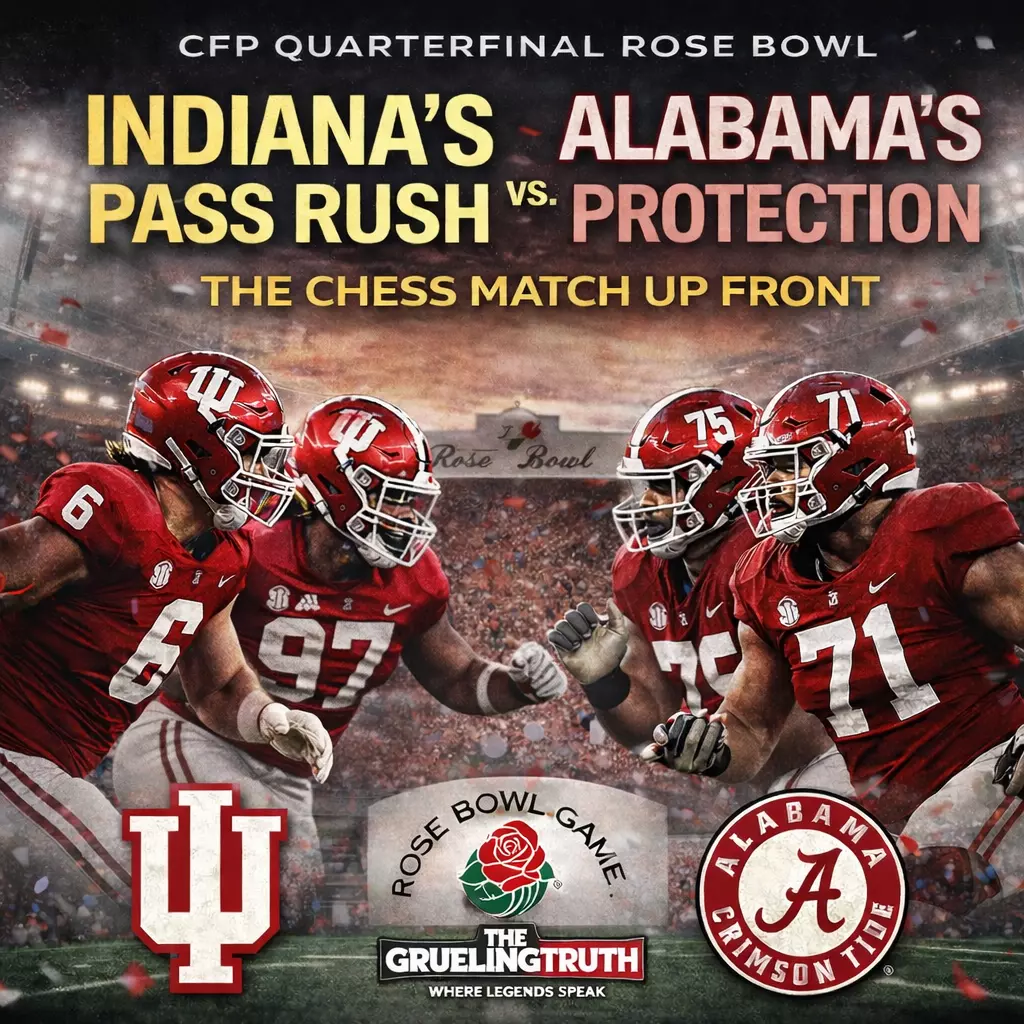
Indiana’s pass rush against Alabama’s protection
is the engine underneath it. One does not exist without the other. Indiana’s defensive backs thrive on hesitation throws; Alabama’s receivers thrive on timing. The battle up front determines which identity survives. Check out part one of our series
Indiana Secondary vs Alabama Wide Receivers.
This is not a matchup defined by one superstar pass rusher or one dominant offensive tackle. It is instead a test of
discipline, depth, and cohesion—exactly the kind of trench fight that often decides Playoff games long before the fourth quarter.
Indiana’s Pass Rush: Pressure by Committee, Not a Single Name
Indiana does not rely on a single edge rusher to wreck games. Instead, the Hoosiers generate pressure through
rotation, alignment variation, and disciplined rush lanes, which is why they’ve consistently forced quarterbacks into uncomfortable pockets rather than reckless scrambles.
What Indiana Does Well
1. Four-Man Pressure with Integrity
Indiana’s base approach is to win with four. The defensive front focuses on:
Keeping rush lanes intact
Collapsing the pocket rather than flying past it
Forcing quarterbacks to throw from a shrinking platform
This matters against Alabama because their quarterback is at his best when he can
step up cleanly and throw on rhythm. Indiana’s interior push is designed specifically to remove that comfort.
2. Stunts and Late Movement, Not All-Out Blitzing
Indiana is selective with blitzes. When they come, they’re often:
Delayed
Disguised
Designed to force protection miscommunication rather than free runners
That approach pairs perfectly with a turnover-driven secondary. Indiana doesn’t need sacks on every dropback—they need
one rushed throw every drive.
3. Depth Over Star Dependence
Indiana rotates defensive linemen frequently. That matters late. Alabama wants to wear defenses down with tempo and balance. Indiana counters by keeping fresh bodies on the field and maintaining effort level into the fourth quarter.
Alabama’s Protection: Talent Meets Communication
Alabama’s offensive line is talented, physical, and battle-tested. But protection in Playoff games is not about raw strength—it’s about
recognition, assignment, and discipline.
What Alabama Does Well
1. Interior Stability
Alabama’s protection strength starts inside. The guards and center are strong at:
Passing off twists
Anchoring against power rushes
Keeping the quarterback’s launch point clean
Indiana’s interior pressure is designed to test exactly that. If Alabama’s interior holds, the Tide’s passing game opens up dramatically.
2. Tackles vs. Discipline, Not Speed Alone
Indiana’s edge rushers are not pure speed merchants. They win with:
Hand placement
Leverage
Patience
That forces Alabama’s tackles to stay technically sound for longer than they want to. Over-setting or chasing speed opens the door for inside counters and delayed pressure.
3. Protection Adjustments Against Disguise
Indiana will show pressure looks that never come and rush looks that arrive late. Alabama’s protection calls must be clean—especially against third-and-medium, where Indiana thrives on confusion.
The Quarterback Factor: The Hidden Variable
This matchup ultimately comes down to how
Alabama’s quarterback handles compressed pockets, not broken ones.
Indiana wants:
The quarterback uncomfortable but upright
Forced to reset his feet
Throwing with bodies around him
That’s when Indiana’s secondary becomes dangerous.
Alabama wants:
A consistent pocket depth
Clear throwing lanes
On-time delivery
If Alabama can keep the quarterback clean for the first 2.5 seconds, their receivers win. If Indiana forces hesitation at that moment, the advantage flips.
Situational Football: Where This Matchup Decides the Game
Third Down
Indiana’s pass rush is at its best on third down because:
Routes take longer
Protection has to hold longer
Disguises matter more
If Indiana wins third down with pressure—not sacks, pressure—Alabama’s explosive plays get limited.
Red Zone
In the red zone, protection windows shrink. Indiana doesn’t need edge pressure here; interior push is enough. Alabama must win one-on-one blocks quickly or settle for field goals.
Late Game
Depth becomes decisive late. Indiana’s rotation up front allows them to keep effort high. Alabama’s protection must stay disciplined when fatigue sets in—one missed assignment late can swing the game.
How This Ties to the Secondary Battle
This pass-rush matchup directly fuels the first article’s theme:
Indiana does not need five sacks. They need
three or four throws that are half a beat late. That’s enough.
Bottom Line
This chess match is about
structure, not spectacle.
Indiana’s pass rush is built to:
Collapse pockets
Force timing disruptions
Complement a ball-hawking secondary
Alabama’s protection is built to:
Stay calm under disguise
Win the interior
Let route talent decide the game
If Alabama protects cleanly, the Tide’s offense looks unstoppable. If Indiana muddies the pocket, the Hoosiers turn this into a turnover-leverage game.
That’s the battle that decides whether this is a shootout—or a grinder that Indiana wants.
New Users – Get $350 in Bonus Bets when you wager $5 for 7 days
T&Cs apply
4.6/5
Gambling Problem? Call 1-800-GAMBLER or 1-800-MY-RESET. Call 1-888-789-7777 or visit ccpgg.org/chat (CT). Hope is here. GamblingHelpLineMA.org or call (800) 327-5050 for 24/7 support (MA). Visit www.mdgamblinghelp.org (MD). Call 1-877-8HOPE-NY or text HOPENY (NY). 21+ (18+ DC, WY) and present in select states (for KS, in affiliation with Kansas Star Casino). Find online real money wagering only. Min $5 wager required for 7 consecutive days. $5 free play credit. Bonus issued as non-withdrawable bonus with cash withdrawable bonus with cash withdrawable. Bonus bets which expire 7 days after receipt. Restrictions apply. See terms at sportsbook.fanduel.com. Call 1-877-770-7867 (LA).
Up To $1500 in Bonus Bets Paid Back if your First Bet Does Not Win
T&Cs apply
4.5/5
Gambling problem? Call 1-800-GAMBLER or 1-800-MY-RESET (Available in the US) 877-8-HOPENY or text HOPENY (467369) (NY) 1-800-327-5050 (MA), 1-800-BETS-OFF (IA), 1-800-981-0023 (PR). 21+ only. Please Gamble Responsibly. See BetMGM.com for Terms. First Bet Offer for new customers only (if applicable). Subject to eligibility requirements. Bonus bets are non-withdrawable. In partnership with Kansas Crossing Casino and Hotel. Promotional offers not available in Mississippi, Massachusetts, New York, Ontario, or Puerto Rico.
New DraftKings Customers: Bet $5, Get $200 + 3 Months of NBA League Pass!
T&Cs apply
4.5/5
GAMBLING PROBLEM? CALL 1-800-GAMBLER or 1-800-MY-RESET, (800) 327-5050 or visit gamblinghelplinema.org (MA). Please Gamble Responsibly. 888-789-7777/visit ccpg.org (CT), or visit www.mdgamblinghelp.org (MD), 1-800-981-0023 (PR). 21+ and present in most states. (18+ DC/NH/PR/WY). Void in CAN. Eligibility restrictions apply. On behalf of Boot Hill Casino (KS). Pass-thru of per wager tax may apply in IL. 1 per new Sportsbook customer. $5+ first-time bet req. Max. $200 issued as non-withdrawable Bonus Bets. Stake removed from payout. Reward issued as $50 in Bonus Bets every 7 days via click-to-claim for 21 days. Bonus Bets and click-to-claims expire 7 days (168hrs) after issuance. Terms: dkng.co/offer. Get 1 promo code to redeem a 3-month NBA League Pass subscription, complimentary of DraftKings. Subscription auto-renews monthly at then-current price (currently $16.99/mo); cancel anytime. Terms, restrictions, and eligibility requirements apply. Redeem League Pass by 12/19/26 at 11:59 PM ET. Addt’l terms: support.watch.nba.com/hc/en-us/articles/9165532876183-League-Pass-Terms-of-Use_. Ends 11/29/26 at 11:59 PM ET. Sponsored by DK.
Must be 21+. GAMBLING PROBLEM? CALL 1-800-GAMBLER OR CALL 1-800-MY-RESET, www.mdgamblinghelp.org (MD), (800)-327-5050 or gamblinghelplinema.org (MA), Call (877)8-HOPENY or text HOPENY (467369) (NY), (888) 789-7777 or ccpg.org (CT), morethanagame.nc.gov (NC), 1800gambler.net (WV)
Bet $1 and get double the winnings up to $25 for your next 10 bets
T&Cs apply
4.4/5
21+ New users only. Must register using eligible promo code. First bet after registration must qualify. Max. Bonus Bet: $1,000. Bonus Bet expires 14 days after receipt. Void where prohibited. See Caesars.com/promos for full terms. Gambling Problem? 1-800-GAMBLER (1-800-426-2537)
21+ and present in OH. Gambling Problem? Call 1-800-GAMBLER.
This site is using
Cloudflare
and adheres to the
Google Safe Browsing Program. We adapted
Google's Privacy Guidelines
to keep your data safe at all times.
Close
Ready to Win Big? Join the Elite with Our Sports Betting Deals!
FanDuel Promo
New Users – Get $350 in Bonus Bets when you wager $5 for 7 days
Our Favorite
T&Cs and 21+ apply
Gambling Problem? Call 1-800-GAMBLER or 1-800-MY-RESET. Call 1-888-789-7777 or visit ccpgg.org/chat (CT). Hope is here. GamblingHelpLineMA.org or call (800) 327-5050 for 24/7 support (MA). Visit www.mdgamblinghelp.org (MD). Call 1-877-8HOPE-NY or text HOPENY (NY). 21+ (18+ DC, WY) and present in select states (for KS, in affiliation with Kansas Star Casino). Find online real money wagering only. Min $5 wager required for 7 consecutive days. $5 free play credit. Bonus issued as non-withdrawable bonus with cash withdrawable bonus with cash withdrawable. Bonus bets which expire 7 days after receipt. Restrictions apply. See terms at sportsbook.fanduel.com. Call 1-877-770-7867 (LA).
Code:
Open FanDuel
Get Bonus
BetMGM Promo
Up To $1500 in Bonus Bets Paid Back if your First Bet Does Not Win
Best Slots
T&Cs and 21+ apply
Gambling problem? Call 1-800-GAMBLER or 1-800-MY-RESET (Available in the US) 877-8-HOPENY or text HOPENY (467369) (NY) 1-800-327-5050 (MA), 1-800-BETS-OFF (IA), 1-800-981-0023 (PR). 21+ only. Please Gamble Responsibly. See BetMGM.com for Terms. First Bet Offer for new customers only (if applicable). Subject to eligibility requirements. Bonus bets are non-withdrawable. In partnership with Kansas Crossing Casino and Hotel. Promotional offers not available in Mississippi, Massachusetts, New York, Ontario, or Puerto Rico.
Code:
Open BetMGM
Get Bonus
DraftKings Promo
New DraftKings Customers: Bet $5, Get $200 + 3 Months of NBA League Pass!
Newcomer
T&Cs and 21+ apply
GAMBLING PROBLEM? CALL 1-800-GAMBLER or 1-800-MY-RESET, (800) 327-5050 or visit gamblinghelplinema.org (MA). Please Gamble Responsibly. 888-789-7777/visit ccpg.org (CT), or visit www.mdgamblinghelp.org (MD), 1-800-981-0023 (PR). 21+ and present in most states. (18+ DC/NH/PR/WY). Void in CAN. Eligibility restrictions apply. On behalf of Boot Hill Casino (KS). Pass-thru of per wager tax may apply in IL. 1 per new Sportsbook customer. $5+ first-time bet req. Max. $200 issued as non-withdrawable Bonus Bets. Stake removed from payout. Reward issued as $50 in Bonus Bets every 7 days via click-to-claim for 21 days. Bonus Bets and click-to-claims expire 7 days (168hrs) after issuance. Terms: dkng.co/offer. Get 1 promo code to redeem a 3-month NBA League Pass subscription, complimentary of DraftKings. Subscription auto-renews monthly at then-current price (currently $16.99/mo); cancel anytime. Terms, restrictions, and eligibility requirements apply. Redeem League Pass by 12/19/26 at 11:59 PM ET. Addt’l terms: support.watch.nba.com/hc/en-us/articles/9165532876183-League-Pass-Terms-of-Use_. Ends 11/29/26 at 11:59 PM ET. Sponsored by DK.
Code:
Open DraftKings
Get Bonus
Find out what the legends have to say about sports this week....
New Users – Get $350 in Bonus Bets when you wager $5 for 7 days
Gambling Problem? Call 1-800-GAMBLER or 1-800-MY-RESET. Call 1-888-789-7777 or visit ccpgg.org/chat (CT). Hope is here. GamblingHelpLineMA.org or call (800) 327-5050 for 24/7 support (MA). Visit www.mdgamblinghelp.org (MD). Call 1-877-8HOPE-NY or text HOPENY (NY). 21+ (18+ DC, WY) and present in select states (for KS, in affiliation with Kansas Star Casino). Find online real money wagering only. Min $5 wager required for 7 consecutive days. $5 free play credit. Bonus issued as non-withdrawable bonus with cash withdrawable bonus with cash withdrawable. Bonus bets which expire 7 days after receipt. Restrictions apply. See terms at sportsbook.fanduel.com. Call 1-877-770-7867 (LA).