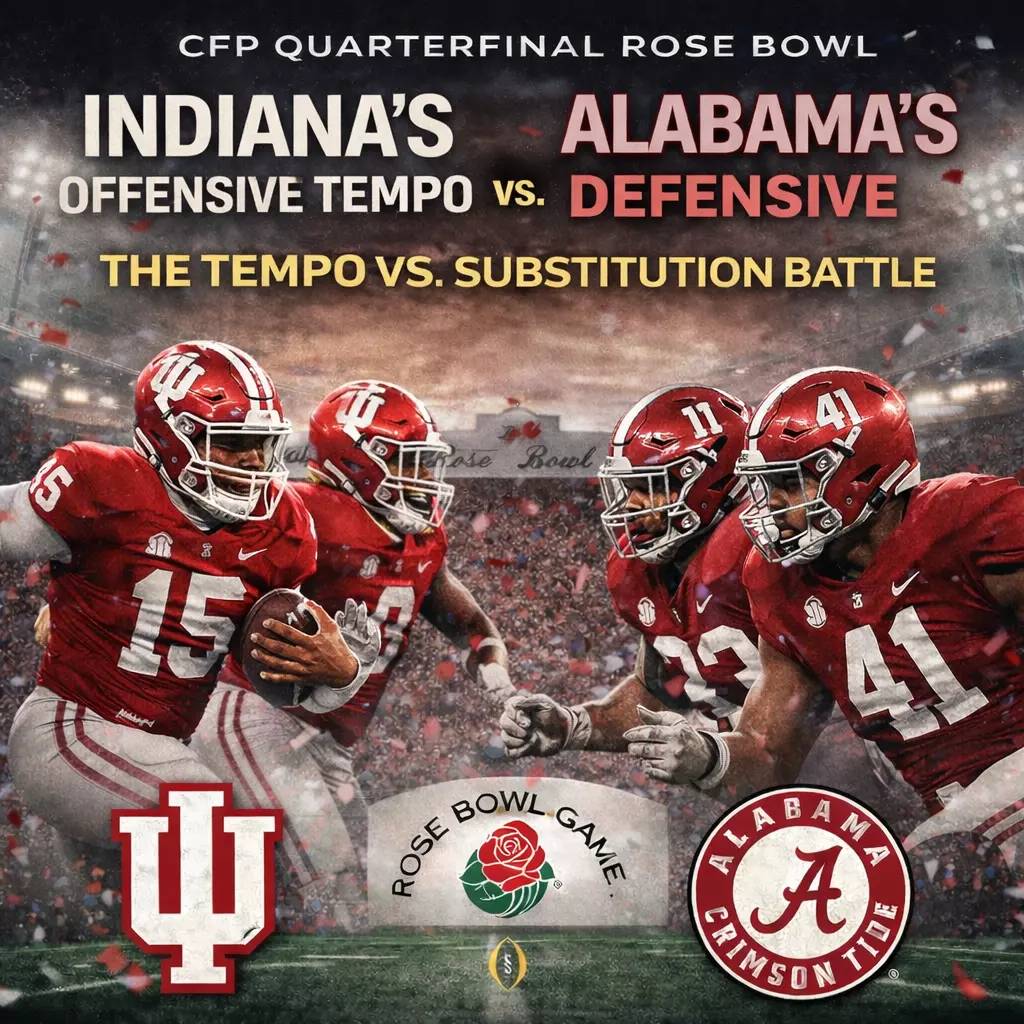
Indiana’s Offensive Tempo vs. Alabama’s Defensive Substitutions
If Indiana’s secondary and pass rush define how the Hoosiers survive Alabama’s firepower, then
Indiana’s offensive tempo versus Alabama’s defensive substitutions
defines whether Indiana can
control
the game.
This matchup is not about trick plays or gimmicks. It is about
pace, personnel stress, and forcing defensive mistakes—the quiet battlefield where underdogs turn elite opponents uncomfortable.
Indiana’s Offensive Tempo: Controlled Pressure, Not Chaos
Indiana’s tempo is often misunderstood. The Hoosiers are not a reckless hurry-up team trying to snap the ball every 12 seconds. Instead, they operate with
situational tempo—speeding up at moments when defenses are most vulnerable and slowing down when control is needed.
What Indiana Does Well
1. Tempo as a Weapon, Not an Identity
Indiana accelerates:
After first downs
After explosive plays
When defenses show confusion or mismatched personnel
This prevents Alabama from freely rotating its defensive front and secondary packages.
2. Personnel Locking
Indiana frequently uses tempo to
trap defenses in unfavorable groupings. Once Alabama substitutes based on formation, Indiana speeds up and:
Forces linebackers to cover in space
Forces pass-rush specialists to defend the run
Prevents situational defensive backs from entering on passing downs
This is where tempo becomes less about speed and more about
control.
3. Formation Variety Without Substitution
Indiana can shift from spread looks to condensed formations without changing personnel. That flexibility allows them to:
Maintain tempo
Prevent defensive counter-substitutions
Force Alabama to defend multiple looks with the same 11 players
Alabama’s Defensive Substitution Model: Depth as a Strength
Alabama’s defense is built around
waves of bodies, not just starters. Their substitution pattern is intentional and effective—when allowed.
What Alabama Wants to Do
1. Rotate the Defensive Front
Alabama prefers to:
Keep defensive linemen fresh
Use pass-rush specialists in obvious passing situations
Maintain interior strength against the run
Tempo disrupts this immediately.
2. Match Personnel with Situation
Alabama’s defensive advantage often comes from:
Bringing in extra defensive backs on passing downs
Heavier fronts on short yardage
Specialized edge defenders late in drives
Indiana’s tempo attacks the
window
between recognition and execution.
3. Communicate Cleanly
Substitution defense requires flawless communication. When tempo removes that margin for error, small mistakes compound:
Misaligned safeties
Late defensive line stunts
Missed gap fits
Indiana does not need busted coverages—they need
one misfit per drive.
Where the Tempo Battle Is Won or Lost
Early Downs
Indiana’s tempo is most dangerous on first and second down. By snapping quickly after moderate gains, they:
Prevent Alabama from resetting its front
Keep base personnel on the field
Force linebackers to play downhill and laterally without rest
If Indiana stays on schedule, tempo becomes sustainable.
After Explosive Plays
Indiana is at its best immediately following chunk plays. Alabama’s instinct is to substitute after giving up an explosive. Indiana counters by snapping before that can happen, catching defenders mid-transition.
This is where Alabama is most vulnerable.
Red Zone Tempo
Inside the 20, tempo compresses communication. Defensive substitutions become harder, and confusion increases. Indiana does not need touchdowns on every trip—but tempo can turn a red-zone stalemate into points.
Alabama’s Counters: How the Tide Fight Back
Alabama is not helpless against tempo. Their counters include:
Keeping hybrid defenders on the field who can handle multiple roles
Using simplified calls to avoid confusion
Deliberately slowing tempo with simulated injuries or late shifts (within the rules)
If Alabama forces Indiana into longer huddles or negative plays, the advantage flips quickly.
Why This Matchup Matters More Than It Looks
Tempo affects everything:
Pass rush effectiveness
Secondary communication
Fatigue late in drives
Fourth-quarter execution
Indiana’s offensive tempo is the
glue
that holds the other matchups together. Without it:
Alabama’s pass rush gets fresh
Defensive substitutions become clean
Indiana’s margin for error shrinks dramatically
With it:
Alabama’s depth advantage narrows
Communication stress rises
One or two mental errors can swing momentum
Bottom Line
Indiana’s offensive tempo is not about playing fast—it’s about
playing smart at speed.
If the Hoosiers can:
Stay on schedule
Use tempo selectively
Lock Alabama into unfavorable defensive personnel
They turn this CFP matchup into a game of
execution and patience, not raw athleticism.
Alabama wants control through rotation and matchup dominance. Indiana wants chaos through timing and denial.
Whichever philosophy wins this chess match will dictate whether Indiana stays within striking distance—or whether Alabama’s depth finally takes over.
Up To $1500 in Bonus Bets Paid Back if your First Bet Does Not Win
T&Cs apply
4.5/5
Gambling problem? Call 1-800-GAMBLER or 1-800-MY-RESET (Available in the US) 877-8-HOPENY or text HOPENY (467369) (NY) 1-800-327-5050 (MA), 1-800-BETS-OFF (IA), 1-800-981-0023 (PR). 21+ only. Please Gamble Responsibly. See BetMGM.com for Terms. First Bet Offer for new customers only (if applicable). Subject to eligibility requirements. Bonus bets are non-withdrawable. In partnership with Kansas Crossing Casino and Hotel. Promotional offers not available in Mississippi, Massachusetts, New York, Ontario, or Puerto Rico.
New DraftKings Customer: SPEND $5, GET $200 IN BONUSES
T&Cs apply
4.5/5
To be eligible for DraftKings Sportsbook and the Promotion, you must be physically located in AR, AZ, CO, CT, DC, IA, IL, IN, KS, KY, LA (select parishes), MA, MD, ME, MI, MO, NC, NJ, NH, NY, OH, OR, PA, PR (residents only), TN, VA, VT, WY, WV, CA-ONT or CA-AB (each an “Eligible Jurisdiction” or, collectively, the “Eligible Jurisdictions”). Must be 21+ years of age or older (18+ if in DC/NH/PR/WY/CA-AB) (19+ in CA-ONT). GAMBLING PROBLEM? CALL 1-800-GAMBLER or 1-800-MY-RESET, (800) 327-5050 or visit gamblinghelplinema.org (MA) Please Gamble Responsibly. 888-789-7777/visit ccpg.org (CT), or visit www.mdgamblinghelp.org (MD), 1-800-981-0023 (PR). 21+ and present in most states. (18+ DC/NH/PR/WY). Void in CAN. Eligibility restrictions apply. On behalf of Boot Hill Casino (KS). Pass-thru of per wager tax may apply in IL. 1 per new DraftKings customer. $5+ first-time bet req. Max. $200 issued as non-withdrawable Bonus Bets. Stake removed from payout. Reward issued as $50 in Bonus Bets every 7 days via click-to-claim for 21 days. Bonus Bets and click-to-claims expire 7 days (168hrs) after issuance. Terms: Promos | DraftKings Sportsbook . Ends 9/20/26 at 11:59 PM ET. Sponsored by DK.
Must be 21+. GAMBLING PROBLEM? CALL 1-800-GAMBLER OR CALL 1-800-MY-RESET, www.mdgamblinghelp.org (MD), (800)-327-5050 or gamblinghelplinema.org (MA), Call (877)8-HOPENY or text HOPENY (467369) (NY), (888) 789-7777 or ccpg.org (CT), morethanagame.nc.gov (NC), 1800gambler.net (WV)
Bet $1 and get double the winnings up to $25 for your next 10 bets
T&Cs apply
4.4/5
21+ New users only. Must register using eligible promo code. First bet after registration must qualify. Max. Bonus Bet: $1,000. Bonus Bet expires 14 days after receipt. Void where prohibited. See Caesars.com/promos for full terms. Gambling Problem? 1-800-GAMBLER (1-800-426-2537)
21+ and present in OH. Gambling Problem? Call 1-800-GAMBLER.
This site is using
Cloudflare
and adheres to the
Google Safe Browsing Program. We adapted
Google's Privacy Guidelines
to keep your data safe at all times.
Close
Ready to Win Big? Join the Elite with Our Sports Betting Deals!
FanDuel Promo
New Users – Get $350 in Bonus Bets when you wager $5 for 7 days
Up To $1500 in Bonus Bets Paid Back if your First Bet Does Not Win
Best Slots
T&Cs and 21+ apply
Gambling problem? Call 1-800-GAMBLER or 1-800-MY-RESET (Available in the US) 877-8-HOPENY or text HOPENY (467369) (NY) 1-800-327-5050 (MA), 1-800-BETS-OFF (IA), 1-800-981-0023 (PR). 21+ only. Please Gamble Responsibly. See BetMGM.com for Terms. First Bet Offer for new customers only (if applicable). Subject to eligibility requirements. Bonus bets are non-withdrawable. In partnership with Kansas Crossing Casino and Hotel. Promotional offers not available in Mississippi, Massachusetts, New York, Ontario, or Puerto Rico.
Code:
Open BetMGM
Get Bonus
DraftKings Promo
New DraftKings Customer: SPEND $5, GET $200 IN BONUSES
Newcomer
T&Cs and 21+ apply
To be eligible for DraftKings Sportsbook and the Promotion, you must be physically located in AR, AZ, CO, CT, DC, IA, IL, IN, KS, KY, LA (select parishes), MA, MD, ME, MI, MO, NC, NJ, NH, NY, OH, OR, PA, PR (residents only), TN, VA, VT, WY, WV, CA-ONT or CA-AB (each an “Eligible Jurisdiction” or, collectively, the “Eligible Jurisdictions”). Must be 21+ years of age or older (18+ if in DC/NH/PR/WY/CA-AB) (19+ in CA-ONT). GAMBLING PROBLEM? CALL 1-800-GAMBLER or 1-800-MY-RESET, (800) 327-5050 or visit gamblinghelplinema.org (MA) Please Gamble Responsibly. 888-789-7777/visit ccpg.org (CT), or visit www.mdgamblinghelp.org (MD), 1-800-981-0023 (PR). 21+ and present in most states. (18+ DC/NH/PR/WY). Void in CAN. Eligibility restrictions apply. On behalf of Boot Hill Casino (KS). Pass-thru of per wager tax may apply in IL. 1 per new DraftKings customer. $5+ first-time bet req. Max. $200 issued as non-withdrawable Bonus Bets. Stake removed from payout. Reward issued as $50 in Bonus Bets every 7 days via click-to-claim for 21 days. Bonus Bets and click-to-claims expire 7 days (168hrs) after issuance. Terms: Promos | DraftKings Sportsbook . Ends 9/20/26 at 11:59 PM ET. Sponsored by DK.
Code:
Open DraftKings
Get Bonus
Find out what the legends have to say about sports this week....