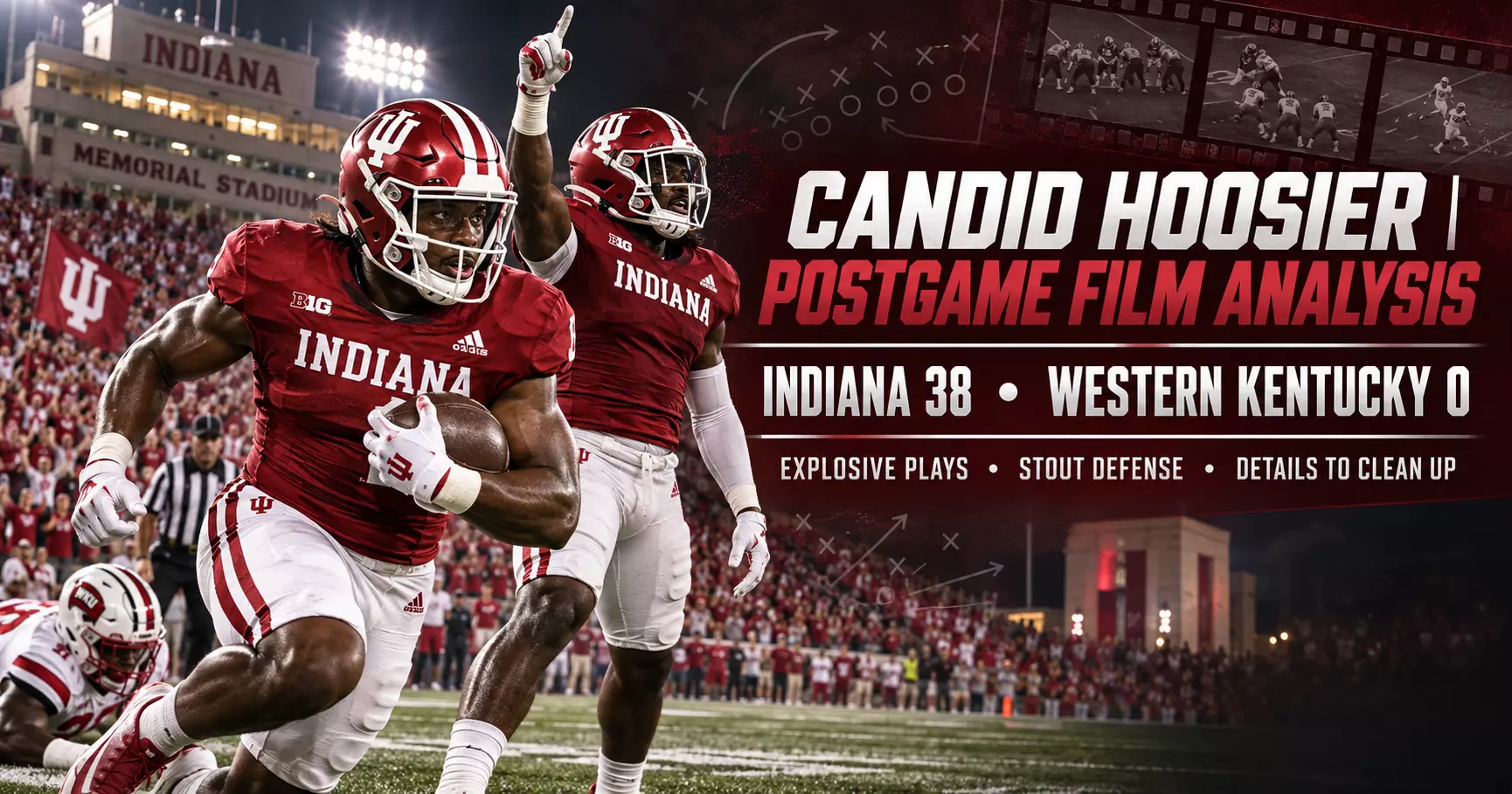
A 38–0 Win, Explosive Plays, Stout Defense, and the Details Still Worth Cleaning Up as the Hoosiers roll into Big ten Play!
Indiana improved to 3–0 with a shutout victory over Western Kentucky this past Saturday. The final score tells one story: Indiana controlled the game and kept WKU off the scoreboard. This was Indiana’s second straight shutout defensively. But the film reveals a more detailed picture of how the Hoosiers generated offense, adjusted defensively at halftime, responded to defensive pressure, and continued developing their identity. From Josh Hoover’s accuracy and decision-making to the offensive line’s inconsistent execution, there were several encouraging developments—and a few areas that still deserve attention.
The biggest takeaway: Indiana showed it can create explosive plays through the air, produce chunk gains on the ground, and finish drives. But there is still room to improve consistency on drives, as the run game, pass protection, and situational downs remain inconsistent. While the defense continues to show that they are strong in the red area, preventing touchdowns, the ability to adjust on the fly remains a strength of Broyles Award Winner Bryant Haines.
Here is my offensive breakdown of the game, drive by drive, with the focus on what the film shows. This is followed by a summary of the defensive performance, and concluding with final thoughts heading into conference play.
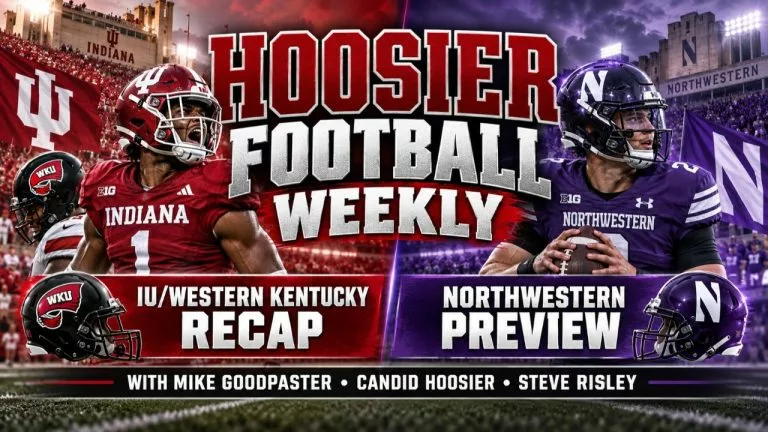
Hoosier football weekly IU/WKU Recap
Hoosier Football Weekly: IU/WKU Recap and northwestern preview
First Half: The offense had answers, but execution was inconsistent
Drive 1 — A slow start
Indiana’s opening possession
highlighted one of the areas I wanted to watch: Run blocking. Are we getting a push and staying engaged? How have the tight ends improved their blocking?
The blocking on the first drive wasn’t good, and then on 3rd and long, Beebe was pushed back into Hoover on the high incompletion intended for Becker. Pressure forced Hoover to throw off his back foot, making the pass sail high over Becker. Indiana was forced to punt. Nothing catastrophic, but the offense didn’t establish the physical presence it wanted early after the defense stopped WKU on their opening drive. This improved in different parts of the game later on.
Drive 2 — Hoover’s processing, delivery, and O-Line inconsistency.
This was one of the more revealing drives of the game. It was also one of Hoover’s best drives of the season. Indiana started backed up and managed to gain three yards against a stacked box. On the next two plays, Hoover delivered back-to-back RPO hitch throws to Marsh and Becker for first downs. Hoover’s reads, footwork, and delivery were excellent. The most impressive throw of the drive came on the 13-yard out to Becker. Hoover placed the ball over the slot defensive back and toward the sideline, allowing Becker to make the toe-tap catch. The play-action completion to Marsh was another example of Hoover’s mechanics. He set his feet, stepped into the throw, and placed the ball between two defenders on an 11-yard hitch. However, the drive also exposed some run game inconsistencies. On second-and-four, IU ran a weak-side zone concept. The offensive line took lateral steps without getting vertical movement. WKU knifed a blitz between Brunner and Lynch, making them cross their zone step paths, and the backside linebacker made the play. On third-and-three, Ajani’s false step and lateral movement allowed the defender to get penetration. The backside hang player made the tackle. The drive ended with an excellent fourth-down touchdown. WKU brought a six-man rush with a linebacker spying the running back, leaving zero coverage behind it. Hoover got the ball out quickly to Chandler for the score. The protection appeared to be a left-slide concept, with the running back responsible for the right side. Smith was late getting to the edge blitzer after initially punching inside. Hoover’s quick release and ability to step up under pressure made the play. The technical takeaway: Indiana’s run-game issues weren’t simply about WKU loading the box. There were individual execution errors, including false steps, poor angles, and insufficient vertical movement (get off and push). Indiana 7, WKU 0.
Drive 3 — A missed opportunity
Indiana opened the drive with a good play-action completion to Marsh in space, followed by an excellent RPO read by Hoover. The linebacker stepped forward into the box, and Hoover threw the slant behind him to Morris for a first down. The pin-and-pull concept produced another positive play, but WKU’s backside pursuit stood out. Number 17, Zsacari Minnis, ran Turbo Richard down from behind. That was an excellent defensive play by Minnis. The run game continued to show flashes. Beebe picked up three yards against a seven-man box after a corner blitz, but following that play, Lynch’s false step on the next inside-zone play created penetration and forced Beebe to cut back for only two yards. On third-and-five, WKU covered well. Hoover worked through his reads, found Preston on the underneath drag, and attempted a difficult throw through a tight window. His feet were wide on his reset, making his shoulders not square to the throw. He had a sidearm delivery that carried over Preston’s head. On fourth-and-five, Hoover missed Marsh behind him, and IU turned the ball over on downs. His mechanics looked fine and looked like a timing issue. He has shown so far that he can make these throws rather consistently. A miss on occasion will happen. The takeaway: The offense created opportunities, but negative plays and execution errors put it in difficult situations.
Drive 4 — Protection held up, but the drive stalled
Hoover opened with an excellent 12-yard out to Becker. The swing screen to Beebe gained only two yards after Schott missed his block. Hoover then narrowly missed Marsh down the sideline, putting the ball in the hole between the corner and the safety, which would have been a possible touchdown opportunity. On third-and-eight, the offensive line and Beebe did a good job picking up the pressure. With no one open, Hoover scrambled for five yards. Indiana punted.
This drive was a reminder that protection can hold up while the offense still struggles to convert third downs. Hoover made the correct decision by not forcing a pass that would have likely been a turnover opportunity for the defense. This creates a field position advantage for Indiana’s defense. He has continued making sound decisions when the initial read isn’t available, which was a concern for national media about Hoover so far in his career.
Drive 5 — The defense creates a short field
Bones Jones’ interception gave Indiana the ball at the WKU three-yard line.
IU went jumbo and scored in two runs, with Beebe finishing the drive. This was exactly what you want to see from a physical offense in a short-yardage situation: get into the heavy personnel, create movement, and finish. This was an area of concern in the first couple of games for Indiana at the start of the 2025 season. This area has been addressed since then.
Halftime: Indiana 14, Western Kentucky 0.
The first half wasn’t
dominant offensively, but IU had a two-score lead, and the defense had created a major scoring opportunity before the half to swing momentum.
Second Half: Explosive plays and better offensive rhythm.
Drive 6 — The run game starts creating chunk plays
Indiana opened the second half with an RPO hitch to the boundary. Hoover delivered a good ball to Becker for a big gain. The next play was a tight bunch formation with Preston, Marsh, and Barker aligned beside C. Smith. From my observation, Marsh and Preston appeared to block the wrong defenders, limiting the play to two yards. Barker’s block was good.
Then came the biggest run of the drive. IU used a draw to Turbo Richard, and the blocking was excellent. Barker delivered a particularly good lead block, washing out the defender, followed by an excellent block and effort by Tyler Morris, allowing Turbo to break off a 31-yard gain.
The goal-line sequence also showed the value of physical blocking. On first-and-goal, Beebe ran downhill behind good work from the offensive line: Barker, Smith, Evans, and Lynch.
IU settled for a field goal after a two-yard run and an incomplete pass to Morris on third-and-goal. I thought this was a good pass by Hoover, but the corner made a great play on the ball. The important point is that the run game was producing chunk plays, but IU still needed more consistency in short-yardage and goal-line execution. I thought that Indiana should’ve run the ball again out of their jumbo package on 3rd and goal instead of the pass play called. You then have an opportunity to run the ball two more times to score on the goal line, and if you don’t get it, then your defense has WKU backed up for a possible safety situation. However, taking points is never a bad thing. Indiana 17, WKU 0.
Drive 7 — Becker’s explosive touchdown
This was the explosive play Indiana needed. Hoover connected with Becker for a 79-yard touchdown, extending the lead to 24-0. The play demonstrated the impact of IU’s vertical passing game. After establishing the run and using short RPO throws to move the chains on the previous drive, Indiana was able to create a major explosive opportunity downfield. Great job by the offensive line with protection, receivers separating, and Hoover delivering the pass. Great job by Becker redirecting his track to catch the ball and sprinting to beat the defender to the pylon. Indiana 24, WKU 0.
Drive 8 — A missed opportunity on third down
IU’s next drive began with Brunner getting beat across his face and not staying engaged on his initial punch, resulting in a one-yard loss. Beebe responded with a five-yard run behind good blocks from Brunner, Ajani, and Gibbs. On third-and-six, Hoover delivered a beautiful back-shoulder fade to Marsh down the sideline. Marsh dropped it, and IU punted.
This is an important distinction in evaluating the offense: the quarterback gave his receiver a catchable opportunity, but the play wasn’t completed due to a drop.
Drive 9 — A complete scoring drive and great execution
This was one of the better offensive possessions of the game. Indiana opened with a well-designed play to Marsh, although Marsh fumbled and recovered the ball. Turbo then gained positive yardage behind a good block from Ajani. On second-and-six, IU ran a pin-and-pull toss concept. Carter Smith delivered an excellent pull and lead block, allowing Turbo to move the chains. Hoover followed with a great 15-yard dig to Preston, setting up first-and-goal. Beebe finished the drive with a touchdown on a split zone. Smith and Evans had excellent get-offs, and Gibbs delivered a strong split block. This was a great drive by the offensive line in both blocking and protection. This drive showcased the variety Indiana can use to move the football: perimeter concepts, pull blocks, intermediate passing, and downhill runs. Indiana 31, WKU 0.
Drive 10 — Negative plays stall the offense
This drive featured several execution issues. IU gained only one yard on first down against an eight-man box. On second down, the bubble to Chandler ended without a gain due to the referee calling him down by his own slip without defensive contact. Hoover then broke off a big run on third down, but it was called back for a holding penalty on Carter Smith. Facing third-and-24 backed up toward Indiana’s goal line, Turbo gained ten yards before IU punted.
The takeaway is straightforward: penalties and negative plays can erase explosive gains and make it difficult to sustain drives.
Drive 11 and 12 — Closing the game
Hoover and Becker were done for the day, and Wilson entered at quarterback.
Indiana leaned on the run game to manage the clock, with Turbo Richard finishing the scoring on a 25-yard touchdown run. Indiana had 121 rushing yards going into the 4th quarter. They then gained 112 yards in the 4th quarter bringing their rushing total to 233 yards for the game.
Final: Indiana 38, Western Kentucky 0.
Offensive analysis
Josh Hoover has overall been efficient, accurate, and still developing timing on some throws. Hoover played well overall. Hoover’s best moments in the game came when he trusted his reads and delivered the ball on time. The back-to-back RPO hitches to Marsh and Becker, the two sideline throws to Becker, the dig to Shazz Preston, the touchdown delayed slant to Chandler, and the intermediate completion to Marsh are examples of strong processing and mechanics. However, the missed fourth-down throw to Marsh on the slant and the missed ball down the sideline to Marsh are examples of working on continued comfort with timing and placement. Hoover finished with 18 completions on 24 attempts for 273 yards, two touchdowns, and no interceptions. The run game has been explosive at times, but not yet consistent.
Indiana showed
it can produce chunk gains with outside zone, pin-and-pull, draws, and split zone. Turbo’s 31-yard draw and 25-yard touchdown were particularly impressive. But the tape also showed false steps, missed blocks, penetration, and inconsistent vertical movement on early down situations. Beebe had 14 attempts for 25 yards (2-yard average) going into the 4th quarter. The next step is turning those flashes into more consistent execution. Indiana was 2-10 on 3rd down in the game. A part of this was being behind the chains due to mishaps in the run game. The receivers continue to show playmaking ability with a few missed opportunities. Becker’s 79-yard touchdown and Marsh’s ability to work multiple alignments showed the value of IU’s receiving group. Shazz Preston, Davion Chandler, and Tyler Morris all contributed to good plays in different spots of the field. At the same time, Marsh’s dropped back-shoulder opportunity and the fumble following this play are reminders that execution matters for everyone, not just Hoover at quarterback. Execution keeps the offense a head of the chains and on schedule, which keeps them out of high-pressure situations.
Defensive and Special Teams Impact
The offense deserves credit for improving in the second half, but the defense helped maintain a lead in the first half while setting the tone to turn the momentum of the game. Bones Jones’ interception created the short field for Beebe’s first-half touchdown. Indiana’s defense held WKU scoreless, while the offense converted that turnover into points. The defensive performance was a major part of the shutout, and Indiana’s ability to generate a short field helped change the game’s momentum. The adjustments by Haines and the staff going into the second half were great. While at the game, it seemed like they were playing more man coverage, but upon review of the film, it was more of a mix of zone and hybrid coverage where they would roll coverage to one side of the field while the corner played man on the weak side. There were more simulated pressures called, which created havoc. Hardy and Jones play best in space and when sent on a rush. They were unleashed in different moments of the second half, which confused the WKU offense, setting them up for negative plays. Haines has an ability to almost control what the opposing offense will do in certain passing situations based on what they show pre-snap versus what happens at the snap of the ball. For example, when the ball was on a hash, the bench side edge player would drop in coverage to play underneath the receiver to that side of the field, and pressure would come with a linebacker and remaining defensive lineman from that side. This would force the quarterback to push towards the short side of the field, limiting options. This would end in a pressure, sack, or throwaway. This was the best game by our safeties this season. Zachman and Ferrell were flying around in coverage and coming up to fill run and pass lanes to make hits. It was relieving to see how Jamari Sharpe played post-injury. He was great in coverage while posting five tackles, one tackle for loss, and one pass breakup. I thought the defensive line stayed in their rush lanes, preventing the WKU quarterback from hurting Indiana with his legs. WKU’s quarterback Brock Glenn finished with 11 rushes for 30 yards. Excellent job by the defense holding WKU to zero points, 4-15 on 3rd down, and 0-3 on 4th down. Additionally, as a unit, the defense recorded one sack, seven tackles for a loss, two pass deflections, and one interception. Special teams also played a role in the overall result. The game wasn’t decided by one unit alone; it was a collective performance that allowed IU to build a lead and control the second half due to a won field position battle.
Final Thoughts
The details matter as Big Ten play begins. Indiana’s 38-0 win over Western Kentucky was a successful result, but the film provides plenty to evaluate.
The positives:
Hoover’s accuracy, decision-making, and delivery with intermediate throws.
Explosive plays in the passing game.
Chunk gains from the run game (Turbo).
Strong short-yardage touchdown execution.
The defense preventing chunk and explosive plays.
Continued improved tackling and alignment.
The defense creating a short field and securing the shutout.
The areas to improve:
False steps and inconsistent run blocking.
Protection communication against pressure.
Third-down execution (20%)
Missed opportunities to extend drives.
The biggest takeaway is that Indiana has multiple ways to move the football and score offensively. The next step is making the execution more consistent in situational downs. 2-10 on 3rd down is not a recipe for success against better competition, particularly against pressure and in short-yardage situations. The defense played well, pitching another shutout while turning up the pressure in the second half with adjustments made by the staff.
The final score was 38-0, but the film shows a team that still has details to clean up before conference play. The advantage that Indiana has that other teams do not –Curt Cignetti, Mike Shanahan, Bryant Haines, and Staff. These gentlemen will get it done, as they have proven time and time again since they arrived on campus in 2024.
3-0. On to Northwestern.
🔴⚪️🦬
Please continue to read, share, and follow Candid Hoosiers analysis on X. Follow @candidhoosier. See Candid Hoosier on Hoosier Football Weekly, Monday evenings, live at 7:30 pm.
Up To $1500 in Bonus Bets Paid Back if your First Bet Does Not Win
T&Cs apply
4.5/5
Gambling problem? Call 1-800-GAMBLER or 1-800-MY-RESET (Available in the US) 877-8-HOPENY or text HOPENY (467369) (NY) 1-800-327-5050 (MA), 1-800-BETS-OFF (IA), 1-800-981-0023 (PR). 21+ only. Please Gamble Responsibly. See BetMGM.com for Terms. First Bet Offer for new customers only (if applicable). Subject to eligibility requirements. Bonus bets are non-withdrawable. In partnership with Kansas Crossing Casino and Hotel. Promotional offers not available in Mississippi, Massachusetts, New York, Ontario, or Puerto Rico.
New DraftKings Customers: Spend $5+ Get $150 in Bonuses
T&Cs apply
4.5/5
GAMBLING PROBLEM? CALL 1-800-GAMBLER or 1-800-MY-RESET, (800) 327-5050 or visit gamblinghelplinema.org (MA). Please Gamble Responsibly. 888-789-7777/visit ccpg.org (CT), or visit www.mdgamblinghelp.org (MD), 1-800-981-0023 (PR). 21+ and present in most states. (18+ DC/NH/PR/WY). Void in CAN. Eligibility restrictions apply. On behalf of Boot Hill Casino (KS). Pass-thru of per wager tax may apply in IL. 1 per new DraftKings customer. $5+ first-time bet req. Max. $150 issued as non-withdrawable Bonus Bets. Stake removed from payout. Reward issued as $50 in Bonus Bets every 7 days via click-to-claim for 14 days. Bonus Bets and click-to-claims expire 7 days (168hrs) after issuance. Terms: sportsbook.draftkings.com/promos. Ends 10/11/26 at 11:59 PM ET. Sponsored by DK.
Must be 21+. GAMBLING PROBLEM? CALL 1-800-GAMBLER OR CALL 1-800-MY-RESET, www.mdgamblinghelp.org (MD), (800)-327-5050 or gamblinghelplinema.org (MA), Call (877)8-HOPENY or text HOPENY (467369) (NY), (888) 789-7777 or ccpg.org (CT), morethanagame.nc.gov (NC), 1800gambler.net (WV)
Bet $1 and get double the winnings up to $25 for your next 10 bets
T&Cs apply
4.4/5
21+ New users only. Must register using eligible promo code. First bet after registration must qualify. Max. Bonus Bet: $1,000. Bonus Bet expires 14 days after receipt. Void where prohibited. See Caesars.com/promos for full terms. Gambling Problem? 1-800-GAMBLER (1-800-426-2537)
21+ and present in OH. Gambling Problem? Call 1-800-GAMBLER.
This site is using
Cloudflare
and adheres to the
Google Safe Browsing Program. We adapted
Google's Privacy Guidelines
to keep your data safe at all times.
Close
Ready to Win Big? Join the Elite with Our Sports Betting Deals!
FanDuel Promo
New Users – Get $250 in Bonus Bets when you wager $5 for 5 days
Up To $1500 in Bonus Bets Paid Back if your First Bet Does Not Win
Best Slots
T&Cs and 21+ apply
Gambling problem? Call 1-800-GAMBLER or 1-800-MY-RESET (Available in the US) 877-8-HOPENY or text HOPENY (467369) (NY) 1-800-327-5050 (MA), 1-800-BETS-OFF (IA), 1-800-981-0023 (PR). 21+ only. Please Gamble Responsibly. See BetMGM.com for Terms. First Bet Offer for new customers only (if applicable). Subject to eligibility requirements. Bonus bets are non-withdrawable. In partnership with Kansas Crossing Casino and Hotel. Promotional offers not available in Mississippi, Massachusetts, New York, Ontario, or Puerto Rico.
Code:
Open BetMGM
Get Bonus
DraftKings Promo
New DraftKings Customers: Spend $5+ Get $150 in Bonuses
Newcomer
T&Cs and 21+ apply
GAMBLING PROBLEM? CALL 1-800-GAMBLER or 1-800-MY-RESET, (800) 327-5050 or visit gamblinghelplinema.org (MA). Please Gamble Responsibly. 888-789-7777/visit ccpg.org (CT), or visit www.mdgamblinghelp.org (MD), 1-800-981-0023 (PR). 21+ and present in most states. (18+ DC/NH/PR/WY). Void in CAN. Eligibility restrictions apply. On behalf of Boot Hill Casino (KS). Pass-thru of per wager tax may apply in IL. 1 per new DraftKings customer. $5+ first-time bet req. Max. $150 issued as non-withdrawable Bonus Bets. Stake removed from payout. Reward issued as $50 in Bonus Bets every 7 days via click-to-claim for 14 days. Bonus Bets and click-to-claims expire 7 days (168hrs) after issuance. Terms: sportsbook.draftkings.com/promos. Ends 10/11/26 at 11:59 PM ET. Sponsored by DK.
Code:
Open DraftKings
Get Bonus
Find out what the legends have to say about sports this week....