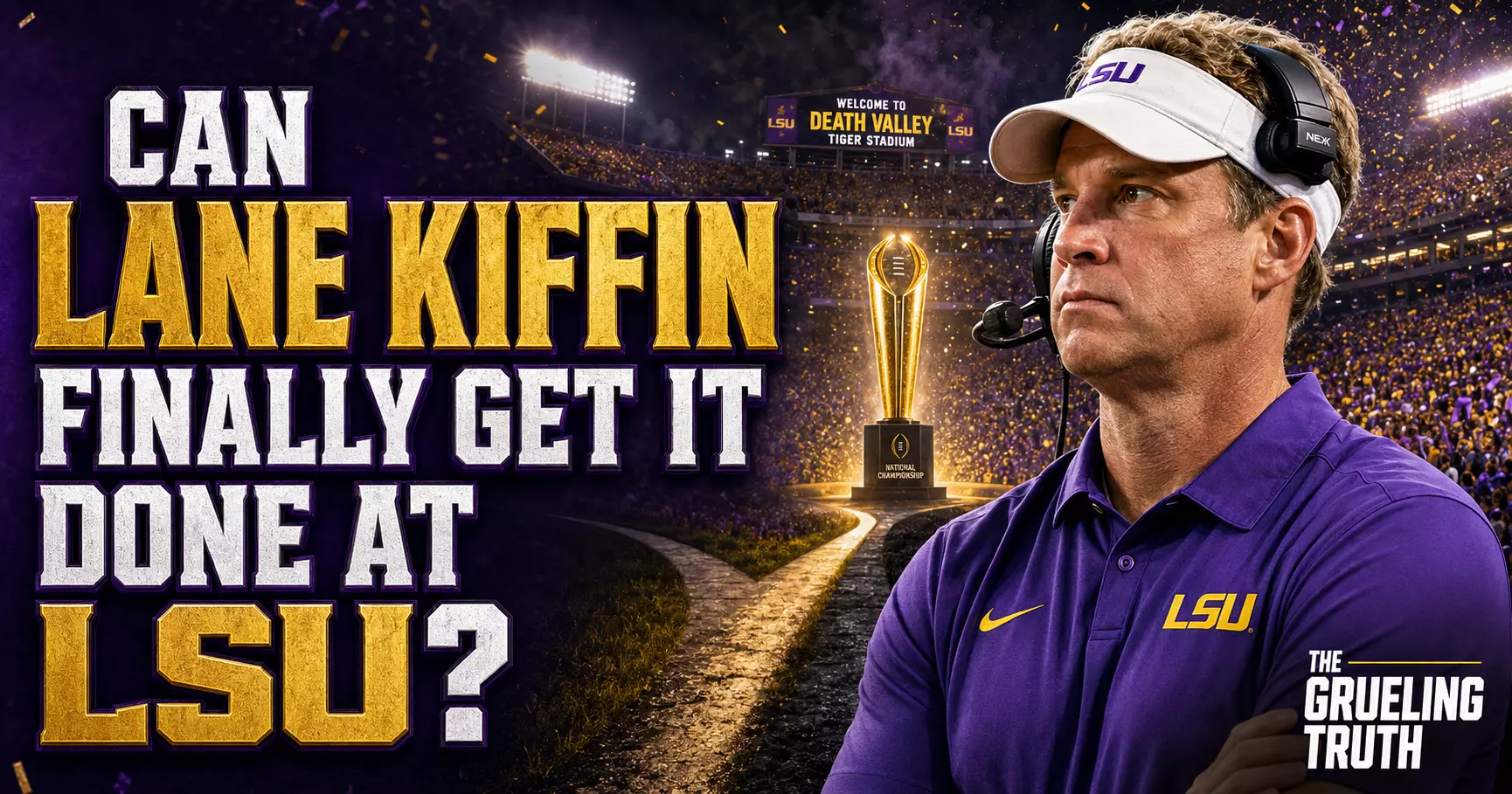
Lane Kiffin has spent most of his coaching career surrounded by attention, expectations and controversy. labeled a Genuis.
Lane Kiffin has spent most of his coaching career surrounded by attention, expectations and controversy. He has been labeled an offensive genius, a coaching prodigy, a social-media provocateur and one of the brightest minds in college football. He has also been fired twice, abandoned Tennessee after one season and left Ole Miss on the eve of the program’s first College Football Playoff appearance.
Kiffin has won plenty of games and rehabilitated a career that once appeared permanently damaged. What he has not done as a head coach is win a championship at the highest level.
That is why his arrival at LSU represents the defining opportunity of his career.
Kiffin no longer works at a program where limited resources, recruiting geography or institutional commitment can be used as explanations for falling short. LSU has elite facilities, a passionate fan base, strong financial support, fertile recruiting territory and a history of winning national championships under multiple coaches.
Everything Kiffin could reasonably want is waiting for him in Baton Rouge. Now he must prove he can turn all his offensive creativity, recruiting success and national attention into something more meaningful than entertaining football.
He must win a national championship.
From Coaching Prodigy to Oakland Disaster
Kiffin’s rapid rise through the coaching profession created expectations that were almost impossible to satisfy.
After working his way through USC’s staff under Pete Carroll, Kiffin became the
Trojans’ offensive coordinator
and helped direct one of the most talented offenses in college football history. His work at USC made him one of the hottest young coaches in the sport.
The Oakland Raiders hired him in 2007 when he was only 31, making him the youngest head coach in the modern NFL at the time. He was given a difficult roster and an unstable organization, but his tenure quickly became a public disaster.
Kiffin went 5-15 before Raiders owner Al Davis fired him four games into his second season. The dismissal included an extraordinary press conference in which Davis called Kiffin a liar and accused him of bringing disgrace to the franchise. Kiffin later challenged the firing, but an arbitrator ruled that the Raiders had cause to dismiss him.
Oakland was dysfunctional long before Kiffin arrived and remained dysfunctional after he departed. Still, the ugly ending established a pattern that would follow him: Kiffin’s coaching stops rarely concluded quietly.
One Season at Tennessee
Tennessee gave Kiffin another major opportunity in 2009. He immediately injected energy into a program that had grown stale during the final years of Phillip Fulmer’s tenure.
Kiffin was brash, aggressive and unafraid to challenge SEC rivals. He publicly traded shots with Urban Meyer, accused Florida of recruiting violations and promised Tennessee fans that the Volunteers would compete with the conference’s best programs.
On the field, Tennessee improved from 5-7 to 7-6. The Volunteers defeated Georgia, South Carolina and Kentucky and came within a blocked field goal of upsetting eventual national champion Alabama.
Kiffin appeared to have Tennessee headed in the right direction. Then USC called.
After only 14 months in Knoxville, Kiffin left Tennessee to replace Carroll. His abrupt departure during the recruiting period infuriated players, fans and administrators. Students gathered outside the football facility, blocked exits and started small fires in protest.
Kiffin had every right to accept his dream job, but the way he departed reinforced the belief that loyalty was secondary to ambition. Tennessee had taken a chance on him immediately after his disastrous Oakland tenure. He repaid that faith by leaving at the first opportunity.
Fired at the Airport
Kiffin’s return to USC initially appeared to validate his decision. He inherited a program facing severe NCAA sanctions, including scholarship reductions and a postseason ban, yet still led the Trojans to a 10-2 record in 2011.
That performance created national championship expectations entering 2012. USC opened the season ranked No. 1, but the Trojans collapsed to 7-6 and became one of the most disappointing teams in the country.
The decline continued into 2013. After USC allowed 62 points in a loss to Arizona State, athletic director Pat Haden fired Kiffin shortly after the team landed at Los Angeles International Airport. Kiffin was removed from the team bus in the early morning hours and informed that his tenure was over.
The “tarmac firing” became one of the most infamous dismissals in college football history. Kiffin later described it as the lowest point of his career.
At that stage, he was no longer regarded as college football’s young genius. He was viewed as an overpromoted coach whose famous last name and offensive reputation had provided opportunities his results did not justify.
Nick Saban Rebuilt Kiffin’s Career
Kiffin’s professional rehabilitation began with Nick Saban at Alabama.
Instead of immediately chasing another head-coaching position, Kiffin accepted the offensive coordinator job in Tuscaloosa. It proved to be one of the smartest decisions of his career.
Kiffin modernized Alabama’s offense, adapted his system to different quarterbacks and helped the Crimson Tide win three consecutive
SEC championships. Alabama also won the 2015 national championship with Kiffin directing the offense.
Working under Saban forced Kiffin to operate within a demanding, disciplined structure. He could not rely on clever play designs or personality alone. He witnessed how a championship program recruited, prepared and held everyone accountable.
The experience restored Kiffin’s credibility. More importantly, it appeared to mature him as a coach.
Florida Atlantic gave him another head-coaching opportunity in 2017, and Kiffin responded by winning two Conference USA championships in three seasons. The success was not enough to prove he could win at the highest level, but it demonstrated that he could build a program and manage a locker room.
Ole Miss then brought him back to the SEC.
Kiffin Proved Himself at Ole Miss—But Did Not Finish the Job
Kiffin’s six seasons at Ole Miss represented the best head-coaching work of his career.
He inherited a program still recovering from NCAA sanctions and transformed it into a consistent national contender. The Rebels won 55 games under Kiffin, including an 11-1 regular season in 2025 that earned the program its first College Football Playoff berth. LSU described him as the coach who turned Ole Miss into a “national powerhouse” when announcing his hiring.
Kiffin made Ole Miss more relevant than it had been in decades. His offenses were creative and explosive, his transfer-portal strategy became a model for other programs, and he proved he could win consistently in the SEC.
But there remained a ceiling.
Kiffin never won the SEC or a national championship at Ole Miss. His teams occasionally struggled in their biggest games, particularly when facing deeper and more physical opponents. Even his greatest season ended without him on the sideline.
After leading Ole Miss to an 11-1 record and a playoff berth in 2025, Kiffin accepted LSU’s offer before the postseason. Ole Miss would not allow him to continue coaching the team after taking another job, leaving Pete Golding to guide the Rebels through the playoff.
Kiffin later expressed regret over how the departure unfolded, although he stood by his decision to accept the LSU position.
Once again, a successful Kiffin tenure ended in controversy. Once again, ambition took him somewhere else before the job was completely finished.
LSU Eliminates the Excuses
Ole Miss is a good football program. LSU is a national championship program.
Nick Saban, Les Miles and Ed Orgeron all won national titles in Baton Rouge. Those coaches possessed different personalities, systems and leadership styles, but each proved that the right coach can win everything at LSU.
The state of Louisiana produces elite high school talent, and LSU is its only major in-state Power Four program. The Tigers can build championship rosters without leaving their own borders. They also recruit nationally, possess enormous NIL resources and now have a head coach regarded as one of the best transfer-portal recruiters in the country.
LSU reportedly gave Kiffin a seven-year, $91 million contract worth approximately $13 million annually. That salary does not purchase patience or gradual improvement. It purchases championship expectations.
Kiffin has already used LSU’s resources to rebuild the roster aggressively. The Tigers landed former Arizona State quarterback Sam Leavitt, the top-rated transfer quarterback in the 2026 portal. Leavitt led Arizona State to a Big 12 championship and playoff appearance in 2024 before an injury interrupted his 2025 season. He has passed for 4,652 yards and 36 touchdowns during his college career while adding 816 rushing yards and ten scores.
Kiffin also added former Colorado offensive tackle Jordan Seaton and edge rusher Princewill Umanmielen as part of a transfer class ranked among the best in the country.
LSU has supplied the quarterback, linemen, defensive talent, facilities and financial resources. Kiffin cannot claim that he is being asked to defeat programs with advantages unavailable to him. He now possesses those advantages.
The Expectations Begin Immediately
LSU enters Kiffin’s first season ranked No. 13 in the preseason Coaches Poll. The Tigers are coming off a 7-5 campaign, but this is not being treated as a traditional rebuild.
The roster was assembled to compete immediately.
LSU opens at home against Clemson before facing Louisiana Tech. The emotion surrounding Kiffin’s arrival will reach its peak in Week 3 when the Tigers travel to Oxford to face Ole Miss.
That game will be personal for everyone involved. Ole Miss players and supporters will want to prove the program was bigger than Kiffin. LSU will want to validate his decision to leave. Kiffin will face the roster he built inside a stadium filled with fans who once celebrated him and now view him as a traitor.
After Ole Miss comes Texas A&M, followed later by games against Tennessee, Alabama and Texas. LSU will face five opponents ranked in the preseason top 25, giving Kiffin numerous opportunities to build a playoff résumé.
Nine victories would represent improvement, but LSU did not make Kiffin one of college football’s highest-paid coaches to win nine games. The minimum acceptable result is playoff contention. Within his first three seasons, the expectation will be an SEC championship and a serious national title run.
Can Kiffin Build a Complete Team?
There has never been much doubt about Kiffin’s ability to design an offense. His play calling creates favorable matchups, simplifies decisions for quarterbacks and forces defenses to defend the entire field.
Kiffin’s best Ole Miss teams were explosive, but they were not always dominant along both lines of scrimmage. In the SEC, an imaginative offense can win ten games. Winning four consecutive postseason games requires depth, defense, special teams, discipline and the ability to survive when the offense is not operating perfectly.
Kiffin must also prove he can manage a program without allowing his personality to become the story. His social-media activity and public trolling can energize fans, but they can also create unnecessary distractions. At Ole Miss, being entertaining helped elevate the program’s national profile. At LSU, entertainment is irrelevant if it does not end with trophies.
Saban gave Kiffin a close look at what championship leadership requires. LSU will reveal how much of that lesson he retained.
This Is Kiffin’s Best—and Perhaps Last—Chance
Kiffin is no longer the 31-year-old prodigy hired by the Raiders or the reckless young coach who abandoned Tennessee. He is an experienced head coach who has endured humiliation, rebuilt his reputation and proven he can construct a nationally relevant program.
That growth deserves recognition.
However, Kiffin’s career still lacks the accomplishment necessary to justify the hype that has followed him for two decades. He has won Conference USA championships, produced outstanding offenses and elevated Ole Miss, but he has never won a Power Four conference title as a head coach. He has never coached his own team in a national championship game.
LSU is his best opportunity to change that—and possibly his last great one.
If Kiffin cannot win at LSU, there will be nowhere else to go with better resources, greater recruiting access or a stronger championship history. He cannot blame NCAA sanctions, an unstable owner, limited finances or the disadvantages of coaching at one of the SEC’s smaller programs.
Everything is finally in place.
Lane Kiffin has spent his career being described as a coach capable of winning a national championship. At LSU, being capable is no longer enough. He must actually do it.
New Users – Get $350 in Bonus Bets when you wager $5 for 7 days
T&Cs apply
4.6/5
Gambling Problem? Call 1-800-GAMBLER or 1-800-MY-RESET. Call 1-888-789-7777 or visit ccpgg.org/chat (CT). Hope is here. GamblingHelpLineMA.org or call (800) 327-5050 for 24/7 support (MA). Visit www.mdgamblinghelp.org (MD). Call 1-877-8HOPE-NY or text HOPENY (NY). 21+ (18+ DC, WY) and present in select states (for KS, in affiliation with Kansas Star Casino). Find online real money wagering only. Min $5 wager required for 7 consecutive days. $5 free play credit. Bonus issued as non-withdrawable bonus with cash withdrawable bonus with cash withdrawable. Bonus bets which expire 7 days after receipt. Restrictions apply. See terms at sportsbook.fanduel.com. Call 1-877-770-7867 (LA).
Up To $1500 in Bonus Bets Paid Back if your First Bet Does Not Win
T&Cs apply
4.5/5
Gambling problem? Call 1-800-GAMBLER or 1-800-MY-RESET (Available in the US) 877-8-HOPENY or text HOPENY (467369) (NY) 1-800-327-5050 (MA), 1-800-BETS-OFF (IA), 1-800-981-0023 (PR). 21+ only. Please Gamble Responsibly. See BetMGM.com for Terms. First Bet Offer for new customers only (if applicable). Subject to eligibility requirements. Bonus bets are non-withdrawable. In partnership with Kansas Crossing Casino and Hotel. Promotional offers not available in Mississippi, Massachusetts, New York, Ontario, or Puerto Rico.
New DraftKings Customers: Bet $5, Get $200 + 3 Months of NBA League Pass!
T&Cs apply
4.5/5
GAMBLING PROBLEM? CALL 1-800-GAMBLER or 1-800-MY-RESET, (800) 327-5050 or visit gamblinghelplinema.org (MA). Please Gamble Responsibly. 888-789-7777/visit ccpg.org (CT), or visit www.mdgamblinghelp.org (MD), 1-800-981-0023 (PR). 21+ and present in most states. (18+ DC/NH/PR/WY). Void in CAN. Eligibility restrictions apply. On behalf of Boot Hill Casino (KS). Pass-thru of per wager tax may apply in IL. 1 per new Sportsbook customer. $5+ first-time bet req. Max. $200 issued as non-withdrawable Bonus Bets. Stake removed from payout. Reward issued as $50 in Bonus Bets every 7 days via click-to-claim for 21 days. Bonus Bets and click-to-claims expire 7 days (168hrs) after issuance. Terms: dkng.co/offer. Get 1 promo code to redeem a 3-month NBA League Pass subscription, complimentary of DraftKings. Subscription auto-renews monthly at then-current price (currently $16.99/mo); cancel anytime. Terms, restrictions, and eligibility requirements apply. Redeem League Pass by 12/19/26 at 11:59 PM ET. Addt’l terms: support.watch.nba.com/hc/en-us/articles/9165532876183-League-Pass-Terms-of-Use_. Ends 11/29/26 at 11:59 PM ET. Sponsored by DK.
Must be 21+. GAMBLING PROBLEM? CALL 1-800-GAMBLER OR CALL 1-800-MY-RESET, www.mdgamblinghelp.org (MD), (800)-327-5050 or gamblinghelplinema.org (MA), Call (877)8-HOPENY or text HOPENY (467369) (NY), (888) 789-7777 or ccpg.org (CT), morethanagame.nc.gov (NC), 1800gambler.net (WV)
Bet $1 and get double the winnings up to $25 for your next 10 bets
T&Cs apply
4.4/5
21+ New users only. Must register using eligible promo code. First bet after registration must qualify. Max. Bonus Bet: $1,000. Bonus Bet expires 14 days after receipt. Void where prohibited. See Caesars.com/promos for full terms. Gambling Problem? 1-800-GAMBLER (1-800-426-2537)
21+ and present in OH. Gambling Problem? Call 1-800-GAMBLER.
This site is using
Cloudflare
and adheres to the
Google Safe Browsing Program. We adapted
Google's Privacy Guidelines
to keep your data safe at all times.
Close
Ready to Win Big? Join the Elite with Our Sports Betting Deals!
FanDuel Promo
New Users – Get $350 in Bonus Bets when you wager $5 for 7 days
Our Favorite
T&Cs and 21+ apply
Gambling Problem? Call 1-800-GAMBLER or 1-800-MY-RESET. Call 1-888-789-7777 or visit ccpgg.org/chat (CT). Hope is here. GamblingHelpLineMA.org or call (800) 327-5050 for 24/7 support (MA). Visit www.mdgamblinghelp.org (MD). Call 1-877-8HOPE-NY or text HOPENY (NY). 21+ (18+ DC, WY) and present in select states (for KS, in affiliation with Kansas Star Casino). Find online real money wagering only. Min $5 wager required for 7 consecutive days. $5 free play credit. Bonus issued as non-withdrawable bonus with cash withdrawable bonus with cash withdrawable. Bonus bets which expire 7 days after receipt. Restrictions apply. See terms at sportsbook.fanduel.com. Call 1-877-770-7867 (LA).
Code:
Open FanDuel
Get Bonus
BetMGM Promo
Up To $1500 in Bonus Bets Paid Back if your First Bet Does Not Win
Best Slots
T&Cs and 21+ apply
Gambling problem? Call 1-800-GAMBLER or 1-800-MY-RESET (Available in the US) 877-8-HOPENY or text HOPENY (467369) (NY) 1-800-327-5050 (MA), 1-800-BETS-OFF (IA), 1-800-981-0023 (PR). 21+ only. Please Gamble Responsibly. See BetMGM.com for Terms. First Bet Offer for new customers only (if applicable). Subject to eligibility requirements. Bonus bets are non-withdrawable. In partnership with Kansas Crossing Casino and Hotel. Promotional offers not available in Mississippi, Massachusetts, New York, Ontario, or Puerto Rico.
Code:
Open BetMGM
Get Bonus
DraftKings Promo
New DraftKings Customers: Bet $5, Get $200 + 3 Months of NBA League Pass!
Newcomer
T&Cs and 21+ apply
GAMBLING PROBLEM? CALL 1-800-GAMBLER or 1-800-MY-RESET, (800) 327-5050 or visit gamblinghelplinema.org (MA). Please Gamble Responsibly. 888-789-7777/visit ccpg.org (CT), or visit www.mdgamblinghelp.org (MD), 1-800-981-0023 (PR). 21+ and present in most states. (18+ DC/NH/PR/WY). Void in CAN. Eligibility restrictions apply. On behalf of Boot Hill Casino (KS). Pass-thru of per wager tax may apply in IL. 1 per new Sportsbook customer. $5+ first-time bet req. Max. $200 issued as non-withdrawable Bonus Bets. Stake removed from payout. Reward issued as $50 in Bonus Bets every 7 days via click-to-claim for 21 days. Bonus Bets and click-to-claims expire 7 days (168hrs) after issuance. Terms: dkng.co/offer. Get 1 promo code to redeem a 3-month NBA League Pass subscription, complimentary of DraftKings. Subscription auto-renews monthly at then-current price (currently $16.99/mo); cancel anytime. Terms, restrictions, and eligibility requirements apply. Redeem League Pass by 12/19/26 at 11:59 PM ET. Addt’l terms: support.watch.nba.com/hc/en-us/articles/9165532876183-League-Pass-Terms-of-Use_. Ends 11/29/26 at 11:59 PM ET. Sponsored by DK.
Code:
Open DraftKings
Get Bonus
Find out what the legends have to say about sports this week....
New Users – Get $350 in Bonus Bets when you wager $5 for 7 days
Gambling Problem? Call 1-800-GAMBLER or 1-800-MY-RESET. Call 1-888-789-7777 or visit ccpgg.org/chat (CT). Hope is here. GamblingHelpLineMA.org or call (800) 327-5050 for 24/7 support (MA). Visit www.mdgamblinghelp.org (MD). Call 1-877-8HOPE-NY or text HOPENY (NY). 21+ (18+ DC, WY) and present in select states (for KS, in affiliation with Kansas Star Casino). Find online real money wagering only. Min $5 wager required for 7 consecutive days. $5 free play credit. Bonus issued as non-withdrawable bonus with cash withdrawable bonus with cash withdrawable. Bonus bets which expire 7 days after receipt. Restrictions apply. See terms at sportsbook.fanduel.com. Call 1-877-770-7867 (LA).