The Cougars finished the regular season 11-1, earned their first appearance in the conference championship game and climbed to No. 11
BYU came painfully close to winning the Big 12 in 2025.
The Cougars finished the regular season 11-1, earned their first appearance in the conference championship game and climbed to No. 11 in the College Football Playoff rankings. Their only regular-season defeat came against Texas Tech, the same opponent waiting for them in Arlington.
Unfortunately, BYU’s opportunity to avenge that loss became a nightmare.
The Cougars scored on their opening possession but surrendered the next 34 points. Four second-half turnovers helped Texas Tech pull away for a 34-7 victory, leaving BYU without a conference championship or
playoff invitation. The Cougars responded by defeating Georgia Tech in the Pop-Tarts Bowl and finishing 12-2, but the championship-game collapse defined an otherwise outstanding season.
BYU enters 2026 with a chance to finish the job. The Cougars return quarterback Bear Bachmeier, Big 12 Offensive Player of the Year LJ Martin and many of their most important defensive players. They also benefit from a favorable conference schedule that does not include Texas Tech, Kansas State or Houston.
The Cougars are no longer an unexpected contender. They are a legitimate conference favorite.
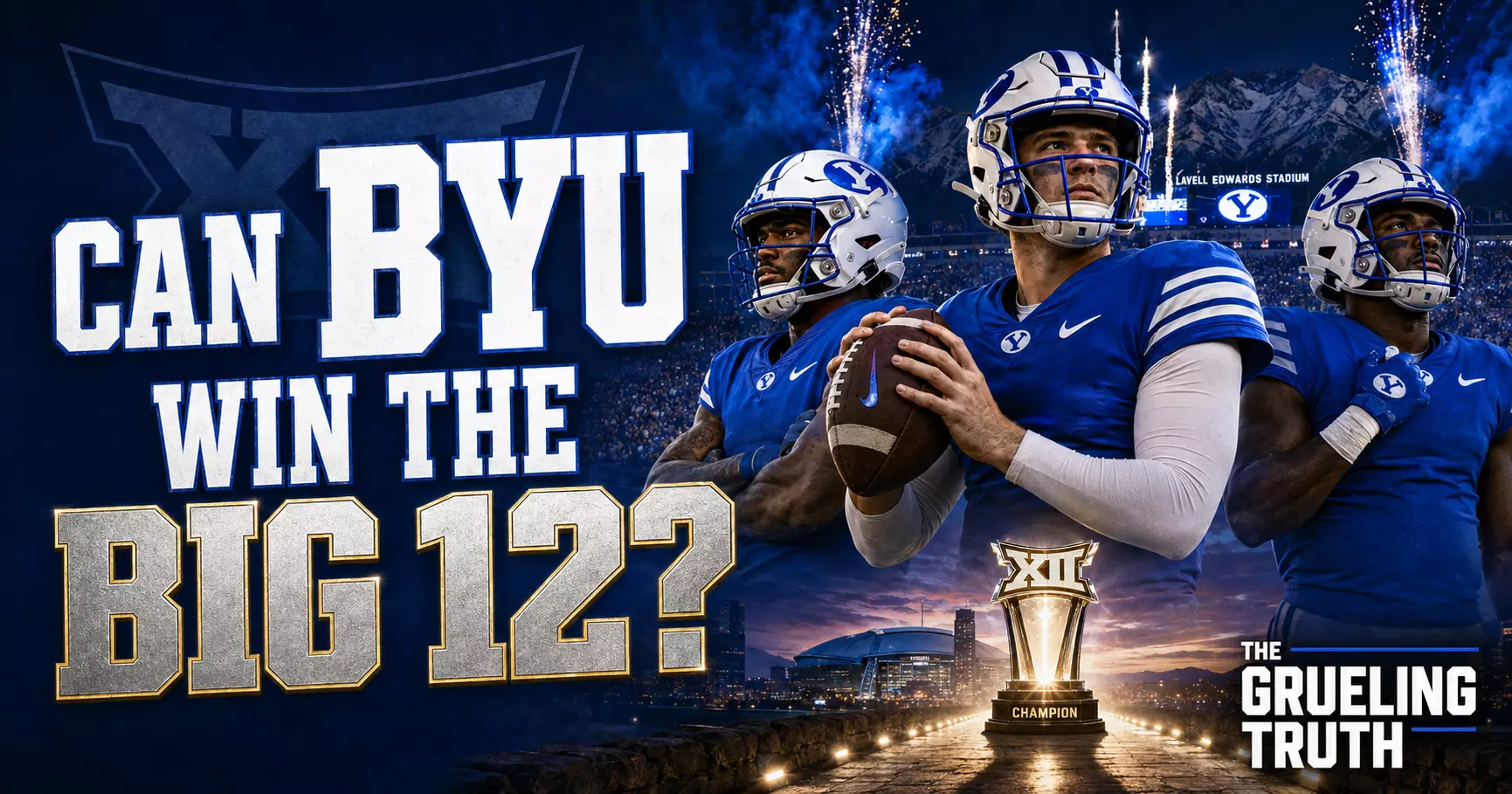
Can BYU win the Big 12?
Absolutely. But reaching Arlington again will require Bachmeier to improve as a passer, the receiving corps to develop quickly and a new defensive coordinator to preserve the identity that made BYU so difficult to beat.
BYU Has Become One of the Big 12’s Best Programs
BYU has won 23 games over the past two seasons, the most of any team in the current 16-member Big 12. That level of consistency matters in a conference where parity creates unpredictable results nearly every week.
The Cougars went 11-2 in 2024 and 12-2 in 2025. Kalani Sitake has developed a program capable of winning close games, handling difficult road environments and overcoming adversity. BYU no longer needs to prove it belongs in the Big 12. The next challenge is proving it can win the conference.
A preseason media poll consisting of reporters who cover all 16 teams placed BYU second behind defending champion Texas Tech. The Red Raiders received 14 first-place votes, while BYU received the other two. Arizona and Houston tied for third, followed by Utah.
That is a fair assessment. Texas Tech deserves to begin as the favorite after defeating BYU twice and winning the 2025 championship. However, BYU may possess the conference’s best combination of quarterback stability, offensive experience, defensive talent and schedule advantage.
The Cougars are not chasing a fantasy. They are trying to move one step beyond what they accomplished last season.
Bear Bachmeier Is the Key
Bear Bachmeier entered the 2025 season as one of the greatest unknowns in college football.
He transferred from Stanford during the summer, missed spring practice and arrived in Provo late. BYU expected to build its offense around veteran quarterback Jake Retzlaff, but an unexpected departure completely changed the plan.
Bachmeier responded by winning the starting job and leading BYU to 12 victories.
He became the Big 12 Offensive Freshman of the Year and the 15th quarterback in school history to pass for at least 3,000 yards in a season. He also provided an important rushing threat, particularly near the goal line and on third down.
What Bachmeier accomplished was remarkable considering how little preparation time he received. He entered his first season still learning the playbook and developing chemistry with his teammates. In 2026, he has completed an entire offseason as the established starter.
That should produce a more confident and complete quarterback.
Bachmeier must improve his deep passing. He completed only 30.2 percent of his throws traveling at least 20 yards downfield, ranking near the bottom among Power Four quarterbacks. He also produced too many turnover-worthy plays when attacking deep coverage.
He cannot remain merely efficient underneath. Championship offenses must punish defenses for crowding the line of scrimmage, especially when those defenses are attempting to slow LJ Martin.
Bachmeier must also protect himself. His physical running style helped BYU convert important downs but resulted in unnecessary punishment. He played through injuries late in the season and was not completely healthy for the conference championship game.
BYU needs his mobility, but it needs him healthy in November even more.
If Bachmeier becomes a more accurate downfield passer and learns when to avoid contact, he could be the best quarterback in the Big 12.
LJ Martin Gives BYU a Championship Foundation
Few teams in the country possess a more dependable offensive player than LJ Martin.
Martin rushed for 1,305 yards and 12 touchdowns in 2025 while averaging 5.5 yards per carry. He also caught 36 passes for 255 yards, demonstrating that he can remain on the field in almost every situation. His performance earned him Big 12 Offensive Player of the Year honors.
Instead of entering the NFL Draft, Martin returned for his senior season.
That decision transformed BYU from a possible contender into one of the conference favorites. Martin gives offensive coordinator Aaron Roderick a proven runner capable of controlling games, wearing down defenses and protecting Bachmeier from having to carry the offense alone.
Martin is at his best when the game becomes physical. He embraces short-yardage situations and runs with the balance to absorb contact without immediately losing momentum. Defenses know he is receiving the ball and still struggle to stop him.
His return also creates opportunities for play-action passes and quarterback runs. Opponents must commit defenders to the box, leaving receivers and tight ends in favorable matchups.
The concern is depth behind him. Sione Moa provides experience, but BYU cannot afford another series of injuries at running back. Martin underwent offseason shoulder surgery and must be managed intelligently throughout the year.
BYU does not need to give him 30 carries against Utah Tech or Colorado State. It needs him healthy for TCU, Arizona State, Utah and a possible championship game.
An Experienced Offensive Line
BYU’s offensive line gives Martin and Bachmeier an excellent chance to succeed.
Center Bruce Mitchell and guards Kyle Sfarcioc and Andrew Gentry return as experienced veterans. BYU also added
Washington transfer Paki Finau
and Stanford transfer Zak Yamauchi to strengthen the group.
Mitchell provides stability in the middle, while Gentry brings extensive experience and NFL-level physical traits. Sfarcioc has played enough football to understand the demands of BYU’s power-running system.
The projected offensive line includes five players with significant college experience. That matters in a conference featuring several aggressive defensive fronts.
The line must improve its performance against Texas Tech. The Red Raiders controlled the line of scrimmage in both meetings last season, limiting BYU to a season-low 200 yards in the championship game. No amount of quarterback development or offensive creativity will matter if the Cougars cannot block the defending champions in a potential rematch.
Against most of the Big 12, however, BYU should be capable of establishing the run and protecting Bachmeier. The Cougars will enter nearly every game believing they can win at the line of scrimmage.
That is a championship trait.
The Receiving Corps Is the Biggest Offensive Question
BYU’s greatest concern is wide receiver.
The Cougars lost their most accomplished pass catchers and then suffered additional offseason attrition. Cody Hagen announced his medical retirement after continued knee problems, thinning a room already searching for new leaders.
Jojo Phillips, Tei Nacua, Tiger Bachmeier, Reggie Frischknecht and Oregon transfer Kyler Kasper are among the players expected to compete for significant roles. The group has size and potential, but it does not possess much proven high-level production.
Phillips could become the primary outside target. At 6-foot-5, he gives Bachmeier a large catch radius and a possible downfield weapon. Kasper also provides excellent size and came to BYU with considerable recruiting pedigree.
Potential will not be enough. At least two receivers must emerge as dependable options before conference play becomes difficult.
The good news is that BYU strengthened the tight end position.
USC transfer Walker Lyons caught 20 passes for 223 yards and two touchdowns last season. His 6-foot-4, 245-pound frame makes him an attractive target in the middle of the field and near the goal line. Oregon transfer Roger Saleapaga gives BYU another large, athletic tight end and creates the possibility of using multiple-tight-end formations.
Those additions fit BYU’s identity. Roderick can create mismatches without asking an inexperienced receiver group to dominate every game.
Still, if BYU falls behind by two touchdowns against an elite defense, someone on the outside must prove capable of changing the game.
A Talented Defense Faces a Major Transition
BYU’s defense ranked 19th nationally in scoring defense and 35th in total defense during the 2025 season. It was physical, opportunistic and particularly effective when games became tight.
Most of the important personnel returns.
Linebacker Isaiah Glasker is one of the best defensive players in the Big 12. His range, instincts and ability to create disruption make him the centerpiece of the defense. Siale Esera returns alongside him, while Cal transfer Cade Uluave adds another experienced playmaker to what the conference’s strongest linebacker unit could be.
Defensive tackle Keanu Tanuvasa gives BYU a proven presence inside. Bodie Schoonover, Hunter Clegg and Tausili Akana provide experience on the edge, while Justin Kirkland returns to strengthen the defensive-line rotation.
The secondary may be just as encouraging. Evan Johnson returns at cornerback, with Tre Alexander III and Mississippi State transfer Jayven Williams providing additional experience. Faletau Satuala and Raider Damuni give BYU two proven safeties.
The personnel is good enough to win the conference.
The uncertainty comes from the coaching booth.
Defensive coordinator Jay Hill left BYU for Michigan after the season, taking defensive pass-game coordinator Jernaro Gilford with him. Sitake promoted Kelly Poppinga to defensive coordinator and restructured the staff.
Poppinga knows the players, the program and BYU’s defensive philosophy. That continuity should make the transition easier than hiring a complete outsider. However, coordinating the entire defense is different from coaching one position group.
BYU cannot afford a major schematic decline. The Cougars won several close games over the past two seasons because their defense produced takeaways and delivered late stops. Poppinga must maintain that aggression without exposing the secondary to unnecessary big plays.
The players are championship caliber. The new defensive structure must prove it is, too.
The Schedule Gives BYU a Real Advantage
BYU’s 2026 schedule is one of the strongest arguments for picking the Cougars to reach Arlington.
The Cougars do not play Texas Tech, Houston, Kansas State, Oklahoma State, Colorado or West Virginia during the regular season. Avoiding Texas Tech is especially important because the Red Raiders defeated BYU twice by a combined score of 63-14 last year.
BYU opens with Utah Tech before hosting Arizona in its Big 12 opener. That September 12 matchup will immediately influence the conference race. Arizona is projected as one of the league’s top teams, but playing in Provo gives BYU a significant advantage.
A road game against Colorado State follows before an open week. The Cougars then travel to TCU and host Iowa State.
Notre Dame visits Provo on October 17 for one of the season’s most anticipated nonconference games. The result will not affect the Big 12 standings, but it could shape BYU’s playoff résumé and physical condition entering the second half of the season.
BYU then travels to UCF before hosting Arizona State. The Cougars visit Utah on November 7 in what will likely be their most emotional game of the season.
The final stretch includes Baylor at home, Kansas on the road and Cincinnati at home.
There are dangerous games, particularly at TCU, UCF, Utah and Kansas. However, BYU avoids the defending champion and receives Arizona, Iowa State, Arizona State, Baylor and Cincinnati in Provo.
The path to seven or eight conference victories is clearly available.
Texas Tech Remains the Standard
Any discussion about BYU winning the Big 12 must begin with Texas Tech.
The Red Raiders
did not merely defeat BYU last season. They dominated the Cougars twice.
Texas Tech won the regular-season meeting 29-7 and the championship game 34-7. In Arlington, the Red Raiders forced four turnovers and limited BYU to only 200 total yards.
Those results established a clear gap between the two teams.
Texas Tech invested heavily in its roster and produced immediate returns. The Red Raiders finished 12-1, won their first Big 12 championship and reached the College Football Playoff.
BYU’s favorable schedule means it may not have to defeat Texas Tech to reach the championship game. But winning the title could eventually require beating the one opponent it could not solve.
Bachmeier was a freshman and played through an injury in the championship game. He should be better prepared in a rematch. BYU’s offensive line is more experienced, and its defense returns several stars.
Even so, the Cougars must develop a plan for Texas Tech’s physical front and aggressive coverage. Running the same offense and hoping for a different result will not be enough.
The Rest of the Big 12 Will Be Dangerous
Texas Tech and BYU may lead the preseason conversation, but the Big 12 rarely follows a predictable script.
Houston is coming off a 10-3 season under Willie Fritz and will be a serious contender. Arizona brings enough talent to challenge for a championship and visits Provo in BYU’s first conference game.
Utah remains dangerous, particularly when facing BYU in Salt Lake City. TCU must replace quarterback Josh Hoover, who transferred to Indiana, but the Horned Frogs still possess enough talent to create problems. Arizona State, Kansas and Kansas State are also capable of beating anyone in the conference.
The Big 12 does not offer many weeks in which a contender can play poorly and survive. BYU must avoid the type of unexpected loss that can create chaos in tiebreaker scenarios.
Reaching the championship game may require an 8-1 conference record. At 7-2, the Cougars could find themselves depending on complicated tiebreakers.
That makes the Arizona opener and November trip to Utah especially important.
What Must Happen for BYU to Win It?
BYU’s championship formula is straightforward.
First, Bachmeier must become a more complete passer. He does not need to throw for 4,000 yards, but he must connect on more deep throws and reduce the burden on Martin.
Second, Martin must remain healthy. He is the player who gives BYU its offensive identity and provides stability when the passing game struggles.
Third, two wide receivers must emerge. The tight ends can carry part of the passing game, but BYU needs outside threats capable of creating explosive plays.
Fourth, Poppinga must preserve the defense’s aggression and discipline. The personnel is experienced enough to remain among the best units in the conference.
Finally, BYU must win its home games. Arizona, Iowa State, Arizona State, Baylor and Cincinnati all visit Provo. An undefeated home conference record would place the Cougars in excellent position to return to Arlington.
The Verdict
BYU can win the Big 12 in 2026.
The Cougars return the conference’s reigning
Offensive Player of the Year, its reigning Offensive Freshman of the Year and several of its best defensive players. They possess an experienced offensive line, a proven head coach and a schedule that avoids the defending champion.
There are legitimate concerns. The receiving corps is inexperienced, Martin’s health must be protected and the defense must adjust to life without Jay Hill. Most importantly, BYU must prove it can compete physically with Texas Tech if the teams meet again.
But BYU is better positioned than almost anyone in the conference.
The Cougars were one victory away last season. They now return a more experienced quarterback, the league’s best running back and a defense filled with veteran talent.
Texas Tech deserves to begin as the favorite. BYU deserves to be considered the most likely challenger.
Prediction: BYU finishes 10-2 overall, goes 8-1 in Big 12 play and returns to the conference championship game. If Bachmeier takes the expected sophomore leap and the receivers develop, the Cougars will not merely return to Arlington.
New Users – Get $350 in Bonus Bets when you wager $5 for 7 days
T&Cs apply
4.6/5
Gambling Problem? Call 1-800-GAMBLER or 1-800-MY-RESET. Call 1-888-789-7777 or visit ccpgg.org/chat (CT). Hope is here. GamblingHelpLineMA.org or call (800) 327-5050 for 24/7 support (MA). Visit www.mdgamblinghelp.org (MD). Call 1-877-8HOPE-NY or text HOPENY (NY). 21+ (18+ DC, WY) and present in select states (for KS, in affiliation with Kansas Star Casino). Find online real money wagering only. Min $5 wager required for 7 consecutive days. $5 free play credit. Bonus issued as non-withdrawable bonus with cash withdrawable bonus with cash withdrawable. Bonus bets which expire 7 days after receipt. Restrictions apply. See terms at sportsbook.fanduel.com. Call 1-877-770-7867 (LA).
Up To $1500 in Bonus Bets Paid Back if your First Bet Does Not Win
T&Cs apply
4.5/5
Gambling problem? Call 1-800-GAMBLER or 1-800-MY-RESET (Available in the US) 877-8-HOPENY or text HOPENY (467369) (NY) 1-800-327-5050 (MA), 1-800-BETS-OFF (IA), 1-800-981-0023 (PR). 21+ only. Please Gamble Responsibly. See BetMGM.com for Terms. First Bet Offer for new customers only (if applicable). Subject to eligibility requirements. Bonus bets are non-withdrawable. In partnership with Kansas Crossing Casino and Hotel. Promotional offers not available in Mississippi, Massachusetts, New York, Ontario, or Puerto Rico.
New DraftKings Customers: Bet $5, Get $200 + 3 Months of NBA League Pass!
T&Cs apply
4.5/5
GAMBLING PROBLEM? CALL 1-800-GAMBLER or 1-800-MY-RESET, (800) 327-5050 or visit gamblinghelplinema.org (MA). Please Gamble Responsibly. 888-789-7777/visit ccpg.org (CT), or visit www.mdgamblinghelp.org (MD), 1-800-981-0023 (PR). 21+ and present in most states. (18+ DC/NH/PR/WY). Void in CAN. Eligibility restrictions apply. On behalf of Boot Hill Casino (KS). Pass-thru of per wager tax may apply in IL. 1 per new Sportsbook customer. $5+ first-time bet req. Max. $200 issued as non-withdrawable Bonus Bets. Stake removed from payout. Reward issued as $50 in Bonus Bets every 7 days via click-to-claim for 21 days. Bonus Bets and click-to-claims expire 7 days (168hrs) after issuance. Terms: dkng.co/offer. Get 1 promo code to redeem a 3-month NBA League Pass subscription, complimentary of DraftKings. Subscription auto-renews monthly at then-current price (currently $16.99/mo); cancel anytime. Terms, restrictions, and eligibility requirements apply. Redeem League Pass by 12/19/26 at 11:59 PM ET. Addt’l terms: support.watch.nba.com/hc/en-us/articles/9165532876183-League-Pass-Terms-of-Use_. Ends 11/29/26 at 11:59 PM ET. Sponsored by DK.
Must be 21+. GAMBLING PROBLEM? CALL 1-800-GAMBLER OR CALL 1-800-MY-RESET, www.mdgamblinghelp.org (MD), (800)-327-5050 or gamblinghelplinema.org (MA), Call (877)8-HOPENY or text HOPENY (467369) (NY), (888) 789-7777 or ccpg.org (CT), morethanagame.nc.gov (NC), 1800gambler.net (WV)
Bet $1 and get double the winnings up to $25 for your next 10 bets
T&Cs apply
4.4/5
21+ New users only. Must register using eligible promo code. First bet after registration must qualify. Max. Bonus Bet: $1,000. Bonus Bet expires 14 days after receipt. Void where prohibited. See Caesars.com/promos for full terms. Gambling Problem? 1-800-GAMBLER (1-800-426-2537)
21+ and present in OH. Gambling Problem? Call 1-800-GAMBLER.
This site is using
Cloudflare
and adheres to the
Google Safe Browsing Program. We adapted
Google's Privacy Guidelines
to keep your data safe at all times.
Close
Ready to Win Big? Join the Elite with Our Sports Betting Deals!
FanDuel Promo
New Users – Get $350 in Bonus Bets when you wager $5 for 7 days
Our Favorite
T&Cs and 21+ apply
Gambling Problem? Call 1-800-GAMBLER or 1-800-MY-RESET. Call 1-888-789-7777 or visit ccpgg.org/chat (CT). Hope is here. GamblingHelpLineMA.org or call (800) 327-5050 for 24/7 support (MA). Visit www.mdgamblinghelp.org (MD). Call 1-877-8HOPE-NY or text HOPENY (NY). 21+ (18+ DC, WY) and present in select states (for KS, in affiliation with Kansas Star Casino). Find online real money wagering only. Min $5 wager required for 7 consecutive days. $5 free play credit. Bonus issued as non-withdrawable bonus with cash withdrawable bonus with cash withdrawable. Bonus bets which expire 7 days after receipt. Restrictions apply. See terms at sportsbook.fanduel.com. Call 1-877-770-7867 (LA).
Code:
Open FanDuel
Get Bonus
BetMGM Promo
Up To $1500 in Bonus Bets Paid Back if your First Bet Does Not Win
Best Slots
T&Cs and 21+ apply
Gambling problem? Call 1-800-GAMBLER or 1-800-MY-RESET (Available in the US) 877-8-HOPENY or text HOPENY (467369) (NY) 1-800-327-5050 (MA), 1-800-BETS-OFF (IA), 1-800-981-0023 (PR). 21+ only. Please Gamble Responsibly. See BetMGM.com for Terms. First Bet Offer for new customers only (if applicable). Subject to eligibility requirements. Bonus bets are non-withdrawable. In partnership with Kansas Crossing Casino and Hotel. Promotional offers not available in Mississippi, Massachusetts, New York, Ontario, or Puerto Rico.
Code:
Open BetMGM
Get Bonus
DraftKings Promo
New DraftKings Customers: Bet $5, Get $200 + 3 Months of NBA League Pass!
Newcomer
T&Cs and 21+ apply
GAMBLING PROBLEM? CALL 1-800-GAMBLER or 1-800-MY-RESET, (800) 327-5050 or visit gamblinghelplinema.org (MA). Please Gamble Responsibly. 888-789-7777/visit ccpg.org (CT), or visit www.mdgamblinghelp.org (MD), 1-800-981-0023 (PR). 21+ and present in most states. (18+ DC/NH/PR/WY). Void in CAN. Eligibility restrictions apply. On behalf of Boot Hill Casino (KS). Pass-thru of per wager tax may apply in IL. 1 per new Sportsbook customer. $5+ first-time bet req. Max. $200 issued as non-withdrawable Bonus Bets. Stake removed from payout. Reward issued as $50 in Bonus Bets every 7 days via click-to-claim for 21 days. Bonus Bets and click-to-claims expire 7 days (168hrs) after issuance. Terms: dkng.co/offer. Get 1 promo code to redeem a 3-month NBA League Pass subscription, complimentary of DraftKings. Subscription auto-renews monthly at then-current price (currently $16.99/mo); cancel anytime. Terms, restrictions, and eligibility requirements apply. Redeem League Pass by 12/19/26 at 11:59 PM ET. Addt’l terms: support.watch.nba.com/hc/en-us/articles/9165532876183-League-Pass-Terms-of-Use_. Ends 11/29/26 at 11:59 PM ET. Sponsored by DK.
Code:
Open DraftKings
Get Bonus
Find out what the legends have to say about sports this week....
New Users – Get $350 in Bonus Bets when you wager $5 for 7 days
Gambling Problem? Call 1-800-GAMBLER or 1-800-MY-RESET. Call 1-888-789-7777 or visit ccpgg.org/chat (CT). Hope is here. GamblingHelpLineMA.org or call (800) 327-5050 for 24/7 support (MA). Visit www.mdgamblinghelp.org (MD). Call 1-877-8HOPE-NY or text HOPENY (NY). 21+ (18+ DC, WY) and present in select states (for KS, in affiliation with Kansas Star Casino). Find online real money wagering only. Min $5 wager required for 7 consecutive days. $5 free play credit. Bonus issued as non-withdrawable bonus with cash withdrawable bonus with cash withdrawable. Bonus bets which expire 7 days after receipt. Restrictions apply. See terms at sportsbook.fanduel.com. Call 1-877-770-7867 (LA).