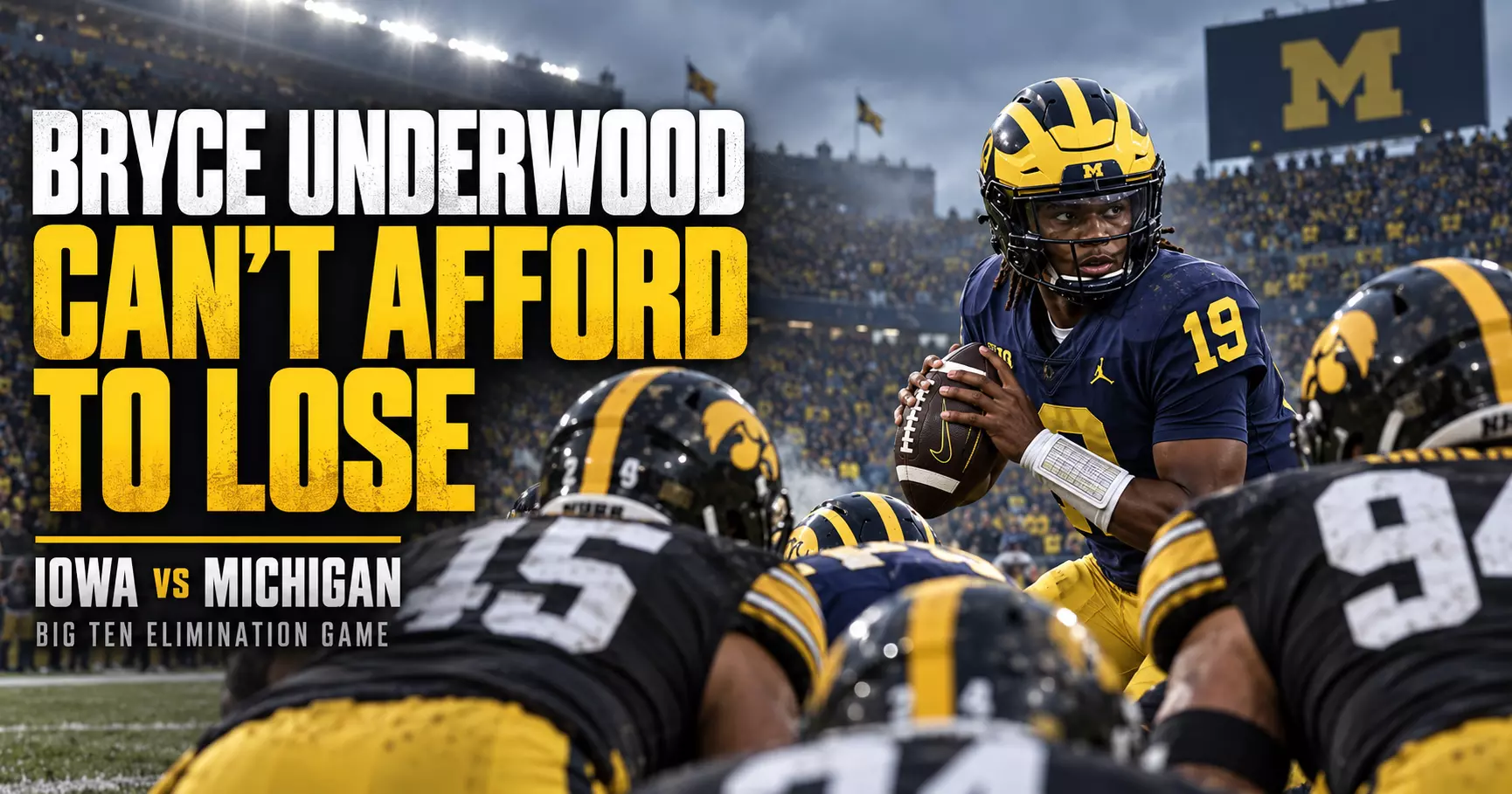
No. 17 Iowa will walk into Michigan Stadium on Saturday carrying something the Hawkeyes have rarely possessed during the Kirk Ferentz era: an offense
No. 17 Iowa will walk into Michigan Stadium on Saturday carrying something the Hawkeyes have rarely possessed during the Kirk Ferentz era: an offense opponents must take seriously.
No. 18 Michigan will counter with Bryce Underwood, one of the most talented quarterbacks in college football, and a defense built to make Iowa look ordinary again.
Both teams are 3–0. Both believe they can contend in the Big Ten. Neither can afford to begin conference play by falling behind defending national champion Indiana, Ohio State, Penn State and the rest of the league’s playoff contenders.
That makes Saturday’s matchup feel like the Big Ten’s first elimination game.
The loser will not be officially removed from championship contention. The expanded playoff provides room for recovery, and one September defeat does not destroy an entire season.
But the margin for error will nearly disappear.
For Underwood and Michigan, the pressure is particularly intense. The Wolverines need their young quarterback to prove that his performance against UTEP represented genuine progress—not another encouraging afternoon against an overmatched opponent.
Iowa’s defense is about to demand an answer. Check out the Week 4
Big Ten Power rankings!
Underwood Finally Looked Comfortable Against UTEP
Underwood delivered his best performance of the season during Michigan’s 52–17 victory over UTEP.
He completed 19 of 25 passes for 223 yards and two touchdowns. He connected with Andrew Marsh 10 times for 105 yards and found J.J. Buchanan seven times for 92 yards. Both receivers caught touchdown passes.
Most importantly, Underwood played with control. He completed 76 percent of his passes, averaged nearly nine yards per attempt and did not throw an interception.
That was an important step after an uneven beginning to the season.
Underwood entered the UTEP game having completed 21 of 39 passes for 281 yards, one touchdown and one interception over Michigan’s first two contests. His physical ability remained obvious, but the offense struggled to create consistent rhythm.
Against UTEP, the Wolverines finally looked more comfortable.
The offensive line protected Underwood, the running game improved, and Michigan’s receivers created dependable targets. Jordan Marshall and Savion Hiter combined for 121 rushing yards and three touchdowns, giving the Wolverines the balance required to keep pressure off their quarterback.
The concern is that Michigan still started slowly.
Underwood and Hiter both fumbled early, allowing UTEP to remain competitive before the Wolverines took control. Michigan could recover from those mistakes because UTEP generated only 150 total yards and converted two of 12 third downs.
Iowa will not be as forgiving.
An early turnover against the Hawkeyes could create the only touchdown Iowa needs to dictate the entire game.
Iowa’s Defense Remains Its Foundation
The arrival of a more functional offense has not changed Iowa’s identity.
The Hawkeyes are still built around defense, discipline and forcing opponents to become impatient.
Through three games, Iowa is allowing approximately 4.3 points and 176.7 yards per game. Opponents are averaging only 2.2 yards per rushing attempt, and the Hawkeyes rank among the national leaders in first downs allowed.
Those statistics came against a manageable nonconference schedule, but Iowa’s defense has already demonstrated its ability to respond under pressure.
Iowa State built a 10–0 advantage in the Cy-Hawk game and found early success with heavy formations. Iowa adjusted and limited the Cyclones to approximately 50 total yards over the final 25 minutes, allowing the Hawkeyes to complete a 16–13 comeback.
That performance looked like vintage Iowa.
The defense did not panic. It prevented the game from escaping, forced Iowa State into difficult situations and gave the offense enough opportunities to recover. Caden Buhr eventually kicked the winning field goal with 15 seconds remaining.
Michigan should expect a similar challenge.
Iowa will attempt to eliminate the running game, force Underwood to remain patient and wait for him to challenge a coverage that only appears open.
The Hawkeyes do not need to sack Underwood repeatedly. They need to make him process every snap and complete long drives without committing a major mistake.
Iowa’s Offense May Finally Be Real
For years, the question surrounding Iowa has been simple: Can the offense provide anything close to adequate support?
The early evidence in 2026 is encouraging.
Iowa produced 640 total yards during its 55–0 victory over Northern Iowa. The Hawkeyes rushed for 422 yards while averaging 10.3 yards per carry.
Three running backs surpassed 100 yards in the same game for the first time since 1983. Xavier Williams finished with 151 yards, Braeden Jackson added 125 yards and two touchdowns, and Nathan McNeil contributed 111 yards.
Starting quarterback Hank Brown completed all 12 of his passes for 153 yards and two touchdowns. Ten Iowa players caught at least one pass, and the Hawkeyes did not commit a turnover.
Nobody should confuse Northern Iowa with Michigan.
The Wolverines possess a powerful defensive front, better athletes at every level and a secondary capable of challenging Iowa’s receivers. The running lanes available last weekend will disappear quickly at Michigan Stadium.
But Iowa’s performance still matters.
The Hawkeyes demonstrated depth at running back, competent quarterback play and the ability to create explosive plays. They also showed that offensive coordinator Tim Lester can adjust his approach to the available personnel.
Brown has completed 72.6 percent of his passes for 473 yards, three touchdowns and no interceptions.
Those are not Heisman numbers. Iowa does not need them to be.
The Hawkeyes need Brown to protect the football, convert manageable third downs and punish Michigan when the Wolverines devote too many defenders to stopping the run.
If he accomplishes those things, Iowa can win.
Michigan’s Defensive Front Must Take Control
The clearest path to a Michigan victory runs through its front seven.
Iowa wants to shorten the game, create favorable down-and-distance situations and prevent Underwood from needing to win a high-scoring contest. Michigan must disrupt that plan immediately.
The Wolverines cannot allow Iowa to average five or six yards on first down. If the Hawkeyes consistently face second-and-4, their entire offense becomes available. They can run in either direction, use play-action and keep Brown away from obvious passing situations.
Michigan must create second-and-9 and third-and-7.
That is when the Wolverines can generate pressure, challenge Iowa’s protection and force Brown to make throws he has not been required to make during the opening three games.
Michigan’s defense limited UTEP to 150 yards and produced consistent disruption at the line of scrimmage. Edge rushers Dom Nichols and John Henry Daley were particularly effective.
The Wolverines need that same aggression against a much more physical opponent.
If
Michigan’s defense
dominates first down, Iowa’s improved offensive numbers will mean very little.
Underwood’s Legs Could Be the Difference
Iowa’s defense is designed to limit conventional offense. Underwood’s athleticism gives Michigan a way to create yards after a play breaks down.
The Michigan quarterback has rushed for 156 yards and two touchdowns on 33 attempts.
Those numbers make him Michigan’s most dangerous offensive variable.
Iowa can cover receivers, defeat blocks and force Underwood away from his initial read. The Hawkeyes must still finish the play.
If Underwood escapes the pocket on third-and-7 and gains nine yards, Iowa’s defense must begin the process again. Several successful scrambles could also force the Hawkeyes to use a defender as a quarterback spy, creating more room in the passing game.
Michigan should use Underwood’s legs strategically.
That does not mean exposing him to repeated designed runs or unnecessary contact. It means moving the pocket, using read-option concepts and allowing him to punish Iowa when its defenders become too aggressive.
Underwood does not need to become Michigan’s leading rusher.
He may need to convert the two or three plays that determine the result.
Hank Brown Must Handle the Big House
Brown has protected the football through the first three games. Saturday will present an entirely different mental challenge.
Michigan Stadium will be loud, especially if the Wolverines create early negative plays. Iowa’s offensive line must communicate, avoid false starts and prevent the environment from turning manageable situations into obvious passing downs.
Brown cannot become frustrated if Iowa begins with several punts.
This game may be decided in the fourth quarter with neither team reaching 20 points. Field position and patience will matter more than total yardage.
Brown must also recognize that Michigan will attempt to bait him into a critical mistake.
The Wolverines know Iowa’s defense can keep the game close. Creating a short field—or scoring directly on defense—may be Michigan’s easiest route to separation.
Brown’s job is not to outshine Underwood.
His job is to avoid providing Michigan with easy points.
The Big Ten Race Creates Immediate Pressure
The Big Ten contains too many playoff contenders for either team to dismiss an early conference defeat.
Indiana is the defending national champion and has opened the season with three dominant victories. Ohio State remains one of the country’s most talented teams despite its loss to Texas. Penn State is undefeated, USC is 4–0, and Oregon still possesses a playoff-caliber roster despite its loss at Oklahoma State.
Iowa’s upcoming schedule makes Saturday even more important.
The Hawkeyes face Ohio State and Washington after leaving Ann Arbor. A loss to Michigan could begin a difficult stretch in which one defeat quickly becomes two or three.
Michigan cannot afford to depend on a future recovery either.
The Wolverines entered the season needing to prove that Underwood’s development and Kyle Whittingham’s arrival could restore them as a national contender. Losing their first conference game at home would immediately weaken that argument.
The winner will leave Saturday at 4–0 with a ranked victory and a legitimate place in the Big Ten race.
The loser will spend the remainder of the season chasing teams that already possess stronger résumés.
Iowa Has Not Won in Ann Arbor Since 2010
History also favors Michigan.
The Wolverines lead the all-time series 45–15–4 and have won the last four meetings. Iowa has not won at Michigan Stadium since 2010. The Wolverines also defeated the Hawkeyes in two Big Ten Championship Games during that period.
Those results do not determine what happens Saturday, but they contribute to the pressure surrounding Iowa.
The Hawkeyes have frequently been competitive against Michigan. They have not consistently generated enough offense to finish the job.
This Iowa team may be better equipped to change that pattern.
The running-back depth is real. Brown has been efficient, and the defense remains capable of controlling a low-scoring game.
The question is whether Iowa’s offense can maintain that progress against a Michigan defense built to expose its limitations.
The Game Will Be Decided by Patience
This does not look like a matchup that will be decided by 50-yard touchdown passes and a final score in the forties.
It looks like a defensive street fight.
Possessions will be limited. Punts will matter. One turnover could be worth more than 100 yards of offense.
Michigan must resist the temptation to force Underwood into becoming a superhero. Iowa wants him to become impatient and challenge tight coverage.
The Wolverines should run the ball, move Underwood and accept that some drives will end without points.
Iowa must follow the same philosophy.
The Hawkeyes cannot abandon the running game if Michigan controls the first quarter. Brown cannot begin forcing throws because Iowa falls behind by one score.
Whichever team remains comfortable playing an uncomfortable game will have the advantage.
Underwood Cannot Afford to Lose This One
Bryce Underwood
is too talented for every Michigan defeat to become his responsibility.
But quarterbacks with his recruiting profile and physical ability are judged by games like this.
Michigan is at home. The Wolverines have the more explosive quarterback and enough defensive talent to control Iowa’s offense. This is the type of game a playoff contender must win.
Underwood does not need spectacular statistics.
He needs to protect the football, extend drives with his legs and deliver two or three important throws against one of the country’s best defenses.
If he does, Michigan can enter October undefeated and positioned as a serious Big Ten contender.
If he struggles and Iowa wins another low-scoring battle, the questions surrounding Michigan’s offense will return immediately.
The Hawkeyes finally appear capable of providing their defense with meaningful support.
Now Underwood must prove Michigan can survive when the opponent refuses to give him anything easily.
Saturday will not officially eliminate either team.
It may tell us which one never truly belonged in the Big Ten championship race.
New Users – Get $350 in Bonus Bets when you wager $5 for 7 days
T&Cs apply
4.6/5
Gambling Problem? Call 1-800-GAMBLER or 1-800-MY-RESET. Call 1-888-789-7777 or visit ccpgg.org/chat (CT). Hope is here. GamblingHelpLineMA.org or call (800) 327-5050 for 24/7 support (MA). Visit www.mdgamblinghelp.org (MD). Call 1-877-8HOPE-NY or text HOPENY (NY). 21+ (18+ DC, WY) and present in select states (for KS, in affiliation with Kansas Star Casino). Find online real money wagering only. Min $5 wager required for 7 consecutive days. $5 free play credit. Bonus issued as non-withdrawable bonus with cash withdrawable bonus with cash withdrawable. Bonus bets which expire 7 days after receipt. Restrictions apply. See terms at sportsbook.fanduel.com. Call 1-877-770-7867 (LA).
Up To $1500 in Bonus Bets Paid Back if your First Bet Does Not Win
T&Cs apply
4.5/5
Gambling problem? Call 1-800-GAMBLER or 1-800-MY-RESET (Available in the US) 877-8-HOPENY or text HOPENY (467369) (NY) 1-800-327-5050 (MA), 1-800-BETS-OFF (IA), 1-800-981-0023 (PR). 21+ only. Please Gamble Responsibly. See BetMGM.com for Terms. First Bet Offer for new customers only (if applicable). Subject to eligibility requirements. Bonus bets are non-withdrawable. In partnership with Kansas Crossing Casino and Hotel. Promotional offers not available in Mississippi, Massachusetts, New York, Ontario, or Puerto Rico.
New DraftKings Customers: Bet $5, Get $200 + 3 Months of NBA League Pass!
T&Cs apply
4.5/5
GAMBLING PROBLEM? CALL 1-800-GAMBLER or 1-800-MY-RESET, (800) 327-5050 or visit gamblinghelplinema.org (MA). Please Gamble Responsibly. 888-789-7777/visit ccpg.org (CT), or visit www.mdgamblinghelp.org (MD), 1-800-981-0023 (PR). 21+ and present in most states. (18+ DC/NH/PR/WY). Void in CAN. Eligibility restrictions apply. On behalf of Boot Hill Casino (KS). Pass-thru of per wager tax may apply in IL. 1 per new Sportsbook customer. $5+ first-time bet req. Max. $200 issued as non-withdrawable Bonus Bets. Stake removed from payout. Reward issued as $50 in Bonus Bets every 7 days via click-to-claim for 21 days. Bonus Bets and click-to-claims expire 7 days (168hrs) after issuance. Terms: dkng.co/offer. Get 1 promo code to redeem a 3-month NBA League Pass subscription, complimentary of DraftKings. Subscription auto-renews monthly at then-current price (currently $16.99/mo); cancel anytime. Terms, restrictions, and eligibility requirements apply. Redeem League Pass by 12/19/26 at 11:59 PM ET. Addt’l terms: support.watch.nba.com/hc/en-us/articles/9165532876183-League-Pass-Terms-of-Use_. Ends 11/29/26 at 11:59 PM ET. Sponsored by DK.
Must be 21+. GAMBLING PROBLEM? CALL 1-800-GAMBLER OR CALL 1-800-MY-RESET, www.mdgamblinghelp.org (MD), (800)-327-5050 or gamblinghelplinema.org (MA), Call (877)8-HOPENY or text HOPENY (467369) (NY), (888) 789-7777 or ccpg.org (CT), morethanagame.nc.gov (NC), 1800gambler.net (WV)
Bet $1 and get double the winnings up to $25 for your next 10 bets
T&Cs apply
4.4/5
21+ New users only. Must register using eligible promo code. First bet after registration must qualify. Max. Bonus Bet: $1,000. Bonus Bet expires 14 days after receipt. Void where prohibited. See Caesars.com/promos for full terms. Gambling Problem? 1-800-GAMBLER (1-800-426-2537)
21+ and present in OH. Gambling Problem? Call 1-800-GAMBLER.
This site is using
Cloudflare
and adheres to the
Google Safe Browsing Program. We adapted
Google's Privacy Guidelines
to keep your data safe at all times.
Close
Ready to Win Big? Join the Elite with Our Sports Betting Deals!
FanDuel Promo
New Users – Get $350 in Bonus Bets when you wager $5 for 7 days
Our Favorite
T&Cs and 21+ apply
Gambling Problem? Call 1-800-GAMBLER or 1-800-MY-RESET. Call 1-888-789-7777 or visit ccpgg.org/chat (CT). Hope is here. GamblingHelpLineMA.org or call (800) 327-5050 for 24/7 support (MA). Visit www.mdgamblinghelp.org (MD). Call 1-877-8HOPE-NY or text HOPENY (NY). 21+ (18+ DC, WY) and present in select states (for KS, in affiliation with Kansas Star Casino). Find online real money wagering only. Min $5 wager required for 7 consecutive days. $5 free play credit. Bonus issued as non-withdrawable bonus with cash withdrawable bonus with cash withdrawable. Bonus bets which expire 7 days after receipt. Restrictions apply. See terms at sportsbook.fanduel.com. Call 1-877-770-7867 (LA).
Code:
Open FanDuel
Get Bonus
BetMGM Promo
Up To $1500 in Bonus Bets Paid Back if your First Bet Does Not Win
Best Slots
T&Cs and 21+ apply
Gambling problem? Call 1-800-GAMBLER or 1-800-MY-RESET (Available in the US) 877-8-HOPENY or text HOPENY (467369) (NY) 1-800-327-5050 (MA), 1-800-BETS-OFF (IA), 1-800-981-0023 (PR). 21+ only. Please Gamble Responsibly. See BetMGM.com for Terms. First Bet Offer for new customers only (if applicable). Subject to eligibility requirements. Bonus bets are non-withdrawable. In partnership with Kansas Crossing Casino and Hotel. Promotional offers not available in Mississippi, Massachusetts, New York, Ontario, or Puerto Rico.
Code:
Open BetMGM
Get Bonus
DraftKings Promo
New DraftKings Customers: Bet $5, Get $200 + 3 Months of NBA League Pass!
Newcomer
T&Cs and 21+ apply
GAMBLING PROBLEM? CALL 1-800-GAMBLER or 1-800-MY-RESET, (800) 327-5050 or visit gamblinghelplinema.org (MA). Please Gamble Responsibly. 888-789-7777/visit ccpg.org (CT), or visit www.mdgamblinghelp.org (MD), 1-800-981-0023 (PR). 21+ and present in most states. (18+ DC/NH/PR/WY). Void in CAN. Eligibility restrictions apply. On behalf of Boot Hill Casino (KS). Pass-thru of per wager tax may apply in IL. 1 per new Sportsbook customer. $5+ first-time bet req. Max. $200 issued as non-withdrawable Bonus Bets. Stake removed from payout. Reward issued as $50 in Bonus Bets every 7 days via click-to-claim for 21 days. Bonus Bets and click-to-claims expire 7 days (168hrs) after issuance. Terms: dkng.co/offer. Get 1 promo code to redeem a 3-month NBA League Pass subscription, complimentary of DraftKings. Subscription auto-renews monthly at then-current price (currently $16.99/mo); cancel anytime. Terms, restrictions, and eligibility requirements apply. Redeem League Pass by 12/19/26 at 11:59 PM ET. Addt’l terms: support.watch.nba.com/hc/en-us/articles/9165532876183-League-Pass-Terms-of-Use_. Ends 11/29/26 at 11:59 PM ET. Sponsored by DK.
Code:
Open DraftKings
Get Bonus
Find out what the legends have to say about sports this week....
New Users – Get $350 in Bonus Bets when you wager $5 for 7 days
Gambling Problem? Call 1-800-GAMBLER or 1-800-MY-RESET. Call 1-888-789-7777 or visit ccpgg.org/chat (CT). Hope is here. GamblingHelpLineMA.org or call (800) 327-5050 for 24/7 support (MA). Visit www.mdgamblinghelp.org (MD). Call 1-877-8HOPE-NY or text HOPENY (NY). 21+ (18+ DC, WY) and present in select states (for KS, in affiliation with Kansas Star Casino). Find online real money wagering only. Min $5 wager required for 7 consecutive days. $5 free play credit. Bonus issued as non-withdrawable bonus with cash withdrawable bonus with cash withdrawable. Bonus bets which expire 7 days after receipt. Restrictions apply. See terms at sportsbook.fanduel.com. Call 1-877-770-7867 (LA).