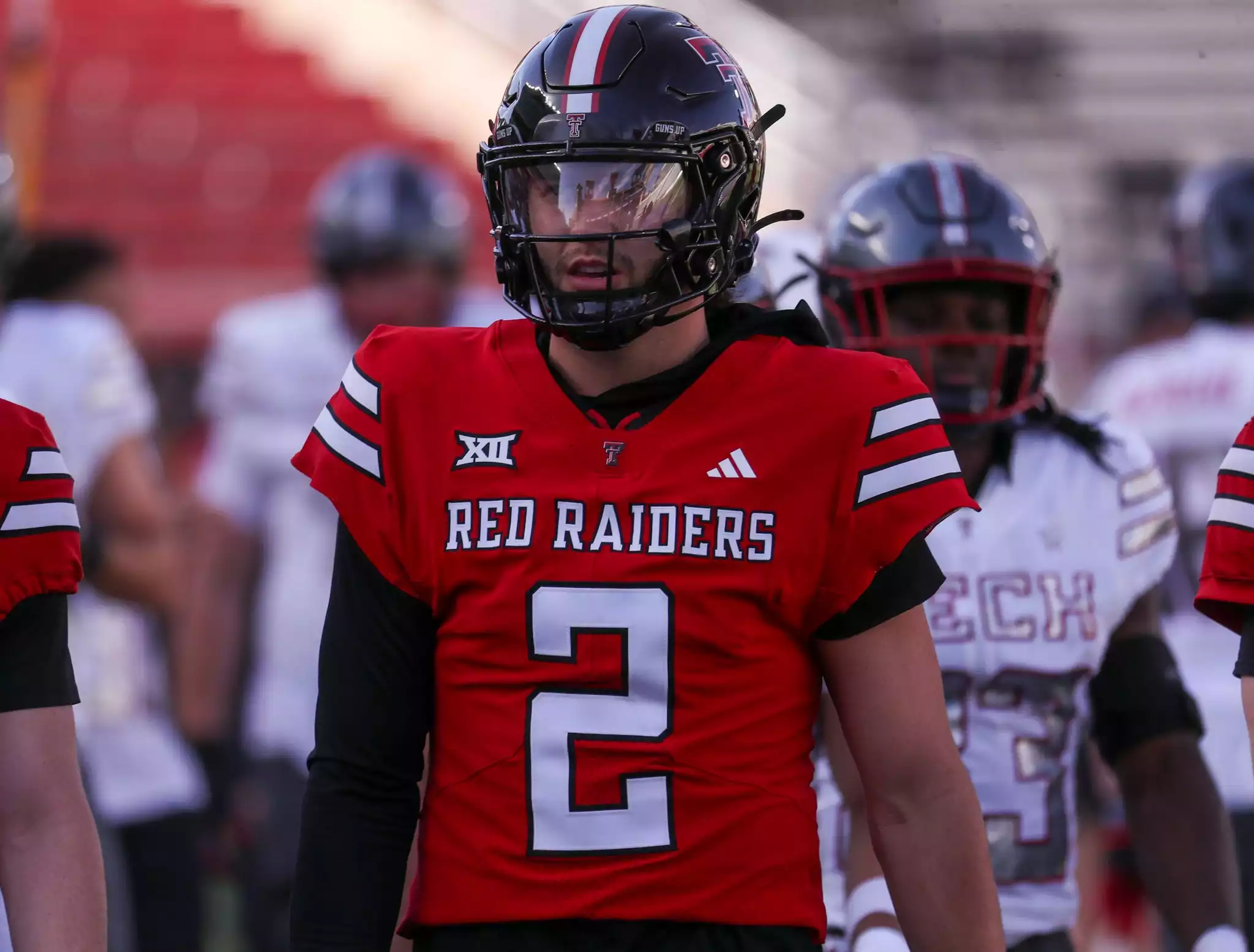
Texas Tech's Brendan Sorsby looks on during the spring football game, Friday, April 17, 2026, at Jones AT&T Stadium.
The college football world was rocked on Monday when a Texas judge granted Texas Tech quarterback Brendan Sorsby a temporary injunction against the NCAA, restoring his eligibility for the 2026 season despite his admitted involvement in sports gambling. The ruling allows Sorsby to play for the Red Raiders this fall while the legal battle continues, although he will serve a two-game suspension.
For those unfamiliar with the case, Sorsby admitted to placing thousands of sports wagers totaling roughly $90,000 over a four-year period. Court documents revealed that some of those bets involved college football, including wagers on Indiana football while he was a member of the program and on the Cincinnati Bearcats, where he started last season. The NCAA ruled him permanently ineligible, arguing that gambling on college sports—especially involving a player’s own team—strikes at the heart of competitive integrity.
Lubbock County Judge Ken Curry ruled that Sorsby would suffer “irreparable harm” if he were prevented from playing during the 2026 season. The injunction prohibits the NCAA from blocking Sorsby’s participation while the broader case proceeds through the courts.
The ruling immediately ignited fierce debate throughout college athletics.
The NCAA has built much of its modern gambling policy around the idea that betting on games involving your own team is the ultimate line that cannot be crossed. Professional sports have historically treated similar violations with extreme severity. The concern is obvious: even if a player never alters the outcome of a game, public confidence in competition can be damaged when athletes are involved in gambling activity connected to the sport they play.
Critics of the ruling argue that allowing Sorsby to play creates a dangerous precedent. If courts begin overturning NCAA gambling penalties, the association’s ability to enforce integrity rules could be severely weakened. Several athletic directors and administrators across college football have already expressed concerns about the long-term consequences of the decision.
Supporters of Sorsby point to another side of the story.
Sorsby’s legal team argued that he has acknowledged his mistakes, entered treatment for gambling addiction, and taken significant steps toward rehabilitation. According to court filings and public statements, he has participated in treatment programs and counseling while attempting to rebuild his career. The court apparently found those efforts compelling enough to justify temporary relief.
What makes this case especially fascinating is that it may represent another chapter in the ongoing erosion of NCAA authority. Over the past several years, courts have repeatedly sided with athletes in disputes involving transfers, NIL rights, eligibility rules, and conference movement. Many observers believe the Sorsby decision is another example of judges becoming increasingly willing to challenge NCAA enforcement actions.
The NCAA has already filed an appeal and intends to continue fighting the decision. As a result, this story is far from over.
For Texas Tech, the immediate impact is clear. One of the nation’s most talented quarterbacks remains available for the 2026 season. For the NCAA, however, the implications could be far more significant.
This case is no longer just about Brendan Sorsby.
It’s about whether the NCAA still has the power to enforce some of its most fundamental rules—and whether the courts are willing to let it.
Did Cincinnati know that Sorsby was betting on games last season?
During his two years in Cincinnati, Sorsby is alleged to have wagered more than $60,000 on a FanDuel account belonging to his brother-in-law that was accessed by Sorsby and a friend. In total, Sorsby was said to have placed at least 165 bets on college and pro sports throughout his time at UC.
Additionally, after Sorsby transferred to Texas Tech earlier this year, he is then alleged to have continued to regularly gamble by indirectly placing wagers on accounts that belonged to two of his friends. He sent a total of $5,000 to the friends, who then placed bets on his behalf on the PGA Tour, NBA and MLB.
Sorsby was ESPN’s No. 1 player in the
NCAA transfer portal
rankings this year, and was expected to have been one of the sport’s highest-paid players at $5 million during the 2026 football season prior to being suspended.
Why would Texas Tech even want this player on the team? That’s easy it’s too late to replace him and winning is all that matters at Texas Tech. For years Red Raiders fans have accused the University of Texas of doing shady things to win, but when it comes down to it the Red Raiders and their fans are okay with doing it themselves to win. Texas Tech now has a big cross on their chest as a program that will do anything to win. Don’t get me wrong many other teams do as well but gambling is something that cannot be allowed to continue if College Football wants to continue as a mainstream sport with massive popularity.
People will say that Sorsby is young and made a mistake, but that is nothing but pure bullshit! This is a grown man who is already set to make millions of dollars he should own up to his mistake and pay for it like others have. Truth be told he is a good college Quarterback and that’s it. I highly doubt an NFL team will want him after his Senior season. If he was an elite talent, I am sure they would overlook this, but he is good not elite. If he plays it sends the wrong message to every other Football player in this country. Texas Tech has shown it is incapable of doing the right thing, so they need to be made to do the right thing. If not, these will have serious consequences for all of College Football.
Up To $1500 in Bonus Bets Paid Back if your First Bet Does Not Win
T&Cs apply
4.5/5
Gambling problem? Call 1-800-GAMBLER or 1-800-MY-RESET (Available in the US) 877-8-HOPENY or text HOPENY (467369) (NY) 1-800-327-5050 (MA), 1-800-BETS-OFF (IA), 1-800-981-0023 (PR). 21+ only. Please Gamble Responsibly. See BetMGM.com for Terms. First Bet Offer for new customers only (if applicable). Subject to eligibility requirements. Bonus bets are non-withdrawable. In partnership with Kansas Crossing Casino and Hotel. Promotional offers not available in Mississippi, Massachusetts, New York, Ontario, or Puerto Rico.
New DraftKings Customers: Spend $5+ Get $150 in Bonuses
T&Cs apply
4.5/5
GAMBLING PROBLEM? CALL 1-800-GAMBLER or 1-800-MY-RESET, (800) 327-5050 or visit gamblinghelplinema.org (MA). Please Gamble Responsibly. 888-789-7777/visit ccpg.org (CT), or visit www.mdgamblinghelp.org (MD), 1-800-981-0023 (PR). 21+ and present in most states. (18+ DC/NH/PR/WY). Void in CAN. Eligibility restrictions apply. On behalf of Boot Hill Casino (KS). Pass-thru of per wager tax may apply in IL. 1 per new DraftKings customer. $5+ first-time bet req. Max. $150 issued as non-withdrawable Bonus Bets. Stake removed from payout. Reward issued as $50 in Bonus Bets every 7 days via click-to-claim for 14 days. Bonus Bets and click-to-claims expire 7 days (168hrs) after issuance. Terms: sportsbook.draftkings.com/promos. Ends 10/11/26 at 11:59 PM ET. Sponsored by DK.
Must be 21+. GAMBLING PROBLEM? CALL 1-800-GAMBLER OR CALL 1-800-MY-RESET, www.mdgamblinghelp.org (MD), (800)-327-5050 or gamblinghelplinema.org (MA), Call (877)8-HOPENY or text HOPENY (467369) (NY), (888) 789-7777 or ccpg.org (CT), morethanagame.nc.gov (NC), 1800gambler.net (WV)
Bet $1 and get double the winnings up to $25 for your next 10 bets
T&Cs apply
4.4/5
21+ New users only. Must register using eligible promo code. First bet after registration must qualify. Max. Bonus Bet: $1,000. Bonus Bet expires 14 days after receipt. Void where prohibited. See Caesars.com/promos for full terms. Gambling Problem? 1-800-GAMBLER (1-800-426-2537)
21+ and present in OH. Gambling Problem? Call 1-800-GAMBLER.
This site is using
Cloudflare
and adheres to the
Google Safe Browsing Program. We adapted
Google's Privacy Guidelines
to keep your data safe at all times.
Close
Ready to Win Big? Join the Elite with Our Sports Betting Deals!
FanDuel Promo
New Users – Get $250 in Bonus Bets when you wager $5 for 5 days
Up To $1500 in Bonus Bets Paid Back if your First Bet Does Not Win
Best Slots
T&Cs and 21+ apply
Gambling problem? Call 1-800-GAMBLER or 1-800-MY-RESET (Available in the US) 877-8-HOPENY or text HOPENY (467369) (NY) 1-800-327-5050 (MA), 1-800-BETS-OFF (IA), 1-800-981-0023 (PR). 21+ only. Please Gamble Responsibly. See BetMGM.com for Terms. First Bet Offer for new customers only (if applicable). Subject to eligibility requirements. Bonus bets are non-withdrawable. In partnership with Kansas Crossing Casino and Hotel. Promotional offers not available in Mississippi, Massachusetts, New York, Ontario, or Puerto Rico.
Code:
Open BetMGM
Get Bonus
DraftKings Promo
New DraftKings Customers: Spend $5+ Get $150 in Bonuses
Newcomer
T&Cs and 21+ apply
GAMBLING PROBLEM? CALL 1-800-GAMBLER or 1-800-MY-RESET, (800) 327-5050 or visit gamblinghelplinema.org (MA). Please Gamble Responsibly. 888-789-7777/visit ccpg.org (CT), or visit www.mdgamblinghelp.org (MD), 1-800-981-0023 (PR). 21+ and present in most states. (18+ DC/NH/PR/WY). Void in CAN. Eligibility restrictions apply. On behalf of Boot Hill Casino (KS). Pass-thru of per wager tax may apply in IL. 1 per new DraftKings customer. $5+ first-time bet req. Max. $150 issued as non-withdrawable Bonus Bets. Stake removed from payout. Reward issued as $50 in Bonus Bets every 7 days via click-to-claim for 14 days. Bonus Bets and click-to-claims expire 7 days (168hrs) after issuance. Terms: sportsbook.draftkings.com/promos. Ends 10/11/26 at 11:59 PM ET. Sponsored by DK.
Code:
Open DraftKings
Get Bonus
Find out what the legends have to say about sports this week....