The offensive explosions disappeared. The annual College Football Playoff appearances stopped. The gap between Clemson and Elite is growing
Clemson’s decline did not begin with one embarrassing loss to LSU.
It has been developing for years.
The offensive explosions disappeared. The annual College Football Playoff appearances stopped. The gap between Clemson and the best programs in the country widened as Dabo Swinney continued defending a roster-building philosophy designed for a version of college football that no longer exists.
The Tigers remained respectable enough to prevent the concern from becoming a full-blown crisis. They continued winning ACC championships, producing NFL players and defeating enough lesser opponents for Swinney to point toward his overall record.
Then LSU demolished Clemson 51–10 in the 2026 season opener.
The 41-point defeat was the worst of Swinney’s 19 seasons at Clemson. Instead of responding with a convincing performance, the Tigers struggled to defeat Georgia Southern 22–7. Now they enter their ACC opener at 1–1, ranked near the bottom of the country offensively and preparing to start a true freshman quarterback.
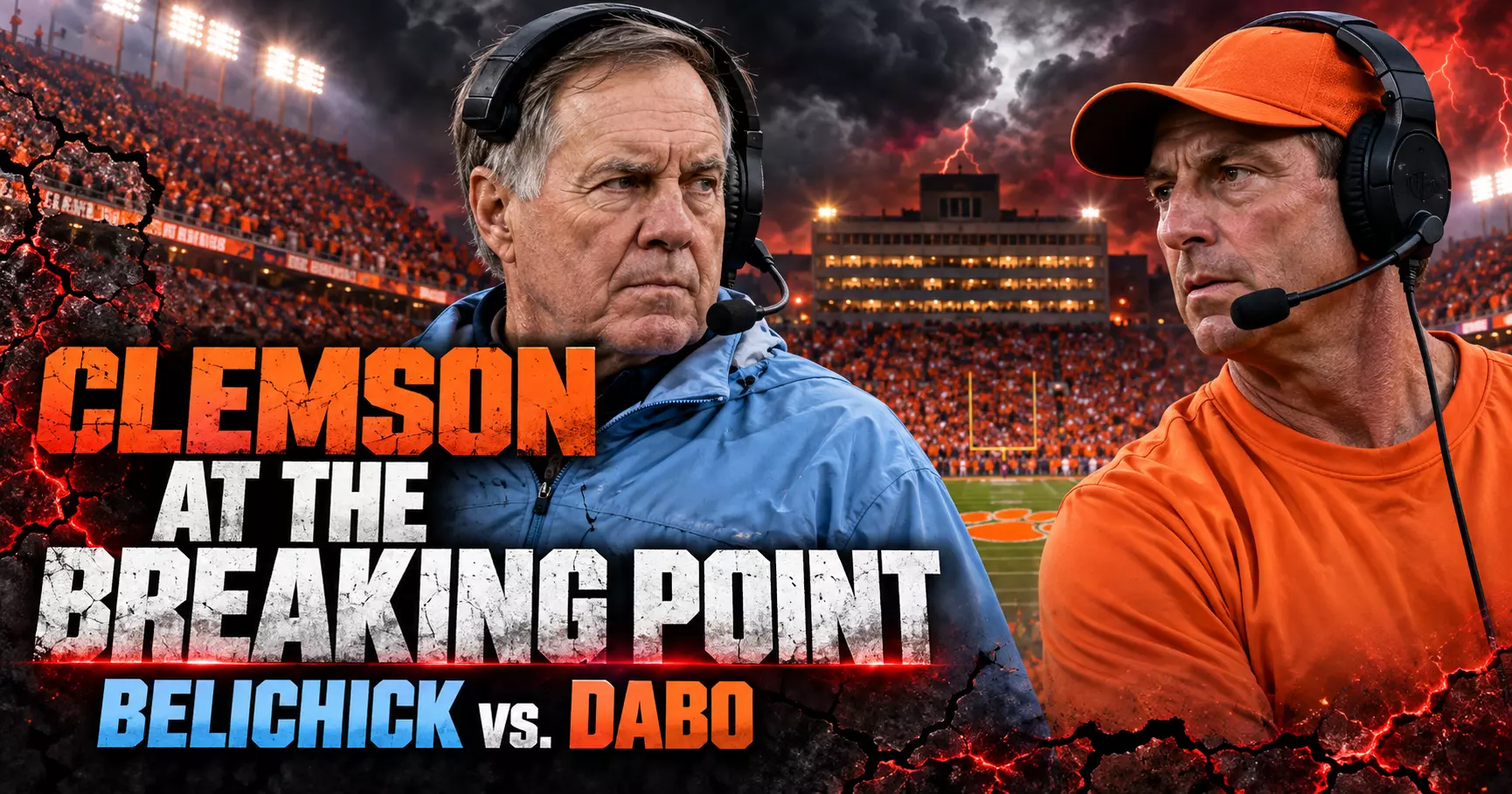
North Carolina arrives at Death Valley undefeated and allowing only 6.5 points per game. The Tar Heels are not yet a national championship contender, but they may not need to be one to push Clemson toward the breaking point.
A home loss to Belichick would drop the Tigers to 1–2 for the second consecutive season.
More importantly, it would remove almost every argument that Clemson’s problems are temporary.
Clemson’s Offense Has Become Almost Unrecognizable
There was a time when Clemson’s offense represented everything exciting about modern college football.
Chad Morris arrived as offensive coordinator in 2011 and installed an aggressive, fast-paced system that transformed the Tigers. Clemson averaged more than 30 points per game in each of his four seasons, won 41 games and developed quarterbacks Tajh Boyd and Deshaun Watson.
That offensive foundation helped Swinney build a national powerhouse.
Clemson eventually surpassed the success it achieved with Morris, winning national championships in 2016 and 2018 while becoming the only program capable of consistently challenging Nick Saban’s Alabama dynasty.
Swinney responded to Clemson’s recent offensive decline by bringing Morris back for the 2026 season.
The reunion was supposed to restore the creativity, pace and explosiveness that once made Clemson impossible to defend. Instead, the Tigers have looked slow, predictable and completely incapable of sustaining drives.
Clemson has converted only three of its first 27 third-down opportunities. That is not a minor early-season concern. It is a complete offensive failure.
The Tigers were held to 10 points and 72 total yards by LSU. They followed that humiliation with only 22 points against Georgia Southern, with one touchdown drive covering just 27 yards after a muffed punt.
An offense that once dictated games is now waiting for opponents to make mistakes.
Tait Reynolds Is Being Asked to Rescue a Broken System
Christopher Vizzina suffered an injury to his non-throwing elbow against Georgia Southern and is expected to miss at least one or two weeks.
That places the offense in the hands of true freshman Tait Reynolds.
Reynolds completed 16 of 27 passes for 178 yards against Georgia Southern and added 38 rushing yards. He has completed 60.6 percent of his passes across two appearances but has yet to throw his first college touchdown pass.
The freshman possesses mobility and competitive toughness, but expecting him to repair Clemson’s offense immediately would be unfair.
Reynolds will make his first career start against a defense coached by Belichick, one of football’s most accomplished defensive strategists. North Carolina’s staff now has film showing Reynolds’ tendencies, Clemson’s protection problems and the third-down concepts that have repeatedly failed.
Belichick has spent his career making inexperienced quarterbacks uncomfortable. He disguises pressure, removes the throws a quarterback prefers and forces offenses to complete lengthy drives without making mental mistakes.
That is a significant challenge for any freshman.
It becomes even more difficult when
Clemson’s offensive line
has struggled to protect the quarterback and the entire offense has converted barely 11 percent of its third downs.
Reynolds may eventually become a star. On Saturday, he is being asked to save Clemson from a crisis created long before he reached campus.
Swinney’s Loyalty Has Become His Greatest Weakness
Nobody can erase what Swinney accomplished at Clemson.
He built a program that won two national championships, nine ACC titles and 29 consecutive games between 2018 and 2019. He transformed Clemson from an inconsistent regional program into one of college football’s most recognizable brands.
That history has earned Swinney patience.
It should not make him immune from criticism.
Clemson has not finished inside the top 10 since 2020. The Tigers went 7–6 in 2025 despite beginning the season ranked fourth nationally. Their offense averaged only 27.2 points, placing 11th in the ACC, while their passing defense finished 120th nationally.
Swinney admitted that he failed his players, but his roster decisions suggested he did not fully accept why.
The transfer portal has completely changed roster construction. The best programs use it to repair weaknesses, replace unexpected departures and add experienced competition at critical positions.
Swinney has reluctantly increased Clemson’s portal participation, but he continues treating transfers as a supplement rather than an essential part of roster management.
Clemson added 15 transfers before the 2026 season. LSU added 48.
After LSU’s 51–10 victory, Swinney insisted that the portal was not why Clemson lost. Technically, he was correct. The portal did not miss tackles, lose blocks or fail to convert third downs.
But roster construction determines which players are available to make those plays.
Clemson did not add a quarterback or offensive lineman from the portal despite obvious uncertainty at both positions. Swinney chose to trust the players already in the program.
Two games into the season, that decision looks like the most consequential gamble of his career.
North Carolina Is Better Than Its Offense Suggests
Belichick’s first season at North Carolina was a disappointment.
The Tar Heels finished 4–8, averaged only 19.3 points and ranked near the bottom of the ACC in total offense. Belichick responded by dismissing offensive coordinator Freddie Kitchens and hiring Bobby Petrino.
The offense remains a work in progress, but the defense has given North Carolina an identity.
The Tar Heels opened the season by defeating TCU 15–10 in Ireland. They surrendered 10 points on the Horned Frogs’ first two possessions and then shut them out for the remainder of the game.
North Carolina stopped TCU twice on fourth down deep in Tar Heels territory. Defensive lineman Melkart Abou Jaoude forced a fumble with a blindside sack, while Xavier Lewis recorded 4.5 tackles for loss and two sacks.
The Tar Heels then handled East Tennessee State 35–3.
North Carolina has allowed only 13 points through two games, an average of 6.5 per contest. The Tar Heels rank among the country’s best teams in scoring defense and have not allowed either opponent to rush for three yards per carry.
There are weaknesses. North Carolina’s defense has allowed opponents to convert 47 percent of their third downs, and neither TCU nor East Tennessee State possesses the talent Clemson was expected to have.
But the matchup still favors Belichick.
Clemson’s offensive line has allowed too many negative plays. North Carolina’s defensive front has been its greatest strength. If the Tar Heels can control the line of scrimmage, Reynolds will spend his first start facing uncomfortable down-and-distance situations.
That is exactly where Belichick wants him.
Death Valley No Longer Feels Invincible
Clemson once entered home games with an aura of inevitability.
Opponents did not merely need to handle the noise and Clemson’s talent. They had to withstand the feeling that the Tigers would eventually produce the decisive scoring run, defensive takeaway or special-teams play.
That confidence has faded.
Clemson lost three home games against unranked opponents during its 7–6 season in 2025. The Tigers are no longer automatically overwhelming teams at Death Valley.
North Carolina should arrive believing it can win.
The Tar Heels have lost seven consecutive games in the series, including a 38–10 defeat in Chapel Hill last season. Clemson led 28–3 after the first quarter in that meeting and never gave Belichick’s team a realistic opportunity.
Saturday provides North Carolina with a chance to demonstrate how much has changed.
For Clemson, it provides a chance to prove that not enough has changed.
Belichick Can Force Clemson to Play Patiently
Clemson’s desperation may become one of North Carolina’s greatest advantages.
The Tigers know the crowd expects an immediate response. Swinney knows every failed possession will produce louder criticism. Reynolds knows he is being asked to create energy for an offense that has produced almost none.
That pressure can lead to forced throws, unnecessary trick plays and poor decisions.
Belichick will be comfortable allowing Clemson to become impatient. His defense does not need to dominate every snap. It needs to eliminate explosive plays, disguise coverage and force the freshman quarterback to make repeated correct decisions.
North Carolina’s offense must provide enough support.
Quarterback Billy Edwards Jr. passed for 232 yards against TCU, but the Tar Heels scored only one touchdown. Petrino’s offense must avoid placing the defense in impossible situations with turnovers or repeated three-and-outs.
North Carolina does not need to score 35 points to win this game. Based on Clemson’s first two performances, reaching the low 20s could be enough.
The longer the game remains close, the more pressure will shift toward Swinney.
A Loss Would Change the Conversation Around Swinney
Clemson firing Swinney during the season would still be shocking.
His accomplishments, contract and importance to the university give him more security than almost any coach in the sport. Clemson would also have to consider whether it could find someone capable of recreating even a portion of Swinney’s peak success.
But Saturday is not necessarily about an immediate coaching change.
It is about whether Clemson’s decline can still be dismissed as temporary.
A loss to North Carolina would leave the Tigers at 1–2 with a difficult schedule still ahead.
Clemson must visit California
before hosting Miami, the ACC’s strongest team. What was expected to be a rebound season could begin unraveling before September ends.
Swinney could no longer point exclusively toward the LSU loss as one terrible night against a talented opponent. He would have lost at home to a North Carolina team coming off a four-win season.
He would have lost to a coach who entered college football only two years earlier and immediately constructed the kind of disciplined defense Clemson’s offense cannot solve.
Most damagingly, he would have lost while starting a freshman quarterback because he declined to add an experienced option from the portal.
That would turn criticism of Clemson’s execution into a referendum on Swinney’s entire philosophy.
Clemson Must Decide Whether History Is a Foundation or a Hiding Place
Swinney frequently responds to criticism by discussing Clemson’s accomplishments.
He has every right to be proud of them. Two national championships and nine conference titles represent one of the greatest coaching tenures in modern college football history.
But Clemson cannot use its past to avoid confronting its present.
Deshaun Watson is not walking through the tunnel. Trevor Lawrence is not rescuing the offense. The recruiting advantages, staff continuity and developmental system that powered Clemson’s dynasty are no longer enough by themselves.
The sport evolved. Swinney has resisted evolving with it.
Saturday gives Clemson an opportunity to stop the decline. A decisive victory would give Reynolds confidence, quiet the criticism surrounding Morris and restore some belief that the Tigers can still contend in the ACC.
A loss would produce the opposite.
Belichick does not need to embarrass Clemson. He does not need to expose the Tigers by 30 or 40 points. He only needs to make them uncomfortable, keep the game close and allow the pressure inside Death Valley to do the rest.
Clemson’s decline has been slow enough for Swinney to defend it one season at a time.
Bill Belichick can turn it into a full-blown crisis in one afternoon.
Up To $1500 in Bonus Bets Paid Back if your First Bet Does Not Win
T&Cs apply
4.5/5
Gambling problem? Call 1-800-GAMBLER or 1-800-MY-RESET (Available in the US) 877-8-HOPENY or text HOPENY (467369) (NY) 1-800-327-5050 (MA), 1-800-BETS-OFF (IA), 1-800-981-0023 (PR). 21+ only. Please Gamble Responsibly. See BetMGM.com for Terms. First Bet Offer for new customers only (if applicable). Subject to eligibility requirements. Bonus bets are non-withdrawable. In partnership with Kansas Crossing Casino and Hotel. Promotional offers not available in Mississippi, Massachusetts, New York, Ontario, or Puerto Rico.
New DraftKings Customers: Spend $5+ Get $150 in Bonuses
T&Cs apply
4.5/5
GAMBLING PROBLEM? CALL 1-800-GAMBLER or 1-800-MY-RESET, (800) 327-5050 or visit gamblinghelplinema.org (MA). Please Gamble Responsibly. 888-789-7777/visit ccpg.org (CT), or visit www.mdgamblinghelp.org (MD), 1-800-981-0023 (PR). 21+ and present in most states. (18+ DC/NH/PR/WY). Void in CAN. Eligibility restrictions apply. On behalf of Boot Hill Casino (KS). Pass-thru of per wager tax may apply in IL. 1 per new DraftKings customer. $5+ first-time bet req. Max. $150 issued as non-withdrawable Bonus Bets. Stake removed from payout. Reward issued as $50 in Bonus Bets every 7 days via click-to-claim for 14 days. Bonus Bets and click-to-claims expire 7 days (168hrs) after issuance. Terms: sportsbook.draftkings.com/promos. Ends 10/11/26 at 11:59 PM ET. Sponsored by DK.
Must be 21+. GAMBLING PROBLEM? CALL 1-800-GAMBLER OR CALL 1-800-MY-RESET, www.mdgamblinghelp.org (MD), (800)-327-5050 or gamblinghelplinema.org (MA), Call (877)8-HOPENY or text HOPENY (467369) (NY), (888) 789-7777 or ccpg.org (CT), morethanagame.nc.gov (NC), 1800gambler.net (WV)
Bet $1 and get double the winnings up to $25 for your next 10 bets
T&Cs apply
4.4/5
21+ New users only. Must register using eligible promo code. First bet after registration must qualify. Max. Bonus Bet: $1,000. Bonus Bet expires 14 days after receipt. Void where prohibited. See Caesars.com/promos for full terms. Gambling Problem? 1-800-GAMBLER (1-800-426-2537)
21+ and present in OH. Gambling Problem? Call 1-800-GAMBLER.
This site is using
Cloudflare
and adheres to the
Google Safe Browsing Program. We adapted
Google's Privacy Guidelines
to keep your data safe at all times.
Close
Ready to Win Big? Join the Elite with Our Sports Betting Deals!
FanDuel Promo
New Users – Get $250 in Bonus Bets when you wager $5 for 5 days
Up To $1500 in Bonus Bets Paid Back if your First Bet Does Not Win
Best Slots
T&Cs and 21+ apply
Gambling problem? Call 1-800-GAMBLER or 1-800-MY-RESET (Available in the US) 877-8-HOPENY or text HOPENY (467369) (NY) 1-800-327-5050 (MA), 1-800-BETS-OFF (IA), 1-800-981-0023 (PR). 21+ only. Please Gamble Responsibly. See BetMGM.com for Terms. First Bet Offer for new customers only (if applicable). Subject to eligibility requirements. Bonus bets are non-withdrawable. In partnership with Kansas Crossing Casino and Hotel. Promotional offers not available in Mississippi, Massachusetts, New York, Ontario, or Puerto Rico.
Code:
Open BetMGM
Get Bonus
DraftKings Promo
New DraftKings Customers: Spend $5+ Get $150 in Bonuses
Newcomer
T&Cs and 21+ apply
GAMBLING PROBLEM? CALL 1-800-GAMBLER or 1-800-MY-RESET, (800) 327-5050 or visit gamblinghelplinema.org (MA). Please Gamble Responsibly. 888-789-7777/visit ccpg.org (CT), or visit www.mdgamblinghelp.org (MD), 1-800-981-0023 (PR). 21+ and present in most states. (18+ DC/NH/PR/WY). Void in CAN. Eligibility restrictions apply. On behalf of Boot Hill Casino (KS). Pass-thru of per wager tax may apply in IL. 1 per new DraftKings customer. $5+ first-time bet req. Max. $150 issued as non-withdrawable Bonus Bets. Stake removed from payout. Reward issued as $50 in Bonus Bets every 7 days via click-to-claim for 14 days. Bonus Bets and click-to-claims expire 7 days (168hrs) after issuance. Terms: sportsbook.draftkings.com/promos. Ends 10/11/26 at 11:59 PM ET. Sponsored by DK.
Code:
Open DraftKings
Get Bonus
Find out what the legends have to say about sports this week....