The established order in the Big Ten was blown apart Saturday. Ohio State squandered a 20-point fourth-quarter lead at Texas.
The established order in the Big Ten was blown apart Saturday.
Ohio State squandered a 20-point fourth-quarter lead at Texas. Oregon suffered a stunning loss to an Oklahoma State team that had dropped 21 consecutive games against FBS opponents. Michigan reentered the national conversation by beating No. 11 Oklahoma.
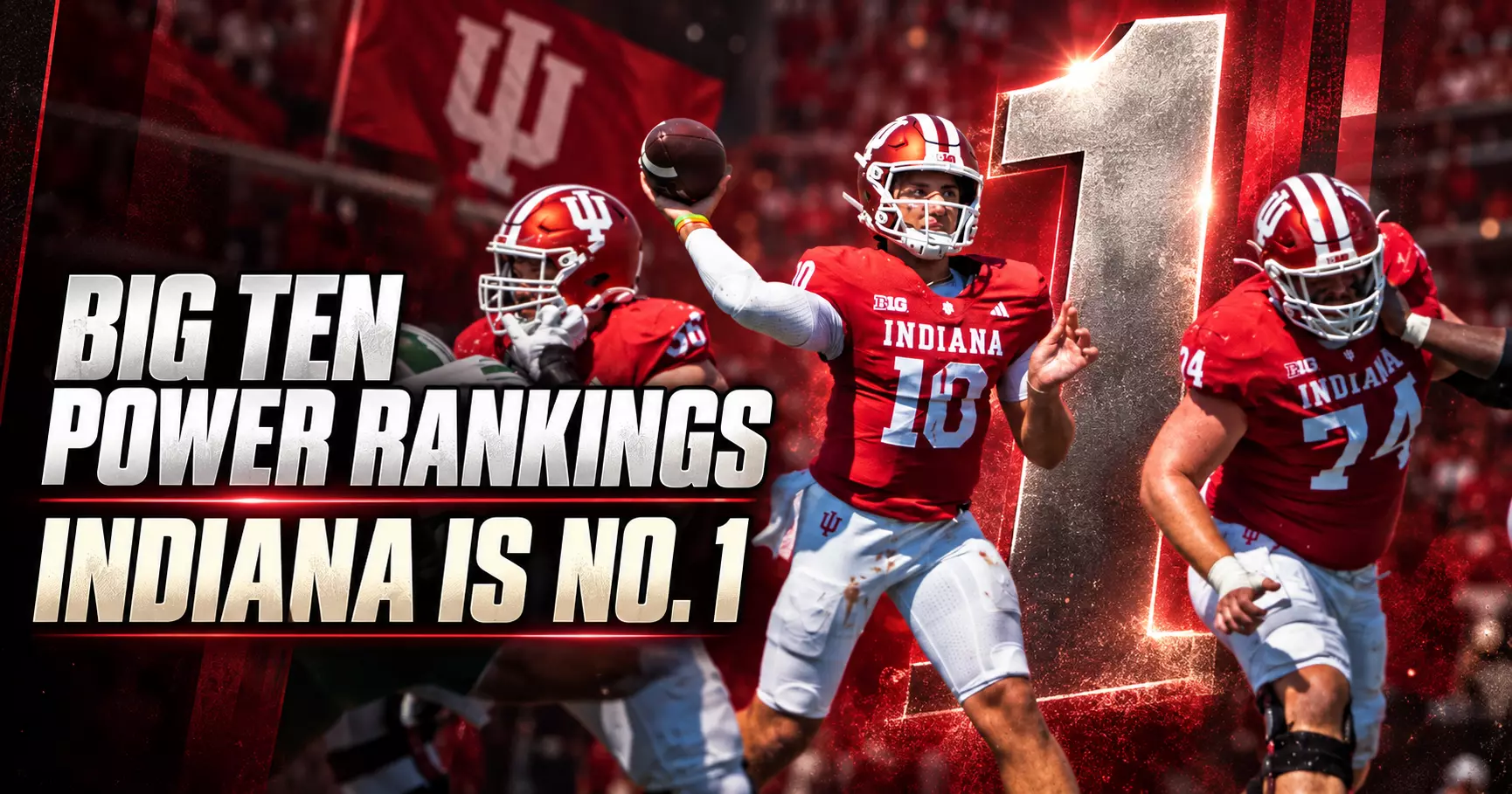
While several of the conference’s traditional powers stumbled, Indiana delivered another dominant performance. The defending Big Ten champion has earned the top position until somebody takes it away.
Here are the updated Big Ten power rankings following Week 2 of the 2026 college football season. Checkout how are
Preseason Power Rankings
looked before the season started.
18. Rutgers Scarlet Knights
Rutgers suffered a disappointing 28–21 loss at Boston College on Friday night.
Mason McKenzie passed for 252 yards, and KJ Duff recorded 137 receiving yards, but the Scarlet Knights could not complete their comeback. Boston College controlled too much of the game and repeatedly exposed weaknesses in the Rutgers defense.
The Scarlet Knights have some legitimate offensive pieces, but their margin for error remains extremely small. Rutgers is not talented enough to overcome turnovers, defensive breakdowns or long stretches of offensive inconsistency.
If the defense cannot dictate games and keep the score low, Rutgers will struggle to survive the Big Ten schedule. The Scarlet Knights must become more physical and considerably more dependable.
17. Minnesota Golden Gophers
No
Big Ten team
had a more damaging weekend than Minnesota.
The Golden Gophers were routed 38–13 at home by Mississippi State. Minnesota allowed 279 passing yards to Drake Lindsey and 113 rushing yards to Fluff Bothwell while producing little resistance after halftime.
Losing to an SEC opponent is not automatically embarrassing, but being thoroughly controlled on your home field is different. Minnesota was outplayed on both sides of the ball and never looked capable of changing the direction of the game once Mississippi State seized control.
The Golden Gophers currently lack an offensive identity, defensive consistency and anything resembling momentum. Until they provide evidence that Saturday was an exception, they belong at the bottom of the conference.
16. Purdue Boilermakers
Purdue showed fight but still left the field with another discouraging result.
The Boilermakers lost 38–36 to Wake Forest in double overtime despite Ryan Browne passing for 329 yards. Purdue had multiple opportunities to win and displayed more offensive life than it has in many recent games.
That represents progress, but moral victories do not move a program out of the Big Ten basement. Purdue must learn how to finish close games before its improvement can be reflected in the standings or these rankings.
The Boilermakers appear more competitive than they were a year ago. They are playing harder, and the offense possesses more potential. They are not yet dependable enough to rank any higher.
15. Northwestern Wildcats
Northwestern had the weekend off after opening its season with a 34–18 victory over South Dakota State.
The Wildcats deserve credit for pulling away from a respected FCS opponent, but one victory does not erase the enormous questions surrounding the roster. Northwestern must prove it can generate points consistently once it encounters Big Ten size and speed.
There is reason for cautious optimism. The offense showed signs of improvement in the opener, and the Wildcats handled the fourth quarter well instead of allowing South Dakota State to remain within striking distance.
There is not yet enough evidence to move Northwestern any higher. The Wildcats will receive opportunities to climb once they begin facing stronger competition.
14. Illinois Fighting Illini
Illinois had an opportunity to establish itself as a legitimate Big Ten contender. Instead, the Illini lost 31–27 at home to Duke.
Illinois led 24–14 during the second quarter but could not contain Duke running back Nate Sheppard, who accumulated 188 yards from scrimmage and scored three touchdowns. The Illini were outplayed during the decisive second half and failed to make the critical defensive stop.
This was not a season-ending defeat, but it was a damaging one. Teams hoping to contend in the Big Ten cannot surrender double-digit home leads against unranked opponents.
Illinois still has enough talent to recover. First, the Illini must prove their defense can protect a lead when the game becomes physical late.
13. Wisconsin Badgers
Wisconsin defeated Western Illinois 36–9 in a game that provided few definitive answers.
The Badgers controlled the second half and avoided embarrassment, but Western Illinois is not an opponent capable of revealing whether Wisconsin has truly improved.
There were positive signs. Wisconsin ran the ball effectively, limited explosive plays and eventually imposed its size. The Badgers still need to demonstrate that their offense can operate efficiently against Big Ten defenses.
For now, Wisconsin looks competent but unproven. The pressure on Luke Fickell will continue to increase, and beating an overmatched opponent does little to change the larger questions surrounding the direction of the program.
12. Washington Huskies
Washington survived Utah State 16–14, but little about the performance inspired confidence.
Demond Williams Jr. passed for 249 yards, yet the Huskies struggled to finish drives and were forced to protect a narrow lead against a significant underdog.
Winning matters, particularly during a weekend when Ohio State and Oregon failed to do so. But Washington entered the season with expectations extending far beyond narrowly escaping Utah State at home.
The Huskies remain dangerous because Williams can create explosive plays with his arm and legs. The rest of the offense must become more efficient, and Washington cannot continue allowing lesser opponents to remain within one possession late in games.
11. Michigan State Spartans
Michigan State dispatched Eastern Michigan 35–7 and continued its encouraging start.
Cam Edwards rushed for 152 yards, providing the Spartans with the dependable ground game they will need once conference play begins. Michigan State was more talented than Eastern Michigan, but it also played with the physicality and discipline that have too often been missing in recent seasons.
The Spartans have not accomplished enough to join the conference’s upper tier. They have, however, provided evidence that they could become a difficult opponent capable of disrupting the Big Ten race.
Michigan State does not need to become an immediate championship contender. It needs to demonstrate consistent progress, and its Week 2 performance represented another step forward.
The Hawkeyes defeated Iowa State 16–13 in another low-scoring Cy-Hawk battle. Iowa did not generate much offensive excitement, but it protected the football, controlled the game’s critical moments and relied on its defense to finish the job.
The ceiling remains limited unless the offense develops a more dangerous passing attack. Against the conference’s best teams, 16 points probably will not be enough.
Still, Iowa continues to win games that other teams find ways to lose. That reliability places the Hawkeyes ahead of several more talented but less trustworthy conference opponents. Nobody will enjoy playing Iowa, especially if the Hawkeyes can turn every game into a fourth-quarter struggle.
9. Maryland Terrapins
Maryland may be the Big Ten’s most underrated team.
The Terrapins rolled past UConn 38–14 behind an outstanding performance from Malik Washington. The Maryland quarterback completed 34 of 41 passes for 347 yards and two touchdowns. Na’eem Abdul-Rahim Gladding and Chris Durr Jr. both surpassed 100 receiving yards.
Maryland’s offense has legitimate playmakers, and Washington appears capable of becoming one of the conference’s breakout stars.
The Terrapins have not faced an elite opponent yet, so some caution is warranted. However, their early offensive production is impossible to ignore. If Washington continues playing at this level, Maryland will be capable of upsetting several more highly regarded Big Ten teams.
8. UCLA Bruins
UCLA earned a much-needed 28–10 victory over San Diego State.
Wayne Knight rushed for 97 yards, while Nico Iamaleava passed for 151. The Bruins leaned on their running game and defense instead of asking their quarterback to carry the entire offense.
That formula worked Saturday, but UCLA will need more explosiveness against the top half of the Big Ten. The Bruins cannot expect to control conference games while producing so little through the air.
The victory stabilized UCLA after an uneven start and provided something upon which to build. The Bruins are moving in the right direction, but they have not traveled far enough to be considered a serious Big Ten threat.
7. Nebraska Cornhuskers
Nebraska did what a good team is supposed to do against an overmatched opponent.
The Cornhuskers demolished Bowling Green 56–7, amassed 546 yards and surrendered only 169. Anthony Colandrea completed 20 of 24 passes for 222 yards and four touchdowns—all before halftime.
The most encouraging development was Nebraska’s complete control. There was no slow start, unnecessary drama or late-game collapse. The Cornhuskers overwhelmed Bowling Green immediately and never relaxed.
Nebraska has spent years turning comfortable situations into crises. This team appears more mature, more explosive and considerably more confident. The Cornhuskers still need a quality victory, but their early performances suggest they could become one of the Big Ten’s biggest surprises.
6. Oregon Ducks
There is no acceptable explanation for what happened to Oregon in Stillwater.
The Ducks lost 39–31 to an Oklahoma State team that entered Saturday riding a 21-game losing streak against FBS opponents. Oregon was not merely upset—it was physically dominated.
Oklahoma State outgained the Ducks 554–281, while quarterback Drew Mestemaker shredded Oregon for 426 total yards. The Ducks had no answers defensively and never demonstrated the control expected from a national championship contender.
Oregon possesses enough talent to recover, and one terrible afternoon does not end its season. Nevertheless, this was one of the most alarming losses of the Dan Lanning era. The Ducks must prove it was an aberration before they can return to the top tier.
5. USC Trojans
USC remained undefeated with a 49–30 victory over Louisiana.
Jayden Maiava passed for 261 yards, King Miller rushed for 128, and the Trojans again demonstrated their offensive explosiveness. USC can score rapidly and attack defenses from multiple positions.
The concern is that Louisiana also scored 30 points. Allowing that kind of production against a Sun Belt opponent raises familiar questions about whether the Trojans can survive a physical Big Ten schedule.
USC has playoff-level offensive talent. Whether it possesses a playoff-level defense remains an open question. The Trojans can outscore most teams in the conference, but that approach becomes dangerous against opponents capable of controlling possession and dominating the line of scrimmage.
4. Penn State Nittany Lions
Penn State has not been spectacular, but it has been steady.
The Nittany Lions handled Temple 27–9 behind 268 passing yards from Rocco Becht. The offense did enough, while the defense prevented the Owls from reaching the end zone.
That performance will not convince anyone that Penn State is ready to win the Big Ten. It also did nothing to damage the Nittany Lions’ position among the conference contenders.
Penn State is talented, physical and undefeated. The larger questions surrounding this team will not be answered until it faces stronger competition. For now, avoiding the chaos that swallowed Ohio State and Oregon counts for something. The Nittany Lions have taken care of business while other contenders have stumbled.
3. Michigan Wolverines
Michigan produced the Big Ten’s most impressive victory of the weekend.
The Wolverines defeated No. 11 Oklahoma 17–10 by turning the game into precisely the kind of physical struggle they wanted. Bryce Underwood passed for only 111 yards but added 87 yards and a touchdown on the ground.
More importantly, Michigan’s defense looked like a championship-caliber unit. The Wolverines held Oklahoma to 289 total yards and limited the Sooners to three conversions on 13 third-down attempts.
Michigan still needs more consistency from its passing game. However, beating a ranked opponent while controlling the line of scrimmage was a major statement. The Wolverines are back in the Big Ten race and may be more dangerous than many expected.
2. Ohio State Buckeyes
Ohio State spent three quarters looking like the best team in college football. Unfortunately for the Buckeyes, games last four quarters.
Ryan Day’s team led Texas 23–3 before surrendering 21 unanswered points in a devastating 24–23 loss. Julian Sayin passed for 278 yards, and Jeremiah Smith produced 164 receiving yards, but the offense failed to finish when Ohio State desperately needed one more drive.
Losing by one point on the road against an elite Texas team does not suddenly make Ohio State ordinary. The Buckeyes still have one of the country’s most talented rosters and remain capable of winning the Big Ten and the national championship.
But blowing a 20-point fourth-quarter lead is not something the conference’s top team does. For now, Ohio State falls behind Indiana.
The Hoosiers were expected to crush Howard, and they did exactly that in a 55–0 victory. Josh Hoover threw four touchdown passes, Charlie Becker caught three of them, and both Lee Beebe Jr. and Turbo Richard rushed for more than 100 yards.
Indiana’s defense was equally overwhelming, recording five sacks, 12 tackles for loss and a pick-six. Howard never had a chance to make the game competitive.
The schedule will become substantially more difficult, but Indiana has earned the benefit of the doubt. The Hoosiers are the defending Big Ten champions, they look loaded again, and they are playing with the confidence of a program that expects to compete for another national championship.
Indiana is not No. 1 because Ohio State and Oregon lost. The Hoosiers are No. 1 because their performance, consistency and recent accomplishments demand it.
Until somebody beats Indiana and takes control of the conference, the road to the Big Ten championship runs through Bloomington.
New Users – Get $350 in Bonus Bets when you wager $5 for 7 days
T&Cs apply
4.6/5
Gambling Problem? Call 1-800-GAMBLER or 1-800-MY-RESET. Call 1-888-789-7777 or visit ccpgg.org/chat (CT). Hope is here. GamblingHelpLineMA.org or call (800) 327-5050 for 24/7 support (MA). Visit www.mdgamblinghelp.org (MD). Call 1-877-8HOPE-NY or text HOPENY (NY). 21+ (18+ DC, WY) and present in select states (for KS, in affiliation with Kansas Star Casino). Find online real money wagering only. Min $5 wager required for 7 consecutive days. $5 free play credit. Bonus issued as non-withdrawable bonus with cash withdrawable bonus with cash withdrawable. Bonus bets which expire 7 days after receipt. Restrictions apply. See terms at sportsbook.fanduel.com. Call 1-877-770-7867 (LA).
Up To $1500 in Bonus Bets Paid Back if your First Bet Does Not Win
T&Cs apply
4.5/5
Gambling problem? Call 1-800-GAMBLER or 1-800-MY-RESET (Available in the US) 877-8-HOPENY or text HOPENY (467369) (NY) 1-800-327-5050 (MA), 1-800-BETS-OFF (IA), 1-800-981-0023 (PR). 21+ only. Please Gamble Responsibly. See BetMGM.com for Terms. First Bet Offer for new customers only (if applicable). Subject to eligibility requirements. Bonus bets are non-withdrawable. In partnership with Kansas Crossing Casino and Hotel. Promotional offers not available in Mississippi, Massachusetts, New York, Ontario, or Puerto Rico.
New DraftKings Customers: Bet $5, Get $200 + 3 Months of NBA League Pass!
T&Cs apply
4.5/5
GAMBLING PROBLEM? CALL 1-800-GAMBLER or 1-800-MY-RESET, (800) 327-5050 or visit gamblinghelplinema.org (MA). Please Gamble Responsibly. 888-789-7777/visit ccpg.org (CT), or visit www.mdgamblinghelp.org (MD), 1-800-981-0023 (PR). 21+ and present in most states. (18+ DC/NH/PR/WY). Void in CAN. Eligibility restrictions apply. On behalf of Boot Hill Casino (KS). Pass-thru of per wager tax may apply in IL. 1 per new Sportsbook customer. $5+ first-time bet req. Max. $200 issued as non-withdrawable Bonus Bets. Stake removed from payout. Reward issued as $50 in Bonus Bets every 7 days via click-to-claim for 21 days. Bonus Bets and click-to-claims expire 7 days (168hrs) after issuance. Terms: dkng.co/offer. Get 1 promo code to redeem a 3-month NBA League Pass subscription, complimentary of DraftKings. Subscription auto-renews monthly at then-current price (currently $16.99/mo); cancel anytime. Terms, restrictions, and eligibility requirements apply. Redeem League Pass by 12/19/26 at 11:59 PM ET. Addt’l terms: support.watch.nba.com/hc/en-us/articles/9165532876183-League-Pass-Terms-of-Use_. Ends 11/29/26 at 11:59 PM ET. Sponsored by DK.
Must be 21+. GAMBLING PROBLEM? CALL 1-800-GAMBLER OR CALL 1-800-MY-RESET, www.mdgamblinghelp.org (MD), (800)-327-5050 or gamblinghelplinema.org (MA), Call (877)8-HOPENY or text HOPENY (467369) (NY), (888) 789-7777 or ccpg.org (CT), morethanagame.nc.gov (NC), 1800gambler.net (WV)
Bet $1 and get double the winnings up to $25 for your next 10 bets
T&Cs apply
4.4/5
21+ New users only. Must register using eligible promo code. First bet after registration must qualify. Max. Bonus Bet: $1,000. Bonus Bet expires 14 days after receipt. Void where prohibited. See Caesars.com/promos for full terms. Gambling Problem? 1-800-GAMBLER (1-800-426-2537)
21+ and present in OH. Gambling Problem? Call 1-800-GAMBLER.
This site is using
Cloudflare
and adheres to the
Google Safe Browsing Program. We adapted
Google's Privacy Guidelines
to keep your data safe at all times.
Close
Ready to Win Big? Join the Elite with Our Sports Betting Deals!
FanDuel Promo
New Users – Get $350 in Bonus Bets when you wager $5 for 7 days
Our Favorite
T&Cs and 21+ apply
Gambling Problem? Call 1-800-GAMBLER or 1-800-MY-RESET. Call 1-888-789-7777 or visit ccpgg.org/chat (CT). Hope is here. GamblingHelpLineMA.org or call (800) 327-5050 for 24/7 support (MA). Visit www.mdgamblinghelp.org (MD). Call 1-877-8HOPE-NY or text HOPENY (NY). 21+ (18+ DC, WY) and present in select states (for KS, in affiliation with Kansas Star Casino). Find online real money wagering only. Min $5 wager required for 7 consecutive days. $5 free play credit. Bonus issued as non-withdrawable bonus with cash withdrawable bonus with cash withdrawable. Bonus bets which expire 7 days after receipt. Restrictions apply. See terms at sportsbook.fanduel.com. Call 1-877-770-7867 (LA).
Code:
Open FanDuel
Get Bonus
BetMGM Promo
Up To $1500 in Bonus Bets Paid Back if your First Bet Does Not Win
Best Slots
T&Cs and 21+ apply
Gambling problem? Call 1-800-GAMBLER or 1-800-MY-RESET (Available in the US) 877-8-HOPENY or text HOPENY (467369) (NY) 1-800-327-5050 (MA), 1-800-BETS-OFF (IA), 1-800-981-0023 (PR). 21+ only. Please Gamble Responsibly. See BetMGM.com for Terms. First Bet Offer for new customers only (if applicable). Subject to eligibility requirements. Bonus bets are non-withdrawable. In partnership with Kansas Crossing Casino and Hotel. Promotional offers not available in Mississippi, Massachusetts, New York, Ontario, or Puerto Rico.
Code:
Open BetMGM
Get Bonus
DraftKings Promo
New DraftKings Customers: Bet $5, Get $200 + 3 Months of NBA League Pass!
Newcomer
T&Cs and 21+ apply
GAMBLING PROBLEM? CALL 1-800-GAMBLER or 1-800-MY-RESET, (800) 327-5050 or visit gamblinghelplinema.org (MA). Please Gamble Responsibly. 888-789-7777/visit ccpg.org (CT), or visit www.mdgamblinghelp.org (MD), 1-800-981-0023 (PR). 21+ and present in most states. (18+ DC/NH/PR/WY). Void in CAN. Eligibility restrictions apply. On behalf of Boot Hill Casino (KS). Pass-thru of per wager tax may apply in IL. 1 per new Sportsbook customer. $5+ first-time bet req. Max. $200 issued as non-withdrawable Bonus Bets. Stake removed from payout. Reward issued as $50 in Bonus Bets every 7 days via click-to-claim for 21 days. Bonus Bets and click-to-claims expire 7 days (168hrs) after issuance. Terms: dkng.co/offer. Get 1 promo code to redeem a 3-month NBA League Pass subscription, complimentary of DraftKings. Subscription auto-renews monthly at then-current price (currently $16.99/mo); cancel anytime. Terms, restrictions, and eligibility requirements apply. Redeem League Pass by 12/19/26 at 11:59 PM ET. Addt’l terms: support.watch.nba.com/hc/en-us/articles/9165532876183-League-Pass-Terms-of-Use_. Ends 11/29/26 at 11:59 PM ET. Sponsored by DK.
Code:
Open DraftKings
Get Bonus
Find out what the legends have to say about sports this week....
New Users – Get $350 in Bonus Bets when you wager $5 for 7 days
Gambling Problem? Call 1-800-GAMBLER or 1-800-MY-RESET. Call 1-888-789-7777 or visit ccpgg.org/chat (CT). Hope is here. GamblingHelpLineMA.org or call (800) 327-5050 for 24/7 support (MA). Visit www.mdgamblinghelp.org (MD). Call 1-877-8HOPE-NY or text HOPENY (NY). 21+ (18+ DC, WY) and present in select states (for KS, in affiliation with Kansas Star Casino). Find online real money wagering only. Min $5 wager required for 7 consecutive days. $5 free play credit. Bonus issued as non-withdrawable bonus with cash withdrawable bonus with cash withdrawable. Bonus bets which expire 7 days after receipt. Restrictions apply. See terms at sportsbook.fanduel.com. Call 1-877-770-7867 (LA).