Saturday brought another reshuffling of the Big Ten.Indiana survived Michigan in overtime, UCLA remained unbeaten, Wisconsin handled USC
Saturday brought another reshuffling of the Big Ten.
Indiana
survived Michigan in overtime, UCLA remained unbeaten, Wisconsin handled USC, Minnesota reclaimed Floyd of Rosedale, and Illinois delivered a significant win over Oregon.
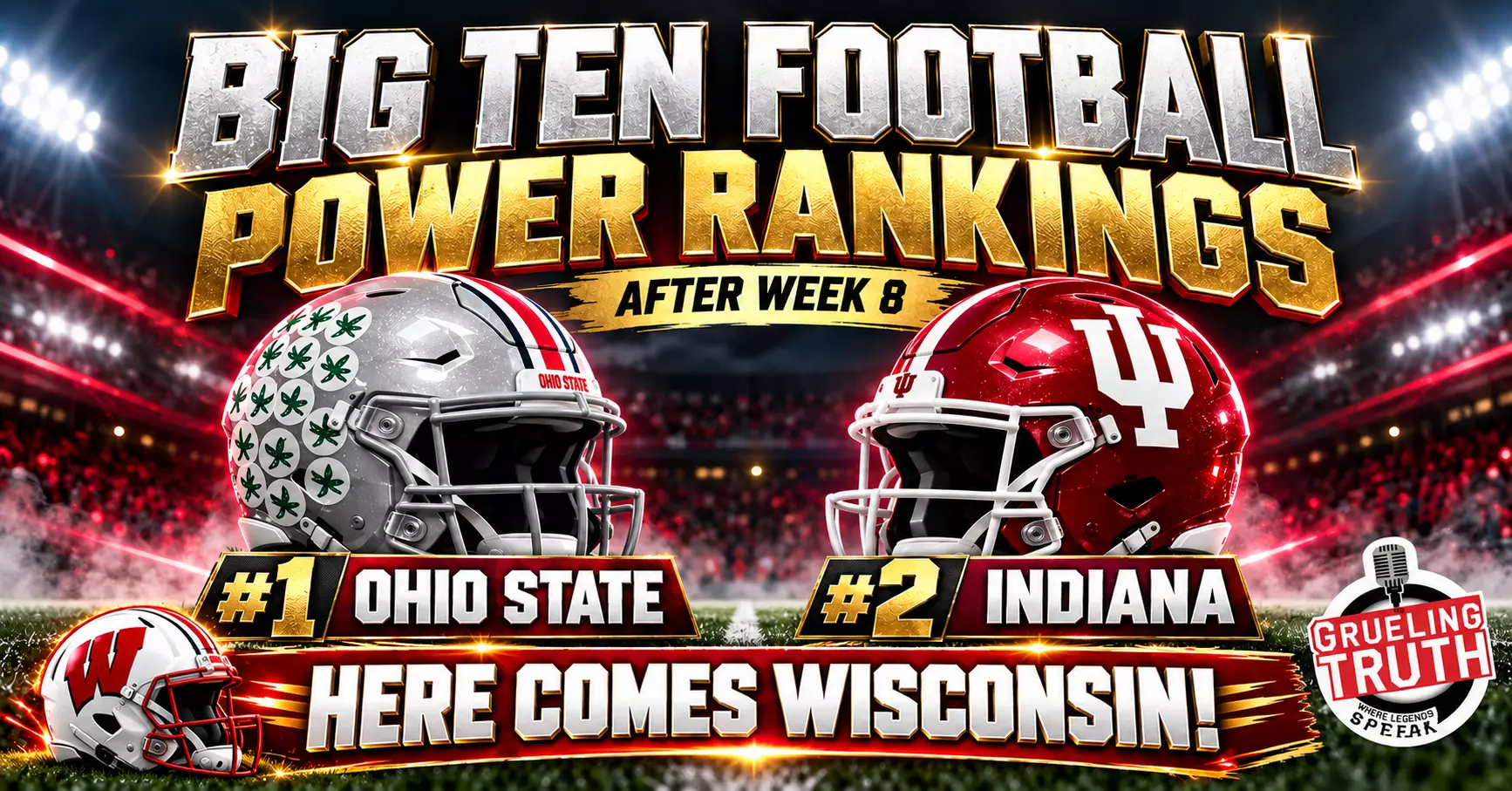
Ohio State holds the top spot, followed by Indiana and UCLA. These rankings weigh results, consistency and current performance—not simply conference standings.
18. Michigan State Spartans
Record: 2–6 | Big Ten: 0–5
Michigan State remains at the bottom after losing
28–10 at UCLA. The Spartans have now dropped six consecutive games, and their conference record leaves little room to argue for a higher placement.
The immediate challenge is to sustain enough offense to give the defense a realistic opportunity. Competitive stretches matter, but Michigan State needs those stretches to become complete performances. Until that happens, the Spartans remain the conference’s weakest team in these rankings.
17. Maryland Terrapins
Record: 2–5 | Big Ten: 0–4
Maryland was idle Saturday, leaving its five-game losing streak intact. The Terrapins need a conference victory before there is much justification for moving them out of the bottom tier.
The remaining season should be judged by tangible improvement: fewer wasted possessions, better execution in competitive situations and enough consistency to finish a game. Maryland cannot change its position during an open week. Its next performance must supply the evidence.
16. Rutgers Scarlet Knights
Record: 2–5 | Big Ten: 1–3
Rutgers lost
42–14 at Northwestern, a decisive setback that keeps the Scarlet Knights near the bottom.
The margin matters. Rutgers needed a competitive road performance and instead left with another substantial gap to address. Its conference victory provides some separation from the winless teams below, but the overall body of work remains thin.
The Scarlet Knights need to make opponents sustain drives while producing more dependable offense themselves.
15. Penn State Nittany Lions
Record: 3–4 | Big Ten: 0–4
Penn State’s name cannot outweigh its conference results. The Nittany Lions were idle this weekend and remain without a Big Ten victory.
There is still an opportunity to improve the season, but it must begin with execution rather than expectations. Penn State needs to finish possessions, avoid the mistakes that swing close games and produce a result that changes its direction.
For now, four consecutive losses keep the Nittany Lions in the bottom quarter of the conference.
14. Purdue Boilermakers
Record: 3–4 | Big Ten: 2–2
Purdue’s two
conference victories
keep the Boilermakers above several teams with better overall records. Their open week leaves them positioned in the lower middle of the league.
The argument for Purdue is that it has converted some conference opportunities into wins. The argument against a higher placement is the need for greater consistency.
The Boilermakers must show they can sustain their best football across consecutive weeks. That would give their improvement more weight.
13. Washington Huskies
Record: 4–3 | Big Ten: 1–3
Washington was off Saturday and remains part of the crowded group trying to establish a reliable identity.
The Huskies have a winning overall record, but their conference results prevent a higher placement. The next step is demonstrating that they can consistently handle Big Ten opponents rather than alternating encouraging moments with damaging setbacks.
Washington has an opportunity to climb. It needs a performance strong enough to distinguish itself from the teams immediately above it.
12. Oregon Ducks
Record: 4–3 | Big Ten: 2–2
Oregon falls after losing
21–10 at Illinois. The Illini scored the game’s final 21 points, leaving the Ducks with another disappointing offensive result.
Potential cannot keep Oregon near the top when its production fails to support it. The Ducks need an offense that can sustain possessions and respond after an opponent changes the game’s momentum.
Their placement reflects current performance. Oregon must earn its way back toward the conference’s upper tier.
11. Illinois Fighting Illini
Record: 4–3 | Big Ten: 2–2
Illinois earns a meaningful jump after beating Oregon
21–10. The Illini responded to an early deficit and finished with 21 unanswered points.
That is the kind of result that deserves to change a power ranking. Illinois demonstrated an ability to adjust, remain involved and take control.
The next challenge is making this performance the beginning of a pattern. The Illini have earned more attention, but consistency will determine how much farther they climb.
10. Michigan Wolverines
Record: 4–3 | Big Ten: 1–3
Michigan’s defense delivered a performance worthy of respect in the
13–6 overtime loss to Indiana. The Wolverines limited the Hoosiers to 81 passing yards and prevented an offensive touchdown during regulation.
That defensive effort keeps Michigan competitive. Scoring six points, however, explains why the Wolverines remain outside the top half.
Michigan needs its offense to provide more support. A defense capable of containing a contender should not repeatedly have to operate with virtually no margin for error.
9. Iowa Hawkeyes
Record: 5–2 | Big Ten: 2–2
Iowa drops after losing
13–10 at
Minnesota. The Hawkeyes managed to tie the game late, but Minnesota answered with the deciding field goal.
This was a costly missed opportunity. Iowa entered with national attention and left with another conference loss.
The Hawkeyes remain capable of beating good opponents, but ten points provided too little support in a game decided by narrow margins. Their next response must include more reliable offensive execution.
8. Nebraska Cornhuskers
Record: 5–2 | Big Ten: 2–2
Nebraska was idle Saturday, leaving the Cornhuskers with a winning record and questions to answer after consecutive defeats.
They remain above the lower middle of the conference because of their overall results. Their placement also reflects the need to regain momentum before a promising season becomes defined by missed opportunities.
Nebraska needs better finishing: complete drives, complete quarters and complete games. The record leaves room for a productive final stretch, but the response must come on the field.
7. USC Trojans
Record: 6–2 | Big Ten: 3–2
USC’s
24–7 loss at Wisconsin
demands a significant downgrade. The Trojans’ record remains respectable, but Saturday exposed the distance between accumulating victories and consistently controlling strong conference opponents.
Seven points is an especially disappointing return for an offense expected to provide USC’s advantage.
The Trojans remain in the upper half because of their overall results. Their position is vulnerable, however, until they demonstrate that the Wisconsin performance was a correctable setback.
6. Minnesota Golden Gophers
Record: 5–2 | Big Ten: 3–1
Minnesota climbs after reclaiming Floyd of Rosedale with its
13–10 victory over Iowa.
The Gophers intercepted Iowa twice, blocked a punt and received a decisive late completion from Drake Lindsey to Jalen Smith before Luke Drzewiecki’s winning 46-yard field goal.
That combination of defense, special teams and late execution deserves recognition. Minnesota must still demonstrate greater week-to-week consistency, but Saturday supplied a meaningful result against a ranked opponent.
5. Northwestern Wildcats
Record: 6–1 | Big Ten: 3–1
Northwestern’s
42–14 win over Rutgers
strengthens its hold on a place near the top.
The Wildcats deserve credit for handling a game they needed to win. A contender should create separation when opportunities arise, and Northwestern did exactly that.
Their record gives them a stronger claim than several programs with more preseason attention. The remaining challenge is to keep translating that consistency into results as the conference race becomes more demanding.
4. Wisconsin Badgers
Record: 5–2 | Big Ten: 3–1
Wisconsin earns the No. 5 spot after beating USC
24–7. The Badgers held the Trojans scoreless after halftime and produced a convincing response to their loss at UCLA.
This result gives Wisconsin more than an encouraging talking point. It provides a clear reason to place the Badgers among the conference’s better teams.
The challenge now is maintaining that standard. Wisconsin’s best performances support this placement; repeating them would justify further movement.
3. UCLA Bruins
Record: 7–0 | Big Ten: 5–0
UCLA remains unbeaten after defeating Michigan State
28–10. The Bruins continue to lead the conference standings and have earned a place in its top tier.
There is a reasonable argument for placing UCLA higher. A perfect record deserves substantial weight.
For these power rankings, Ohio State and Indiana retain the first two positions, but the gap is narrow. UCLA’s sustained consistency makes the Bruins a serious championship contender, and another strong performance could force a reconsideration of the order.
2. Indiana Hoosiers
Record: 7–1 | Big Ten: 4–1
Indiana holds No. 2 after winning
13–6 in overtime at Michigan. Josh Hoover’s four-yard touchdown run supplied the decisive score.
The defense remains the strongest foundation for Indiana’s championship ambitions. Winning on the road while allowing no touchdowns is meaningful, even when the offense struggles.
The concern is clear: the Hoosiers need more dependable offensive production. Their defense and ability to finish difficult games keep them second, but continued inefficiency would make that position harder to defend.
1. Ohio State Buckeyes
Record: 6–1 | Big Ten: 4–0
Ohio State
remains first after its open week. The Buckeyes’ 19–15 victory at Indiana provides the decisive head-to-head result separating the top two.
The uncertainty surrounds the offense. Julian Sayin’s injury places greater responsibility on the backup quarterbacks and the supporting cast. Ohio State must demonstrate that it can preserve its offensive effectiveness through that transition.
For now, the Buckeyes have earned the top position. Their next performances will determine whether they can maintain it as Indiana and unbeaten UCLA continue to apply pressure.
New Users – Get $350 in Bonus Bets when you wager $5 for 7 days
T&Cs apply
4.6/5
Gambling Problem? Call 1-800-GAMBLER or 1-800-MY-RESET. Call 1-888-789-7777 or visit ccpgg.org/chat (CT). Hope is here. GamblingHelpLineMA.org or call (800) 327-5050 for 24/7 support (MA). Visit www.mdgamblinghelp.org (MD). Call 1-877-8HOPE-NY or text HOPENY (NY). 21+ (18+ DC, WY) and present in select states (for KS, in affiliation with Kansas Star Casino). Find online real money wagering only. Min $5 wager required for 7 consecutive days. $5 free play credit. Bonus issued as non-withdrawable bonus with cash withdrawable bonus with cash withdrawable. Bonus bets which expire 7 days after receipt. Restrictions apply. See terms at sportsbook.fanduel.com. Call 1-877-770-7867 (LA).
Up To $1500 in Bonus Bets Paid Back if your First Bet Does Not Win
T&Cs apply
4.5/5
Gambling problem? Call 1-800-GAMBLER or 1-800-MY-RESET (Available in the US) 877-8-HOPENY or text HOPENY (467369) (NY) 1-800-327-5050 (MA), 1-800-BETS-OFF (IA), 1-800-981-0023 (PR). 21+ only. Please Gamble Responsibly. See BetMGM.com for Terms. First Bet Offer for new customers only (if applicable). Subject to eligibility requirements. Bonus bets are non-withdrawable. In partnership with Kansas Crossing Casino and Hotel. Promotional offers not available in Mississippi, Massachusetts, New York, Ontario, or Puerto Rico.
New DraftKings Customers: Bet $5, Get $200 + 3 Months of NBA League Pass!
T&Cs apply
4.5/5
GAMBLING PROBLEM? CALL 1-800-GAMBLER or 1-800-MY-RESET, (800) 327-5050 or visit gamblinghelplinema.org (MA). Please Gamble Responsibly. 888-789-7777/visit ccpg.org (CT), or visit www.mdgamblinghelp.org (MD), 1-800-981-0023 (PR). 21+ and present in most states. (18+ DC/NH/PR/WY). Void in CAN. Eligibility restrictions apply. On behalf of Boot Hill Casino (KS). Pass-thru of per wager tax may apply in IL. 1 per new Sportsbook customer. $5+ first-time bet req. Max. $200 issued as non-withdrawable Bonus Bets. Stake removed from payout. Reward issued as $50 in Bonus Bets every 7 days via click-to-claim for 21 days. Bonus Bets and click-to-claims expire 7 days (168hrs) after issuance. Terms: dkng.co/offer. Get 1 promo code to redeem a 3-month NBA League Pass subscription, complimentary of DraftKings. Subscription auto-renews monthly at then-current price (currently $16.99/mo); cancel anytime. Terms, restrictions, and eligibility requirements apply. Redeem League Pass by 12/19/26 at 11:59 PM ET. Addt’l terms: support.watch.nba.com/hc/en-us/articles/9165532876183-League-Pass-Terms-of-Use_. Ends 11/29/26 at 11:59 PM ET. Sponsored by DK.
Must be 21+. GAMBLING PROBLEM? CALL 1-800-GAMBLER OR CALL 1-800-MY-RESET, www.mdgamblinghelp.org (MD), (800)-327-5050 or gamblinghelplinema.org (MA), Call (877)8-HOPENY or text HOPENY (467369) (NY), (888) 789-7777 or ccpg.org (CT), morethanagame.nc.gov (NC), 1800gambler.net (WV)
Bet $1 and get double the winnings up to $25 for your next 10 bets
T&Cs apply
4.4/5
21+ New users only. Must register using eligible promo code. First bet after registration must qualify. Max. Bonus Bet: $1,000. Bonus Bet expires 14 days after receipt. Void where prohibited. See Caesars.com/promos for full terms. Gambling Problem? 1-800-GAMBLER (1-800-426-2537)
21+ and present in OH. Gambling Problem? Call 1-800-GAMBLER.
This site is using
Cloudflare
and adheres to the
Google Safe Browsing Program. We adapted
Google's Privacy Guidelines
to keep your data safe at all times.
Close
Ready to Win Big? Join the Elite with Our Sports Betting Deals!
FanDuel Promo
New Users – Get $350 in Bonus Bets when you wager $5 for 7 days
Our Favorite
T&Cs and 21+ apply
Gambling Problem? Call 1-800-GAMBLER or 1-800-MY-RESET. Call 1-888-789-7777 or visit ccpgg.org/chat (CT). Hope is here. GamblingHelpLineMA.org or call (800) 327-5050 for 24/7 support (MA). Visit www.mdgamblinghelp.org (MD). Call 1-877-8HOPE-NY or text HOPENY (NY). 21+ (18+ DC, WY) and present in select states (for KS, in affiliation with Kansas Star Casino). Find online real money wagering only. Min $5 wager required for 7 consecutive days. $5 free play credit. Bonus issued as non-withdrawable bonus with cash withdrawable bonus with cash withdrawable. Bonus bets which expire 7 days after receipt. Restrictions apply. See terms at sportsbook.fanduel.com. Call 1-877-770-7867 (LA).
Code:
Open FanDuel
Get Bonus
BetMGM Promo
Up To $1500 in Bonus Bets Paid Back if your First Bet Does Not Win
Best Slots
T&Cs and 21+ apply
Gambling problem? Call 1-800-GAMBLER or 1-800-MY-RESET (Available in the US) 877-8-HOPENY or text HOPENY (467369) (NY) 1-800-327-5050 (MA), 1-800-BETS-OFF (IA), 1-800-981-0023 (PR). 21+ only. Please Gamble Responsibly. See BetMGM.com for Terms. First Bet Offer for new customers only (if applicable). Subject to eligibility requirements. Bonus bets are non-withdrawable. In partnership with Kansas Crossing Casino and Hotel. Promotional offers not available in Mississippi, Massachusetts, New York, Ontario, or Puerto Rico.
Code:
Open BetMGM
Get Bonus
DraftKings Promo
New DraftKings Customers: Bet $5, Get $200 + 3 Months of NBA League Pass!
Newcomer
T&Cs and 21+ apply
GAMBLING PROBLEM? CALL 1-800-GAMBLER or 1-800-MY-RESET, (800) 327-5050 or visit gamblinghelplinema.org (MA). Please Gamble Responsibly. 888-789-7777/visit ccpg.org (CT), or visit www.mdgamblinghelp.org (MD), 1-800-981-0023 (PR). 21+ and present in most states. (18+ DC/NH/PR/WY). Void in CAN. Eligibility restrictions apply. On behalf of Boot Hill Casino (KS). Pass-thru of per wager tax may apply in IL. 1 per new Sportsbook customer. $5+ first-time bet req. Max. $200 issued as non-withdrawable Bonus Bets. Stake removed from payout. Reward issued as $50 in Bonus Bets every 7 days via click-to-claim for 21 days. Bonus Bets and click-to-claims expire 7 days (168hrs) after issuance. Terms: dkng.co/offer. Get 1 promo code to redeem a 3-month NBA League Pass subscription, complimentary of DraftKings. Subscription auto-renews monthly at then-current price (currently $16.99/mo); cancel anytime. Terms, restrictions, and eligibility requirements apply. Redeem League Pass by 12/19/26 at 11:59 PM ET. Addt’l terms: support.watch.nba.com/hc/en-us/articles/9165532876183-League-Pass-Terms-of-Use_. Ends 11/29/26 at 11:59 PM ET. Sponsored by DK.
Code:
Open DraftKings
Get Bonus
Find out what the legends have to say about sports this week....
New Users – Get $350 in Bonus Bets when you wager $5 for 7 days
Gambling Problem? Call 1-800-GAMBLER or 1-800-MY-RESET. Call 1-888-789-7777 or visit ccpgg.org/chat (CT). Hope is here. GamblingHelpLineMA.org or call (800) 327-5050 for 24/7 support (MA). Visit www.mdgamblinghelp.org (MD). Call 1-877-8HOPE-NY or text HOPENY (NY). 21+ (18+ DC, WY) and present in select states (for KS, in affiliation with Kansas Star Casino). Find online real money wagering only. Min $5 wager required for 7 consecutive days. $5 free play credit. Bonus issued as non-withdrawable bonus with cash withdrawable bonus with cash withdrawable. Bonus bets which expire 7 days after receipt. Restrictions apply. See terms at sportsbook.fanduel.com. Call 1-877-770-7867 (LA).