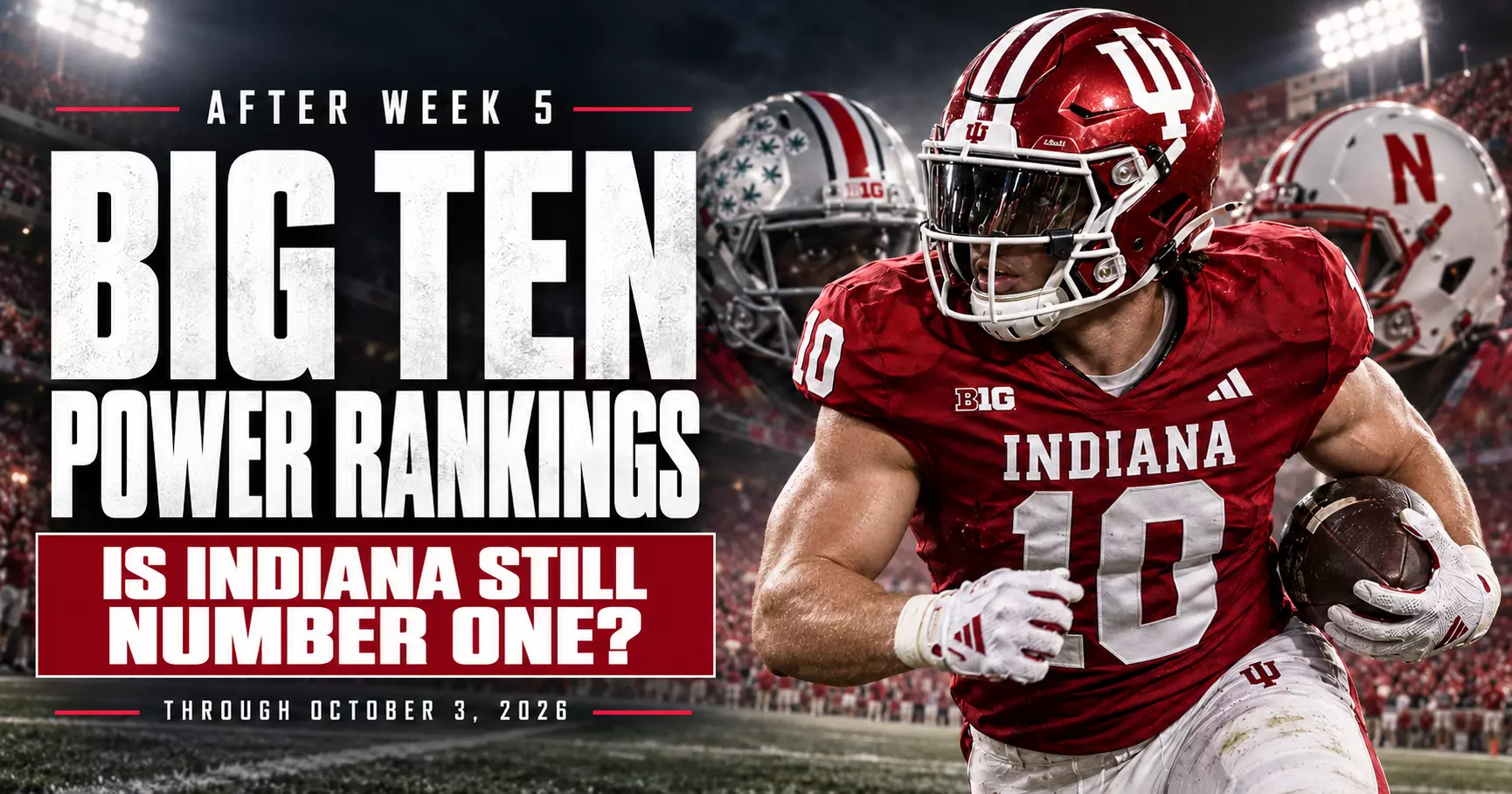
The Big Ten’s reputation means very little once conference games begin. Michigan and Penn State are discovering that the hard way.
The Big Ten’s reputation means very little once conference games begin. Michigan and Penn State are discovering that the hard way, while Minnesota, Wisconsin and Northwestern are giving everyone reasons to reconsider the league’s pecking order.
At the top, Indiana continues to set the standard. The Hoosiers went to Rutgers and delivered another convincing victory, showing the offensive balance and defensive control that make Curt Cignetti’s team so difficult to beat. Ohio State strengthened its case with a road victory at Iowa, and Nebraska remained unbeaten with an impressive second-half response against Maryland.
These rankings weigh the full season, recent performance, and head-to-head results. Here is the countdown from No. 18 to No. 1,
through games played Saturday, October 3, 2026, including Friday night’s Northwestern–Penn State matchup. See where these teams stood last week in the
Week 4 Big Ten Football Power Rankings.
Records below are overall, followed by Big Ten records.
18. Rutgers Scarlet Knights
Record: 1–4, 0–2 Big Ten
Rutgers stays at the bottom after a 47–15 home loss to Indiana. The Scarlet Knights surrendered 593 total yards while producing just 254, including only 59 on the ground. Indiana built a 23–0 halftime lead and extended it to 37–0 before Rutgers finally scored. That was a substantial gap in execution and physical control.
Losing to the conference’s best team is understandable. Being unable to make the game competitive is the bigger concern. Rutgers needs a dependable offensive foundation, because falling behind and abandoning the running game leaves this team with too much to overcome. Until the Scarlet Knights show they can sustain drives and get opponents off the field, there is little justification for moving them higher.
17. Maryland Terrapins
Record: 2–3, 0–2 Big Ten
Maryland showed more offensive life against Nebraska, but the 48–23 defeat still exposed a team unable to sustain its best stretches. The Terrapins led 23–14 late in the first half before Nebraska scored the game’s final 34 points. An 81-yard interception return by Dwayne McDougle III helped turn the game decisively toward the Huskers.
There is enough ability here to create problems for opponents. The first half demonstrated that. However, Maryland cannot keep letting one damaging play become the beginning of a complete unraveling. A competitive opening means little if the second half becomes one-sided. The Terrapins remain slightly above Illinois and Michigan State because their offense showed some promise, but they need to turn that promise into a complete game.
16. Michigan State Spartans
Record: 2–3, 0–2 Big Ten
Michigan State’s 31–3 loss at Wisconsin was the kind of performance that forces a team toward the bottom of these rankings. The Spartans trailed 17–3 at halftime and never scored again. Their lone points came on a field goal shortly before the break.
The issue is how little resistance Michigan State offered once Wisconsin took control. Three points will not keep a team competitive in this conference, especially when the defense is also struggling to limit its opponent. The Spartans need to establish something they can consistently rely on offensively. Right now, there is no strong reason to trust them against the league’s better teams, and their latest performance puts them behind the other struggling programs.
15. Illinois Fighting Illini
Record: 2–3, 0–2 Big Ten
Illinois takes a significant hit after losing 24–17 at home to Purdue. The Illini entered a rivalry game with an opportunity to stabilize their season, but instead watched the Boilermakers leave Champaign with the Cannon Trophy. Illinois scored a late touchdown, yet could not erase the deficit.
This is precisely the type of game Illinois needs to win to remain relevant in the conference’s middle tier. There is a difference between losing to an elite opponent and losing at home to a team trying to climb out of the basement. The Illini now have to rebuild confidence while fixing the execution that left them chasing Purdue. Their ranking reflects what they are producing, and that production currently belongs near the bottom.
14. Purdue Boilermakers
Record: 2–3, 1–1 Big Ten
Purdue earns a meaningful move upward after its 24–17 road victory over Illinois. Winning a conference rivalry game away from home gives the Boilermakers something tangible to build on. They made enough plays on both sides of the ball and protected their advantage through the finish.
One victory does not erase the earlier struggles, but it changes the conversation. Purdue now has evidence that it can compete with and defeat another Big Ten program in a difficult setting. The next step is making that effort repeatable. The Boilermakers still belong in the lower tier because of their overall body of work, but placing them behind Illinois immediately after beating the Illini would ignore the clearest evidence available.
13. Penn State Nittany Lions
Record: 3–2, 0–2 Big Ten
Penn State’s 34–13 loss at Northwestern was far more troubling than the final margin alone. The Wildcats rushed for 413 yards and never trailed. Penn State was repeatedly beaten at the line of scrimmage, allowing Northwestern to dictate the game without needing a prolific passing attack.
Matt Campbell’s team cannot receive a favorable ranking simply because of the name on the helmet. When an opponent runs the ball that successfully, it raises fundamental questions about defensive execution and physical readiness. Penn State still has time to improve, but two conference losses have sharply reduced its margin for error. The Nittany Lions need a response that goes beyond looking better for a quarter. They need to reestablish control of an entire football game.
12. Michigan Wolverines
Record: 3–2, 0–2 Big Ten
Michigan falls again after losing 20–14 at Minnesota. The Wolverines led at halftime, but
Minnesota’s defense
controlled the matchup well enough to bring the Little Brown Jug home. Bryce Underwood and the Michigan offense could not produce the response needed when the game turned against them.
The Wolverines remain just ahead of Penn State because their latest defeat was more competitive, but neither program belongs near the top right now. Michigan needs more consistent offensive answers, particularly when its opponent forces it into uncomfortable situations. Talent creates expectations; execution determines whether those expectations are met. At the moment, Michigan is not playing with the offensive reliability necessary to challenge the conference’s leaders.
11. Washington Huskies
Record: 3–2, 0–2 Big Ten
Washington gets some credit for pushing USC, but a 25–21 loss still leaves the Huskies searching for their first conference victory. USC’s defensive plays, including Jahkeem Stewart’s fumble-return touchdown, helped swing a game Washington had an opportunity to win.
The Huskies look more competitive than several teams below them, which is why they hold this position despite the same conference record as Michigan and Penn State. However, competitive losses cannot become the season’s defining achievement. Washington needs to finish drives, protect possessions and close games when opportunities present themselves. There is a path into the upper half of these rankings, but it requires a victory that turns a respectable performance into a meaningful result.
10. Northwestern Wildcats
Record: 3–1, 1–1 Big Ten
Northwestern delivered one of the weekend’s strongest statements by overwhelming Penn State 34–13 in the opening game at the new Ryan Field. Caleb Komolafe rushed for 188 yards, Joseph Himon II added 162, and the Wildcats controlled the game through their rushing attack.
That performance deserves a substantial reward. Northwestern played with a clear identity and forced Penn State to deal with it for four quarters. The Wildcats remain below the teams with stronger overall résumés, but they have earned a place above the struggling traditional powers. If Northwestern can reproduce that physical approach, this ranking could improve quickly. A team that can impose its running game so decisively becomes dangerous even when its opponent knows what is coming.
9. Iowa Hawkeyes
Record: 4–1, 1–1 Big Ten
Iowa drops after Ohio State came into Kinnick Stadium and won 31–14. The Buckeyes built a 31–6 lead before Iowa added its final points, making this a more decisive defeat than a quick glance at the final score might suggest.
The Hawkeyes still deserve respect for their overall start, but Saturday exposed the distance between a solid team and a championship contender. Iowa needs enough offensive production to prevent elite opponents from gradually taking over. Its defensive reputation alone cannot carry every matchup. The Hawkeyes remain in the upper half because one loss should not erase their earlier work, but the teams immediately above them currently have stronger momentum.
8. Minnesota Golden Gophers
Record: 4–1, 2–0 Big Ten
Minnesota earns this position after beating Michigan 20–14 and improving to 2–0 in conference play. Drake Lindsey connected with Darius Taylor for the go-ahead touchdown early in the fourth quarter, while the defense made Michigan work for every opportunity.
The Gophers showed the composure required to win a tight conference game. They overcame adversity and made the decisive plays when the result was still uncertain. That matters in a league where many middle-tier games will come down to a handful of possessions. Minnesota has earned a higher ranking through results, and its defense gives it a credible foundation. The next challenge is maintaining that standard after the excitement of reclaiming the Little Brown Jug.
7. Wisconsin Badgers
Record: 4–1, 2–0 Big Ten
Wisconsin’s 31–3 victory over Michigan State was a complete performance. Colton Joseph rushed for 141 yards, threw three touchdown passes and added a rushing score. The Badgers took control early and continued extending their advantage rather than allowing the Spartans back into the game.
The balance between offensive production and defensive control puts Wisconsin slightly ahead of Minnesota. Both teams deserve credit for unbeaten conference starts, but the Badgers’ latest performance was more convincing from beginning to end. Wisconsin is becoming a team that opponents have to prepare for carefully. If Joseph continues creating problems with both his arm and his legs, the Badgers have a realistic opportunity to push further into the conference’s upper tier.
6. USC Trojans
Record: 5–1, 2–1 Big Ten
USC needed a response and got one, beating Washington 25–21. It was not an overwhelming performance, but the Trojans found a way to win through defensive contributions and important late points. That gives them a valuable conference victory while they work through their inconsistencies.
The Trojans remain behind Oregon because the Ducks won their head-to-head meeting, and they sit below the unbeaten teams near the top. Still, USC’s overall record deserves recognition. The ceiling remains high, but the Trojans need to make winning feel less dependent on dramatic momentum swings. Their next climb in these rankings will require more consistent control against quality opposition.
5. Nebraska Cornhuskers
Record: 5–0, 2–0 Big Ten
Nebraska stays near the top after beating Maryland 48–23. The Huskers were in trouble late in the first half, but responded with 34 unanswered points to finish the game. McDougle’s interception return changed the momentum, and Nebraska made sure Maryland never recovered it.
There is value in seeing how an unbeaten team responds when things go wrong. Nebraska passed that test. The Huskers showed they could absorb a difficult stretch, regain control and finish decisively. They remain behind Ohio State because the Buckeyes’ latest road win came against a stronger opponent. Still, Nebraska has earned its place in the top three, and its upcoming meeting with Indiana will be a major test of how high this team can climb.
4. UCLA Bruins
Record: 4–0, 2–0 Big Ten
UCLA remains one of the conference’s most interesting unbeaten teams. The Bruins entered their open weekend following a 54–3 road demolition of Maryland, a game in which they allowed only a field goal and pulled away emphatically after halftime. Their next matchup is at Oregon on October 10.
The Bruins have earned this ranking through performance. An unbeaten record matters, and so does the manner in which they are winning. The Oregon game will provide a much stronger measure of their championship potential. For now, UCLA belongs ahead of the teams still struggling to establish consistency. The Bruins have created an opportunity to turn an encouraging start into a serious conference title pursuit.
Bob Chesney
is proving that he is the right man for this job.
3. Oregon Ducks
Record: 3–1, 1–0 Big Ten
Oregon holds fourth after an open weekend. The Ducks’ most recent result was a 41–27 road victory over USC, with Dylan Raiola helping lead the offense after Dante Moore left the game. Oregon produced the second-half response necessary to beat a quality conference opponent away from home.
That win keeps Oregon ahead of UCLA for now. The Ducks have demonstrated a level of offensive resilience that deserves respect, and their head-to-head victory gives them a clear advantage over USC. However, they remain behind the top three because their full-season performance has been less consistent. The upcoming UCLA matchup offers a chance to strengthen their position and take another important step toward the conference championship race.
2. Ohio State Buckeyes
Record: 4–1, 2–0 Big Ten
Ohio State delivered one of the conference’s best performances by winning 31–14 at Iowa. The Buckeyes took control in a difficult road environment and built a commanding lead against a previously unbeaten opponent. It was the kind of victory that supports a serious championship argument.
Ohio State has the strongest case to challenge Indiana for the top spot. The Buckeyes are showing they can translate their talent into convincing conference victories, and Saturday provided a meaningful test of their ability to win away from home. They stay second because Indiana has delivered a more consistent season to this point. The gap, however, is narrow enough that every coming performance will matter.
1. Indiana Hoosiers
Record: 5–0, 2–0 Big Ten
Indiana remains No. 1 because the Hoosiers continue to control games in multiple ways. Their 47–15 victory at Rutgers featured 593 total yards, including 329 rushing yards, while the defense held the Scarlet Knights to 59 yards on the ground. Indiana led 23–0 at halftime and never allowed the outcome to become seriously threatened.
Josh Hoover threw for 251 yards and four touchdowns, while Turbo Richard rushed for 204 yards and a score. That balance makes Indiana particularly difficult to defend: opponents cannot simply concentrate on taking away one part of the offense.
Curt Cignetti’s team continues to play with purpose and confidence. Ohio State is applying pressure, and Nebraska has earned a major opportunity to challenge the Hoosiers next. Through October 3, however, Indiana has earned the top position.
Indiana Sets the Standard Entering October
The conference race is becoming clearer at the top and more unpredictable everywhere else. Indiana and Ohio State look like the strongest teams, Nebraska has earned contender status, and Oregon and UCLA have an opportunity to reshape the picture when they meet.
Further down, the rankings are being decided by what teams accomplish on the field. Minnesota, Wisconsin and Northwestern earned their rise. Michigan and Penn State must earn their way back.
For now, the Big Ten’s No. 1 team is Indiana—and the Hoosiers continue giving everyone good reasons to keep them there.
New Users – Get $350 in Bonus Bets when you wager $5 for 7 days
T&Cs apply
4.6/5
Gambling Problem? Call 1-800-GAMBLER or 1-800-MY-RESET. Call 1-888-789-7777 or visit ccpgg.org/chat (CT). Hope is here. GamblingHelpLineMA.org or call (800) 327-5050 for 24/7 support (MA). Visit www.mdgamblinghelp.org (MD). Call 1-877-8HOPE-NY or text HOPENY (NY). 21+ (18+ DC, WY) and present in select states (for KS, in affiliation with Kansas Star Casino). Find online real money wagering only. Min $5 wager required for 7 consecutive days. $5 free play credit. Bonus issued as non-withdrawable bonus with cash withdrawable bonus with cash withdrawable. Bonus bets which expire 7 days after receipt. Restrictions apply. See terms at sportsbook.fanduel.com. Call 1-877-770-7867 (LA).
Up To $1500 in Bonus Bets Paid Back if your First Bet Does Not Win
T&Cs apply
4.5/5
Gambling problem? Call 1-800-GAMBLER or 1-800-MY-RESET (Available in the US) 877-8-HOPENY or text HOPENY (467369) (NY) 1-800-327-5050 (MA), 1-800-BETS-OFF (IA), 1-800-981-0023 (PR). 21+ only. Please Gamble Responsibly. See BetMGM.com for Terms. First Bet Offer for new customers only (if applicable). Subject to eligibility requirements. Bonus bets are non-withdrawable. In partnership with Kansas Crossing Casino and Hotel. Promotional offers not available in Mississippi, Massachusetts, New York, Ontario, or Puerto Rico.
New DraftKings Customers: Bet $5, Get $200 + 3 Months of NBA League Pass!
T&Cs apply
4.5/5
GAMBLING PROBLEM? CALL 1-800-GAMBLER or 1-800-MY-RESET, (800) 327-5050 or visit gamblinghelplinema.org (MA). Please Gamble Responsibly. 888-789-7777/visit ccpg.org (CT), or visit www.mdgamblinghelp.org (MD), 1-800-981-0023 (PR). 21+ and present in most states. (18+ DC/NH/PR/WY). Void in CAN. Eligibility restrictions apply. On behalf of Boot Hill Casino (KS). Pass-thru of per wager tax may apply in IL. 1 per new Sportsbook customer. $5+ first-time bet req. Max. $200 issued as non-withdrawable Bonus Bets. Stake removed from payout. Reward issued as $50 in Bonus Bets every 7 days via click-to-claim for 21 days. Bonus Bets and click-to-claims expire 7 days (168hrs) after issuance. Terms: dkng.co/offer. Get 1 promo code to redeem a 3-month NBA League Pass subscription, complimentary of DraftKings. Subscription auto-renews monthly at then-current price (currently $16.99/mo); cancel anytime. Terms, restrictions, and eligibility requirements apply. Redeem League Pass by 12/19/26 at 11:59 PM ET. Addt’l terms: support.watch.nba.com/hc/en-us/articles/9165532876183-League-Pass-Terms-of-Use_. Ends 11/29/26 at 11:59 PM ET. Sponsored by DK.
Must be 21+. GAMBLING PROBLEM? CALL 1-800-GAMBLER OR CALL 1-800-MY-RESET, www.mdgamblinghelp.org (MD), (800)-327-5050 or gamblinghelplinema.org (MA), Call (877)8-HOPENY or text HOPENY (467369) (NY), (888) 789-7777 or ccpg.org (CT), morethanagame.nc.gov (NC), 1800gambler.net (WV)
Bet $1 and get double the winnings up to $25 for your next 10 bets
T&Cs apply
4.4/5
21+ New users only. Must register using eligible promo code. First bet after registration must qualify. Max. Bonus Bet: $1,000. Bonus Bet expires 14 days after receipt. Void where prohibited. See Caesars.com/promos for full terms. Gambling Problem? 1-800-GAMBLER (1-800-426-2537)
21+ and present in OH. Gambling Problem? Call 1-800-GAMBLER.
This site is using
Cloudflare
and adheres to the
Google Safe Browsing Program. We adapted
Google's Privacy Guidelines
to keep your data safe at all times.
Close
Ready to Win Big? Join the Elite with Our Sports Betting Deals!
FanDuel Promo
New Users – Get $350 in Bonus Bets when you wager $5 for 7 days
Our Favorite
T&Cs and 21+ apply
Gambling Problem? Call 1-800-GAMBLER or 1-800-MY-RESET. Call 1-888-789-7777 or visit ccpgg.org/chat (CT). Hope is here. GamblingHelpLineMA.org or call (800) 327-5050 for 24/7 support (MA). Visit www.mdgamblinghelp.org (MD). Call 1-877-8HOPE-NY or text HOPENY (NY). 21+ (18+ DC, WY) and present in select states (for KS, in affiliation with Kansas Star Casino). Find online real money wagering only. Min $5 wager required for 7 consecutive days. $5 free play credit. Bonus issued as non-withdrawable bonus with cash withdrawable bonus with cash withdrawable. Bonus bets which expire 7 days after receipt. Restrictions apply. See terms at sportsbook.fanduel.com. Call 1-877-770-7867 (LA).
Code:
Open FanDuel
Get Bonus
BetMGM Promo
Up To $1500 in Bonus Bets Paid Back if your First Bet Does Not Win
Best Slots
T&Cs and 21+ apply
Gambling problem? Call 1-800-GAMBLER or 1-800-MY-RESET (Available in the US) 877-8-HOPENY or text HOPENY (467369) (NY) 1-800-327-5050 (MA), 1-800-BETS-OFF (IA), 1-800-981-0023 (PR). 21+ only. Please Gamble Responsibly. See BetMGM.com for Terms. First Bet Offer for new customers only (if applicable). Subject to eligibility requirements. Bonus bets are non-withdrawable. In partnership with Kansas Crossing Casino and Hotel. Promotional offers not available in Mississippi, Massachusetts, New York, Ontario, or Puerto Rico.
Code:
Open BetMGM
Get Bonus
DraftKings Promo
New DraftKings Customers: Bet $5, Get $200 + 3 Months of NBA League Pass!
Newcomer
T&Cs and 21+ apply
GAMBLING PROBLEM? CALL 1-800-GAMBLER or 1-800-MY-RESET, (800) 327-5050 or visit gamblinghelplinema.org (MA). Please Gamble Responsibly. 888-789-7777/visit ccpg.org (CT), or visit www.mdgamblinghelp.org (MD), 1-800-981-0023 (PR). 21+ and present in most states. (18+ DC/NH/PR/WY). Void in CAN. Eligibility restrictions apply. On behalf of Boot Hill Casino (KS). Pass-thru of per wager tax may apply in IL. 1 per new Sportsbook customer. $5+ first-time bet req. Max. $200 issued as non-withdrawable Bonus Bets. Stake removed from payout. Reward issued as $50 in Bonus Bets every 7 days via click-to-claim for 21 days. Bonus Bets and click-to-claims expire 7 days (168hrs) after issuance. Terms: dkng.co/offer. Get 1 promo code to redeem a 3-month NBA League Pass subscription, complimentary of DraftKings. Subscription auto-renews monthly at then-current price (currently $16.99/mo); cancel anytime. Terms, restrictions, and eligibility requirements apply. Redeem League Pass by 12/19/26 at 11:59 PM ET. Addt’l terms: support.watch.nba.com/hc/en-us/articles/9165532876183-League-Pass-Terms-of-Use_. Ends 11/29/26 at 11:59 PM ET. Sponsored by DK.
Code:
Open DraftKings
Get Bonus
Find out what the legends have to say about sports this week....
New Users – Get $350 in Bonus Bets when you wager $5 for 7 days
Gambling Problem? Call 1-800-GAMBLER or 1-800-MY-RESET. Call 1-888-789-7777 or visit ccpgg.org/chat (CT). Hope is here. GamblingHelpLineMA.org or call (800) 327-5050 for 24/7 support (MA). Visit www.mdgamblinghelp.org (MD). Call 1-877-8HOPE-NY or text HOPENY (NY). 21+ (18+ DC, WY) and present in select states (for KS, in affiliation with Kansas Star Casino). Find online real money wagering only. Min $5 wager required for 7 consecutive days. $5 free play credit. Bonus issued as non-withdrawable bonus with cash withdrawable bonus with cash withdrawable. Bonus bets which expire 7 days after receipt. Restrictions apply. See terms at sportsbook.fanduel.com. Call 1-877-770-7867 (LA).