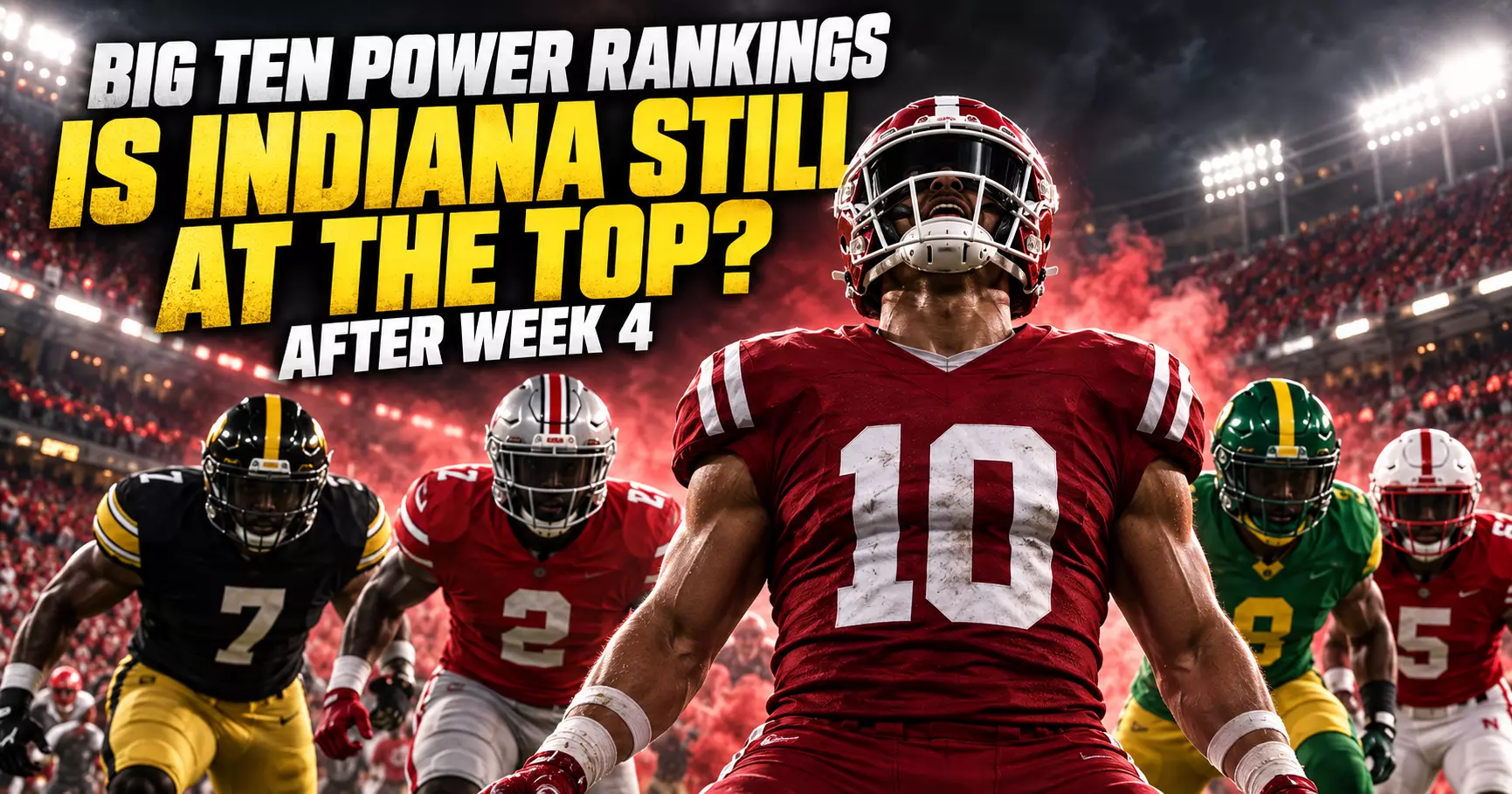
Indiana survived its first serious challenge of the season, Iowa proved it could win a defensive battle at Michigan, Oregon handed USC its first loss, and Wisconsin delivered one of the weekend’s biggest surprises against Penn State.
The opening weekend of Big Ten conference play provided several significant developments.
Indiana survived its first serious challenge of the season, Iowa proved it could win a defensive battle at Michigan, Oregon handed USC its first loss, and Wisconsin delivered one of the weekend’s biggest surprises against Penn State. Nebraska and UCLA also remained undefeated, while Ohio State continued rebuilding its momentum after losing to Texas.
These rankings are based on performance, résumé, roster strength and how each team is playing right now—not simply the conference standings or national polls. A lot of changes from last weeks week 3
Big Ten Power Rankings!
18. Purdue Boilermakers
Record: 1–3
Purdue drops to the bottom after suffering its third consecutive loss. Losing to Notre Dame is hardly disqualifying by itself, but the Boilermakers have not shown enough consistency to justify placing them above another Big Ten team.
The offense occasionally produces encouraging moments, but Purdue still struggles to sustain drives and finish scoring opportunities. The defense has been placed in too many unfavorable situations and has not demonstrated that it can consistently keep the Boilermakers competitive against quality opposition.
Purdue now enters conference play needing immediate improvement. The schedule will provide some winnable games, but this team must become more physical and efficient before it can move out of the conference basement.
17. Rutgers Scarlet Knights
Record: 1–3
Rutgers finally stopped its three-game losing streak, but one victory does not erase an extremely disappointing start.
The Scarlet Knights were expected to be competitive this season, particularly because Greg Schiano’s teams are usually physical, disciplined and difficult to beat. Instead, Rutgers has struggled to establish an offensive identity and has already fallen well behind the conference’s legitimate contenders.
There is still enough defensive talent for Rutgers to become a difficult opponent later in the season, but the offense must show that it can consistently generate points against Big Ten defenses. Until that happens, the Scarlet Knights belong near the bottom of the rankings.
16. Maryland Terrapins
Record: 2–2
Maryland opened the season with two victories, but consecutive losses have exposed several weaknesses.
The Terrapins’ loss to UCLA was particularly revealing because it showed the difference between a team capable of producing explosive plays and one capable of controlling an entire game. Maryland has talent at the skill positions, but the offense remains inconsistent when opponents create pressure and force it to operate methodically.
The defense also needs to improve against the run. Maryland can remain competitive with the middle of the conference, but it has not yet demonstrated the physicality or consistency required to defeat the Big Ten’s best teams.
15. Michigan State Spartans
Record: 2–2
Michigan State has now lost consecutive games after opening the season 2–0.
The Spartans were soundly defeated 31–13 by Nebraska and committed three turnovers in the loss. Michigan State managed only 39 rushing yards and averaged 1.2 yards per attempt, preventing the offense from consistently placing pressure on Nebraska’s defense.
Pat Fitzgerald inherited a difficult rebuilding project, and those problems will not disappear in one season. Michigan State appears better organized than it was during the final stages of the previous regime, but the talent gap remains noticeable. The Spartans must improve along both lines of scrimmage before they can seriously climb these rankings.
14. Illinois Fighting Illini
Record: 2–2
Illinois entered Columbus with an opportunity to make a statement but could not seriously threaten Ohio State.
There is no shame in losing to the Buckeyes, especially on the road, but Illinois remains difficult to evaluate. The Fighting Illini handled their lesser opponents but have not demonstrated that they can consistently compete with nationally ranked teams.
Katin Houser gives Illinois experience at quarterback, and Bret Bielema’s team should become more effective as its rebuilt offensive line gains experience. For now, however, Illinois looks like a middle-to-lower-tier Big Ten team—capable of winning six or seven games but unlikely to challenge the conference’s elite.
13. Washington Huskies
Record: 3–1
Washington suffered its first loss of the season and drops several positions.
The Huskies entered the weekend undefeated but were unable to handle their first Big Ten test. Washington still possesses enough athleticism to remain dangerous, particularly when the offense establishes an early rhythm, but questions remain about the program’s ability to win physical conference games away from home.
Washington is not a bad team, and one loss should not erase three victories. The problem is that several Big Ten teams produced more impressive performances this weekend. The Huskies now need to respond quickly because another defeat would remove them from the early conference championship discussion.
12. Northwestern Wildcats
Record: 2–1
Northwestern lost at Indiana, but the Wildcats improved their standing despite the result.
Northwestern entered Bloomington as a
significant underdog
and pushed the defending national champions deep into the fourth quarter before losing 29–23. The Wildcats’ comeback fell short, but their performance confirmed that the program’s undefeated start was not entirely the product of a manageable schedule.
Northwestern played with discipline, handled the hostile environment and forced Indiana to earn the victory. The Wildcats do not have the depth of the conference’s top teams, but they appear capable of creating problems for nearly everyone on their schedule. Penn State will provide another major test next week.
11. Michigan Wolverines
Record: 3–1
Michigan’s offensive concerns finally resulted in a loss.
The Wolverines entered their matchup against Iowa undefeated, but their inability to consistently create explosive plays left them vulnerable in a defensive game. Bryce Underwood remains one of the most talented young quarterbacks in the country, but Michigan cannot expect him to solve every problem by himself.
The offensive line, running game and receiving corps must provide more assistance. Michigan’s defense remains strong enough to keep the Wolverines in almost every game, but elite Big Ten opponents will eventually capitalize when the offense repeatedly fails to finish drives.
Michigan remains dangerous, but it no longer looks like a serious conference favorite.
10. Penn State Nittany Lions
Record: 3–1
Penn State’s first significant test under Matt Campbell ended with a disappointing home loss to Wisconsin.
The Nittany Lions opened the season 3–0 but did not face an opponent capable of exposing their weaknesses. Wisconsin did exactly that. Penn State struggled to control the game physically and failed to generate the offensive consistency expected from a nationally ranked team.
Campbell deserves time to build the program in his image, and one loss does not mean Penn State’s season is over. However, the Nittany Lions no longer receive the benefit of the doubt based solely on recruiting rankings and preseason expectations.
A difficult trip to Northwestern now becomes considerably more important than anyone anticipated.
9. Minnesota Golden Gophers
Record: 3–1
Minnesota quietly produced one of the weekend’s most important Big Ten victories by defeating Washington.
The Golden Gophers are rarely spectacular, but P.J. Fleck continues to field teams that understand how they want to play. Minnesota emphasizes ball control, avoids unnecessary risks and attempts to turn every game into a physical fourth-quarter contest.
That approach worked against Washington and gave Minnesota its third victory of the season. The Golden Gophers are not yet a legitimate conference championship contender, but they have become dangerous enough to defeat teams with more highly rated talent.
Minnesota’s position inside the top 10 is deserved.
8. USC Trojans
Record: 4–1
USC remains inside the top eight, but the loss to Oregon revived familiar questions about Lincoln Riley’s program.
The Trojans opened 4–0 and displayed one of the conference’s most productive offenses. Once USC encountered an opponent with comparable talent, however, the game again came down to physicality, defensive execution and performance under pressure.
Oregon’s victory does not destroy USC’s season, but it prevents the Trojans from claiming a position among the Big Ten favorites. USC can still score with almost anyone, and its 4–1 record deserves respect.
The concern is whether the Trojans can defeat
elite opponents
when offensive fireworks are not enough.
7. Wisconsin Badgers
Record: 3–1
Wisconsin makes the week’s biggest jump after defeating Penn State.
The Badgers opened the season with a loss but have responded with three consecutive victories. Winning at Penn State represents the first major statement of the season and suggests Wisconsin may be ready to outperform its modest preseason expectations.
The Badgers succeeded by playing the kind of football historically associated with the program: physical defense, a committed running game and limited self-inflicted mistakes.
One victory does not prove Wisconsin is ready to challenge Indiana or Ohio State, but the Badgers have earned a place in the upper half of the conference. Their upcoming game against Michigan State gives them an opportunity to build additional momentum.
6. UCLA Bruins
Record: 4–0
UCLA may be the Big Ten’s biggest surprise.
The Bruins moved to 4–0 by defeating Maryland and are now 2–0 in conference play. No other Big Ten team has earned more league victories through the opening month.
UCLA does not possess the preseason reputation of Indiana, Ohio State, Penn State or Oregon, but the Bruins have been productive, aggressive and remarkably consistent. They deserve to be evaluated on what they have accomplished rather than what anyone expected in August.
The schedule will become more challenging, and UCLA must still prove it can defeat one of the conference’s nationally ranked powers. For now, an undefeated record and two conference victories are enough to earn the No. 3 position.
5. Nebraska Cornhuskers
Record: 4–0
Nebraska is undefeated and becoming increasingly difficult to dismiss.
The Cornhuskers defeated Michigan State 31–13 while committing no turnovers and holding the Spartans to only 39 rushing yards. Anthony Colandrea threw for 212 yards and two touchdowns, while Nebraska produced 369 total yards.
Matt Rhule’s team has not yet defeated an opponent ranked in the national top 25, but Nebraska is winning comfortably and avoiding the late-game mistakes that damaged previous seasons.
The Cornhuskers appear more physical, confident and disciplined. Maryland awaits next, giving Nebraska another favorable opportunity to remain unbeaten before the schedule becomes more difficult.
4. Oregon Ducks
Record: 3–1
Oregon has recovered impressively from its stunning loss to Oklahoma State.
The Ducks have won two consecutive games, including Saturday’s road victory over previously undefeated USC. That result matters because Oregon entered Los Angeles under pressure and responded against a nationally ranked conference opponent.
Oregon’s roster remains one of the most talented in the Big Ten, and the Ducks appear to have addressed some of the defensive problems that contributed to their early loss. They cannot completely erase that defeat, which keeps them outside the top five, but their championship hopes remain alive.
Saturday’s performance looked much more like the Oregon team everyone expected to see entering the season.
3. Iowa Hawkeyes
Record: 4–0
Iowa is no longer simply a team with an elite defense and an offense trying to survive.
The Hawkeyes went into Michigan Stadium and defeated a ranked Wolverines team in the kind of game Michigan expected to control. Iowa embraced the physical battle, protected the football and demonstrated that its early offensive improvement could translate against a quality defense.
The Hawkeyes are now 4–0 and have one of the best victories earned by any Big Ten team this season. Their 422-yard rushing performance against Northern Iowa generated excitement, but beating Michigan provided genuine validation.
Iowa will have an opportunity to take over the top position when Ohio State visits next weekend.
2. Ohio State Buckeyes
Record: 3–1
Ohio State continues working its way back toward the top after the devastating collapse against Texas.
The Buckeyes took care of Illinois and have now won two consecutive games. Julian Sayin continues to grow into his role, while Ohio State’s overall talent gives the program a higher ceiling than most teams in the conference.
The question is whether the Buckeyes have completely recovered from blowing a 20-point fourth-quarter lead against Texas. Dominating overmatched opponents is one thing. Winning a close conference game against another contender is something different.
Ohio State will receive that opportunity next week at Iowa in one of the biggest Big Ten games of the young season.
1. Indiana Hoosiers
Record: 4–0
Indiana remains No. 1, but Northwestern provided the
defending national champions
with their first real warning.
The Hoosiers defeated the Wildcats 29–23 after three consecutive comfortable victories. It was not Indiana’s cleanest performance, but championship teams must occasionally win when they are challenged, frustrated and unable to create separation.
Josh Hoover and the offense did enough to survive, while Indiana’s defense delivered important stops late in the game. Curt Cignetti will have plenty to correct, particularly after Northwestern remained within one possession for most of the night.
Indiana is 4–0, owns the conference’s longest active winning streak and remains the defending national champion. Until somebody defeats the Hoosiers, the top position belongs to them.
Final Thoughts
Week 4 created a much deeper Big Ten championship race than expected.
Indiana remains the team to beat, but Iowa, UCLA and Nebraska are all undefeated. Ohio State and Oregon remain dangerous despite early losses, while Wisconsin’s upset of Penn State introduced another potential contender.
The biggest game next weekend will be Ohio State at Iowa. An Iowa victory would establish the Hawkeyes as Indiana’s biggest challenger and could move them to No. 1 in these rankings. Ohio State can reenter the championship discussion by ending Iowa’s unbeaten start.
Indiana, meanwhile, travels to Rutgers with an opportunity to improve to 5–0 and maintain its position atop the conference.
New Users – Get $350 in Bonus Bets when you wager $5 for 7 days
T&Cs apply
4.6/5
Gambling Problem? Call 1-800-GAMBLER or 1-800-MY-RESET. Call 1-888-789-7777 or visit ccpgg.org/chat (CT). Hope is here. GamblingHelpLineMA.org or call (800) 327-5050 for 24/7 support (MA). Visit www.mdgamblinghelp.org (MD). Call 1-877-8HOPE-NY or text HOPENY (NY). 21+ (18+ DC, WY) and present in select states (for KS, in affiliation with Kansas Star Casino). Find online real money wagering only. Min $5 wager required for 7 consecutive days. $5 free play credit. Bonus issued as non-withdrawable bonus with cash withdrawable bonus with cash withdrawable. Bonus bets which expire 7 days after receipt. Restrictions apply. See terms at sportsbook.fanduel.com. Call 1-877-770-7867 (LA).
Up To $1500 in Bonus Bets Paid Back if your First Bet Does Not Win
T&Cs apply
4.5/5
Gambling problem? Call 1-800-GAMBLER or 1-800-MY-RESET (Available in the US) 877-8-HOPENY or text HOPENY (467369) (NY) 1-800-327-5050 (MA), 1-800-BETS-OFF (IA), 1-800-981-0023 (PR). 21+ only. Please Gamble Responsibly. See BetMGM.com for Terms. First Bet Offer for new customers only (if applicable). Subject to eligibility requirements. Bonus bets are non-withdrawable. In partnership with Kansas Crossing Casino and Hotel. Promotional offers not available in Mississippi, Massachusetts, New York, Ontario, or Puerto Rico.
New DraftKings Customers: Bet $5, Get $200 + 3 Months of NBA League Pass!
T&Cs apply
4.5/5
GAMBLING PROBLEM? CALL 1-800-GAMBLER or 1-800-MY-RESET, (800) 327-5050 or visit gamblinghelplinema.org (MA). Please Gamble Responsibly. 888-789-7777/visit ccpg.org (CT), or visit www.mdgamblinghelp.org (MD), 1-800-981-0023 (PR). 21+ and present in most states. (18+ DC/NH/PR/WY). Void in CAN. Eligibility restrictions apply. On behalf of Boot Hill Casino (KS). Pass-thru of per wager tax may apply in IL. 1 per new Sportsbook customer. $5+ first-time bet req. Max. $200 issued as non-withdrawable Bonus Bets. Stake removed from payout. Reward issued as $50 in Bonus Bets every 7 days via click-to-claim for 21 days. Bonus Bets and click-to-claims expire 7 days (168hrs) after issuance. Terms: dkng.co/offer. Get 1 promo code to redeem a 3-month NBA League Pass subscription, complimentary of DraftKings. Subscription auto-renews monthly at then-current price (currently $16.99/mo); cancel anytime. Terms, restrictions, and eligibility requirements apply. Redeem League Pass by 12/19/26 at 11:59 PM ET. Addt’l terms: support.watch.nba.com/hc/en-us/articles/9165532876183-League-Pass-Terms-of-Use_. Ends 11/29/26 at 11:59 PM ET. Sponsored by DK.
Must be 21+. GAMBLING PROBLEM? CALL 1-800-GAMBLER OR CALL 1-800-MY-RESET, www.mdgamblinghelp.org (MD), (800)-327-5050 or gamblinghelplinema.org (MA), Call (877)8-HOPENY or text HOPENY (467369) (NY), (888) 789-7777 or ccpg.org (CT), morethanagame.nc.gov (NC), 1800gambler.net (WV)
Bet $1 and get double the winnings up to $25 for your next 10 bets
T&Cs apply
4.4/5
21+ New users only. Must register using eligible promo code. First bet after registration must qualify. Max. Bonus Bet: $1,000. Bonus Bet expires 14 days after receipt. Void where prohibited. See Caesars.com/promos for full terms. Gambling Problem? 1-800-GAMBLER (1-800-426-2537)
21+ and present in OH. Gambling Problem? Call 1-800-GAMBLER.
This site is using
Cloudflare
and adheres to the
Google Safe Browsing Program. We adapted
Google's Privacy Guidelines
to keep your data safe at all times.
Close
Ready to Win Big? Join the Elite with Our Sports Betting Deals!
FanDuel Promo
New Users – Get $350 in Bonus Bets when you wager $5 for 7 days
Our Favorite
T&Cs and 21+ apply
Gambling Problem? Call 1-800-GAMBLER or 1-800-MY-RESET. Call 1-888-789-7777 or visit ccpgg.org/chat (CT). Hope is here. GamblingHelpLineMA.org or call (800) 327-5050 for 24/7 support (MA). Visit www.mdgamblinghelp.org (MD). Call 1-877-8HOPE-NY or text HOPENY (NY). 21+ (18+ DC, WY) and present in select states (for KS, in affiliation with Kansas Star Casino). Find online real money wagering only. Min $5 wager required for 7 consecutive days. $5 free play credit. Bonus issued as non-withdrawable bonus with cash withdrawable bonus with cash withdrawable. Bonus bets which expire 7 days after receipt. Restrictions apply. See terms at sportsbook.fanduel.com. Call 1-877-770-7867 (LA).
Code:
Open FanDuel
Get Bonus
BetMGM Promo
Up To $1500 in Bonus Bets Paid Back if your First Bet Does Not Win
Best Slots
T&Cs and 21+ apply
Gambling problem? Call 1-800-GAMBLER or 1-800-MY-RESET (Available in the US) 877-8-HOPENY or text HOPENY (467369) (NY) 1-800-327-5050 (MA), 1-800-BETS-OFF (IA), 1-800-981-0023 (PR). 21+ only. Please Gamble Responsibly. See BetMGM.com for Terms. First Bet Offer for new customers only (if applicable). Subject to eligibility requirements. Bonus bets are non-withdrawable. In partnership with Kansas Crossing Casino and Hotel. Promotional offers not available in Mississippi, Massachusetts, New York, Ontario, or Puerto Rico.
Code:
Open BetMGM
Get Bonus
DraftKings Promo
New DraftKings Customers: Bet $5, Get $200 + 3 Months of NBA League Pass!
Newcomer
T&Cs and 21+ apply
GAMBLING PROBLEM? CALL 1-800-GAMBLER or 1-800-MY-RESET, (800) 327-5050 or visit gamblinghelplinema.org (MA). Please Gamble Responsibly. 888-789-7777/visit ccpg.org (CT), or visit www.mdgamblinghelp.org (MD), 1-800-981-0023 (PR). 21+ and present in most states. (18+ DC/NH/PR/WY). Void in CAN. Eligibility restrictions apply. On behalf of Boot Hill Casino (KS). Pass-thru of per wager tax may apply in IL. 1 per new Sportsbook customer. $5+ first-time bet req. Max. $200 issued as non-withdrawable Bonus Bets. Stake removed from payout. Reward issued as $50 in Bonus Bets every 7 days via click-to-claim for 21 days. Bonus Bets and click-to-claims expire 7 days (168hrs) after issuance. Terms: dkng.co/offer. Get 1 promo code to redeem a 3-month NBA League Pass subscription, complimentary of DraftKings. Subscription auto-renews monthly at then-current price (currently $16.99/mo); cancel anytime. Terms, restrictions, and eligibility requirements apply. Redeem League Pass by 12/19/26 at 11:59 PM ET. Addt’l terms: support.watch.nba.com/hc/en-us/articles/9165532876183-League-Pass-Terms-of-Use_. Ends 11/29/26 at 11:59 PM ET. Sponsored by DK.
Code:
Open DraftKings
Get Bonus
Find out what the legends have to say about sports this week....
New Users – Get $350 in Bonus Bets when you wager $5 for 7 days
Gambling Problem? Call 1-800-GAMBLER or 1-800-MY-RESET. Call 1-888-789-7777 or visit ccpgg.org/chat (CT). Hope is here. GamblingHelpLineMA.org or call (800) 327-5050 for 24/7 support (MA). Visit www.mdgamblinghelp.org (MD). Call 1-877-8HOPE-NY or text HOPENY (NY). 21+ (18+ DC, WY) and present in select states (for KS, in affiliation with Kansas Star Casino). Find online real money wagering only. Min $5 wager required for 7 consecutive days. $5 free play credit. Bonus issued as non-withdrawable bonus with cash withdrawable bonus with cash withdrawable. Bonus bets which expire 7 days after receipt. Restrictions apply. See terms at sportsbook.fanduel.com. Call 1-877-770-7867 (LA).