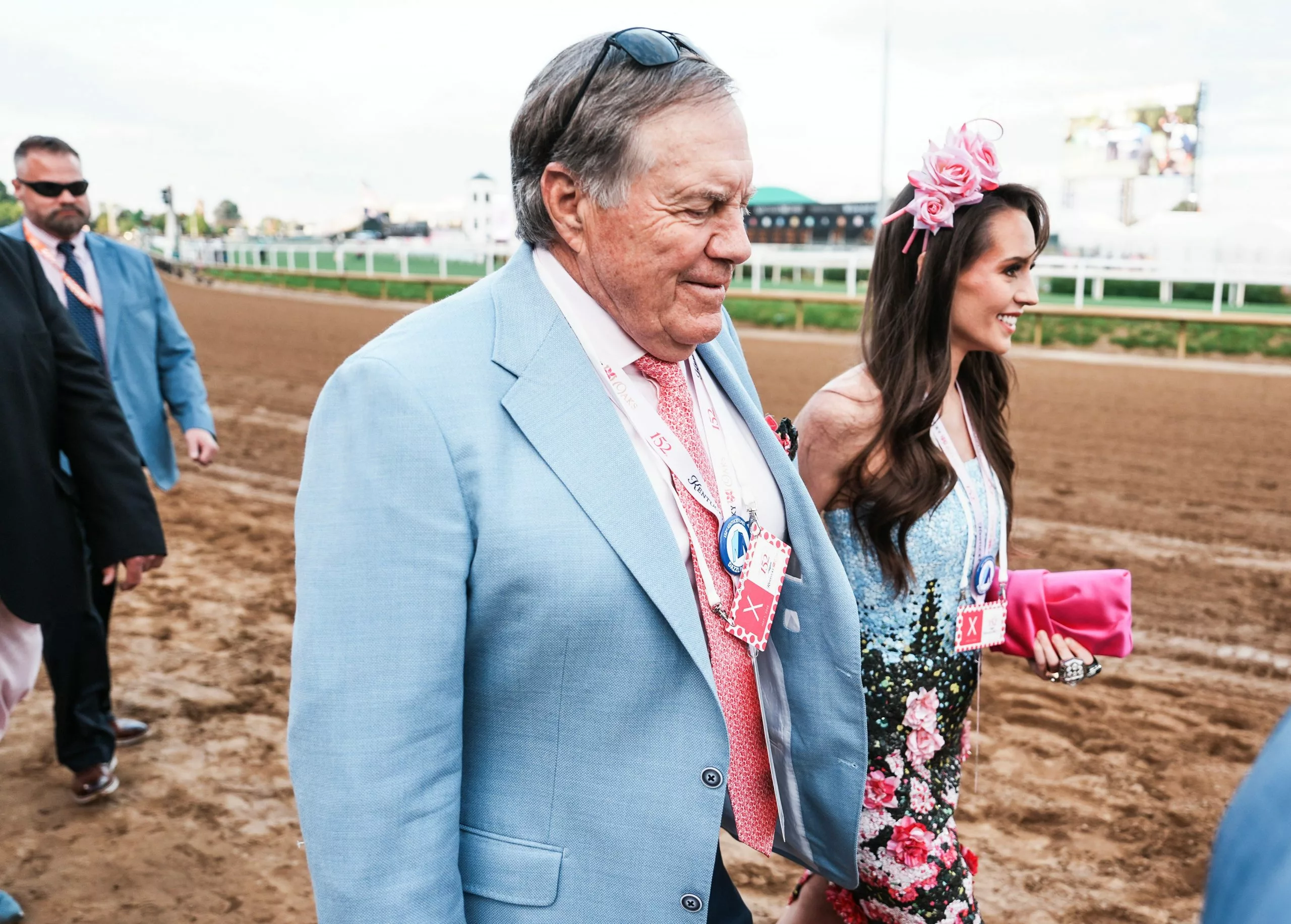
Bill Belichick and girlfriend Jordon Hudson on the dirt track before the 2026 Kentucky Oaks race at Churchill Downs on Friday, May 1, 2026
Bill Belichick arrived at North Carolina carrying the résumé of one of the greatest coaches in football history. Six Super Bowl championships as the head coach of the New England Patriots, two more as a New York Giants assistant, 333 combined regular-season and playoff victories and more than two decades of unprecedented NFL dominance had already secured his place among the sport’s immortals.
He should have spent his final years being celebrated as a football genius.
Instead, Belichick’s move to
Chapel Hill
has turned the most disciplined coach of his generation into the central figure in a traveling circus. His first North Carolina team went 4-8, missed a bowl game and produced one of the worst offenses in the country. Meanwhile, coverage of Belichick became dominated by his relationship with Jordon Hudson, a woman nearly 50 years younger than him, and questions about how much influence she exercised over his professional affairs.
The man who once eliminated distractions better than any coach in football has become surrounded by them.
If the 2026 season unfolds like the first, it should be Belichick’s last.
From “Do Your Job” to a National Punchline
Belichick built his reputation on control.
New England operated under a famously strict system in which individual personalities were supposed to remain secondary to the team. Players were expected to ignore outside noise, avoid unnecessary controversy and concentrate on their assignments. Belichick rarely provided reporters with anything useful and treated questions about subjects outside football like personal insults.
The message was simple: do your job.
That philosophy helped the Patriots win six Super Bowls and appear in nine during Belichick’s tenure. New England rarely beat itself. The Patriots were prepared, disciplined and usually several moves ahead of their opponents.
North Carolina has looked nothing like that.
The Tar Heels finished Belichick’s first season 4-8 overall and 2-6 in the ACC. They lost five games by double digits and ended the year with three consecutive defeats, including a humiliating 42-19 loss to rival North Carolina State.
The offense averaged only 19.2 points and 288.8 yards per game. Those numbers ranked 118th and 129th, respectively, among 134 Football Bowl Subdivision programs.
This was not an undermanned team squeezing every ounce from its talent. It was a poorly functioning program that frequently looked confused, overmatched and incapable of adjusting.
The coach who once demanded perfection could not even produce competence.
The Jordon Hudson Distraction
Belichick’s relationship with Jordon Hudson is legally and personally his business. They are two adults, and the considerable age difference does not automatically make their relationship improper. It does make it disturbing that a man in his mid 70s has decided to be together. What kind of conversations would they have? I guess conversation are not on Bill’s mind!
The problem began when the relationship appeared to cross into Belichick’s professional life.
Hudson became a visible presence around Belichick’s media appearances and business affairs. She attended practices and was involved with Belichick Productions. Her influence attracted national attention during an awkward CBS Sunday Morning interview intended to promote Belichick’s book,
The Art of Winning.
When interviewer Tony Dokoupil asked Belichick how the couple met, Hudson interrupted from off camera and shut down the question. That brief exchange became the defining moment of the interview. Instead of discussing football, leadership or Belichick’s book, the country spent days debating why his girlfriend appeared to be directing the conversation.
Belichick later defended Hudson and accused CBS of deceptively editing the interview. He said she was present because another publicist was unavailable and was merely attempting to keep the discussion focused.
Even if Belichick’s explanation is accepted, the result remains the same: another distraction had overwhelmed the story he wanted to tell.
A proposed college version of HBO’s
Hard Knocks
featuring North Carolina also fell apart. According to reports, NFL Films became uncomfortable with Hudson’s requested involvement, including alleged demands for content approval and partial ownership.
There were also reports that Hudson had been banned from
North Carolina’s football facilities. The university publicly denied those reports and said she remained welcome. That distinction is important, but the fact that UNC felt compelled to issue a statement about its coach’s girlfriend demonstrated how far the situation had traveled from football.
None of these controversies would have mattered nearly as much if North Carolina had been winning. Belichick’s problem was not simply that his relationship attracted attention. It was that the relationship and its accompanying drama became more interesting than his football team.
Belichick Created the Circus
Belichick’s defenders can blame the media for obsessing over his private life. They can accuse reporters of sensationalizing his relationship or attempting to embarrass a legendary coach.
There is some truth to that. A 74-year-old dating a 25-year-old guarantees attention whether that attention is fair or not.
But Belichick cannot spend decades demanding that players eliminate distractions and then refuse responsibility when his own decisions create them.
He chose to bring Hudson into public and professional settings. He defended her involvement. He participated in interviews that opened the door to questions about their relationship. When controversies emerged, he allowed the dispute with CBS to continue into 2026 instead of ending the conversation and returning the focus to football.
That is the great irony of Belichick’s North Carolina experiment. The coach famous for controlling every detail has lost control of his own story.
At New England, Belichick could silence a controversy with a blank stare and a short answer. At North Carolina, every attempt to suppress the story seemed to produce another week of headlines.
The hoodie had been replaced by a soap opera.
The NFL Model Failed in College
North Carolina hired Belichick believing he could turn the Tar Heels into a professional-style operation. General manager Michael Lombardi referred to the program as the NFL’s “33rd team,” creating the impression that Belichick’s system would overwhelm conventional college programs.
Instead, the transition exposed how different college football had become.
Belichick understood professional roster construction, opponent preparation and situational football better than almost anyone. College football, however, now requires constant recruiting, donor relations, NIL management, transfer-portal evaluation and communication with young players who can leave whenever they become unhappy.
A championship ring cannot solve every problem.
Belichick rebuilt the roster with 67 newcomers, but the massive turnover never produced a cohesive team. The offense lacked playmakers, the quarterback position remained unstable and the Tar Heels rarely resembled the efficient professional operation they had promised.
Belichick fired offensive coordinator Freddie Kitchens and special-teams coordinator Mike Priefer after the season. Replacing Kitchens with Bobby Petrino may improve the offense because Petrino remains an accomplished play caller. It also adds another strong personality with a famously checkered history to a program already drowning in controversy. By checkered past I mean that Petrino is a known scumbag with a history littered with transgressions.
The solution to one circus was apparently to hire another ringmaster.
More Chaos Entering 2026
North Carolina needed a quiet offseason devoted to repairing the roster and correcting the mistakes of 2025. It did not get one.
Lombardi, Belichick’s handpicked general manager and longtime associate, was placed on paid administrative leave in July following a human-resources complaint filed by a former football staff member.
Defensive coordinator Steve Belichick then took an indefinite medical leave shortly before the season. His health is a private matter and should not be treated as a scandal, but his absence nevertheless creates another major football challenge. North Carolina must determine who will direct the defense as it prepares for the opener against TCU in Ireland.
There have also been reports of an investigation into potential NIL violations surrounding the program.
One controversy can be dismissed as bad luck. When controversies become constant, they indicate a program that is not being managed properly.
Belichick was hired to bring stability, professionalism and championship standards to Chapel Hill. Instead, North Carolina enters his second season with questions surrounding its head coach, his girlfriend, its general manager, its coordinator structure and the direction of the entire operation.
Has Belichick Damaged His Legacy?
Nothing that happens at North Carolina can erase
six Super Bowl championships. Belichick’s defensive game plans, roster decisions and sustained success in New England remain part of football history.
But legacies are not composed only of achievements. They are also shaped by final impressions.
Belichick’s final Patriots seasons had already raised questions about how much of New England’s dynasty belonged to him and how much belonged to Tom Brady. After Brady left, the Patriots went 29-38 over Belichick’s final four seasons and made only one playoff appearance. New England’s offense deteriorated, quarterback development failed and Belichick’s personnel decisions became increasingly questionable.
His move to North Carolina provided an opportunity to answer those critics. He could build a program without Brady, demonstrate that his system translated to college football and leave the sport on his own terms.
Instead, he went 4-8.
Rather than reminding the public why he was brilliant, Belichick’s first year reinforced the argument that the game had passed him by. Instead of controlling every element of the program, he became the face of its dysfunction.
He has not erased his accomplishments, but he has damaged the ending of his story.
Young fans who did not witness the Patriots dynasty are not seeing the cold, calculating mastermind who outcoached the NFL for two decades. They are seeing an aging coach losing college games while his girlfriend becomes part of the weekly sports-news cycle.
That is not the legacy Belichick spent 50 years constructing.
Winning Is the Only Way Out
The easiest way for Belichick to end the mockery is to win.
If North Carolina reaches eight or nine victories, competes in the ACC and develops into the disciplined team Belichick promised, the conversation will change. Hudson’s presence will become a secondary story. The failed CBS interview will become yesterday’s joke. Belichick will receive credit for adapting after a difficult first season.
But another 4-8 finish would be devastating.
North Carolina owes Belichick substantial guaranteed money if it fires him, which could make an immediate dismissal financially painful. Belichick, however, reportedly can leave for only $1 million. That imbalance gives him far more control over the relationship than the university possesses.
The question is whether either side will want the experiment to continue after another losing season.
Belichick is 74. He is not leading a five-year rebuild. North Carolina did not hire him to gradually reach the Duke’s Mayo Bowl. The school made an extraordinary investment because it believed the greatest coach in NFL history could create immediate credibility and national relevance.
He created relevance, but for all the wrong reasons.
This Should Be the Final Test
Bill Belichick deserves to be remembered as one of football’s greatest coaches. His preparation, adaptability and defensive brilliance changed the NFL. No failed college experiment can take away the banners hanging in New England.
But greatness does not provide lifetime immunity from criticism.
Belichick chose North Carolina. He chose the staff. He chose the professional-style structure. He allowed his personal relationship to become intertwined with his public and business affairs. Most importantly, he coached a football team that lost eight games.
The same standard Belichick applied to thousands of players must now be applied to him: do your job.
If the Tar Heels win in 2026, Belichick can rescue the final chapter of his career. If they lose again while controversy continues consuming the program, North Carolina should stop pretending the experiment is about to work.
The greatest coach of his generation is running out of time. One more season of chasing headlines, managing distractions and losing football games should be enough.
For Bill Belichick, 2026 must be redemption—or retirement.
Up To $1500 in Bonus Bets Paid Back if your First Bet Does Not Win
T&Cs apply
4.5/5
Gambling problem? Call 1-800-GAMBLER or 1-800-MY-RESET (Available in the US) 877-8-HOPENY or text HOPENY (467369) (NY) 1-800-327-5050 (MA), 1-800-BETS-OFF (IA), 1-800-981-0023 (PR). 21+ only. Please Gamble Responsibly. See BetMGM.com for Terms. First Bet Offer for new customers only (if applicable). Subject to eligibility requirements. Bonus bets are non-withdrawable. In partnership with Kansas Crossing Casino and Hotel. Promotional offers not available in Mississippi, Massachusetts, New York, Ontario, or Puerto Rico.
New DraftKings Customers: Spend $5+ Get $150 in Bonuses
T&Cs apply
4.5/5
GAMBLING PROBLEM? CALL 1-800-GAMBLER or 1-800-MY-RESET, (800) 327-5050 or visit gamblinghelplinema.org (MA). Please Gamble Responsibly. 888-789-7777/visit ccpg.org (CT), or visit www.mdgamblinghelp.org (MD), 1-800-981-0023 (PR). 21+ and present in most states. (18+ DC/NH/PR/WY). Void in CAN. Eligibility restrictions apply. On behalf of Boot Hill Casino (KS). Pass-thru of per wager tax may apply in IL. 1 per new DraftKings customer. $5+ first-time bet req. Max. $150 issued as non-withdrawable Bonus Bets. Stake removed from payout. Reward issued as $50 in Bonus Bets every 7 days via click-to-claim for 14 days. Bonus Bets and click-to-claims expire 7 days (168hrs) after issuance. Terms: sportsbook.draftkings.com/promos. Ends 10/11/26 at 11:59 PM ET. Sponsored by DK.
Must be 21+. GAMBLING PROBLEM? CALL 1-800-GAMBLER OR CALL 1-800-MY-RESET, www.mdgamblinghelp.org (MD), (800)-327-5050 or gamblinghelplinema.org (MA), Call (877)8-HOPENY or text HOPENY (467369) (NY), (888) 789-7777 or ccpg.org (CT), morethanagame.nc.gov (NC), 1800gambler.net (WV)
Bet $1 and get double the winnings up to $25 for your next 10 bets
T&Cs apply
4.4/5
21+ New users only. Must register using eligible promo code. First bet after registration must qualify. Max. Bonus Bet: $1,000. Bonus Bet expires 14 days after receipt. Void where prohibited. See Caesars.com/promos for full terms. Gambling Problem? 1-800-GAMBLER (1-800-426-2537)
21+ and present in OH. Gambling Problem? Call 1-800-GAMBLER.
This site is using
Cloudflare
and adheres to the
Google Safe Browsing Program. We adapted
Google's Privacy Guidelines
to keep your data safe at all times.
Close
Ready to Win Big? Join the Elite with Our Sports Betting Deals!
FanDuel Promo
New Users – Get $250 in Bonus Bets when you wager $5 for 5 days
Up To $1500 in Bonus Bets Paid Back if your First Bet Does Not Win
Best Slots
T&Cs and 21+ apply
Gambling problem? Call 1-800-GAMBLER or 1-800-MY-RESET (Available in the US) 877-8-HOPENY or text HOPENY (467369) (NY) 1-800-327-5050 (MA), 1-800-BETS-OFF (IA), 1-800-981-0023 (PR). 21+ only. Please Gamble Responsibly. See BetMGM.com for Terms. First Bet Offer for new customers only (if applicable). Subject to eligibility requirements. Bonus bets are non-withdrawable. In partnership with Kansas Crossing Casino and Hotel. Promotional offers not available in Mississippi, Massachusetts, New York, Ontario, or Puerto Rico.
Code:
Open BetMGM
Get Bonus
DraftKings Promo
New DraftKings Customers: Spend $5+ Get $150 in Bonuses
Newcomer
T&Cs and 21+ apply
GAMBLING PROBLEM? CALL 1-800-GAMBLER or 1-800-MY-RESET, (800) 327-5050 or visit gamblinghelplinema.org (MA). Please Gamble Responsibly. 888-789-7777/visit ccpg.org (CT), or visit www.mdgamblinghelp.org (MD), 1-800-981-0023 (PR). 21+ and present in most states. (18+ DC/NH/PR/WY). Void in CAN. Eligibility restrictions apply. On behalf of Boot Hill Casino (KS). Pass-thru of per wager tax may apply in IL. 1 per new DraftKings customer. $5+ first-time bet req. Max. $150 issued as non-withdrawable Bonus Bets. Stake removed from payout. Reward issued as $50 in Bonus Bets every 7 days via click-to-claim for 14 days. Bonus Bets and click-to-claims expire 7 days (168hrs) after issuance. Terms: sportsbook.draftkings.com/promos. Ends 10/11/26 at 11:59 PM ET. Sponsored by DK.
Code:
Open DraftKings
Get Bonus
Find out what the legends have to say about sports this week....