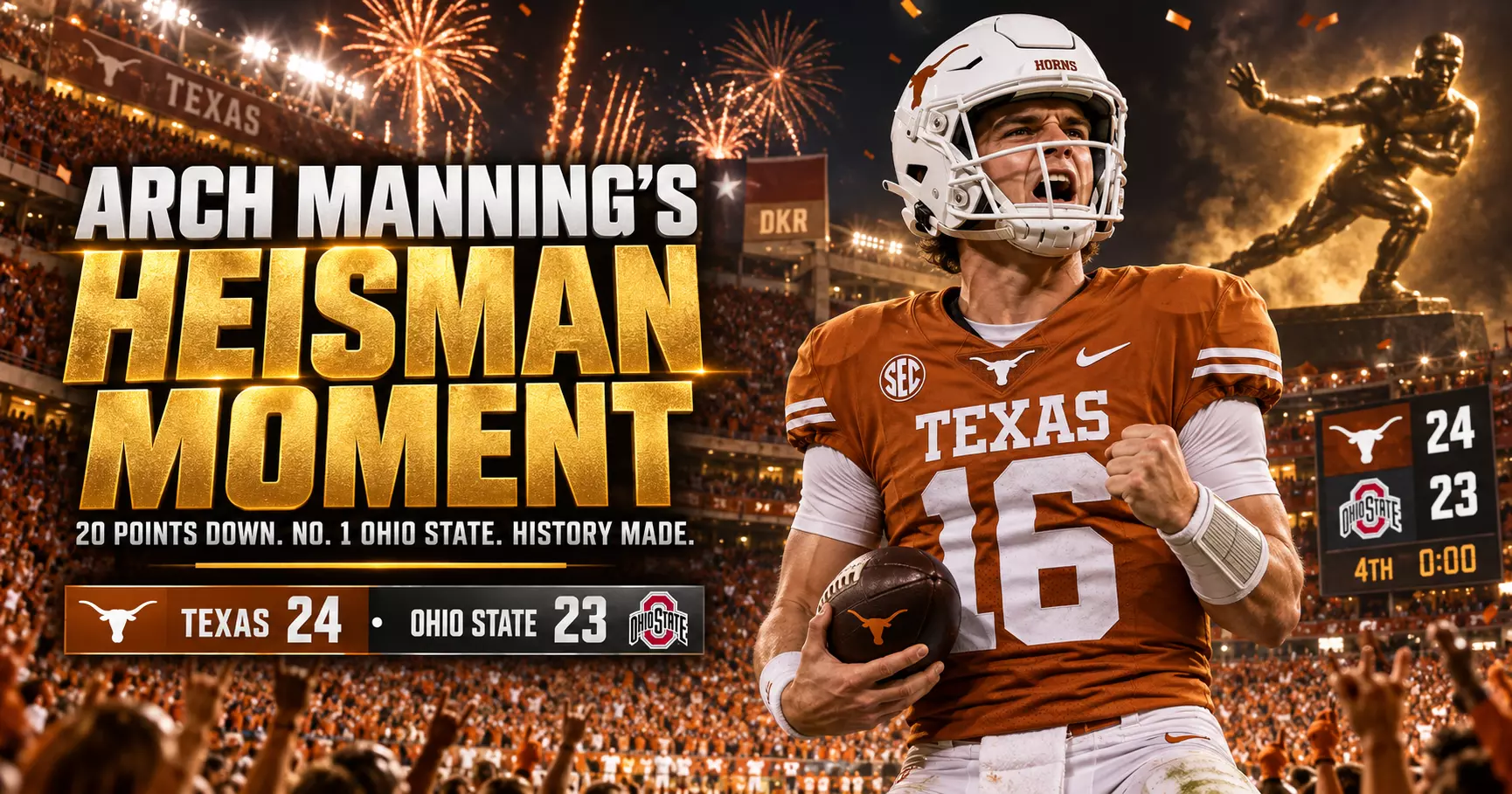
For three quarters against No. 1 Ohio State, Manning and the Texas offense appeared headed toward another bitter disappointment. The fourth-ranked Longhorns trailed 23–3 entering the final period. Ohio State had controlled the game, Manning had struggled to connect on deep throws, and the same doubts that followed him after last year’s loss to the Buckeyes were beginning to return.
Then everything changed.
Manning directed three consecutive touchdown drives in the fourth quarter, converting critical fourth downs and attacking the country’s top-ranked team with the game slipping away. Texas scored 21 unanswered points and won 24–23 on Hollywood Smothers’ 1-yard touchdown run with 25 seconds remaining.
The 20-point rally was the largest fourth-quarter comeback ever completed against an Associated Press No. 1 team.
Manning finished with only 196 passing yards, one touchdown and one interception. Nobody looking exclusively at the box score would identify it as a traditional Heisman performance.
But the Heisman has never been determined exclusively by numbers.
Voters remember what happened when the pressure became unbearable, when the opponent appeared unbeatable and when a quarterback had one final opportunity to change the direction of his season.
For three quarters, Manning looked overwhelmed.
For the final 15 minutes, he looked like the player everyone had been waiting to see.
Manning’s Final Numbers Do Not Explain His Performance
Manning completed 23 of 37 passes against Ohio State. He threw for 196 yards, one touchdown and one interception while adding 22 yards on the ground.
Those numbers will not lead a Heisman highlight package.
His response to adversity should.
Manning entered the fourth quarter having endured nearly everything that could go wrong for a highly scrutinized quarterback. Texas lost a fumble on his first completed pass. His second throw became an interception after receiver Cam Coleman could not secure a diving catch and the ball bounced into the hands of Ohio State safety Jaylen McClain.
Manning also missed open receivers. His first six passes traveling more than 15 yards were incomplete. Ryan Wingo dropped a potential touchdown during the second quarter, costing Texas its best opportunity to change the momentum before halftime.
The Longhorns entered the break trailing 20–3. Ohio State extended the margin to 23–3 in the third quarter.
Texas’ chances of winning reportedly fell to approximately two percent.
Manning could have become frustrated. He could have forced throws, abandoned the structure of the offense or allowed the previous three quarters to convince him that the comeback was impossible.
He did none of those things.
Manning completed 11 of his final 15 passes. During the fourth quarter, he went 8-for-11 for 83 yards and a touchdown. He operated with the confidence and accuracy that had been absent earlier in the game.
The transformation was dramatic.
Manning did not erase his mistakes. He made them irrelevant.
The Comeback Began Before the Fourth Quarter
The play that helped change the game came late in the third quarter.
Texas faced fourth-and-9 from its own 42-yard line with 2:21 remaining. A failure would have given Ohio State the ball in Texas territory with an opportunity to extend its 20-point lead and effectively end the game.
Steve Sarkisian kept the offense on the field.
Manning found tight end Emaree Winston for exactly nine yards.
The conversion did not immediately produce points, but it kept the possession alive and gave Texas something it had lacked throughout the night: belief.
The drive eventually covered 76 yards over 15 plays. Early in the fourth quarter, Manning found Wingo for a 3-yard touchdown, cutting Ohio State’s lead to 23–10.
Texas finally had life.
After the Longhorns forced a three-and-out, Manning faced another season-defining fourth down. Texas had fourth-and-6 at its own 32 with 11:45 remaining.
Once again, failure would have ended the comeback.
Once again, Manning delivered.
He completed a 12-yard pass to Emmett Mosley, keeping alive a 13-play, 72-yard drive that ended with Smothers scoring from one yard out.
The deficit was suddenly six.
Those
fourth-down conversions
may not appear as prominently in the highlights as the touchdowns, but they revealed what made Manning’s performance special. He had no margin for error. One bad read, inaccurate throw or moment of hesitation would have ended the game.
Manning made the correct decision and delivered an accurate pass on both plays.
That is what elite quarterbacks do.
Ohio State Gave Texas One More Chance
The Buckeyes still had an opportunity to regain control.
Leading 23–17, Ohio State moved into position for a 45-yard field goal. A successful kick would have increased the margin to nine points and forced Texas to score twice in the closing minutes.
The kick missed.
Manning received one final opportunity.
He led the Longhorns down the field with the composure of a quarterback who had already forgotten everything that went wrong during the first three quarters. Texas reached the goal line, and Smothers powered across from one yard with 25 seconds remaining.
Gianni Spetic converted the extra point, giving Texas its first lead of the night.
Ohio State attempted one final possession, but Graceson Littleton intercepted Julian Sayin to complete the comeback and send more than 100,000 fans inside Darrell K Royal-Texas Memorial Stadium into celebration.
Smothers scored the winning touchdown. Littleton produced the decisive turnover. The Texas defense prevented Ohio State from scoring during the final quarter.
This was unquestionably a complete-team comeback.
But Manning was the player responsible for making the offense believe it could happen.
This Was the Answer to Last Year’s Failure
Manning’s performance carried additional significance because of what happened against Ohio State in 2025.
The previous meeting was supposed to be his national introduction as Texas’ full-time starting quarterback. Instead, Ohio State’s defense controlled him, Texas lost, and the enormous preseason Heisman expectations surrounding Manning immediately appeared premature.
That game followed him throughout the season.
Every missed throw became evidence that his name had created expectations his performance could not support. Every ordinary statistical line generated another round of debate about whether Manning was truly an elite quarterback or simply the latest beneficiary of college football’s most famous family.
Saturday appeared ready to produce the same conclusion.
Manning struggled early. Ohio State controlled the game. Jeremiah Smith looked like the best player on the field, catching eight passes for 164 yards and a touchdown. The Buckeyes appeared ready to defeat Texas for the third consecutive time.
Manning changed the ending.
After the game, he acknowledged that last season’s Ohio State loss had given him nightmares. That history made the comeback even more meaningful. He did not erase the previous failure by avoiding Ohio State or dominating an overmatched opponent.
He answered it against the same program, facing an even larger deficit and considerably greater pressure.
That is how a quarterback changes the narrative surrounding his career.
The Manning Name Makes Every Performance Bigger
Arch Manning has never been evaluated like an ordinary college quarterback.
He is the grandson of Archie Manning and the nephew of Peyton and Eli Manning. His recruiting process became a national story before he had played his final high school game. His commitment to Texas created immediate expectations that he would become the next great Longhorns quarterback.
That attention has created enormous opportunities. It has also produced an almost impossible standard.
When Manning plays well, critics argue that he is receiving too much credit because of his last name. When he struggles, those same critics rush to declare him overrated.
There is no middle ground.
Saturday’s comeback was significant because it had nothing to do with recruiting rankings, family history or marketing campaigns. Manning had to produce on the field against the No. 1 team in the country.
Peyton and Eli could not make those fourth-down throws for him.
His name could not complete 11 of his final 15 passes.
The Manning legacy may have created the stage, but Arch Manning delivered the performance.
A Heisman Moment Does Not Have to Be Statistically Perfect
Many
Heisman winners
have produced larger statistical games than Manning did Saturday.
That misses the point.
A Heisman moment is not necessarily the afternoon when a quarterback throws six touchdown passes against an overmatched defense. It is the play, drive or comeback that voters immediately remember when the ballots arrive.
Manning now owns the signature victory of the young season.
He led Texas from 20 points down during the fourth quarter against the top-ranked team in the country. No opponent had ever completed a larger fourth-quarter comeback against an AP No. 1 team.
That historical significance will follow Manning throughout the season.
If he continues producing, every Heisman discussion will return to Ohio State. Television broadcasts will replay the fourth-down conversions, the touchdown to Wingo and the winning drive. Analysts will reference the night Manning refused to let Texas lose.
The performance does not automatically make him the Heisman favorite. He must play consistently during the SEC schedule, continue creating touchdowns and avoid the extended stretches of inaccuracy that nearly buried Texas on Saturday.
But he now possesses something every successful campaign needs.
He has the moment.
Texas May Have Found Its Championship Identity
The comeback also changed the way Texas should be evaluated nationally.
The Longhorns opened the season by defeating Texas State 59–7. Manning threw for 305 yards and matched his career high with four touchdown passes. It was dominant, efficient and expected.
Ohio State presented a different test.
Texas had to respond when nothing worked. The Longhorns had to survive turnovers, dropped passes, missed opportunities and a 20-point deficit against the nation’s top-ranked team.
They did.
Great teams eventually face a game they cannot win through talent alone. They need resilience, leadership and the willingness to continue competing when the situation appears hopeless.
Texas discovered those qualities Saturday night.
The defense made critical adjustments and held Ohio State scoreless during the fourth quarter. Smothers carried the ball 21 times for 74 yards and two touchdowns. Wingo recovered from his earlier drop to catch the touchdown that started the comeback.
Sarkisian became aggressive when Texas could no longer afford caution. His decisions to attempt the crucial fourth downs kept the season from taking a devastating turn.
Manning brought everything together.
The Longhorns should move into the No. 1 conversation because they now own the nation’s best victory. More importantly, they have shown they can win a game in which they were thoroughly outplayed for three quarters.
That ability will matter during the SEC schedule and, potentially, the College Football Playoff.
The Heisman Race Has Changed
Manning entered the season as one of the most recognizable candidates in the country, but recognition alone does not win the Heisman Trophy.
He needed a performance capable of separating him from the rest of the field.
He now has one.
His season totals remain important. Through two games, Manning has completed 47 passes for 501 yards with five touchdowns and one interception. He was spectacular against Texas State and resilient against Ohio State.
The combination matters.
The opener demonstrated what Manning can do when Texas controls the game. Saturday demonstrated what he can do when everything turns against him.
Other Heisman candidates will produce more impressive weekly numbers. Some will play in offenses designed to generate 400 passing yards and five touchdowns against weaker opponents.
Manning’s advantage is that no candidate currently owns a more important victory.
He defeated No. 1 Ohio State after trailing by 20 points entering the fourth quarter.
If Texas remains in championship contention and Manning continues playing well, voters will remember that sentence.
The Moment Everyone Was Waiting For
The expectation surrounding Manning was never simply that he would become a productive starting quarterback.
People expected greatness.
They expected him to make impossible throws, lead Texas into championship contention and display the same late-game composure associated with the quarterbacks in his family.
For three quarters Saturday night, greatness appeared far away.
Then Manning converted fourth-and-9. He converted fourth-and-6. He threw the touchdown that started the rally and directed the drive that completed it.
Texas scored 21 unanswered points and defeated the No. 1 team in the country.
The comeback was not perfect. Manning was not perfect. That is precisely what made it meaningful.
He did not begin the night playing like a Heisman winner. He became one when Texas needed him most.
Statistics will determine whether Manning remains in the race. Championships and victories will determine whether he reaches New York.
But when people remember the 2026 season, they will remember what happened in Austin.
They will remember Texas trailing Ohio State 23–3.
They will remember three fourth-quarter touchdown drives.
They will remember the night Arch Manning finally stopped being discussed primarily as the next member of football’s most famous family and became the quarterback who completed the greatest fourth-quarter comeback ever against a No. 1 team.
Arch Manning finally delivered the Heisman moment everyone had been waiting for.
New Users – Get $350 in Bonus Bets when you wager $5 for 7 days
T&Cs apply
4.6/5
Gambling Problem? Call 1-800-GAMBLER or 1-800-MY-RESET. Call 1-888-789-7777 or visit ccpgg.org/chat (CT). Hope is here. GamblingHelpLineMA.org or call (800) 327-5050 for 24/7 support (MA). Visit www.mdgamblinghelp.org (MD). Call 1-877-8HOPE-NY or text HOPENY (NY). 21+ (18+ DC, WY) and present in select states (for KS, in affiliation with Kansas Star Casino). Find online real money wagering only. Min $5 wager required for 7 consecutive days. $5 free play credit. Bonus issued as non-withdrawable bonus with cash withdrawable bonus with cash withdrawable. Bonus bets which expire 7 days after receipt. Restrictions apply. See terms at sportsbook.fanduel.com. Call 1-877-770-7867 (LA).
Up To $1500 in Bonus Bets Paid Back if your First Bet Does Not Win
T&Cs apply
4.5/5
Gambling problem? Call 1-800-GAMBLER or 1-800-MY-RESET (Available in the US) 877-8-HOPENY or text HOPENY (467369) (NY) 1-800-327-5050 (MA), 1-800-BETS-OFF (IA), 1-800-981-0023 (PR). 21+ only. Please Gamble Responsibly. See BetMGM.com for Terms. First Bet Offer for new customers only (if applicable). Subject to eligibility requirements. Bonus bets are non-withdrawable. In partnership with Kansas Crossing Casino and Hotel. Promotional offers not available in Mississippi, Massachusetts, New York, Ontario, or Puerto Rico.
New DraftKings Customers: Bet $5, Get $200 + 3 Months of NBA League Pass!
T&Cs apply
4.5/5
GAMBLING PROBLEM? CALL 1-800-GAMBLER or 1-800-MY-RESET, (800) 327-5050 or visit gamblinghelplinema.org (MA). Please Gamble Responsibly. 888-789-7777/visit ccpg.org (CT), or visit www.mdgamblinghelp.org (MD), 1-800-981-0023 (PR). 21+ and present in most states. (18+ DC/NH/PR/WY). Void in CAN. Eligibility restrictions apply. On behalf of Boot Hill Casino (KS). Pass-thru of per wager tax may apply in IL. 1 per new Sportsbook customer. $5+ first-time bet req. Max. $200 issued as non-withdrawable Bonus Bets. Stake removed from payout. Reward issued as $50 in Bonus Bets every 7 days via click-to-claim for 21 days. Bonus Bets and click-to-claims expire 7 days (168hrs) after issuance. Terms: dkng.co/offer. Get 1 promo code to redeem a 3-month NBA League Pass subscription, complimentary of DraftKings. Subscription auto-renews monthly at then-current price (currently $16.99/mo); cancel anytime. Terms, restrictions, and eligibility requirements apply. Redeem League Pass by 12/19/26 at 11:59 PM ET. Addt’l terms: support.watch.nba.com/hc/en-us/articles/9165532876183-League-Pass-Terms-of-Use_. Ends 11/29/26 at 11:59 PM ET. Sponsored by DK.
Must be 21+. GAMBLING PROBLEM? CALL 1-800-GAMBLER OR CALL 1-800-MY-RESET, www.mdgamblinghelp.org (MD), (800)-327-5050 or gamblinghelplinema.org (MA), Call (877)8-HOPENY or text HOPENY (467369) (NY), (888) 789-7777 or ccpg.org (CT), morethanagame.nc.gov (NC), 1800gambler.net (WV)
Bet $1 and get double the winnings up to $25 for your next 10 bets
T&Cs apply
4.4/5
21+ New users only. Must register using eligible promo code. First bet after registration must qualify. Max. Bonus Bet: $1,000. Bonus Bet expires 14 days after receipt. Void where prohibited. See Caesars.com/promos for full terms. Gambling Problem? 1-800-GAMBLER (1-800-426-2537)
21+ and present in OH. Gambling Problem? Call 1-800-GAMBLER.
This site is using
Cloudflare
and adheres to the
Google Safe Browsing Program. We adapted
Google's Privacy Guidelines
to keep your data safe at all times.
Close
Ready to Win Big? Join the Elite with Our Sports Betting Deals!
FanDuel Promo
New Users – Get $350 in Bonus Bets when you wager $5 for 7 days
Our Favorite
T&Cs and 21+ apply
Gambling Problem? Call 1-800-GAMBLER or 1-800-MY-RESET. Call 1-888-789-7777 or visit ccpgg.org/chat (CT). Hope is here. GamblingHelpLineMA.org or call (800) 327-5050 for 24/7 support (MA). Visit www.mdgamblinghelp.org (MD). Call 1-877-8HOPE-NY or text HOPENY (NY). 21+ (18+ DC, WY) and present in select states (for KS, in affiliation with Kansas Star Casino). Find online real money wagering only. Min $5 wager required for 7 consecutive days. $5 free play credit. Bonus issued as non-withdrawable bonus with cash withdrawable bonus with cash withdrawable. Bonus bets which expire 7 days after receipt. Restrictions apply. See terms at sportsbook.fanduel.com. Call 1-877-770-7867 (LA).
Code:
Open FanDuel
Get Bonus
BetMGM Promo
Up To $1500 in Bonus Bets Paid Back if your First Bet Does Not Win
Best Slots
T&Cs and 21+ apply
Gambling problem? Call 1-800-GAMBLER or 1-800-MY-RESET (Available in the US) 877-8-HOPENY or text HOPENY (467369) (NY) 1-800-327-5050 (MA), 1-800-BETS-OFF (IA), 1-800-981-0023 (PR). 21+ only. Please Gamble Responsibly. See BetMGM.com for Terms. First Bet Offer for new customers only (if applicable). Subject to eligibility requirements. Bonus bets are non-withdrawable. In partnership with Kansas Crossing Casino and Hotel. Promotional offers not available in Mississippi, Massachusetts, New York, Ontario, or Puerto Rico.
Code:
Open BetMGM
Get Bonus
DraftKings Promo
New DraftKings Customers: Bet $5, Get $200 + 3 Months of NBA League Pass!
Newcomer
T&Cs and 21+ apply
GAMBLING PROBLEM? CALL 1-800-GAMBLER or 1-800-MY-RESET, (800) 327-5050 or visit gamblinghelplinema.org (MA). Please Gamble Responsibly. 888-789-7777/visit ccpg.org (CT), or visit www.mdgamblinghelp.org (MD), 1-800-981-0023 (PR). 21+ and present in most states. (18+ DC/NH/PR/WY). Void in CAN. Eligibility restrictions apply. On behalf of Boot Hill Casino (KS). Pass-thru of per wager tax may apply in IL. 1 per new Sportsbook customer. $5+ first-time bet req. Max. $200 issued as non-withdrawable Bonus Bets. Stake removed from payout. Reward issued as $50 in Bonus Bets every 7 days via click-to-claim for 21 days. Bonus Bets and click-to-claims expire 7 days (168hrs) after issuance. Terms: dkng.co/offer. Get 1 promo code to redeem a 3-month NBA League Pass subscription, complimentary of DraftKings. Subscription auto-renews monthly at then-current price (currently $16.99/mo); cancel anytime. Terms, restrictions, and eligibility requirements apply. Redeem League Pass by 12/19/26 at 11:59 PM ET. Addt’l terms: support.watch.nba.com/hc/en-us/articles/9165532876183-League-Pass-Terms-of-Use_. Ends 11/29/26 at 11:59 PM ET. Sponsored by DK.
Code:
Open DraftKings
Get Bonus
Find out what the legends have to say about sports this week....
New Users – Get $350 in Bonus Bets when you wager $5 for 7 days
Gambling Problem? Call 1-800-GAMBLER or 1-800-MY-RESET. Call 1-888-789-7777 or visit ccpgg.org/chat (CT). Hope is here. GamblingHelpLineMA.org or call (800) 327-5050 for 24/7 support (MA). Visit www.mdgamblinghelp.org (MD). Call 1-877-8HOPE-NY or text HOPENY (NY). 21+ (18+ DC, WY) and present in select states (for KS, in affiliation with Kansas Star Casino). Find online real money wagering only. Min $5 wager required for 7 consecutive days. $5 free play credit. Bonus issued as non-withdrawable bonus with cash withdrawable bonus with cash withdrawable. Bonus bets which expire 7 days after receipt. Restrictions apply. See terms at sportsbook.fanduel.com. Call 1-877-770-7867 (LA).