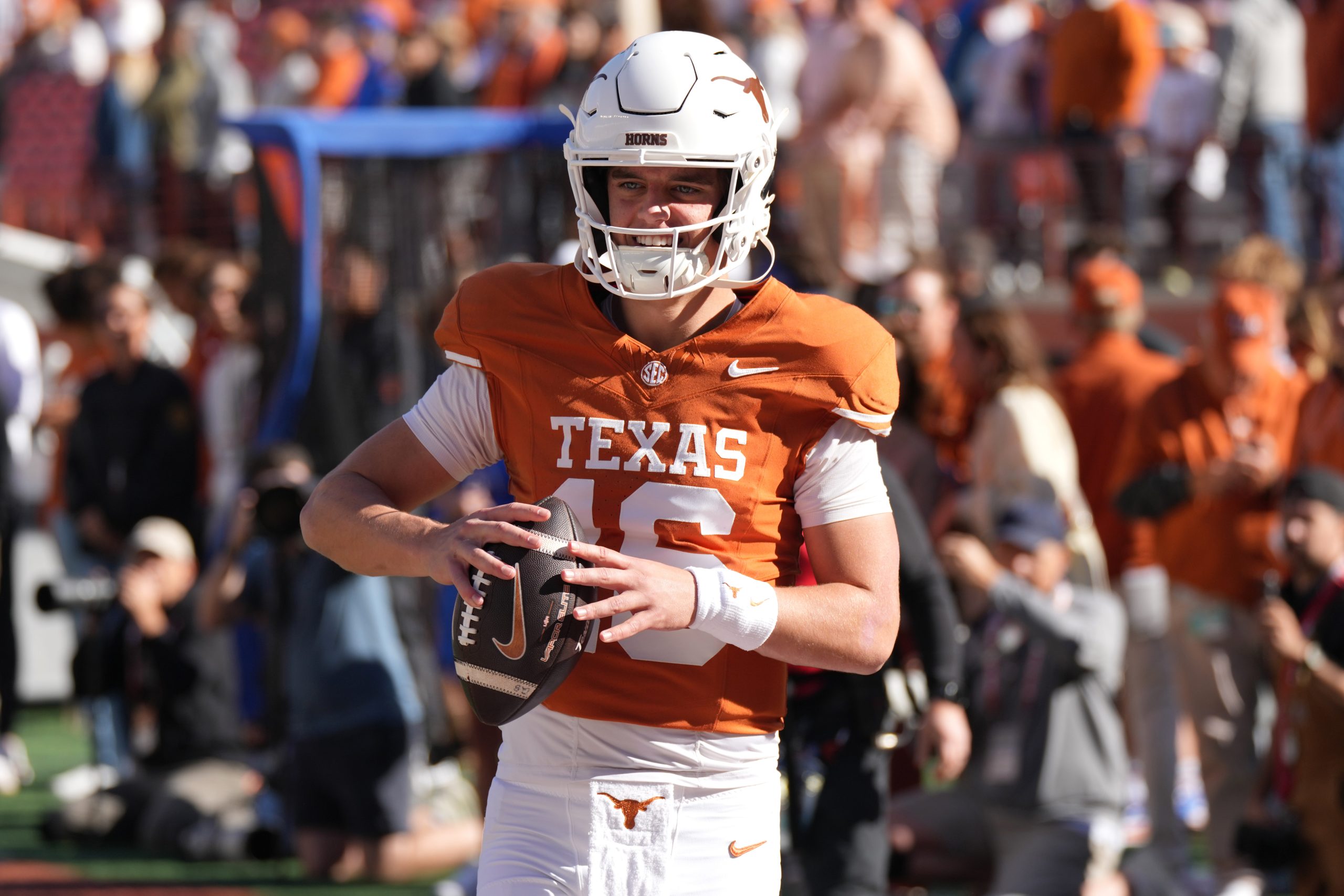
Oct 17, 2026; Austin, Texas, USA; Texas Longhorns quarterback Arch Manning (16) warms up before a game against the Florida Gators at Darrell K Royal-Texas Memorial Stadium. Mandatory Credit: Scott Wachter-Imagn Images
Two weeks ago, Texas was ranked No. 1. Now the Longhorns are preparing for a game that could change the entire purpose of their season.
Consecutive 27–24 losses to Oklahoma and Florida have dropped Texas to No. 19 in the AP poll. The Longhorns are 4–2 overall and 1–2 in the SEC, with seventh-ranked Ole Miss coming to Austin on Saturday. What once looked like a championship campaign now requires an immediate response.
The pressure naturally centers on
Arch Manning. That comes with playing quarterback at Texas, particularly when late mistakes have helped decide consecutive defeats.
But this is also a defining week for Steve Sarkisian.
His responsibility extends beyond announcing confidence in his quarterback. He must build an offensive plan that restores it—and produces results against an opponent capable of making the situation considerably worse.
Another loss would leave Texas 4–3 with three conference defeats. The conversation would shift sharply from how high the Longhorns can climb to why a season with such promise has unraveled.
The Problem Is How Texas Is Losing
Neither defeat was a blowout. That gives Texas a reasonable argument that its problems can be corrected.
It also makes the losses more frustrating.
Against Oklahoma, Manning threw an interception with 19 seconds remaining, giving the Sooners the possession that ended with Tate Sandell’s winning 47-yard field goal. Texas had an opportunity to finish the rivalry game and instead gave Oklahoma the final opening.
Against Florida, the Longhorns squandered a 17–3 lead. After their first two touchdown drives, they went seven consecutive possessions without reaching the end zone. A promising offensive start became a prolonged struggle to produce another meaningful answer.
Manning eventually brought Texas within three points, but a strip-sack in the final two minutes ended its comeback opportunity. He finished with 173 passing yards and one touchdown.
These were games Texas could have won. That matters when evaluating its talent.
But championship expectations require converting those opportunities. Being close enough to win becomes a weak defense when the same team repeatedly fails to finish.
Sarkisian Has Chosen Manning. Now He Must Help Him
Sarkisian reaffirmed Monday that Manning remains the starting quarterback.
“We need to see a better version of him this week,” Sarkisian said.
He also clarified that backup KJ Lacey Jr. receiving first-team practice snaps is part of the normal routine. Those repetitions should not be presented as an announced quarterback change.
Keeping Manning in the lineup is a defensible decision. Changing quarterbacks does not automatically repair protection, improve play design or make an offense more consistent.
But continuity only helps if Texas changes the circumstances producing the poor results.
Sarkisian cannot simply ask Manning to play with more confidence. Confidence needs something concrete underneath it: clear reads, reliable protection, manageable down-and-distance situations and plays that allow the quarterback to make a decision without hesitation.
This week’s offensive plan should begin with a basic question: Which concepts can Texas execute reliably against Ole Miss?
The answer should shape the opening script and remain available when the first series of plays stops working.
Rebuild Confidence Through Decisions Manning Can Make Quickly
My preferred adjustment would be to give Manning more early opportunities to complete passes on rhythm.
That means using defined reads, accessible underneath options and formations that help reveal defensive intentions. Motion can provide information before the snap. Quick throws can keep the offense moving while reducing the time protection must hold.
The objective should be decisiveness.
A short completion on first down can create a manageable second down. Several manageable situations can sustain a possession. A sustained possession gives the offense a chance to establish rhythm without requiring Manning to rescue it on third-and-long.
That does not mean removing aggressive throws. Texas still needs to threaten the defense beyond the line of scrimmage.
It means creating better circumstances for those throws. Taking a calculated shot after establishing a successful sequence is different from asking a struggling offense to manufacture an explosive play because everything else has stalled.
Sarkisian’s task is to make the next decision clearer, then build from there.
Protection Must Be a Shared Responsibility
Florida sacked Manning five times. Whatever share of responsibility belongs to the offensive line, the quarterback or the play call, that is too much disruption for an offense trying to regain stability.
The solution requires more than telling the blockers to win.
Manning must recognize when the ball needs to leave his hands. Receivers must reach their landmarks on time. Sarkisian must account for how long a concept takes to develop and whether the protection can realistically support it.
Extra protection can help on selected downfield attempts. Moving the launch point can change a pass rusher’s angle. Quick-game concepts can punish a defense for attacking too aggressively.
None is a universal solution. Each should serve a specific purpose.
Texas needs an offensive structure in which the protection and the route concept complement each other. Asking an uncertain quarterback to wait for a long-developing opportunity while pressure closes around him is unlikely to rebuild anything.
Ole Miss Makes This a Particularly Difficult Reset
The Longhorns are facing a confident opponent.
Ole Miss just defeated Missouri 31–3, a result that helped move the Rebels to No. 7. Texas must solve its offensive problems against a team coming off a convincing conference victory.
That increases the importance of sustaining production beyond the opening script.
Texas already demonstrated against Florida that it can begin well. The harder question is whether it can respond when the defense adjusts, an early tendency gets identified or a possession starts badly.
One successful quarter will not establish that the offense has recovered.
The
Longhorns
need answers they can return to throughout the game. They need a plan for third down, a way to recover from a negative play and enough consistency to avoid making every possession feel like an emergency.
Against Ole Miss, offensive confidence must survive resistance.
Texas Still Has Evidence That This Season Can Be Saved
The current criticism should not erase what Texas accomplished before the losing streak.
The Longhorns defeated Ohio State 24–23 and won 20–17 at Tennessee. Those results provide a legitimate foundation for believing this team can beat strong opposition.
That is why declaring the season finished would be premature.
A victory over Ole Miss would give Texas another substantial result and stop the immediate decline. It would not erase Oklahoma or Florida, but it would restore a credible argument that the Longhorns are correcting their weaknesses.
The playoff discussion would remain conditional. Texas would still need to keep winning, and its eventual position would depend on the full résumé and the wider field.
But beating Ole Miss would give that discussion substance again.
Another defeat would do the opposite. Three consecutive losses would make it increasingly difficult to describe the situation as a brief interruption to an otherwise healthy season.
Sarkisian Owns the Response
Manning must play better. His decisions matter, and his mistakes cannot be dismissed because of expectations or potential.
Sarkisian must also demonstrate why his offense can be trusted to improve.
The coach is keeping both his starting quarterback and his play-calling responsibilities. That places the response squarely within the partnership already running the offense.
The standard this week should be visible progress: quicker decisions, fewer wasted possessions, better protection and an offense that continues functioning after its first setback.
Texas does not need Manning to justify every prediction ever made about him on Saturday. It needs him to execute the next play well enough to give the team a chance to win.
Sarkisian’s job is to make that possible—and then demand it.
A win would buy Texas a path forward. Another loss would turn mounting concern into a much broader examination of the quarterback, the offense and the direction of the season.
The Longhorns still have an opportunity to change the conversation. Against Ole Miss, they must finally finish the job.
New Users – Get $350 in Bonus Bets when you wager $5 for 7 days
T&Cs apply
4.6/5
Gambling Problem? Call 1-800-GAMBLER or 1-800-MY-RESET. Call 1-888-789-7777 or visit ccpgg.org/chat (CT). Hope is here. GamblingHelpLineMA.org or call (800) 327-5050 for 24/7 support (MA). Visit www.mdgamblinghelp.org (MD). Call 1-877-8HOPE-NY or text HOPENY (NY). 21+ (18+ DC, WY) and present in select states (for KS, in affiliation with Kansas Star Casino). Find online real money wagering only. Min $5 wager required for 7 consecutive days. $5 free play credit. Bonus issued as non-withdrawable bonus with cash withdrawable bonus with cash withdrawable. Bonus bets which expire 7 days after receipt. Restrictions apply. See terms at sportsbook.fanduel.com. Call 1-877-770-7867 (LA).
Up To $1500 in Bonus Bets Paid Back if your First Bet Does Not Win
T&Cs apply
4.5/5
Gambling problem? Call 1-800-GAMBLER or 1-800-MY-RESET (Available in the US) 877-8-HOPENY or text HOPENY (467369) (NY) 1-800-327-5050 (MA), 1-800-BETS-OFF (IA), 1-800-981-0023 (PR). 21+ only. Please Gamble Responsibly. See BetMGM.com for Terms. First Bet Offer for new customers only (if applicable). Subject to eligibility requirements. Bonus bets are non-withdrawable. In partnership with Kansas Crossing Casino and Hotel. Promotional offers not available in Mississippi, Massachusetts, New York, Ontario, or Puerto Rico.
New DraftKings Customers: Bet $5, Get $200 + 3 Months of NBA League Pass!
T&Cs apply
4.5/5
GAMBLING PROBLEM? CALL 1-800-GAMBLER or 1-800-MY-RESET, (800) 327-5050 or visit gamblinghelplinema.org (MA). Please Gamble Responsibly. 888-789-7777/visit ccpg.org (CT), or visit www.mdgamblinghelp.org (MD), 1-800-981-0023 (PR). 21+ and present in most states. (18+ DC/NH/PR/WY). Void in CAN. Eligibility restrictions apply. On behalf of Boot Hill Casino (KS). Pass-thru of per wager tax may apply in IL. 1 per new Sportsbook customer. $5+ first-time bet req. Max. $200 issued as non-withdrawable Bonus Bets. Stake removed from payout. Reward issued as $50 in Bonus Bets every 7 days via click-to-claim for 21 days. Bonus Bets and click-to-claims expire 7 days (168hrs) after issuance. Terms: dkng.co/offer. Get 1 promo code to redeem a 3-month NBA League Pass subscription, complimentary of DraftKings. Subscription auto-renews monthly at then-current price (currently $16.99/mo); cancel anytime. Terms, restrictions, and eligibility requirements apply. Redeem League Pass by 12/19/26 at 11:59 PM ET. Addt’l terms: support.watch.nba.com/hc/en-us/articles/9165532876183-League-Pass-Terms-of-Use_. Ends 11/29/26 at 11:59 PM ET. Sponsored by DK.
Must be 21+. GAMBLING PROBLEM? CALL 1-800-GAMBLER OR CALL 1-800-MY-RESET, www.mdgamblinghelp.org (MD), (800)-327-5050 or gamblinghelplinema.org (MA), Call (877)8-HOPENY or text HOPENY (467369) (NY), (888) 789-7777 or ccpg.org (CT), morethanagame.nc.gov (NC), 1800gambler.net (WV)
Bet $1 and get double the winnings up to $25 for your next 10 bets
T&Cs apply
4.4/5
21+ New users only. Must register using eligible promo code. First bet after registration must qualify. Max. Bonus Bet: $1,000. Bonus Bet expires 14 days after receipt. Void where prohibited. See Caesars.com/promos for full terms. Gambling Problem? 1-800-GAMBLER (1-800-426-2537)
21+ and present in OH. Gambling Problem? Call 1-800-GAMBLER.
This site is using
Cloudflare
and adheres to the
Google Safe Browsing Program. We adapted
Google's Privacy Guidelines
to keep your data safe at all times.
Close
Ready to Win Big? Join the Elite with Our Sports Betting Deals!
FanDuel Promo
New Users – Get $350 in Bonus Bets when you wager $5 for 7 days
Our Favorite
T&Cs and 21+ apply
Gambling Problem? Call 1-800-GAMBLER or 1-800-MY-RESET. Call 1-888-789-7777 or visit ccpgg.org/chat (CT). Hope is here. GamblingHelpLineMA.org or call (800) 327-5050 for 24/7 support (MA). Visit www.mdgamblinghelp.org (MD). Call 1-877-8HOPE-NY or text HOPENY (NY). 21+ (18+ DC, WY) and present in select states (for KS, in affiliation with Kansas Star Casino). Find online real money wagering only. Min $5 wager required for 7 consecutive days. $5 free play credit. Bonus issued as non-withdrawable bonus with cash withdrawable bonus with cash withdrawable. Bonus bets which expire 7 days after receipt. Restrictions apply. See terms at sportsbook.fanduel.com. Call 1-877-770-7867 (LA).
Code:
Open FanDuel
Get Bonus
BetMGM Promo
Up To $1500 in Bonus Bets Paid Back if your First Bet Does Not Win
Best Slots
T&Cs and 21+ apply
Gambling problem? Call 1-800-GAMBLER or 1-800-MY-RESET (Available in the US) 877-8-HOPENY or text HOPENY (467369) (NY) 1-800-327-5050 (MA), 1-800-BETS-OFF (IA), 1-800-981-0023 (PR). 21+ only. Please Gamble Responsibly. See BetMGM.com for Terms. First Bet Offer for new customers only (if applicable). Subject to eligibility requirements. Bonus bets are non-withdrawable. In partnership with Kansas Crossing Casino and Hotel. Promotional offers not available in Mississippi, Massachusetts, New York, Ontario, or Puerto Rico.
Code:
Open BetMGM
Get Bonus
DraftKings Promo
New DraftKings Customers: Bet $5, Get $200 + 3 Months of NBA League Pass!
Newcomer
T&Cs and 21+ apply
GAMBLING PROBLEM? CALL 1-800-GAMBLER or 1-800-MY-RESET, (800) 327-5050 or visit gamblinghelplinema.org (MA). Please Gamble Responsibly. 888-789-7777/visit ccpg.org (CT), or visit www.mdgamblinghelp.org (MD), 1-800-981-0023 (PR). 21+ and present in most states. (18+ DC/NH/PR/WY). Void in CAN. Eligibility restrictions apply. On behalf of Boot Hill Casino (KS). Pass-thru of per wager tax may apply in IL. 1 per new Sportsbook customer. $5+ first-time bet req. Max. $200 issued as non-withdrawable Bonus Bets. Stake removed from payout. Reward issued as $50 in Bonus Bets every 7 days via click-to-claim for 21 days. Bonus Bets and click-to-claims expire 7 days (168hrs) after issuance. Terms: dkng.co/offer. Get 1 promo code to redeem a 3-month NBA League Pass subscription, complimentary of DraftKings. Subscription auto-renews monthly at then-current price (currently $16.99/mo); cancel anytime. Terms, restrictions, and eligibility requirements apply. Redeem League Pass by 12/19/26 at 11:59 PM ET. Addt’l terms: support.watch.nba.com/hc/en-us/articles/9165532876183-League-Pass-Terms-of-Use_. Ends 11/29/26 at 11:59 PM ET. Sponsored by DK.
Code:
Open DraftKings
Get Bonus
Find out what the legends have to say about sports this week....
New Users – Get $350 in Bonus Bets when you wager $5 for 7 days
Gambling Problem? Call 1-800-GAMBLER or 1-800-MY-RESET. Call 1-888-789-7777 or visit ccpgg.org/chat (CT). Hope is here. GamblingHelpLineMA.org or call (800) 327-5050 for 24/7 support (MA). Visit www.mdgamblinghelp.org (MD). Call 1-877-8HOPE-NY or text HOPENY (NY). 21+ (18+ DC, WY) and present in select states (for KS, in affiliation with Kansas Star Casino). Find online real money wagering only. Min $5 wager required for 7 consecutive days. $5 free play credit. Bonus issued as non-withdrawable bonus with cash withdrawable bonus with cash withdrawable. Bonus bets which expire 7 days after receipt. Restrictions apply. See terms at sportsbook.fanduel.com. Call 1-877-770-7867 (LA).