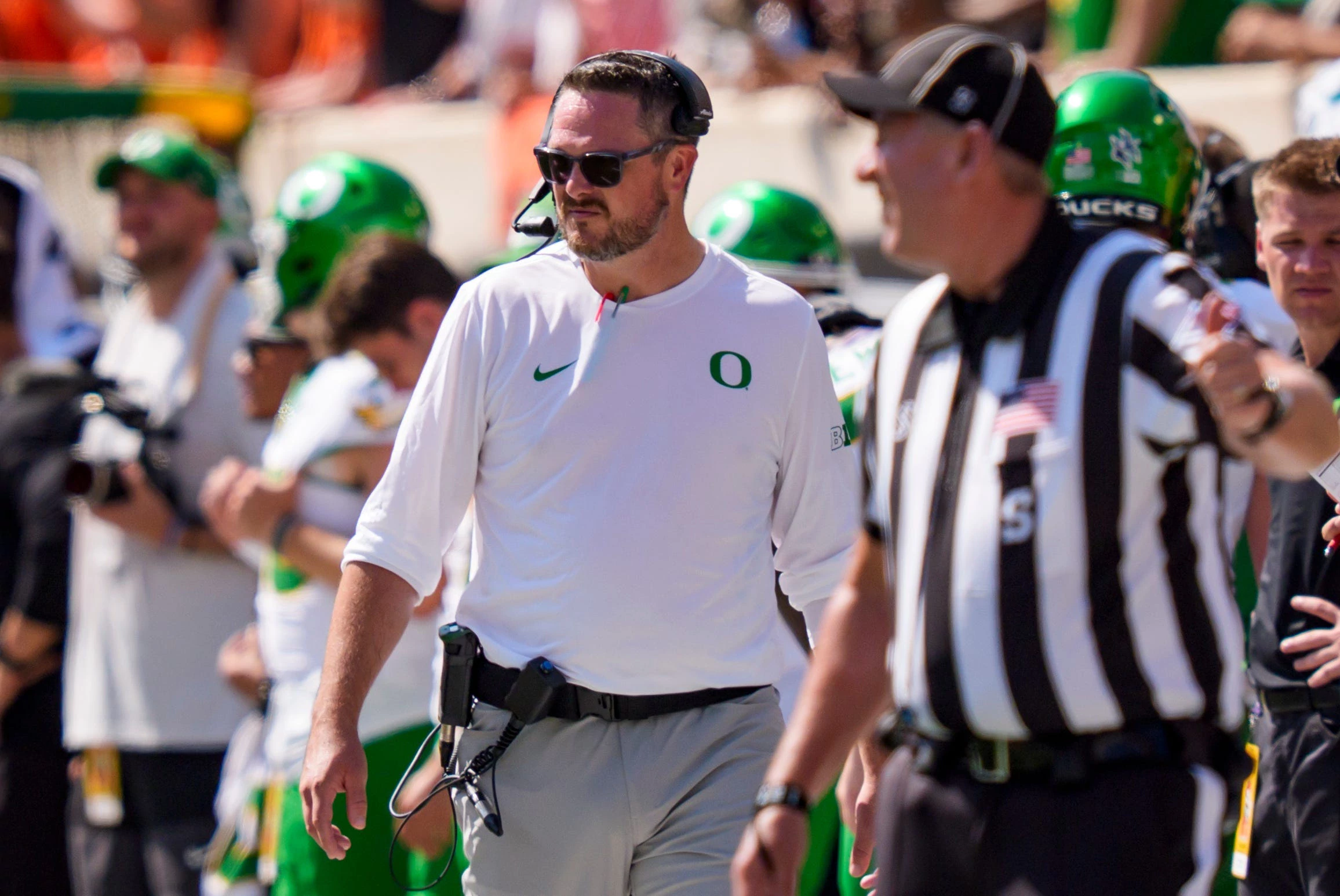
Oregon head coach Dan Lanning looks on as the Oregon Ducks face the Oklahoma State Cowboys on Sept. 12, 2026, at Boone Pickens Stadium in Stillwater, Oklahoma.
Fourth down decisions are supposed to give an offense another chance. Oregon used them Saturday as if every extra chance was worth taking, even when the field position said otherwise. The Ducks eventually reached the point where aggression stopped extending the game and started making Oklahoma State’s job easier.
The sequence that decided the argument came late in the fourth quarter. Oregon had finally taken a 31-30 lead on Dante Moore’s 38-yard touchdown pass to Evan Stewart, but Oklahoma State answered with a 12-play, 75-yard drive. Drew Mestemaker finished it with a 10-yard touchdown run, putting the Cowboys back ahead 36-31 with 10:21 left. Oregon punted on its next possession, forced an Oklahoma State punt, and got the ball back at its own 31 with 7:25 remaining.
Oregon’s Fourth Down Decisions Changed the Field
Oregon gained two yards on the first three plays of that drive. On fourth-and-8 from its own 33, Moore rolled right under pressure and threw incomplete toward Dierre Hill Jr. The clock showed 6:52 when the play began. Oklahoma State took over 33 yards from the end zone, moved 20 yards and let Sam Keltner kick a 31-yard field goal. Oregon now needed a touchdown and a two-point conversion instead of a touchdown alone.
Dan Lanning defended the choice afterward because his defense had struggled to get Oklahoma State off the field.
“I think you have to be aggressive in those moments, especially when you’re not having success, to keep it going,”
Lanning said after the 39-31 loss. His logic deserves some room. A punt does not guarantee Oregon gets the ball back, especially against an offense that had controlled the day.
However, the game had also supplied plenty of evidence against asking Moore to rescue another long fourth down. Oregon finished 0-for-3 on fourth down and produced only 281 total yards. Oklahoma State had 554, including 237 on the ground, while holding the ball for 36:54. Lanning also accepted the coaching responsibility.
“Our guys are much more capable of that, so all that starts with me. I didn’t prepare our guys well enough.”
The actual performance deserved more weight than Oregon’s talent suggested.
Oklahoma State Made Oregon Pay for the Gamble
The short field became one part of an upset Oklahoma State had been building for four quarters. Our feature on
Oklahoma State’s stunning reversal against Oregon
shows why the gamble hurt so much. The Cowboys finished with 25 first downs to Oregon’s 12, and Mestemaker produced 426 total yards. A team carrying a 21-game FBS losing streak did not need charity, but Oregon gave it one final favorable field.
Oregon still had another possession after Keltner’s field goal. The Ducks could have tied the game with a touchdown and two-point conversion, so the game remained within one possession. Instead, a pitch between Moore and Hill came loose, Oklahoma State recovered, and the comeback ended before Oregon reached midfield. The entire sequence is why the decision cannot be judged only by the failed pass. Oregon’s offense received one more chance, but the earlier gamble had removed almost every comfortable option from it.
USC Will Give Oregon a Cleaner Test
Oregon fell to No. 21 in the latest AP poll and gets Portland State at home Friday before opening Big Ten play at USC on Sept. 26. Portland State is Oregon’s immediate chance to repair its execution. USC brings a tougher setting, where field position, clock and confidence can pull a coach in different directions.
Lanning said Oregon has to evaluate its entire approach without throwing away what produced success in previous seasons. Oregon can keep the aggressive identity while changing where it draws the line. Aggression remains part of Oregon’s identity. The next close game will show whether Stillwater changed how Lanning decides when aggression has done enough.
Up To $1500 in Bonus Bets Paid Back if your First Bet Does Not Win
T&Cs apply
4.5/5
Gambling problem? Call 1-800-GAMBLER or 1-800-MY-RESET (Available in the US) 877-8-HOPENY or text HOPENY (467369) (NY) 1-800-327-5050 (MA), 1-800-BETS-OFF (IA), 1-800-981-0023 (PR). 21+ only. Please Gamble Responsibly. See BetMGM.com for Terms. First Bet Offer for new customers only (if applicable). Subject to eligibility requirements. Bonus bets are non-withdrawable. In partnership with Kansas Crossing Casino and Hotel. Promotional offers not available in Mississippi, Massachusetts, New York, Ontario, or Puerto Rico.
New DraftKings Customers: Spend $5+ Get $150 in Bonuses
T&Cs apply
4.5/5
GAMBLING PROBLEM? CALL 1-800-GAMBLER or 1-800-MY-RESET, (800) 327-5050 or visit gamblinghelplinema.org (MA). Please Gamble Responsibly. 888-789-7777/visit ccpg.org (CT), or visit www.mdgamblinghelp.org (MD), 1-800-981-0023 (PR). 21+ and present in most states. (18+ DC/NH/PR/WY). Void in CAN. Eligibility restrictions apply. On behalf of Boot Hill Casino (KS). Pass-thru of per wager tax may apply in IL. 1 per new DraftKings customer. $5+ first-time bet req. Max. $150 issued as non-withdrawable Bonus Bets. Stake removed from payout. Reward issued as $50 in Bonus Bets every 7 days via click-to-claim for 14 days. Bonus Bets and click-to-claims expire 7 days (168hrs) after issuance. Terms: sportsbook.draftkings.com/promos. Ends 10/11/26 at 11:59 PM ET. Sponsored by DK.
Must be 21+. GAMBLING PROBLEM? CALL 1-800-GAMBLER OR CALL 1-800-MY-RESET, www.mdgamblinghelp.org (MD), (800)-327-5050 or gamblinghelplinema.org (MA), Call (877)8-HOPENY or text HOPENY (467369) (NY), (888) 789-7777 or ccpg.org (CT), morethanagame.nc.gov (NC), 1800gambler.net (WV)
Bet $1 and get double the winnings up to $25 for your next 10 bets
T&Cs apply
4.4/5
21+ New users only. Must register using eligible promo code. First bet after registration must qualify. Max. Bonus Bet: $1,000. Bonus Bet expires 14 days after receipt. Void where prohibited. See Caesars.com/promos for full terms. Gambling Problem? 1-800-GAMBLER (1-800-426-2537)
21+ and present in OH. Gambling Problem? Call 1-800-GAMBLER.
This site is using
Cloudflare
and adheres to the
Google Safe Browsing Program. We adapted
Google's Privacy Guidelines
to keep your data safe at all times.
Close
Ready to Win Big? Join the Elite with Our Sports Betting Deals!
FanDuel Promo
New Users – Get $250 in Bonus Bets when you wager $5 for 5 days
Up To $1500 in Bonus Bets Paid Back if your First Bet Does Not Win
Best Slots
T&Cs and 21+ apply
Gambling problem? Call 1-800-GAMBLER or 1-800-MY-RESET (Available in the US) 877-8-HOPENY or text HOPENY (467369) (NY) 1-800-327-5050 (MA), 1-800-BETS-OFF (IA), 1-800-981-0023 (PR). 21+ only. Please Gamble Responsibly. See BetMGM.com for Terms. First Bet Offer for new customers only (if applicable). Subject to eligibility requirements. Bonus bets are non-withdrawable. In partnership with Kansas Crossing Casino and Hotel. Promotional offers not available in Mississippi, Massachusetts, New York, Ontario, or Puerto Rico.
Code:
Open BetMGM
Get Bonus
DraftKings Promo
New DraftKings Customers: Spend $5+ Get $150 in Bonuses
Newcomer
T&Cs and 21+ apply
GAMBLING PROBLEM? CALL 1-800-GAMBLER or 1-800-MY-RESET, (800) 327-5050 or visit gamblinghelplinema.org (MA). Please Gamble Responsibly. 888-789-7777/visit ccpg.org (CT), or visit www.mdgamblinghelp.org (MD), 1-800-981-0023 (PR). 21+ and present in most states. (18+ DC/NH/PR/WY). Void in CAN. Eligibility restrictions apply. On behalf of Boot Hill Casino (KS). Pass-thru of per wager tax may apply in IL. 1 per new DraftKings customer. $5+ first-time bet req. Max. $150 issued as non-withdrawable Bonus Bets. Stake removed from payout. Reward issued as $50 in Bonus Bets every 7 days via click-to-claim for 14 days. Bonus Bets and click-to-claims expire 7 days (168hrs) after issuance. Terms: sportsbook.draftkings.com/promos. Ends 10/11/26 at 11:59 PM ET. Sponsored by DK.
Code:
Open DraftKings
Get Bonus
Find out what the legends have to say about sports this week....