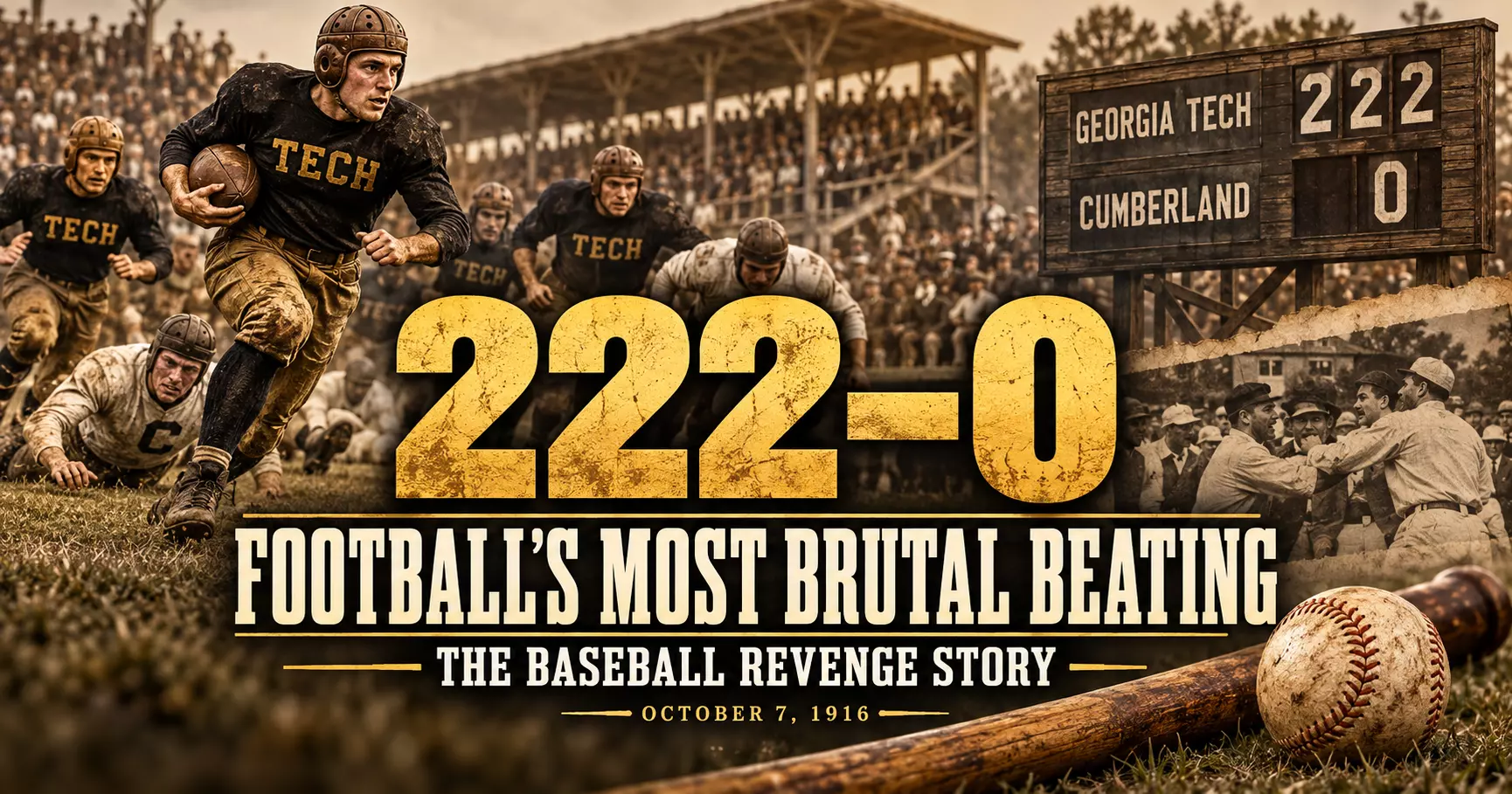
On October 7, 1916, Georgia Tech defeated Cumberland at Grant Field in Atlanta, producing the most lopsided score in college football history
A 50-point loss is humiliating. A 100-point loss sounds almost impossible.
Cumberland lost by 222.
On October 7, 1916, Georgia Tech defeated Cumberland at Grant Field in Atlanta, producing the most lopsided score in college football history. Tech led 63–0 after the first quarter and 126–0 at halftime. The game had become an embarrassment long before the final whistle.
Yet the story behind that scoreboard is more interesting than the score itself. It involves a baseball humiliation, allegations about professional players, a football contract, and an improvised team sent into a game it had virtually no chance of surviving competitively.
The Baseball Game That Made It Personal
Earlier in 1916,
Cumberland defeated Georgia Tech 22–0
in baseball. That result mattered to John Heisman because he coached Tech’s baseball team as well as its football team.
According to Georgia Tech’s historical account, Heisman believed Cumberland had used professional baseball players. The familiar revenge story holds that the defeat—and the suspected use of ringers—helped drive his determination to make Cumberland answer on the football field.
That distinction matters. The baseball score is documented in institutional histories. The professional-player allegation and the extent to which revenge dictated Heisman’s decisions should be identified as the historical explanation, rather than treated as if every detail had been conclusively established.
Still, the connection is compelling. The same coach who absorbed a 22-run baseball defeat would oversee a 222-point football victory against the same school.
For anyone who enjoys sports grudges, that is an irresistible setup. But resentment alone cannot explain what happened in Atlanta.
Cumberland Had Already Dropped Football
Cumberland, located in Lebanon, Tennessee, discontinued its football program in the spring of 1916 amid budget cuts. Unfortunately, its agreement to play Georgia Tech remained a problem.
Tech insisted that the contract be honored. Georgia Tech’s account describes a $500 guarantee and reports that failing to appear would have exposed Cumberland to a $3,000 penalty.
George Allen, Cumberland’s student manager, assembled a small replacement squad, largely from fraternity brothers. Accounts vary on its exact size, so assigning one unquestioned roster total would give the story more precision than the evidence supports.
The essential point is clear: Cumberland was bringing a makeshift group to face an established football program.
Those circumstances change how the game should be understood. This was far beyond a good team catching an ordinary opponent on a terrible afternoon. Cumberland lacked the organized program needed to make the matchup remotely reasonable.
The players who took the field inherited a contractual obligation and whatever anger remained from a different sport.
A Scoreboard That Kept Getting Worse
Georgia Tech scored 63 points in the opening quarter, then another 63 in the second. At halftime, Cumberland trailed 126–0.
Heisman agreed to shorten the second-half quarters. Historical accounts differ on their exact length, but they agree that the remaining playing time was reduced.
It hardly helped.
Tech added 54 points in the third quarter and 42 in the fourth. The final score reached 222–0. Georgia Tech’s athletic history credits the team with 32 touchdowns and records that it never attempted a pass.
That last detail makes the afternoon especially difficult to comprehend. Tech did not need to stretch the field with a passing attack. Cumberland could not stop the running game, and turnovers and returns supplied still more scoring opportunities.
Every possession offered another chance for the mismatch to announce itself. Whatever suspense a football game is supposed to provide had disappeared. The only remaining question was how much larger the number would become.
Why the Statistics Need Care
The famous claim that neither team recorded a first down appears in Georgia Tech’s account. Cumberland could not move the chains, while Tech reached the end zone before needing a conventional first down.
Some other numbers deserve more caution.
Georgia Tech’s retrospective credits its offense with 978 rushing yards. Researcher Jeremy Snyder’s reconstruction of the contemporary play-by-play instead calculates 471, while explicitly acknowledging gaps and errors in the original account.
That disagreement is a useful reminder about century-old sports history. A score can be firmly established while the statistical details surrounding it remain uncertain.
The 222–0 result needs no inflated yardage total to make it astonishing. Avoiding disputed numbers strengthens the story because the verified outcome is already extraordinary.
Revenge Does Not Explain Everything
The baseball angle gives this game its personality. A humiliated coach, suspected ringers, and an opportunity for retaliation make a memorable narrative.
The circumstances give it its explanation.
A discontinued football program still had an obligation to appear. A small group assembled to fulfill that obligation faced an opponent equipped to overwhelm it. Heisman then permitted the scoring to continue far beyond the point at which victory was secure.
Even if revenge influenced his approach, it was the mismatch that made such an outrageous margin possible.
That also makes celebrating the game uncomfortable. Admiring the record is easy. Imagining the afternoon from Cumberland’s sideline is considerably harder. The men absorbing the punishment were not automatically the people responsible for the baseball grievance.
The Beating That Became Bigger Than the Game
More than a century later,
222–0
remains one of the most recognizable scores in American sports.
Its endurance comes from the combination of an unbelievable result and a story people can understand immediately: a coach believed he had been embarrassed, an opponent could not escape its scheduled appearance, and a football field became the setting for a supposed settling of accounts.
But Cumberland’s defeat deserves to be remembered with its circumstances attached.
The baseball revenge story explains why Heisman may have wanted to make a point. The abandoned program and makeshift roster explain why Cumberland was so helpless to prevent him.
Together, they turned a scheduled college football game into an afternoon of humiliation that the sport has never forgotten.
Up To $1500 in Bonus Bets Paid Back if your First Bet Does Not Win
T&Cs apply
4.5/5
Gambling problem? Call 1-800-GAMBLER or 1-800-MY-RESET (Available in the US) 877-8-HOPENY or text HOPENY (467369) (NY) 1-800-327-5050 (MA), 1-800-BETS-OFF (IA), 1-800-981-0023 (PR). 21+ only. Please Gamble Responsibly. See BetMGM.com for Terms. First Bet Offer for new customers only (if applicable). Subject to eligibility requirements. Bonus bets are non-withdrawable. In partnership with Kansas Crossing Casino and Hotel. Promotional offers not available in Mississippi, Massachusetts, New York, Ontario, or Puerto Rico.
New DraftKings Customers: Spend $5+ Get $150 in Bonuses
T&Cs apply
4.5/5
GAMBLING PROBLEM? CALL 1-800-GAMBLER or 1-800-MY-RESET, (800) 327-5050 or visit gamblinghelplinema.org (MA). Please Gamble Responsibly. 888-789-7777/visit ccpg.org (CT), or visit www.mdgamblinghelp.org (MD), 1-800-981-0023 (PR). 21+ and present in most states. (18+ DC/NH/PR/WY). Void in CAN. Eligibility restrictions apply. On behalf of Boot Hill Casino (KS). Pass-thru of per wager tax may apply in IL. 1 per new DraftKings customer. $5+ first-time bet req. Max. $150 issued as non-withdrawable Bonus Bets. Stake removed from payout. Reward issued as $50 in Bonus Bets every 7 days via click-to-claim for 14 days. Bonus Bets and click-to-claims expire 7 days (168hrs) after issuance. Terms: sportsbook.draftkings.com/promos. Ends 10/11/26 at 11:59 PM ET. Sponsored by DK.
Must be 21+. GAMBLING PROBLEM? CALL 1-800-GAMBLER OR CALL 1-800-MY-RESET, www.mdgamblinghelp.org (MD), (800)-327-5050 or gamblinghelplinema.org (MA), Call (877)8-HOPENY or text HOPENY (467369) (NY), (888) 789-7777 or ccpg.org (CT), morethanagame.nc.gov (NC), 1800gambler.net (WV)
Bet $1 and get double the winnings up to $25 for your next 10 bets
T&Cs apply
4.4/5
21+ New users only. Must register using eligible promo code. First bet after registration must qualify. Max. Bonus Bet: $1,000. Bonus Bet expires 14 days after receipt. Void where prohibited. See Caesars.com/promos for full terms. Gambling Problem? 1-800-GAMBLER (1-800-426-2537)
21+ and present in OH. Gambling Problem? Call 1-800-GAMBLER.
This site is using
Cloudflare
and adheres to the
Google Safe Browsing Program. We adapted
Google's Privacy Guidelines
to keep your data safe at all times.
Close
Ready to Win Big? Join the Elite with Our Sports Betting Deals!
FanDuel Promo
New Users – Get $250 in Bonus Bets when you wager $5 for 5 days
Up To $1500 in Bonus Bets Paid Back if your First Bet Does Not Win
Best Slots
T&Cs and 21+ apply
Gambling problem? Call 1-800-GAMBLER or 1-800-MY-RESET (Available in the US) 877-8-HOPENY or text HOPENY (467369) (NY) 1-800-327-5050 (MA), 1-800-BETS-OFF (IA), 1-800-981-0023 (PR). 21+ only. Please Gamble Responsibly. See BetMGM.com for Terms. First Bet Offer for new customers only (if applicable). Subject to eligibility requirements. Bonus bets are non-withdrawable. In partnership with Kansas Crossing Casino and Hotel. Promotional offers not available in Mississippi, Massachusetts, New York, Ontario, or Puerto Rico.
Code:
Open BetMGM
Get Bonus
DraftKings Promo
New DraftKings Customers: Spend $5+ Get $150 in Bonuses
Newcomer
T&Cs and 21+ apply
GAMBLING PROBLEM? CALL 1-800-GAMBLER or 1-800-MY-RESET, (800) 327-5050 or visit gamblinghelplinema.org (MA). Please Gamble Responsibly. 888-789-7777/visit ccpg.org (CT), or visit www.mdgamblinghelp.org (MD), 1-800-981-0023 (PR). 21+ and present in most states. (18+ DC/NH/PR/WY). Void in CAN. Eligibility restrictions apply. On behalf of Boot Hill Casino (KS). Pass-thru of per wager tax may apply in IL. 1 per new DraftKings customer. $5+ first-time bet req. Max. $150 issued as non-withdrawable Bonus Bets. Stake removed from payout. Reward issued as $50 in Bonus Bets every 7 days via click-to-claim for 14 days. Bonus Bets and click-to-claims expire 7 days (168hrs) after issuance. Terms: sportsbook.draftkings.com/promos. Ends 10/11/26 at 11:59 PM ET. Sponsored by DK.
Code:
Open DraftKings
Get Bonus
Find out what the legends have to say about sports this week....