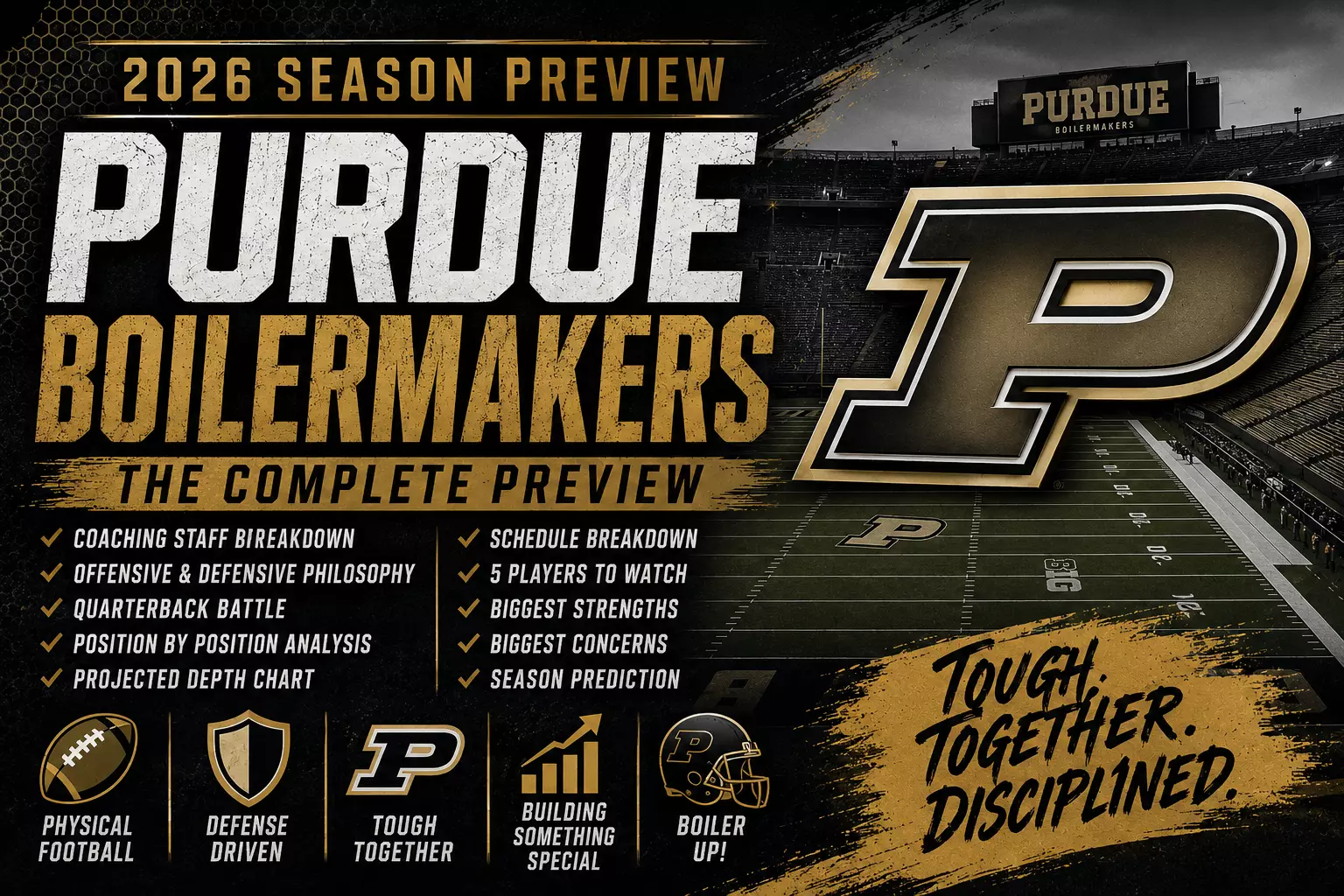
The Boilermakers finished Barry Odom's first season with only two victories, but the record doesn't tell the entire story. Odom inherited a roster that had been gutted by transfers and forced to replace nearly every contributor
Part 1: Coaching Staff, Offensive Philosophy and Position Breakdown
Just two seasons removed from one of the worst years in school history, Purdue football enters 2026 with something it lacked a year ago—direction.
The Boilermakers finished Barry Odom’s first season with only two victories, but the record doesn’t tell the entire story. Odom inherited a roster that had been gutted by transfers and forced to replace nearly every contributor on both sides of the football. The result was expected growing pains, but there were also signs that Purdue was beginning to establish an identity.
That identity is much different than the one fans became accustomed to during the Jeff Brohm era.
Odom wants Purdue to become one of the most physical football teams in the Big Ten. Rather than trying to win shootouts, the Boilermakers want to control games with defense, a balanced rushing attack, disciplined special teams, and mistake-free quarterback play.
The roster still lacks the overall talent of conference powers like Ohio State, Oregon, Penn State, and Michigan, but it is noticeably deeper than it was a year ago thanks to another aggressive transfer portal cycle. Purdue added more than 30 newcomers while retaining several key veterans who now understand Odom’s expectations and culture.
Coaching Staff
One of
Barry Odom’s
greatest strengths has always been assembling experienced coaching staffs.
Unlike many first-time head coaches who attempt to overhaul everything immediately, Odom has surrounded himself with assistants who understand his philosophy and have extensive experience developing players.
Head Coach:
Barry Odom
Offensive Coordinator:
Josh Henson
Defensive Coordinator:
Kevin Kane
Henson has built offenses around physical offensive lines and efficient quarterback play throughout his career. Expect Purdue to emphasize ball control, a stronger running game, and high-percentage passing concepts.
Defensively, Kevin Kane returns to West Lafayette after spending 2025 at Minnesota. Kane understands Odom’s defensive philosophy and will coordinate an aggressive multiple-front defense designed to confuse quarterbacks while stopping the run first.
Offensive Philosophy
Gone are the days when Purdue expected to throw the football 50 times every Saturday.
Barry Odom wants his offense to complement the defense.
The Boilermakers want to:
Run the football 30-35 times per game.
Win first down.
Stay ahead of the chains.
Eliminate turnovers.
Control time of possession.
Create explosive plays through play-action rather than forcing difficult throws into coverage.
That doesn’t mean Purdue won’t throw the football. Josh Henson’s offenses have traditionally been balanced, using multiple formations while asking quarterbacks to make quick, decisive reads instead of holding onto the football.
If Purdue can consistently rush for 175 yards per game, the offense should become significantly more effective.
Quarterbacks
Ryan Browne Looks Ready to Take the Next Step
The most important player on Purdue’s roster is quarterback
Ryan Browne.
After gaining valuable experience during the 2025 season, Browne enters 2026 as the unquestioned leader of the offense. While his numbers—2,153 passing yards, nine touchdowns, and 10 interceptions—were modest, they came behind an offensive line in transition and with a receiving corps that struggled with injuries and inconsistency.
What Purdue likes about Browne isn’t simply his arm talent.
He’s tough.
He’s athletic enough to extend plays.
Most importantly, he has earned the trust of Barry Odom.
Odom doesn’t need Browne to become Drew Brees.
He needs him to become an efficient quarterback capable of completing around 65 percent of his passes while limiting turnovers.
Behind Browne, Purdue has assembled impressive depth.
Former Washington State transfer
Evans Chuba
possesses excellent size and arm strength, while veteran
Bennett Meredith
provides experience in the quarterback room. Freshmen
Corin Berry
and
Garyt Odom
give the Boilermakers developmental talent for the future.
Quarterback play
will ultimately determine whether Purdue reaches bowl eligibility.
Running Backs
A Much Deeper Backfield
One of the biggest upgrades on Purdue’s roster is running back.
Sophomore
Fame Ijeboi
appears poised to become the feature back after transferring from Minnesota. He flashed explosiveness in limited opportunities and possesses the combination of vision, power, and acceleration that Barry Odom wants in his offense.
Texas transfer
Jerrick Gibson
adds another talented option. A former blue-chip recruit, Gibson runs with outstanding balance and has the physical style necessary to wear down Big Ten defenses.
Veteran
Antonio Harris
provides versatility as both a runner and receiver out of the backfield, while transfer
Travis Terrell Jr.
gives Purdue additional speed and depth.
This is easily Purdue’s deepest running back room in several seasons.
Don’t be surprised if the Boilermakers rotate backs early in games before riding the hot hand in the fourth quarter.
If this group averages over 4.5 yards per carry, Purdue’s offense will improve dramatically.
Wide Receivers
Experience Meets Speed
The receiving corps underwent another major makeover through the transfer portal.
The headline addition is
Xavier Townsend, who arrives after stops at UCF and Iowa State. Despite standing just 5-foot-11, Townsend has proven capable of stretching defenses vertically while also creating separation underneath. He is expected to become Ryan Browne’s primary target.
Former Wake Forest receiver
De’Nylon Morrissette
returns after battling injuries and gives Purdue another experienced option with Power Four production.
Chauncey Magwood
brings valuable veteran leadership and reliable hands, while
Jaylan Hornsby
has impressed coaches with his athleticism and upside.
Portal additions
Asaad Waseem
and
Bisi Owens
add length and depth to the outside receiver positions, while junior college transfer
Ricky Sampson
provides additional competition throughout fall camp.
This group has far more depth than last season.
The biggest question isn’t talent.
It’s whether Ryan Browne can consistently distribute the football and allow these receivers to maximize their playmaking ability.
Tight Ends
George Burhenn Headlines an Improved Group
The tight end room could quietly become one of Purdue’s best offensive units.
George Burhenn
emerged as one of the offense’s most dependable weapons during 2025 before injuries interrupted his season. Coaches believe he has the potential to become one of the better all-around tight ends in the Big Ten because of his ability to contribute as both a blocker and receiver.
Behind Burhenn,
Kylan Fox
provides valuable experience, while
Luca Puccinelli
gives Purdue another physical blocker capable of helping the running game in multiple-tight-end formations.
Freshman
Ar’Mari Towns
is one of the more intriguing long-term prospects on the roster thanks to his size and athletic ability.
Josh Henson loves using tight ends in both the running and passing game, so expect this position to play a much larger role in 2026 than Purdue fans have seen in recent years.
Part 2: Offensive Line, Defensive Front, Secondary and Special Teams
Barry Odom has said repeatedly that championships in the Big Ten are won up front. Purdue isn’t there yet, but after a full recruiting cycle and another aggressive transfer portal class, the Boilermakers should be significantly bigger, deeper, and more physical than they were a season ago.
The biggest improvement may not necessarily show up on the stat sheet. Instead, Purdue hopes to become a team that consistently wins the line of scrimmage, limits explosive plays, and forces opponents to earn every yard.
Offensive Line
The Most Important Position Group on the Team
If Purdue reaches bowl eligibility, the offensive line will be the biggest reason why.
Last season the Boilermakers struggled to establish consistency in both pass protection and the running game. There were flashes, but too often quarterback Ryan Browne found himself under pressure before routes could fully develop. Barry Odom and offensive line coach Zach Crabtree attacked that weakness aggressively by rebuilding both the starting lineup and the overall depth.
Projected Starters
LT Joey Tanona (Senior)
The Notre Dame transfer is expected to anchor the left side of the offensive line. Tanona brings experience, leadership and versatility. He’s not flashy, but he understands leverage and should become one of Purdue’s most dependable linemen.
LG Nuku Mafi (Sophomore)
The Oklahoma State transfer possesses tremendous size at 6-foot-4 and over 330 pounds. Mafi is still developing technically, but his raw power gives Purdue another physical presence inside.
C Marc Nave Jr. (Junior)
Nave is expected to take over the leadership role in the middle. His communication skills will be critical as Purdue continues installing Josh Henson’s offense.
RG Ethan Trent (Junior)
One of the more athletic interior linemen on the roster, Trent has shown steady improvement and projects as one of Purdue’s better run blockers.
RT Jatavius Shivers (Junior)
The South Carolina transfer gives Purdue another massive body on the edge. If he develops consistency in pass protection, Purdue’s tackles could become one of the better duos the program has fielded in several seasons.
Depth
Marques Easley, Micah Banuelos, Mason Vicari and several younger linemen provide competition throughout the two-deep. That depth is something Purdue simply didn’t possess a year ago.
The biggest goal for this group isn’t becoming dominant overnight.
It’s becoming reliable.
If Purdue averages over 4.5 yards per carry while reducing sacks allowed, this offense becomes dramatically more dangerous.
Defensive Line
Barry Odom’s Defense Starts Here
Odom has always believed great defenses begin with defensive linemen who can control gaps without constant blitzing.
Purdue’s defensive line has been rebuilt through recruiting and the transfer portal, and while there isn’t an obvious All-American on the roster, there is significantly more depth.
Defensive Ends
Elo Modozie
One of Purdue’s most intriguing transfers, Modozie brings length, athleticism and pass-rushing ability. Coaches believe he has NFL-caliber physical tools and could become the Boilermakers’ top edge defender.
Ian Jeffries
Jeffries provides another experienced edge presence and has the versatility to play multiple techniques depending on Purdue’s defensive front.
Defensive Tackles
TJ Lindsey
The Virginia Tech
transfer immediately
upgrades the interior with his size and experience. Lindsey should become Purdue’s primary run-stuffer while also collapsing the pocket on passing downs.
Josiah Hope
The young defensive tackle has impressed coaches with his strength and motor. While still developing, Hope could become an important rotational player immediately.
Overall Outlook
Expect Kelvin Green to rotate eight or nine defensive linemen throughout the season.
That rotation should keep players fresh late in games and better prepare Purdue for the physical demands of the Big Ten schedule.
Linebackers
Kevin Kane’s Defense Runs Through This Group
Defensive coordinator Kevin Kane has always placed enormous responsibility on his linebackers.
They’re responsible for aligning the defense, stopping the run, covering tight ends and occasionally rushing the passer.
Anthony Speca
The Penn State transfer arrives with outstanding instincts and should immediately compete for a starting role. He’s one of the most technically sound linebackers Purdue has added through the portal.
Manny Correa
Correa has quietly become one of Purdue’s most reliable defenders. His ability to diagnose running plays quickly makes him particularly valuable against the physical rushing attacks found throughout the Big Ten.
Alex Sanford Jr.
Sanford provides excellent athleticism and should see significant snaps in Purdue’s nickel packages.
Depth
JoJo Hayden and several younger linebackers provide quality competition while giving Purdue much-needed depth compared to previous seasons.
This group won’t receive many headlines nationally, but it has the potential to become one of Purdue’s most consistent units.
Secondary
Experience Has Been Replaced by Athleticism
Purdue lost several experienced defensive backs following the 2025 season, forcing the coaching staff to aggressively attack the transfer portal.
While replacing veteran leadership won’t be easy, the overall athletic ability of this secondary appears improved.
Cornerbacks
The competition remains open entering preseason camp, but Purdue has added multiple transfers capable of competing immediately.
Charles Clark has emphasized playing more aggressive press coverage while trusting his safeties over the top.
Expect considerably more man coverage than Purdue employed in previous seasons.
Safeties
The safety position features several newcomers looking to replace departed veterans.
Communication will be critical.
Kevin Kane’s defense asks safeties to disguise coverages, support the run and create turnovers.
Early consistency at this position may determine whether Purdue’s defense takes the next step.
Overall, this secondary has more speed than last year’s unit, but also far less experience.
That makes September especially important.
If the defensive backs develop quickly, Purdue’s pass defense could improve significantly.
Special Teams
Winning Hidden Yardage
One aspect of Barry Odom’s teams that often goes unnoticed is special teams.
James Shibest has consistently produced fundamentally sound special teams units throughout his coaching career, and Purdue expects that trend to continue.
The emphasis throughout preseason camp has been:
Eliminating penalties on returns.
Improving kickoff coverage.
Winning field-position battles.
Becoming more consistent in the kicking game.
Creating explosive return opportunities.
In the Big Ten, where many conference games are decided by one possession, hidden yardage often becomes the difference between winning and losing.
Odom understands that.
Expect Purdue to place far greater emphasis on special teams execution than it has in recent seasons.
Overall Defensive Outlook
Purdue isn’t built to win games 49-42.
Barry Odom wants the Boilermakers to play disciplined, physical defense that forces offenses to drive the length of the field. While the defense still lacks the elite depth of conference powers such as Ohio State, Oregon and Penn State, the talent level is noticeably improved from where it was a year ago.
If the defensive line generates consistent pressure without excessive blitzing, Purdue’s linebackers and secondary should benefit tremendously. The goal won’t necessarily be finishing among the Big Ten’s top three defenses in 2026, but rather making the jump into the middle of the conference—a step that would give the Boilermakers a legitimate chance to compete for bowl eligibility.
Part 3: Game-by-Game Schedule Breakdown, Biggest Strengths, Biggest Concerns, X-Factors and Season Prediction
Barry Odom knew when he accepted the Purdue job that rebuilding in the Big Ten would never happen overnight. The conference has never been deeper, and with the additions of Oregon, USC, Washington and UCLA, there are very few Saturdays where a team can simply out-talent its opponent.
For Purdue, the challenge in 2026 isn’t just improving—it is proving the Boilermakers can consistently compete for four quarters against quality competition.
The roster is better.
The coaching is better.
The culture appears stronger.
Now the next step is translating those improvements into wins.
Five Most Important Players
1. QB Ryan Browne
Everything starts with Browne.
Barry Odom doesn’t need an All-American quarterback. He needs one who protects the football, makes smart decisions, and capitalizes on opportunities created by Purdue’s running game.
Browne enters the season with valuable starting experience and should be far more comfortable operating Josh Henson’s offense. If he completes around 65 percent of his passes while keeping interceptions in single digits, Purdue’s offense can become respectable.
If he struggles with turnovers, however, Purdue will have difficulty reaching bowl eligibility.
Simply put, Ryan Browne is the most important player on the roster.
2. RB Jerrick Gibson
The former five-star recruit has all the physical tools to become one of the better running backs in the Big Ten.
Gibson combines size, balance, vision and explosiveness in a way Purdue has lacked in recent seasons.
The Boilermakers want to establish a physical rushing attack that controls games, and Gibson is expected to become the centerpiece of that effort.
If he rushes for 900 to 1,000 yards, Purdue’s offense becomes significantly more balanced.
3. WR Xavier Townsend
Every quarterback needs a dependable playmaker.
Townsend is expected to become Ryan Browne’s favorite target because of his ability to stretch defenses both vertically and underneath.
His versatility also allows Purdue to use him in jet sweeps, screens and special teams.
A productive season from Townsend would open opportunities for everyone else in the receiving corps.
4. DT TJ Lindsey
Every successful Barry Odom defense has featured an interior defensive lineman capable of controlling the line of scrimmage.
Lindsey has the size and experience to become that player.
If opposing offenses consistently double-team him, Purdue’s edge rushers and linebackers should have more opportunities to make plays.
His production may not always show up in the box score, but his impact could determine the success of Purdue’s defense.
5. LB Anthony Speca
Speca arrives with impressive instincts and immediately becomes one of Purdue’s defensive leaders.
He is expected to quarterback Kevin Kane’s defense, making adjustments before the snap while serving as Purdue’s leading tackler.
If Speca performs at an All-Big Ten level, the Boilermakers’ defense could improve dramatically.
Biggest Strengths
Coaching Stability
For the first time in several years, Purdue enters a season with a clear identity.
Barry Odom has already established accountability throughout the program, and players consistently speak about the structure and expectations that now exist inside the locker room.
That stability matters.
Programs rarely improve until players understand exactly what’s expected every day.
Improved Running Game
Purdue has made a conscious effort to become more physical offensively.
The additions of Jerrick Gibson and other running backs, combined with a larger offensive line, should allow the Boilermakers to control games much more effectively than in recent seasons.
A balanced offense also takes pressure off Ryan Browne.
Defensive Culture
Odom’s reputation has always been built on defense.
The Boilermakers may not possess elite talent at every position, but they should be much more disciplined.
Expect:
Better tackling
Improved gap integrity
Fewer blown coverages
More third-down stops
Increased turnovers
Those improvements alone could swing several close games.
Biggest Concerns
Offensive Line Consistency
Although Purdue added talent through the portal, the offensive line remains largely unproven.
Can this group consistently protect Ryan Browne?
Can it generate enough push to establish the running game?
Until those questions are answered, this remains Purdue’s biggest concern.
Defensive Depth
The starting defense appears improved.
The problem comes if injuries occur.
Ohio State, Oregon and Penn State can rotate future NFL players throughout the game.
Purdue isn’t at that level yet.
Avoiding injuries will be critical.
Schedule Difficulty
There are very few “easy” games in today’s Big Ten.
Every week presents another physical challenge, and Purdue’s margin for error remains small.
Winning the games they’re expected to win—and stealing one or two upsets—will determine whether the Boilermakers reach a bowl game.
Biggest X-Factors
Can Ryan Browne Become an Upper-Tier Big Ten Quarterback?
Quarterback play separates good teams from great ones.
Browne doesn’t need to match quarterbacks like Julian Sayin or Dante Moore statistically.
He simply needs to become one of the conference’s most efficient quarterbacks.
If he does, Purdue’s offense becomes much harder to defend.
Will the Defense Create Turnovers?
Barry Odom’s best defenses have always excelled at forcing turnovers.
Interceptions.
Forced fumbles.
Negative plays.
Those momentum-changing moments often determine close football games.
If Purdue finishes among the Big Ten leaders in turnover margin, its record could improve significantly.
Can Purdue Win Close Games?
Last season the
Boilermakers
repeatedly found themselves within striking distance during the fourth quarter.
Too often they failed to finish.
Improved quarterback play.
Better special teams.
More consistent defense.
Those three factors should help Purdue close out games that slipped away in previous seasons.
Ceiling and Floor
Best-Case Scenario
Everything comes together.
Ryan Browne develops into one of the Big Ten’s most efficient quarterbacks.
Jerrick Gibson becomes one of the conference’s better running backs.
The defense finishes in the upper half of the Big Ten.
Purdue wins several close games and surprises the conference.
Record: 8-4
Worst-Case Scenario
The offensive line struggles.
Quarterback inconsistency returns.
The defense fails to generate pressure.
Injuries expose Purdue’s lack of depth.
The rebuild takes longer than expected.
Record: 3-9
Most Likely Outcome
Reality usually falls somewhere in the middle.
Barry Odom has unquestionably upgraded the culture.
The roster is deeper.
The coaching staff is stronger.
The running game should improve.
However, Purdue still lacks the overall talent of the conference’s elite programs.
The Boilermakers should be far more competitive every Saturday, even if that doesn’t always translate into victories.
Several games are likely to be decided in the fourth quarter.
Winning half of those contests could be the difference between another disappointing season and a return to postseason football.
Final Prediction
Purdue fans should expect noticeable improvement in 2026, even if it doesn’t immediately show up as a dramatic jump in the standings.
The Boilermakers are becoming more physical, more disciplined, and better equipped to compete in Barry Odom’s system. There is still work to do before Purdue can consistently challenge the likes of Ohio State, Oregon, Penn State, and Michigan, but the foundation is finally being established.
One area to watch is the offensive line. If that unit develops quicker than expected, the running game behind Jerrick Gibson and Fame Ijeboi could take pressure off Ryan Browne and allow Purdue to control the tempo of games. Defensively, Kevin Kane’s aggressive approach should produce a tougher, more opportunistic group than fans saw a year ago.
Perhaps the biggest difference will be competitiveness. Purdue may not win every close game this season, but the days of routinely being outmatched appear to be ending. Expect the Boilermakers to play a much more disciplined brand of football and give themselves a chance nearly every Saturday.
Projected Regular Season Record: 6-6
Big Ten Finish:
11th–13th
Bowl Projection:
Guaranteed Rate Bowl, Pinstripe Bowl, or Quick Lane Bowl
For a program that is still in the early stages of its rebuild, a bowl appearance would represent meaningful progress and another important step toward returning Purdue to sustained success in the Big Ten.
Up To $1500 in Bonus Bets Paid Back if your First Bet Does Not Win
T&Cs apply
4.5/5
Gambling problem? Call 1-800-GAMBLER or 1-800-MY-RESET (Available in the US) 877-8-HOPENY or text HOPENY (467369) (NY) 1-800-327-5050 (MA), 1-800-BETS-OFF (IA), 1-800-981-0023 (PR). 21+ only. Please Gamble Responsibly. See BetMGM.com for Terms. First Bet Offer for new customers only (if applicable). Subject to eligibility requirements. Bonus bets are non-withdrawable. In partnership with Kansas Crossing Casino and Hotel. Promotional offers not available in Mississippi, Massachusetts, New York, Ontario, or Puerto Rico.
New DraftKings Customers: Spend $5+ Get $150 in Bonuses
T&Cs apply
4.5/5
GAMBLING PROBLEM? CALL 1-800-GAMBLER or 1-800-MY-RESET, (800) 327-5050 or visit gamblinghelplinema.org (MA). Please Gamble Responsibly. 888-789-7777/visit ccpg.org (CT), or visit www.mdgamblinghelp.org (MD), 1-800-981-0023 (PR). 21+ and present in most states. (18+ DC/NH/PR/WY). Void in CAN. Eligibility restrictions apply. On behalf of Boot Hill Casino (KS). Pass-thru of per wager tax may apply in IL. 1 per new DraftKings customer. $5+ first-time bet req. Max. $150 issued as non-withdrawable Bonus Bets. Stake removed from payout. Reward issued as $50 in Bonus Bets every 7 days via click-to-claim for 14 days. Bonus Bets and click-to-claims expire 7 days (168hrs) after issuance. Terms: sportsbook.draftkings.com/promos. Ends 10/11/26 at 11:59 PM ET. Sponsored by DK.
Must be 21+. GAMBLING PROBLEM? CALL 1-800-GAMBLER OR CALL 1-800-MY-RESET, www.mdgamblinghelp.org (MD), (800)-327-5050 or gamblinghelplinema.org (MA), Call (877)8-HOPENY or text HOPENY (467369) (NY), (888) 789-7777 or ccpg.org (CT), morethanagame.nc.gov (NC), 1800gambler.net (WV)
Bet $1 and get double the winnings up to $25 for your next 10 bets
T&Cs apply
4.4/5
21+ New users only. Must register using eligible promo code. First bet after registration must qualify. Max. Bonus Bet: $1,000. Bonus Bet expires 14 days after receipt. Void where prohibited. See Caesars.com/promos for full terms. Gambling Problem? 1-800-GAMBLER (1-800-426-2537)
21+ and present in OH. Gambling Problem? Call 1-800-GAMBLER.
This site is using
Cloudflare
and adheres to the
Google Safe Browsing Program. We adapted
Google's Privacy Guidelines
to keep your data safe at all times.
Close
Ready to Win Big? Join the Elite with Our Sports Betting Deals!
FanDuel Promo
New Users – Get $250 in Bonus Bets when you wager $5 for 5 days
Up To $1500 in Bonus Bets Paid Back if your First Bet Does Not Win
Best Slots
T&Cs and 21+ apply
Gambling problem? Call 1-800-GAMBLER or 1-800-MY-RESET (Available in the US) 877-8-HOPENY or text HOPENY (467369) (NY) 1-800-327-5050 (MA), 1-800-BETS-OFF (IA), 1-800-981-0023 (PR). 21+ only. Please Gamble Responsibly. See BetMGM.com for Terms. First Bet Offer for new customers only (if applicable). Subject to eligibility requirements. Bonus bets are non-withdrawable. In partnership with Kansas Crossing Casino and Hotel. Promotional offers not available in Mississippi, Massachusetts, New York, Ontario, or Puerto Rico.
Code:
Open BetMGM
Get Bonus
DraftKings Promo
New DraftKings Customers: Spend $5+ Get $150 in Bonuses
Newcomer
T&Cs and 21+ apply
GAMBLING PROBLEM? CALL 1-800-GAMBLER or 1-800-MY-RESET, (800) 327-5050 or visit gamblinghelplinema.org (MA). Please Gamble Responsibly. 888-789-7777/visit ccpg.org (CT), or visit www.mdgamblinghelp.org (MD), 1-800-981-0023 (PR). 21+ and present in most states. (18+ DC/NH/PR/WY). Void in CAN. Eligibility restrictions apply. On behalf of Boot Hill Casino (KS). Pass-thru of per wager tax may apply in IL. 1 per new DraftKings customer. $5+ first-time bet req. Max. $150 issued as non-withdrawable Bonus Bets. Stake removed from payout. Reward issued as $50 in Bonus Bets every 7 days via click-to-claim for 14 days. Bonus Bets and click-to-claims expire 7 days (168hrs) after issuance. Terms: sportsbook.draftkings.com/promos. Ends 10/11/26 at 11:59 PM ET. Sponsored by DK.
Code:
Open DraftKings
Get Bonus
Find out what the legends have to say about sports this week....