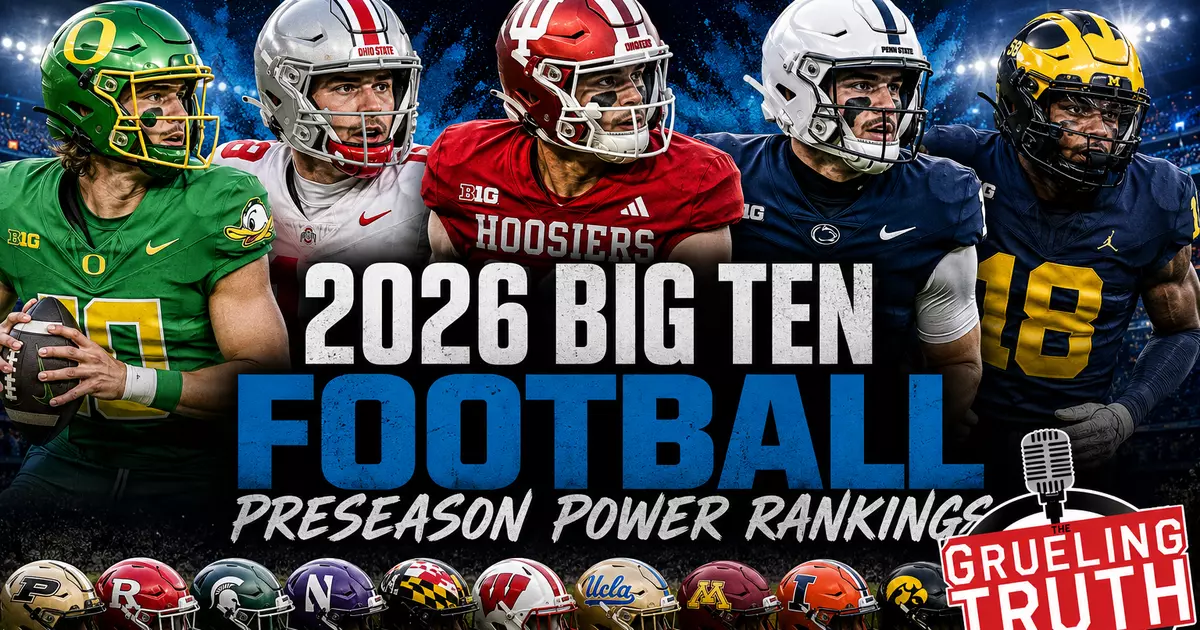
The Big Ten has never been stronger. With 18 programs spanning coast to coast, the conference enters the 2026 season as the best Conference
The Big Ten has never been stronger. With 18 programs spanning coast to coast, the conference enters the 2026 season as the unquestioned centerpiece of college football. Defending national champion Indiana leads a conference loaded with championship contenders, as Oregon, Ohio State, Penn State, Michigan, and USC all have legitimate aspirations of reaching the College Football Playoff. Meanwhile, traditional powers such as Iowa, Nebraska, Illinois, and Wisconsin are looking to reestablish themselves among the conference elite, while rebuilding programs hope to close the gap in one of the nation’s most competitive leagues. Coaching changes, transfer portal additions, returning stars, and challenging schedules make this one of the most unpredictable Big Ten seasons in recent memory. From the race for Indianapolis to the battle for bowl eligibility, every week promises nationally significant matchups. Here is The Grueling Truth’s 2026 Big Ten Football Preseason Power Rankings, with every team ranked from 18 to 1 heading into what should be another unforgettable season.
18. Purdue Boilermakers
Purdue enters the 2026 season with plenty of questions after another difficult campaign. The Boilermakers continue searching for consistency in one of college football’s toughest conferences, and while there are pieces to like on the roster, the talent gap between Purdue and the conference’s elite remains significant. The defense must improve dramatically after struggling against the Big Ten’s more physical offenses, while the offense needs to become more explosive and protect the quarterback better. Ross-Ade Stadium remains a difficult place to play, but Purdue must begin winning more games away from home if it hopes to climb the standings. This season should be about developing young talent, establishing an identity, and proving the program is headed in the right direction. Even modest improvement would be a positive step for the Boilermakers.
17. Rutgers Scarlet Knights
Greg Schiano has unquestionably made Rutgers more competitive than when he returned to
Piscataway, but the Scarlet Knights still struggle to consistently compete with the upper half of the Big Ten. Rutgers plays disciplined football, rarely beats itself, and usually fields a respectable defense. The challenge continues to be generating enough offense to keep pace with the conference’s heavyweights. Recruiting has improved under Schiano, and player development remains one of the program’s strengths, but the margin for error is still very small. Rutgers should once again be a physical football team capable of pulling an upset, yet finding enough wins to reach bowl eligibility will be difficult given another demanding Big Ten schedule. Until the offense takes another step forward, Rutgers remains near the bottom of these rankings.
16. Northwestern Wildcats
Northwestern enters 2026 hoping to show meaningful progress after several rebuilding seasons. The Wildcats continue to rely on discipline, fundamentals, and player development rather than overwhelming talent. Their defense should remain competitive, but offensive consistency has been difficult to find. Northwestern rarely has recruiting classes that rival the conference’s best, making coaching and execution even more important. Ryan Field has traditionally provided a home-field advantage, but the Wildcats must find more explosive playmakers if they hope to move up the conference standings. The schedule is once again unforgiving, and several toss-up games will determine whether Northwestern can exceed expectations. This team has enough experience to be competitive most Saturdays, but depth concerns keep it near the bottom of the preseason rankings.
15. Maryland Terrapins
Maryland has talent, particularly on offense, but consistency has remained elusive. The Terrapins have shown they can compete with quality opponents for stretches, only to struggle maintaining that level over an entire season. Improving along both lines of scrimmage will be essential if Maryland hopes to climb the Big Ten standings. The recruiting base around the Washington, D.C., area continues to provide opportunities, but turning that talent into victories has been difficult. The Terrapins possess enough athletes to challenge bowl-caliber teams, yet they still trail the conference’s elite in overall roster depth. If Maryland can improve defensively and limit mistakes, it has the potential to surprise people, but entering the season, the Terrapins remain a lower-half Big Ten team.
14. Wisconsin Badgers
Wisconsin enters perhaps the most pivotal season of the Luke Fickell era. Expectations were enormous when Fickell arrived in Madison, but the results have not matched the hype. The Badgers were aggressive in the transfer portal this offseason, bringing in numerous newcomers in hopes of reversing recent struggles. The talent level appears improved, but questions remain about whether Wisconsin can rediscover the physical identity that defined the program for decades. The defense should be stronger, and the offense must become far more consistent if the Badgers hope to return to bowl contention. Fickell is coaching under significant pressure entering 2026, making Wisconsin one of the conference’s most intriguing teams. If the pieces come together, the Badgers could finish much higher than this ranking. If not, another disappointing season could bring major changes.
13. Minnesota Golden Gophers
P.J. Fleck continues to prove why Minnesota is one of the conference’s steadiest programs. The Golden Gophers rarely beat themselves, consistently play physical football, and remain one of the better-developed teams in the Big Ten. While Minnesota doesn’t recruit at the level of the conference’s elite, Fleck has built a culture that allows the Gophers to compete every season. The defense should once again be among the better units in the middle of the conference, while the offense hopes to generate more explosive plays than it did last year. Minnesota may not possess the star power necessary to compete for a conference championship, but it has enough experience and coaching to win eight or nine games and once again challenge for a quality bowl appearance.
12. Nebraska Cornhuskers
Matt Rhule has Nebraska headed in the right direction. After several years wandering through coaching changes and inconsistent play, the Cornhuskers finally appear to have stability. Rhule has built successful programs everywhere he has coached, and his recruiting and player development continue paying dividends in Lincoln. Nebraska should field one of its deepest rosters in recent memory, especially on defense, where the physical identity Rhule prefers is beginning to take shape. The offense must become more explosive against the conference’s top defenses, but the overall talent level has improved dramatically. Expectations are rising once again in Lincoln, and for good reason. Nebraska looks capable of competing for nine wins and could become a legitimate contender if it can pull off an upset against one of the conference favorites.
11. Michigan State Spartans
Michigan State begins a new era under Pat Fitzgerald after another coaching change in East Lansing. Fitzgerald built Northwestern into one of the Big Ten’s most respected programs over nearly two decades, and the Spartans are counting on him to restore discipline and stability. The roster still needs work, particularly along the offensive line and at quarterback, but Fitzgerald has a proven history of maximizing talent. Defensively, Michigan State should be much more physical and fundamentally sound. The Spartans won’t challenge for the conference title this season, but they should be far more competitive than they have been recently. Reaching bowl eligibility would represent meaningful progress as Fitzgerald begins rebuilding one of the conference’s proudest programs.
10. UCLA Bruins
The Bruins enter 2026 under first-year head coach
Bob Chesney
following a disappointing 2025 season. Chesney built a reputation as one of the nation’s best program builders at James Madison, and UCLA hopes he can bring that same toughness and organization to Westwood. The roster has talent, but the schedule is brutal, with several games against projected playoff contenders. UCLA’s biggest challenge will be rebuilding confidence while learning a new system on both sides of the football. There are enough athletes to compete with anyone on a given Saturday, but depth remains an issue. If Chesney gets the Bruins playing disciplined football and limits mistakes, UCLA could become one of the conference’s surprise teams. A bowl game would represent an excellent first season and lay the foundation for future success.
9. Washington Huskies
Washington remains one of the conference’s biggest wild cards entering 2026. Jedd Fisch has recruited well and continues building on the foundation established during the Huskies’ national championship run a few years ago. The offense has enough playmakers to score against almost anyone, while the defense continues to improve in Fisch’s system. The biggest concern is a demanding schedule that features several games against projected Top 25 opponents. If Washington protects its home field in Seattle, it could easily finish much higher than this ranking. A double-digit win season isn’t out of the question, but consistency on the road will determine whether the Huskies become a legitimate College Football Playoff contender or simply another solid Big Ten team.
8. Iowa Hawkeyes
Never count out Kirk Ferentz. Every preseason, analysts question whether Iowa has enough offense to compete with the conference’s elite, and every year the Hawkeyes find themselves battling for eight or nine wins. Iowa once again projects to field one of the Big Ten’s stingiest defenses under longtime coordinator Phil Parker, while Tim Lester continues entering his third season directing the offense. If the Hawkeyes receive even average quarterback play and generate a more consistent passing attack, they become a dangerous opponent for everyone on their schedule. Kinnick Stadium remains one of the toughest road environments in college football, and Iowa’s physical style consistently wears teams down. The Hawkeyes may not have the star power of the conference favorites, but few programs are better coached or more fundamentally sound. Expect Iowa to once again be firmly in the race for a quality bowl game and capable of spoiling someone’s playoff hopes.
7. Illinois Fighting Illini
Bret Bielema has transformed Illinois from an afterthought into one of the Big Ten’s toughest football teams. The Illini continue recruiting and developing offensive and defensive linemen at a high level, allowing them to compete physically with almost anyone in the conference. Illinois has embraced Bielema’s identity of running the football, controlling the clock, and playing disciplined defense. That formula has worked remarkably well. The next step is becoming more explosive offensively and consistently beating the conference’s traditional powers. Illinois enters 2026 with realistic expectations of competing for nine or more victories if it stays healthy. The Illini are no longer a surprise—they are now expected to contend every season. That is a testament to the culture Bielema has built in Champaign, and they should once again be one of the conference’s toughest outs.
6. Michigan Wolverines
Michigan begins a new era under Kyle Whittingham, and expectations remain incredibly high despite the coaching transition. Few coaches have done a better job building consistently physical football teams than Whittingham during his remarkable career at Utah. He inherits a Michigan roster loaded with talent but also one facing one of the nation’s most difficult schedules. The Wolverines must replace key veterans while adjusting to a new coaching philosophy, yet there is little doubt Whittingham will emphasize toughness, discipline, and elite defense. If Michigan quickly adapts offensively, the Wolverines have enough talent to compete for a College Football Playoff berth. The biggest question is whether everything comes together quickly enough during Year One. Michigan remains one of the nation’s premier programs and should once again spend most of the season ranked inside the Top 15.
5. USC Trojans
This may be Lincoln Riley’s best USC team since arriving in Los Angeles. The Trojans return one of the conference’s most explosive offenses, and expectations are clear: anything short of a College Football Playoff appearance will be viewed as a disappointment. Riley has continued recruiting at a high level while making major improvements on defense, including the addition of veteran coordinator Gary Patterson. USC’s biggest challenge is surviving one of the nation’s toughest schedules, featuring games against Oregon, Ohio State, and Indiana. If the defense takes another step forward, the Trojans have enough firepower to beat anyone in America. Riley has already proven he can build championship-caliber offenses. Now he must prove USC can consistently win the biggest games. Entering 2026, the Trojans appear ready to make that leap.
4. Penn State Nittany Lions
Penn State enters 2026 with sky-high expectations despite beginning a new era under Matt Campbell. Campbell built Iowa State into one of the nation’s most respected developmental programs, and now he inherits one of college football’s premier jobs. The Nittany Lions possess elite talent on both sides of the football, a passionate fan base, and one of the country’s greatest home-field advantages in Beaver Stadium. While any coaching transition brings uncertainty, Campbell’s track record suggests Penn State will remain disciplined, physical, and fundamentally sound. The Nittany Lions are expected to once again field one of the conference’s best defenses, while the offense should have enough talent to compete with anyone in America. The schedule will provide several major tests, but Penn State has the depth, coaching, and recruiting base to remain firmly in the College Football Playoff conversation. A Big Ten Championship Game appearance is a realistic expectation, and anything less than double-digit victories would likely be viewed as a disappointment.
3. Oregon Ducks
Dan Lanning has transformed Oregon into one of the premier programs in college football, and the Ducks enter 2026 as many experts’ favorite to win the Big Ten Championship. Returning quarterback Dante Moore gives Oregon one of the nation’s biggest advantages at the most important position on the field, while Lanning continues recruiting at an elite national level. The Ducks are fast, physical, and remarkably deep across nearly every position group. Their defensive front may be the best in the conference, and the offense should once again rank among the nation’s highest-scoring units. Perhaps most impressive is the culture Lanning has built. Oregon now expects to compete for championships every season rather than hoping to contend. The Ducks have embraced life in the Big Ten, and their combination of talent, coaching, and experience makes them one of the leading national championship contenders entering 2026. If Oregon stays healthy, it has every opportunity to finish atop both the Big Ten and the national rankings.
2. Ohio State Buckeyes
Ohio State enters 2026 with one of the nation’s most talented rosters, as always. Ryan Day continues recruiting at an elite level, and quarterback Julian Sayin teams with superstar receiver Jeremiah Smith to give the Buckeyes one of college football’s most dangerous offensive combinations. Defensively, Ohio State remains loaded with NFL talent and should once again rank among the country’s best units. The biggest obstacle is an absolutely brutal schedule that includes road trips to Texas, Iowa, Indiana, and USC while hosting Oregon and Michigan. Even with those challenges, Ohio State has enough talent to compete for both the Big Ten championship and the national title. Anything less than a playoff appearance would be considered a disappointment in Columbus. The Buckeyes remain one of college football’s true heavyweights.
1. Indiana Hoosiers
Until someone knocks them off, the
Indiana Hoosiers
deserve to be ranked No. 1. Curt Cignetti has accomplished what many believed impossible, transforming Indiana from one of the Big Ten’s perennial bottom feeders into the defending national champions. There is no longer any reason to wonder whether Indiana belongs among college football’s elite. The Hoosiers have earned that respect. Quarterback Josh Hoover steps into an offense loaded with talent after transferring from TCU, and Cignetti has once again used the transfer portal masterfully to reload rather than rebuild. Indiana’s defense continues to play with relentless effort and discipline, reflecting the personality of its head coach. More importantly, the culture inside the program has completely changed. The Hoosiers no longer hope to compete with Ohio State, Oregon, and Michigan—they expect to beat them. Every opponent will bring its best shot against the defending national champions, but Cignetti has consistently shown that his teams thrive under pressure. Until another Big Ten program proves it can consistently outperform Indiana on the field, the Hoosiers deserve to open the 2026 season atop the conference power rankings.
Final Thoughts
The Big Ten enters the 2026 season as the deepest conference in college football. Indiana begins the year as the defending national champion, Oregon looks loaded for another championship run, Penn State enters a fascinating new era under Matt Campbell, and Ohio State once again possesses one of the nation’s most talented rosters. USC, Michigan, Illinois, Iowa, and Nebraska all have realistic aspirations of competing for major bowl games, while several middle-tier programs are capable of springing upsets throughout the season.
The expanded Big Ten has become college football’s premier conference from top to bottom. There may not be another league with as many legitimate contenders, quality coaches, and passionate fan bases. Every Saturday promises nationally significant matchups, and by season’s end, it would be no surprise if multiple Big Ten teams are once again competing for the College Football Playoff and another national championship. Entering 2026, the road to the national title once again runs straight through the Big Ten.
Up To $1500 in Bonus Bets Paid Back if your First Bet Does Not Win
T&Cs apply
4.5/5
Gambling problem? Call 1-800-GAMBLER or 1-800-MY-RESET (Available in the US) 877-8-HOPENY or text HOPENY (467369) (NY) 1-800-327-5050 (MA), 1-800-BETS-OFF (IA), 1-800-981-0023 (PR). 21+ only. Please Gamble Responsibly. See BetMGM.com for Terms. First Bet Offer for new customers only (if applicable). Subject to eligibility requirements. Bonus bets are non-withdrawable. In partnership with Kansas Crossing Casino and Hotel. Promotional offers not available in Mississippi, Massachusetts, New York, Ontario, or Puerto Rico.
New DraftKings Customers: Spend $5+ Get $150 in Bonuses
T&Cs apply
4.5/5
GAMBLING PROBLEM? CALL 1-800-GAMBLER or 1-800-MY-RESET, (800) 327-5050 or visit gamblinghelplinema.org (MA). Please Gamble Responsibly. 888-789-7777/visit ccpg.org (CT), or visit www.mdgamblinghelp.org (MD), 1-800-981-0023 (PR). 21+ and present in most states. (18+ DC/NH/PR/WY). Void in CAN. Eligibility restrictions apply. On behalf of Boot Hill Casino (KS). Pass-thru of per wager tax may apply in IL. 1 per new DraftKings customer. $5+ first-time bet req. Max. $150 issued as non-withdrawable Bonus Bets. Stake removed from payout. Reward issued as $50 in Bonus Bets every 7 days via click-to-claim for 14 days. Bonus Bets and click-to-claims expire 7 days (168hrs) after issuance. Terms: sportsbook.draftkings.com/promos. Ends 10/11/26 at 11:59 PM ET. Sponsored by DK.
Must be 21+. GAMBLING PROBLEM? CALL 1-800-GAMBLER OR CALL 1-800-MY-RESET, www.mdgamblinghelp.org (MD), (800)-327-5050 or gamblinghelplinema.org (MA), Call (877)8-HOPENY or text HOPENY (467369) (NY), (888) 789-7777 or ccpg.org (CT), morethanagame.nc.gov (NC), 1800gambler.net (WV)
Bet $1 and get double the winnings up to $25 for your next 10 bets
T&Cs apply
4.4/5
21+ New users only. Must register using eligible promo code. First bet after registration must qualify. Max. Bonus Bet: $1,000. Bonus Bet expires 14 days after receipt. Void where prohibited. See Caesars.com/promos for full terms. Gambling Problem? 1-800-GAMBLER (1-800-426-2537)
21+ and present in OH. Gambling Problem? Call 1-800-GAMBLER.
This site is using
Cloudflare
and adheres to the
Google Safe Browsing Program. We adapted
Google's Privacy Guidelines
to keep your data safe at all times.
Close
Ready to Win Big? Join the Elite with Our Sports Betting Deals!
FanDuel Promo
New Users – Get $250 in Bonus Bets when you wager $5 for 5 days
Up To $1500 in Bonus Bets Paid Back if your First Bet Does Not Win
Best Slots
T&Cs and 21+ apply
Gambling problem? Call 1-800-GAMBLER or 1-800-MY-RESET (Available in the US) 877-8-HOPENY or text HOPENY (467369) (NY) 1-800-327-5050 (MA), 1-800-BETS-OFF (IA), 1-800-981-0023 (PR). 21+ only. Please Gamble Responsibly. See BetMGM.com for Terms. First Bet Offer for new customers only (if applicable). Subject to eligibility requirements. Bonus bets are non-withdrawable. In partnership with Kansas Crossing Casino and Hotel. Promotional offers not available in Mississippi, Massachusetts, New York, Ontario, or Puerto Rico.
Code:
Open BetMGM
Get Bonus
DraftKings Promo
New DraftKings Customers: Spend $5+ Get $150 in Bonuses
Newcomer
T&Cs and 21+ apply
GAMBLING PROBLEM? CALL 1-800-GAMBLER or 1-800-MY-RESET, (800) 327-5050 or visit gamblinghelplinema.org (MA). Please Gamble Responsibly. 888-789-7777/visit ccpg.org (CT), or visit www.mdgamblinghelp.org (MD), 1-800-981-0023 (PR). 21+ and present in most states. (18+ DC/NH/PR/WY). Void in CAN. Eligibility restrictions apply. On behalf of Boot Hill Casino (KS). Pass-thru of per wager tax may apply in IL. 1 per new DraftKings customer. $5+ first-time bet req. Max. $150 issued as non-withdrawable Bonus Bets. Stake removed from payout. Reward issued as $50 in Bonus Bets every 7 days via click-to-claim for 14 days. Bonus Bets and click-to-claims expire 7 days (168hrs) after issuance. Terms: sportsbook.draftkings.com/promos. Ends 10/11/26 at 11:59 PM ET. Sponsored by DK.
Code:
Open DraftKings
Get Bonus
Find out what the legends have to say about sports this week....