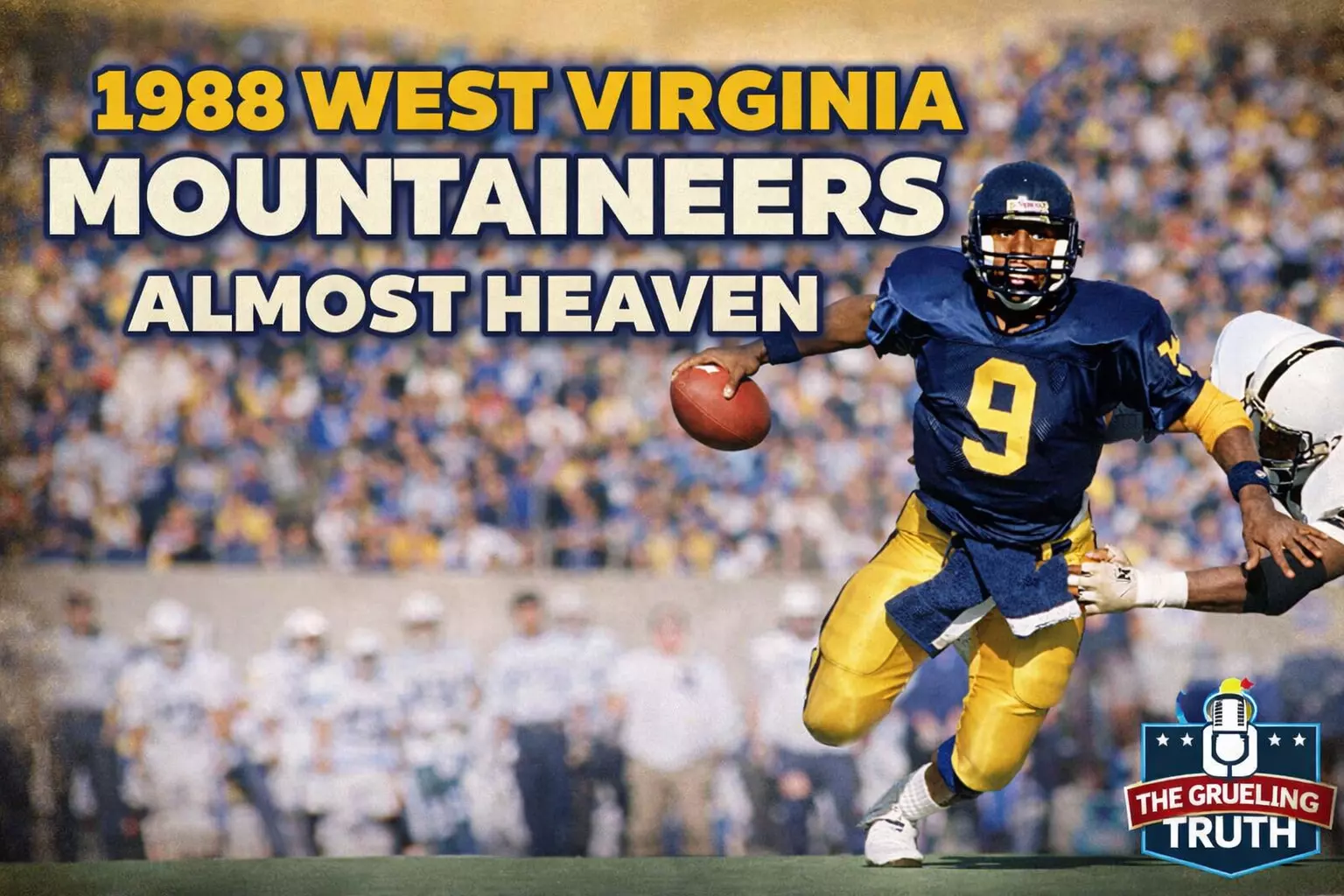
The Lambert Trophy, awarded annually to the best college football team in the Eastern United States, once carried enormous prestige. In an era before conference realignment and national branding overtook regional identity, the Lambert Trophy symbolized supremacy in a densely competitive football corridor that included Penn State, Pitt, Syracuse, Boston College, and Notre Dame. When West Virginia claimed the Lambert Trophy in 1988, it wasn’t a consolation prize—it was a declaration that the Mountaineers had arrived as an elite program.
Under head coach
Don Nehlen, West Virginia produced strong teams throughout the 1980s, but the
1988 Mountaineers
transcended everything that came before and after. Entering the season ranked
No. 16 in the preseason AP Poll, West Virginia was respected but not feared. By the end of the regular season, they were unbeaten, ranked in the top five, and playing for a national championship.
The Catalyst: Don Nehlen and Major Harris
Don Nehlen, who took over the program in 1980, spent nearly a decade building toward 1988. His teams were disciplined, physically tough, and innovative offensively. But the final piece arrived in the form of
Major Harris, one of the most electrifying quarterback’s college football had seen.
Harris was not merely a running quarterback. In 1988, he completed
57 percent of his passes, averaged over
10 yards per attempt, and consistently punished defenses that overcommitted to stopping the option. In a modern spread offense, Harris would have been devastating; in 1988, he was revolutionary.
His receiving corps was led by
Reggie Rembert
and
Calvin Phillips, while
A.B. Brown
and
Undra Johnson
provided balance in the run game. Harris himself finished as one of the team’s leading rushers, making West Virginia nearly impossible to defend schematically.
A Fast Start and National Attention
West Virginia opened the season with dominant wins over
Bowling Green,
Cal State Fullerton, and
Maryland, scoring a combined
162 points
across those three games. Those performances propelled the Mountaineers rapidly up the rankings and set the stage for one of the most important games in school history:
The Backyard Brawl
against Pitt.
Against the Panthers, Harris delivered his first national coming-out performance. A legendary third-and-long scramble kept a critical drive alive, followed by a deep touchdown strike to Rembert. A.B. Brown later broke the game open with a long touchdown run, as West Virginia rolled to a
31–10 victory, announcing itself as a legitimate national contender.
Navigating the Eastern Gauntlet
The Mountaineers followed with road wins over
Virginia Tech,
East Carolina, and
Boston College, pushing their record to 6-0. Each win reinforced what had become increasingly clear: this was not a fluke. West Virginia was fast, physical, and confident.
The defining moment came when
Penn State
arrived in Morgantown. Though the Nittany Lions entered with a losing record, their historical dominance over West Virginia meant nothing could be assumed. Oddsmakers favored WVU heavily—and for once, the odds understated reality.
Harris was sensational, throwing for over
200 yards, rushing for more than
70, and scoring on a breathtaking option keeper. West Virginia overwhelmed Penn State
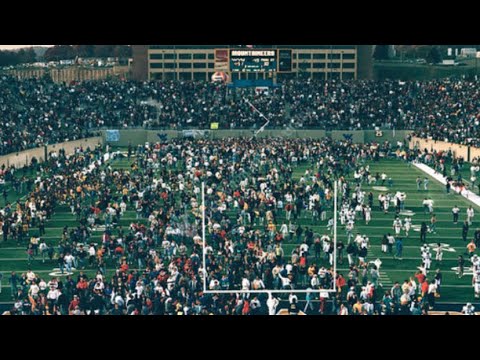
51–30, a scoreline that still stands as one of the most significant wins in program history. The victory vaulted the Mountaineers to
No. 4 nationally.
1988: Penn State vs West Virginia (College Football)
Syracuse and Perfection
With wins over
Cincinnati
and
Rutgers, West Virginia entered its regular-season finale undefeated. Standing in the way was
Syracuse, a 9-1 team with its own Lambert Trophy ambitions.
This game was about toughness. West Virginia’s running game dominated, with Brown and Harris both nearing 100 yards. The defense suffocated Syracuse quarterback
Todd Philcox, and
Willie Edwards’ interception return for a touchdown
sealed the outcome. The
31–9 victory
completed a perfect regular season and secured West Virginia’s Lambert Trophy.
The Fiesta Bowl and What Might Have Been
Ranked
No. 3 nationally, West Virginia earned a berth in the Fiesta Bowl against
Notre Dame, with the national championship at stake. The Irish and Miami were on another level physically, and West Virginia fell behind early. Harris played valiantly but suffered a shoulder injury while throwing a third-quarter touchdown pass, effectively ending any chance of a comeback.
Notre Dame won
34–21, though the final score masked how difficult the night was for the Mountaineers.
Legacy
West Virginia finished
11–1, ranked
No. 5 nationally, and brought home the
Lambert Trophy, the first outright win in program history. More importantly, they proved that West Virginia could compete at the highest level of college football.
The 1988 Mountaineers remain the gold standard in Morgantown. No West Virginia team before or since has played for a national championship. That season wasn’t just successful—it was transformative. It reshaped how the program was viewed nationally and created memories that still define Mountaineer football.
It was a once-in-a-generation team—and a magical year that will never be forgotten.
Up To $1500 in Bonus Bets Paid Back if your First Bet Does Not Win
T&Cs apply
4.5/5
Gambling problem? Call 1-800-GAMBLER or 1-800-MY-RESET (Available in the US) 877-8-HOPENY or text HOPENY (467369) (NY) 1-800-327-5050 (MA), 1-800-BETS-OFF (IA), 1-800-981-0023 (PR). 21+ only. Please Gamble Responsibly. See BetMGM.com for Terms. First Bet Offer for new customers only (if applicable). Subject to eligibility requirements. Bonus bets are non-withdrawable. In partnership with Kansas Crossing Casino and Hotel. Promotional offers not available in Mississippi, Massachusetts, New York, Ontario, or Puerto Rico.
New DraftKings Customers: Spend $5+ Get $150 in Bonuses
T&Cs apply
4.5/5
GAMBLING PROBLEM? CALL 1-800-GAMBLER or 1-800-MY-RESET, (800) 327-5050 or visit gamblinghelplinema.org (MA). Please Gamble Responsibly. 888-789-7777/visit ccpg.org (CT), or visit www.mdgamblinghelp.org (MD), 1-800-981-0023 (PR). 21+ and present in most states. (18+ DC/NH/PR/WY). Void in CAN. Eligibility restrictions apply. On behalf of Boot Hill Casino (KS). Pass-thru of per wager tax may apply in IL. 1 per new DraftKings customer. $5+ first-time bet req. Max. $150 issued as non-withdrawable Bonus Bets. Stake removed from payout. Reward issued as $50 in Bonus Bets every 7 days via click-to-claim for 14 days. Bonus Bets and click-to-claims expire 7 days (168hrs) after issuance. Terms: sportsbook.draftkings.com/promos. Ends 10/11/26 at 11:59 PM ET. Sponsored by DK.
Must be 21+. GAMBLING PROBLEM? CALL 1-800-GAMBLER OR CALL 1-800-MY-RESET, www.mdgamblinghelp.org (MD), (800)-327-5050 or gamblinghelplinema.org (MA), Call (877)8-HOPENY or text HOPENY (467369) (NY), (888) 789-7777 or ccpg.org (CT), morethanagame.nc.gov (NC), 1800gambler.net (WV)
Bet $1 and get double the winnings up to $25 for your next 10 bets
T&Cs apply
4.4/5
21+ New users only. Must register using eligible promo code. First bet after registration must qualify. Max. Bonus Bet: $1,000. Bonus Bet expires 14 days after receipt. Void where prohibited. See Caesars.com/promos for full terms. Gambling Problem? 1-800-GAMBLER (1-800-426-2537)
21+ and present in OH. Gambling Problem? Call 1-800-GAMBLER.
This site is using
Cloudflare
and adheres to the
Google Safe Browsing Program. We adapted
Google's Privacy Guidelines
to keep your data safe at all times.
Close
Ready to Win Big? Join the Elite with Our Sports Betting Deals!
FanDuel Promo
New Users – Get $250 in Bonus Bets when you wager $5 for 5 days
Up To $1500 in Bonus Bets Paid Back if your First Bet Does Not Win
Best Slots
T&Cs and 21+ apply
Gambling problem? Call 1-800-GAMBLER or 1-800-MY-RESET (Available in the US) 877-8-HOPENY or text HOPENY (467369) (NY) 1-800-327-5050 (MA), 1-800-BETS-OFF (IA), 1-800-981-0023 (PR). 21+ only. Please Gamble Responsibly. See BetMGM.com for Terms. First Bet Offer for new customers only (if applicable). Subject to eligibility requirements. Bonus bets are non-withdrawable. In partnership with Kansas Crossing Casino and Hotel. Promotional offers not available in Mississippi, Massachusetts, New York, Ontario, or Puerto Rico.
Code:
Open BetMGM
Get Bonus
DraftKings Promo
New DraftKings Customers: Spend $5+ Get $150 in Bonuses
Newcomer
T&Cs and 21+ apply
GAMBLING PROBLEM? CALL 1-800-GAMBLER or 1-800-MY-RESET, (800) 327-5050 or visit gamblinghelplinema.org (MA). Please Gamble Responsibly. 888-789-7777/visit ccpg.org (CT), or visit www.mdgamblinghelp.org (MD), 1-800-981-0023 (PR). 21+ and present in most states. (18+ DC/NH/PR/WY). Void in CAN. Eligibility restrictions apply. On behalf of Boot Hill Casino (KS). Pass-thru of per wager tax may apply in IL. 1 per new DraftKings customer. $5+ first-time bet req. Max. $150 issued as non-withdrawable Bonus Bets. Stake removed from payout. Reward issued as $50 in Bonus Bets every 7 days via click-to-claim for 14 days. Bonus Bets and click-to-claims expire 7 days (168hrs) after issuance. Terms: sportsbook.draftkings.com/promos. Ends 10/11/26 at 11:59 PM ET. Sponsored by DK.
Code:
Open DraftKings
Get Bonus
Find out what the legends have to say about sports this week....