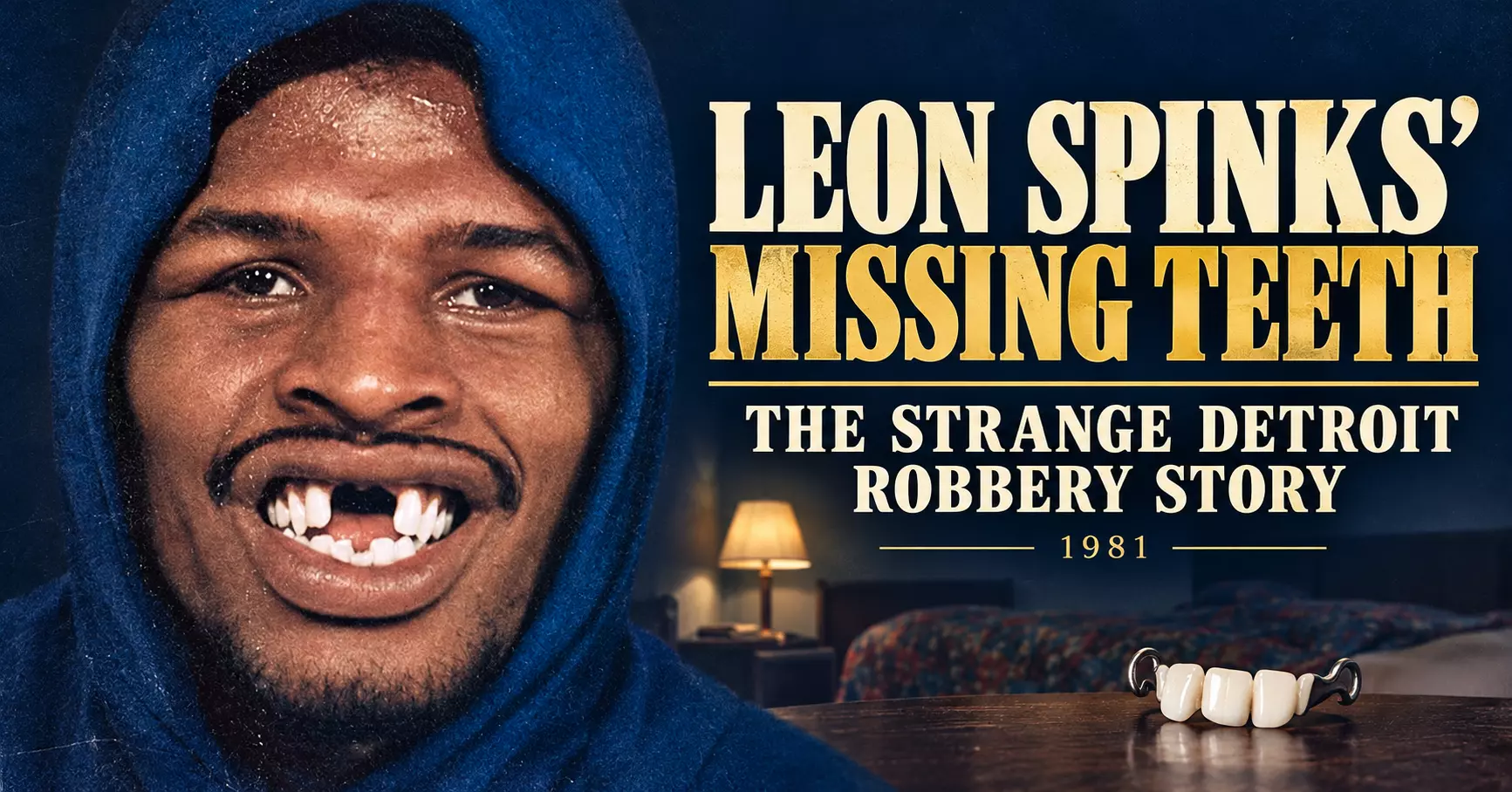
Leon Spinks told Detroit police he had been struck on the head outside a bar and later awakened naked in a motel room. His clothes and jewelry were gone. His false front teeth were missing, too.
Leon Spinks told Detroit police he had been struck on the head outside a bar and later awakened naked in a motel room. His clothes and jewelry were gone. His false front teeth were missing, too.
For a man who had beaten Muhammad Ali less than three years earlier, it was an astonishing situation. But the teeth story came with a twist that many later retellings overlooked: police found the dental plate underneath the motel bed.
The incident became another strange chapter in a life that included Olympic gold, the heavyweight championship and years of financial and personal difficulty.
What the Original Report Actually Said
A UPI dispatch dated January 17, 1981, reported that Spinks told investigators he had been hit outside a Detroit bar late Wednesday. His next memory, he said, was waking Thursday afternoon in a motel approximately five miles away.
He reported a full-length blue fox coat, gold chains, rings, a watch and other clothing missing, estimating the combined value at $45,000. That figure was his estimate for the missing belongings—not a verified valuation of the coat alone.
Police found the partial dental plate under a bed on Friday. It contained four enamel upper teeth and, contrary to an initial report, no gold. Authorities said they were holding it as evidence and would return it to him.
The distinction matters. Spinks reported the teeth missing during a robbery investigation. Their recovery beneath the bed does not establish that a robber deliberately took them.
The documented story is bizarre enough without adding that claim.
Before the Headlines, There Was Olympic Gold
Spinks was born in St. Louis on July 11, 1953. He served in the U.S. Marine Corps before reaching the top of amateur boxing.
At the
1976 Montreal Olympics, he won the light-heavyweight gold medal, stopping Cuba’s Sixto Soria in the final. His younger brother Michael won middleweight gold at the same Games.
Those achievements are essential to understanding Leon. He entered professional boxing with genuine credentials. His later troubles sometimes overshadow the discipline and ability required to become an Olympic champion.
He had already earned an important place in American boxing before Muhammad Ali entered his story.
Eight Professional Fights—and the Heavyweight Championship
On February 15, 1978, Spinks faced Ali in Las Vegas with a professional record of 6–0–1. It was his eighth professional bout.
After 15 rounds, Spinks won a split decision and became the undisputed heavyweight champion.
The achievement remains extraordinary. An Olympic gold medalist with only seven previous professional appearances had defeated boxing’s most famous fighter for its biggest championship.
Ali was past his peak, but that does not make Spinks’ victory automatic or insignificant. Leon had to stay effective over a championship distance against an opponent with vastly greater professional experience. He did enough to earn the judges’ decision.
His career would never again reach that height. Nothing that followed could erase it.
A Championship Reign That Unraveled Quickly
Spinks chose an Ali rematch over a defense against mandatory challenger Ken Norton. The WBC stripped him of its championship in March 1978, while he retained the WBA title.
On September 15, Ali won their rematch by unanimous decision in New Orleans, ending Spinks’ reign.
The sudden arrival of fame also brought difficulties. In the Associated Press’s obituary, promoter Bob Arum recalled that Spinks embraced the partying and entourage that accompanied the championship. Arum’s assessment was that Leon’s enjoyment of that life affected his preparation for the rematch.
That is a promoter’s retrospective assessment, rather than a complete explanation for the defeat. What the fight record establishes is clear: Spinks reached the summit quickly and lost his remaining championship seven months later.
The Robbery Came Before Another Title Chance
The January 1981 robbery report did not mark the end of Spinks’ championship ambitions.
On June 12 that year, he challenged WBC heavyweight champion Larry Holmes in Detroit. Holmes stopped him in the third round.
Spinks later pursued a world title at cruiserweight. On March 22, 1986, Dwight Muhammad Qawi stopped him in the sixth round of their WBA championship fight.
His career continued until 1995. He finished with 26 victories, 17 defeats and three draws.
Those numbers describe a long, uneven professional career. They also show how different his experience became from the spectacular promise of his first championship victory.
Life After the Biggest Payday
Financial security proved elusive. Reuters’ obituary reported that Spinks attributed the disappearance of his boxing earnings to excessive spending and mismanagement. The account also documented problems with alcohol and drugs, driving-related arrests and periods of financial hardship.
By 2005, he was living in Columbus, Nebraska, and working as a YMCA janitor.
There is nothing shameful about earning a living through ordinary work. The striking point is the distance between the rewards associated with the heavyweight championship and the circumstances of his later life.
His decline deserves to be understood with care. A fighter’s bank balance does not measure the value of his achievements, and personal difficulties should not turn an entire life into a punch line.
Spinks died on February 5, 2021, at 67, after battling cancer.
Remember the Champion Behind the Strange Story
The missing teeth provide an irresistible opening because the details seem almost impossible: a
former heavyweight champion, a reported attack, vanished valuables and a dental plate recovered beneath a motel bed.
But the incident should lead readers toward the man’s larger story.
Leon Spinks won Olympic gold. He defeated Muhammad Ali. He struggled to sustain the success and security that seemed to arrive with the championship.
The teeth were found. The harder part of his story was what happened after the world stopped treating him as its newest champion.
Sources
[1] UPI, January 17, 1981: Police recover Spinks’ dental plate
Up To $1500 in Bonus Bets Paid Back if your First Bet Does Not Win
T&Cs apply
4.5/5
Gambling problem? Call 1-800-GAMBLER or 1-800-MY-RESET (Available in the US) 877-8-HOPENY or text HOPENY (467369) (NY) 1-800-327-5050 (MA), 1-800-BETS-OFF (IA), 1-800-981-0023 (PR). 21+ only. Please Gamble Responsibly. See BetMGM.com for Terms. First Bet Offer for new customers only (if applicable). Subject to eligibility requirements. Bonus bets are non-withdrawable. In partnership with Kansas Crossing Casino and Hotel. Promotional offers not available in Mississippi, Massachusetts, New York, Ontario, or Puerto Rico.
New DraftKings Customers: Spend $5+ Get $150 in Bonuses
T&Cs apply
4.5/5
GAMBLING PROBLEM? CALL 1-800-GAMBLER or 1-800-MY-RESET, (800) 327-5050 or visit gamblinghelplinema.org (MA). Please Gamble Responsibly. 888-789-7777/visit ccpg.org (CT), or visit www.mdgamblinghelp.org (MD), 1-800-981-0023 (PR). 21+ and present in most states. (18+ DC/NH/PR/WY). Void in CAN. Eligibility restrictions apply. On behalf of Boot Hill Casino (KS). Pass-thru of per wager tax may apply in IL. 1 per new DraftKings customer. $5+ first-time bet req. Max. $150 issued as non-withdrawable Bonus Bets. Stake removed from payout. Reward issued as $50 in Bonus Bets every 7 days via click-to-claim for 14 days. Bonus Bets and click-to-claims expire 7 days (168hrs) after issuance. Terms: sportsbook.draftkings.com/promos. Ends 10/11/26 at 11:59 PM ET. Sponsored by DK.
Must be 21+. GAMBLING PROBLEM? CALL 1-800-GAMBLER OR CALL 1-800-MY-RESET, www.mdgamblinghelp.org (MD), (800)-327-5050 or gamblinghelplinema.org (MA), Call (877)8-HOPENY or text HOPENY (467369) (NY), (888) 789-7777 or ccpg.org (CT), morethanagame.nc.gov (NC), 1800gambler.net (WV)
Bet $1 and get double the winnings up to $25 for your next 10 bets
T&Cs apply
4.4/5
21+ New users only. Must register using eligible promo code. First bet after registration must qualify. Max. Bonus Bet: $1,000. Bonus Bet expires 14 days after receipt. Void where prohibited. See Caesars.com/promos for full terms. Gambling Problem? 1-800-GAMBLER (1-800-426-2537)
21+ and present in OH. Gambling Problem? Call 1-800-GAMBLER.
This site is using
Cloudflare
and adheres to the
Google Safe Browsing Program. We adapted
Google's Privacy Guidelines
to keep your data safe at all times.
Close
Ready to Win Big? Join the Elite with Our Sports Betting Deals!
FanDuel Promo
New Users – Get $250 in Bonus Bets when you wager $5 for 5 days
Up To $1500 in Bonus Bets Paid Back if your First Bet Does Not Win
Best Slots
T&Cs and 21+ apply
Gambling problem? Call 1-800-GAMBLER or 1-800-MY-RESET (Available in the US) 877-8-HOPENY or text HOPENY (467369) (NY) 1-800-327-5050 (MA), 1-800-BETS-OFF (IA), 1-800-981-0023 (PR). 21+ only. Please Gamble Responsibly. See BetMGM.com for Terms. First Bet Offer for new customers only (if applicable). Subject to eligibility requirements. Bonus bets are non-withdrawable. In partnership with Kansas Crossing Casino and Hotel. Promotional offers not available in Mississippi, Massachusetts, New York, Ontario, or Puerto Rico.
Code:
Open BetMGM
Get Bonus
DraftKings Promo
New DraftKings Customers: Spend $5+ Get $150 in Bonuses
Newcomer
T&Cs and 21+ apply
GAMBLING PROBLEM? CALL 1-800-GAMBLER or 1-800-MY-RESET, (800) 327-5050 or visit gamblinghelplinema.org (MA). Please Gamble Responsibly. 888-789-7777/visit ccpg.org (CT), or visit www.mdgamblinghelp.org (MD), 1-800-981-0023 (PR). 21+ and present in most states. (18+ DC/NH/PR/WY). Void in CAN. Eligibility restrictions apply. On behalf of Boot Hill Casino (KS). Pass-thru of per wager tax may apply in IL. 1 per new DraftKings customer. $5+ first-time bet req. Max. $150 issued as non-withdrawable Bonus Bets. Stake removed from payout. Reward issued as $50 in Bonus Bets every 7 days via click-to-claim for 14 days. Bonus Bets and click-to-claims expire 7 days (168hrs) after issuance. Terms: sportsbook.draftkings.com/promos. Ends 10/11/26 at 11:59 PM ET. Sponsored by DK.
Code:
Open DraftKings
Get Bonus
Find out what the legends have to say about sports this week....