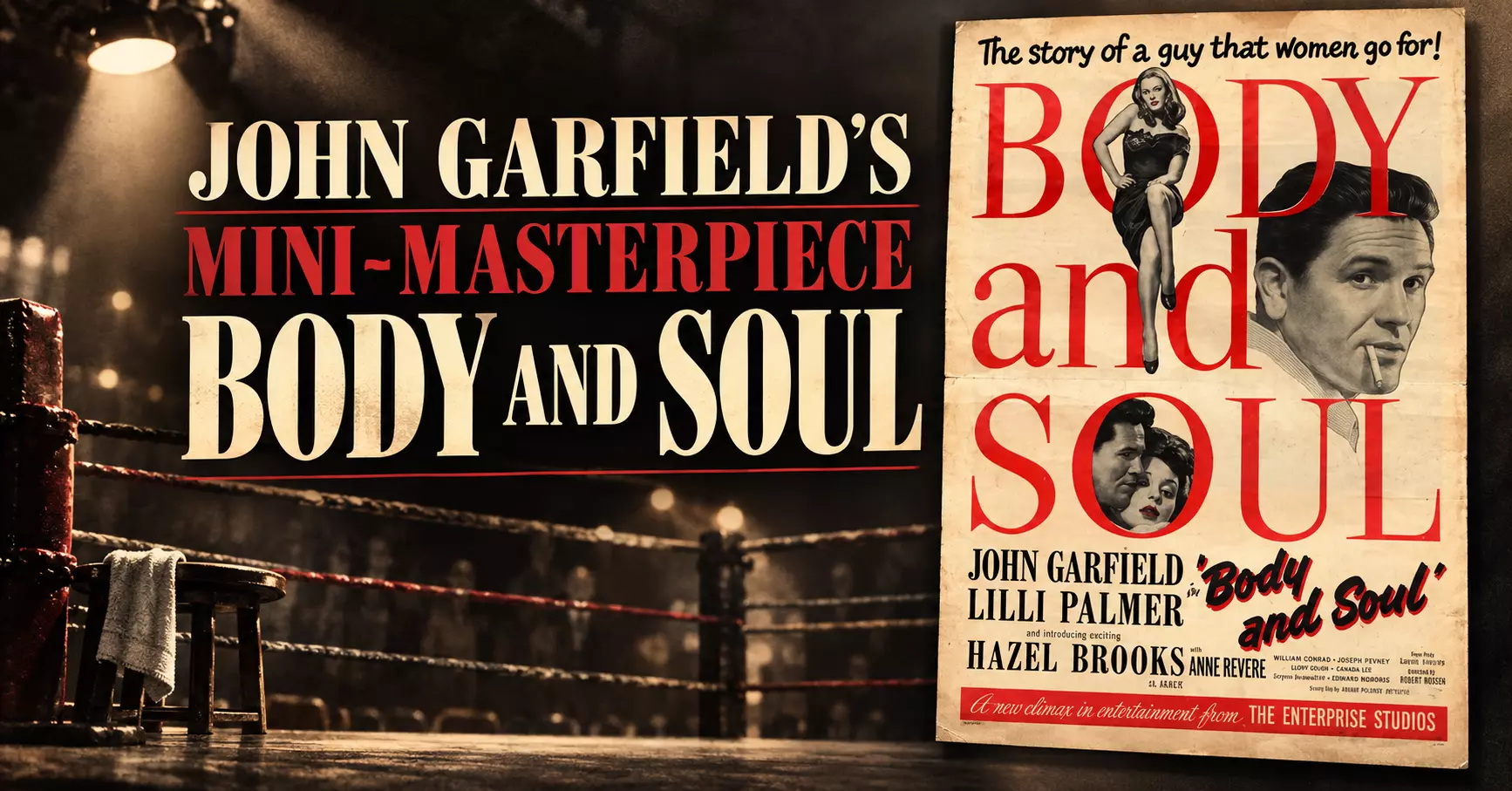
Before “Body and Soul” was made in 1947, most boxing films had a universal theme. The hero was close to perfect.
“What are you gonna do? Kill me? Everybody dies.” — Charlie Davis
Before “Body and Soul” was made in 1947, most boxing films had a universal theme. The hero was close to perfect. If he did anything wrong, it wasn’t usually his fault.
In “Body and Soul,” starring John Garfield, the hero is cast in shades of gray.
He’s human.
The 33-year-old Garfield was the driving force behind the film, having turned down a contract extension from Warner Brothers the year before. Garfield wanted more. His career was on a roll, but he wanted control over the content.
He told writer Mary Morris, “I want to make pictures with a point—zing, spit, fire.”
Garfield formed his own film company in 1946. For his first project, he chose the story of former lightweight champion and war hero Barney Ross, who also battled and defeated a drug problem.
The film was in production hell until screenwriter Abraham Polansky met Garfield for lunch.
Polansky had written his own version of Ross‘s story. He discussed it with Garfield, who liked what he heard.
The working title was
Body and Soul.
The story takes place during the height of the
Great Depression. Garfield plays Charlie Davis, a poor kid with dreams. He wins a trophy in an amateur boxing tournament and realizes that fighting is his ticket out of the slums and a way to make money.
After the unexpected death of his father, due to a bomb exploding in the family store, Davis is left with few choices.
He knows he can do one thing well.
Fight.
With support from his girlfriend Peg, he quickly turns professional and wins his first 21 fights, 19 by knockout.
A shot at a world title beckons.
Here, the movie shifts direction.
To get that shot, fulfill his dreams, and fill his pockets, he has to make a deal.
Not with the devil—but close.
An icy gangster named Roberts appears at his new penthouse door. He wants in on the action.
He smells money.
His best friend, Shorty Davis, knows the way it is.
“He doesn’t care about you,” Shorty says. “He just wants his piece of the pie.”
Davis, oblivious or driven by blind ambition, ignores his friend.
Roberts sweetens the deal by giving Davis an envelope overflowing with cash.
Davis changes. His relationships suffer, including his friendship with Shorty, who dies later in the film. He’s selling out but paying a price.
Roberts delivers Davis his shot at a title. The champion, Ben Chaplin, owes Roberts money. He’s also sick, dealing with a blood clot suffered in a previous fight. He accepts the match with Davis.
Roberts doesn’t tell Davis about the deal.
The bout is no contest. Davis brutalizes the former champion in two rounds. The beating nearly kills him. Shorty finds out the truth of the match. He tells Roberts he’s done and that Davis will quit too. But Davis, after working so hard and selling out to the devil, won’t quit.
He feels terrible about Chaplin but still can’t walk away. He later asks him to be his trainer.
Davis is now the champ, but in the process he loses Shorty, who dies, and his girlfriend.
He’s won, but he’s lost. Davis thought money would bring him happiness; instead, he grows disillusioned. He defends his title several times, then takes an extended vacation to party. Roberts keeps supplying the cash.
The day of reckoning finally comes when Davis stops by Roberts’ office to collect another advance. This time the mobster turns him down.
He tells Davis he needs to fight again. He can square things with Roberts by doing him a favor, but he has to fight a young, up-and-coming boxer—and he has to lose.
Conflicted and worried, Davis ponders what to do. He turns to his loyal ex-girlfriend Peg and his mother for advice. After learning that his old neighborhood is betting on him to win, he explains what he’s up against.
“There’s a million bucks riding on my back,” he says.
“If I don’t fight, I don’t get a dime. I’m all mobbed up, tied hand and foot, down to my last buck. You think I want to end up like Ben, punchy, with a blood clot on the brain, ready to die any day—or with a bullet in my back in an alley?”
Roberts reminds him of their deal. He’s to lose, but during the fight, everything changes. Davis realizes he’s been set up.
“Like Ben,” he says.
Garfield’s performance is riveting. He’s edgy and charismatic and carries the film with his gutsy acting. He landed an Oscar nomination for Best Actor, and Polansky earned a nod for his hard-hitting screenplay.
Neither won, but no matter.
Former prizefighter Canada Lee as his sad-eyed trainer, Ben, is also excellent.
Robert Rossen superbly directs. Cinematographer James Wong Howe wore roller skates to film the fight scenes, adding realism to an already gritty film.
The movie has a haunted quality that foreshadows Garfield and Lee’s futures. They would both die within weeks of each other in 1952.
Body and Soul
has earned the right to be called a magnificent film.
The film resounds as a reflection of today’s boxing scene, where lies and corruption still cause havoc, and disillusionment awaits the ambitious.
But most of all, it’s a testament to the brilliance of Garfield, who was determined to make films of importance and value.
Up To $1500 in Bonus Bets Paid Back if your First Bet Does Not Win
T&Cs apply
4.5/5
Gambling problem? Call 1-800-GAMBLER or 1-800-MY-RESET (Available in the US) 877-8-HOPENY or text HOPENY (467369) (NY) 1-800-327-5050 (MA), 1-800-BETS-OFF (IA), 1-800-981-0023 (PR). 21+ only. Please Gamble Responsibly. See BetMGM.com for Terms. First Bet Offer for new customers only (if applicable). Subject to eligibility requirements. Bonus bets are non-withdrawable. In partnership with Kansas Crossing Casino and Hotel. Promotional offers not available in Mississippi, Massachusetts, New York, Ontario, or Puerto Rico.
New DraftKings Customers: Spend $5+ Get $150 in Bonuses
T&Cs apply
4.5/5
GAMBLING PROBLEM? CALL 1-800-GAMBLER or 1-800-MY-RESET, (800) 327-5050 or visit gamblinghelplinema.org (MA). Please Gamble Responsibly. 888-789-7777/visit ccpg.org (CT), or visit www.mdgamblinghelp.org (MD), 1-800-981-0023 (PR). 21+ and present in most states. (18+ DC/NH/PR/WY). Void in CAN. Eligibility restrictions apply. On behalf of Boot Hill Casino (KS). Pass-thru of per wager tax may apply in IL. 1 per new DraftKings customer. $5+ first-time bet req. Max. $150 issued as non-withdrawable Bonus Bets. Stake removed from payout. Reward issued as $50 in Bonus Bets every 7 days via click-to-claim for 14 days. Bonus Bets and click-to-claims expire 7 days (168hrs) after issuance. Terms: sportsbook.draftkings.com/promos. Ends 10/11/26 at 11:59 PM ET. Sponsored by DK.
Must be 21+. GAMBLING PROBLEM? CALL 1-800-GAMBLER OR CALL 1-800-MY-RESET, www.mdgamblinghelp.org (MD), (800)-327-5050 or gamblinghelplinema.org (MA), Call (877)8-HOPENY or text HOPENY (467369) (NY), (888) 789-7777 or ccpg.org (CT), morethanagame.nc.gov (NC), 1800gambler.net (WV)
Bet $1 and get double the winnings up to $25 for your next 10 bets
T&Cs apply
4.4/5
21+ New users only. Must register using eligible promo code. First bet after registration must qualify. Max. Bonus Bet: $1,000. Bonus Bet expires 14 days after receipt. Void where prohibited. See Caesars.com/promos for full terms. Gambling Problem? 1-800-GAMBLER (1-800-426-2537)
21+ and present in OH. Gambling Problem? Call 1-800-GAMBLER.
This site is using
Cloudflare
and adheres to the
Google Safe Browsing Program. We adapted
Google's Privacy Guidelines
to keep your data safe at all times.
Close
Ready to Win Big? Join the Elite with Our Sports Betting Deals!
FanDuel Promo
New Users – Get $250 in Bonus Bets when you wager $5 for 5 days
Up To $1500 in Bonus Bets Paid Back if your First Bet Does Not Win
Best Slots
T&Cs and 21+ apply
Gambling problem? Call 1-800-GAMBLER or 1-800-MY-RESET (Available in the US) 877-8-HOPENY or text HOPENY (467369) (NY) 1-800-327-5050 (MA), 1-800-BETS-OFF (IA), 1-800-981-0023 (PR). 21+ only. Please Gamble Responsibly. See BetMGM.com for Terms. First Bet Offer for new customers only (if applicable). Subject to eligibility requirements. Bonus bets are non-withdrawable. In partnership with Kansas Crossing Casino and Hotel. Promotional offers not available in Mississippi, Massachusetts, New York, Ontario, or Puerto Rico.
Code:
Open BetMGM
Get Bonus
DraftKings Promo
New DraftKings Customers: Spend $5+ Get $150 in Bonuses
Newcomer
T&Cs and 21+ apply
GAMBLING PROBLEM? CALL 1-800-GAMBLER or 1-800-MY-RESET, (800) 327-5050 or visit gamblinghelplinema.org (MA). Please Gamble Responsibly. 888-789-7777/visit ccpg.org (CT), or visit www.mdgamblinghelp.org (MD), 1-800-981-0023 (PR). 21+ and present in most states. (18+ DC/NH/PR/WY). Void in CAN. Eligibility restrictions apply. On behalf of Boot Hill Casino (KS). Pass-thru of per wager tax may apply in IL. 1 per new DraftKings customer. $5+ first-time bet req. Max. $150 issued as non-withdrawable Bonus Bets. Stake removed from payout. Reward issued as $50 in Bonus Bets every 7 days via click-to-claim for 14 days. Bonus Bets and click-to-claims expire 7 days (168hrs) after issuance. Terms: sportsbook.draftkings.com/promos. Ends 10/11/26 at 11:59 PM ET. Sponsored by DK.
Code:
Open DraftKings
Get Bonus
Find out what the legends have to say about sports this week....