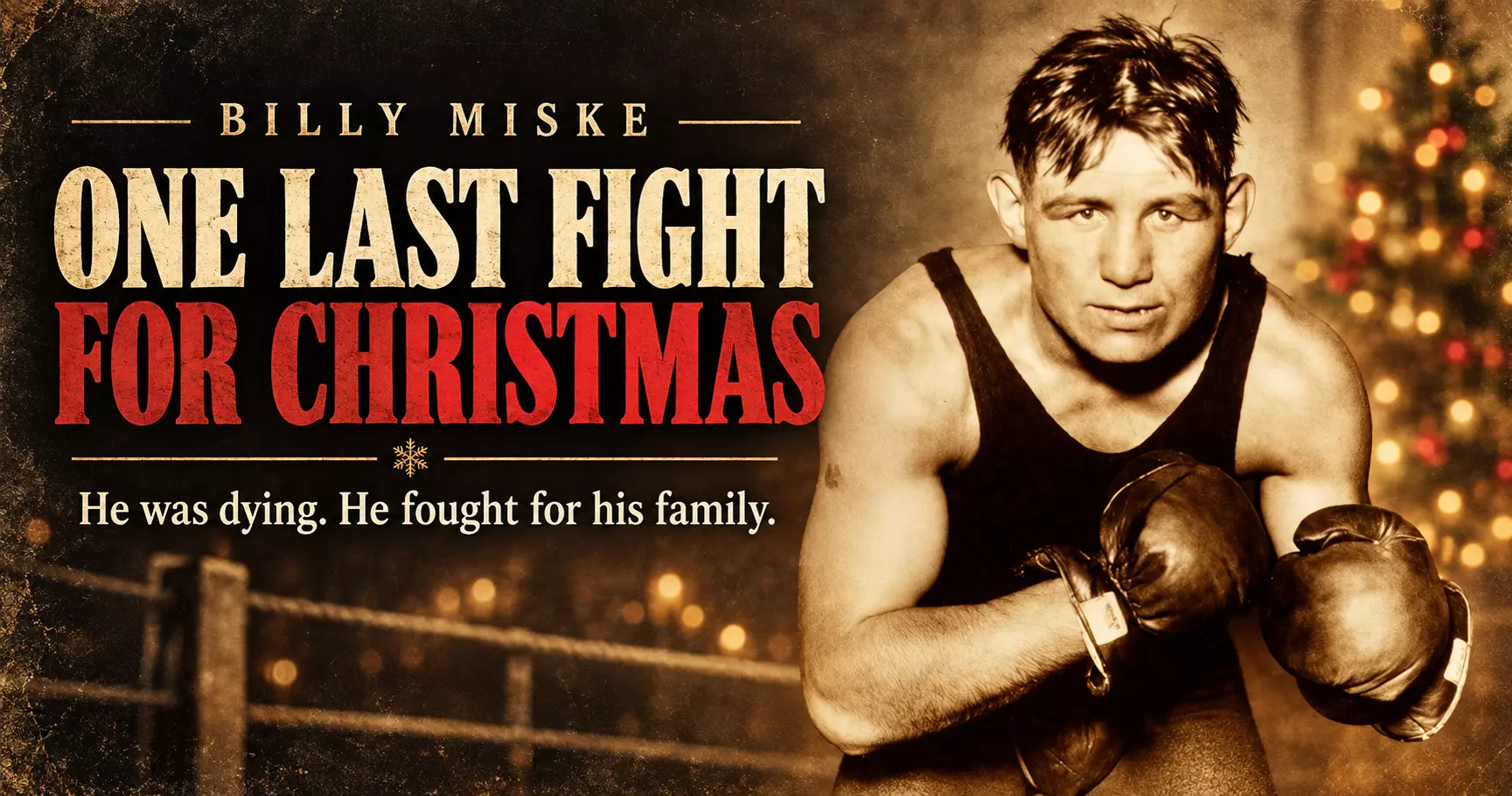
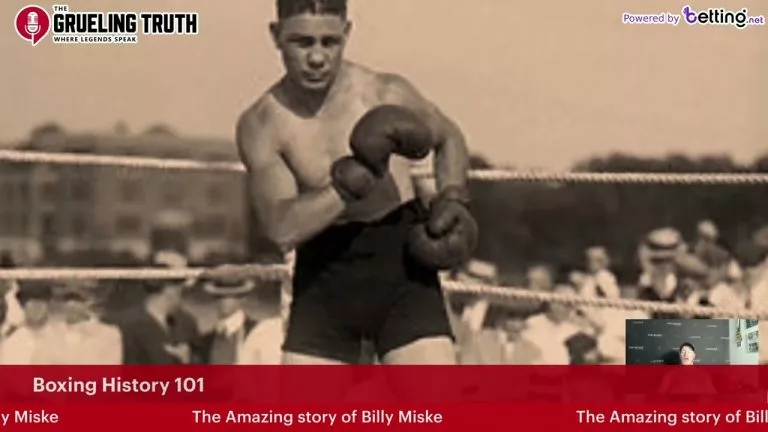
On November 7, 1923, Billy Miske knocked out Bill Brennan in the fourth round in Omaha, Nebraska. On January 1, 1924, Miske died
Billy Miske’s last victory came less than eight weeks before his death.
On November 7, 1923, the Minnesota boxer knocked out Bill Brennan in the fourth round in Omaha, Nebraska. On January 1, 1924, Miske died of kidney disease at 29.
Between those dates came the Christmas that made his final fight one of boxing’s most moving stories.
Later historical accounts describe a desperately ill father returning to the ring to earn money for his wife and three children. The fight result and death date are documented. The intimate Christmas details come from recollections and subsequent reporting, and deserve to be presented as such.
The story remains heartbreaking without adding anything to it.
A Serious Fighter Facing a Fatal Illness
Miske was known as the
St. Paul Thunderbolt. His opponents included Jack Dempsey, Harry Greb, Tommy Gibbons and Jack Dillon.
He was an accomplished professional competing against important fighters of his era. That matters when considering his final victory: the illness had weakened a man who already possessed substantial skill and experience.
In 1918, Miske became ill with what contemporary accounts called Bright’s disease, a historical term associated with kidney disease.
He continued fighting after the diagnosis. His career included a heavyweight championship challenge against Dempsey on September 6, 1920, in Benton Harbor, Michigan. Dempsey stopped him in the third round.
Miske’s career continued, but the disease did too. By the autumn of 1923, according to later accounts, his condition had deteriorated severely.
Why He Wanted Another Fight
The Christmas account places financial responsibility at the center of Miske’s decision.
A 2006 article in
Ramsey County History, drawing on published sources and an interview with his grandson, describes an unsuccessful automobile business and serious financial trouble. Boxing remained the means by which Miske could earn money.
The same account says he wanted another bout so he could provide a Christmas celebration for his family, despite being too weak to train normally.
That is the essential dilemma: the work that could bring money home required physical effort and danger from a man whose health was failing.
It is easy, a century later, to reduce that decision to a slogan about courage. The circumstances deserve more thought than that. Miske had a wife and children, financial obligations and an illness that threatened the time he had left with them.
His decision was both determined and desperate.
Jack Reddy Arranged the Final Bout
According to the later historical narrative, Miske asked manager Jack Reddy to find him another fight. Reddy initially resisted because of his condition, then arranged the Brennan match.
Rick Reilly’s
Sports Illustrated
account describes Miske as unable to undertake conventional training. It gives the purse as $2,400 and presents the bout as his opportunity to fund a final family Christmas.
Those details should remain attributed to the account rather than treated as if every private conversation was recorded.
The documented outcome is extraordinary enough: a boxer suffering from severe kidney disease entered the ring and won by knockout.
He did not merely last long enough to collect a payday. He defeated his opponent.
The November 7 Victory Is Confirmed
The official record places the fight on November 7, 1923.
Contemporary newspaper reporting corroborates it. The November 8
Victoria Daily Times
reported that Brennan had been knocked out in the fourth round of their scheduled ten-round contest in Omaha the previous night.
That report also noted that the Nebraska boxing commission suspended Brennan after the bout and held his purse. The event’s immediate aftermath was more complicated than later sentimental retellings sometimes suggest.
It does not change the recorded result: Miske won by fourth-round knockout.
There is no need to invent what he thought between rounds or describe punches without reliable reporting. The result, considered alongside his illness and approaching death, supplies the drama.
The Christmas Remembered by His Family
The familiar account describes Miske using his earnings to provide presents and a festive Christmas at home.
Reilly’s retelling includes a toy train for the children and a baby grand piano. The Ramsey County Historical Society’s account likewise describes the purse as enabling a memorable family Christmas.
A later
Star Tribune
column reported a recollection from Miske’s son: “I remember my mom sitting down at that baby grand piano.”
These are remembered details, preserved and retold over decades. They give the story its human scale, while requiring a distinction between recollection and a contemporary record.
The emotional meaning does not depend on measuring the number of presents or reconstructing every hour of Christmas Day.
A father facing death wanted to leave his family something joyful. That is the purpose the accounts consistently assign to his final fight.
New Year’s Day Ended the Story
Later accounts describe Miske going to the hospital immediately after Christmas as his condition worsened.
He died on January 1, 1924, leaving his wife, Marie, and three children.
The timing is devastating. His last knockout had come only 55 days earlier. He had lived through Christmas, but not into another year with his family.
Winning the fight had not reversed his illness. Whatever relief or happiness the purse provided, it could not restore his health.
That is why this story resists an easy happy ending. The victory and the loss belong together.
The Story of Billy Miske
Boxing History 101: The incredible story of Billy Miske who fought while battling death
What His Final Fight Means
Miske deserves to be remembered as a skilled boxer as well as the father in a Christmas story. His career brought him into the ring with some of the era’s best fighters.
But his final appearance carries a different significance.
According to the accounts that preserved it, he fought with his family’s needs in mind at a time when his own future was disappearing. That purpose turned an otherwise obscure heavyweight bout into a story that has endured for generations.
The dates require no embellishment: November 7, a fourth-round knockout. Christmas with his family. January 1, his death at 29.
Billy Miske could not stop the illness.
The final victory gave the people who remembered him something else to hold on to.
New Users – Get $350 in Bonus Bets when you wager $5 for 7 days
T&Cs apply
4.6/5
Gambling Problem? Call 1-800-GAMBLER or 1-800-MY-RESET. Call 1-888-789-7777 or visit ccpgg.org/chat (CT). Hope is here. GamblingHelpLineMA.org or call (800) 327-5050 for 24/7 support (MA). Visit www.mdgamblinghelp.org (MD). Call 1-877-8HOPE-NY or text HOPENY (NY). 21+ (18+ DC, WY) and present in select states (for KS, in affiliation with Kansas Star Casino). Find online real money wagering only. Min $5 wager required for 7 consecutive days. $5 free play credit. Bonus issued as non-withdrawable bonus with cash withdrawable bonus with cash withdrawable. Bonus bets which expire 7 days after receipt. Restrictions apply. See terms at sportsbook.fanduel.com. Call 1-877-770-7867 (LA).
Up To $1500 in Bonus Bets Paid Back if your First Bet Does Not Win
T&Cs apply
4.5/5
Gambling problem? Call 1-800-GAMBLER or 1-800-MY-RESET (Available in the US) 877-8-HOPENY or text HOPENY (467369) (NY) 1-800-327-5050 (MA), 1-800-BETS-OFF (IA), 1-800-981-0023 (PR). 21+ only. Please Gamble Responsibly. See BetMGM.com for Terms. First Bet Offer for new customers only (if applicable). Subject to eligibility requirements. Bonus bets are non-withdrawable. In partnership with Kansas Crossing Casino and Hotel. Promotional offers not available in Mississippi, Massachusetts, New York, Ontario, or Puerto Rico.
New DraftKings Customers: Bet $5, Get $200 + 3 Months of NBA League Pass!
T&Cs apply
4.5/5
GAMBLING PROBLEM? CALL 1-800-GAMBLER or 1-800-MY-RESET, (800) 327-5050 or visit gamblinghelplinema.org (MA). Please Gamble Responsibly. 888-789-7777/visit ccpg.org (CT), or visit www.mdgamblinghelp.org (MD), 1-800-981-0023 (PR). 21+ and present in most states. (18+ DC/NH/PR/WY). Void in CAN. Eligibility restrictions apply. On behalf of Boot Hill Casino (KS). Pass-thru of per wager tax may apply in IL. 1 per new Sportsbook customer. $5+ first-time bet req. Max. $200 issued as non-withdrawable Bonus Bets. Stake removed from payout. Reward issued as $50 in Bonus Bets every 7 days via click-to-claim for 21 days. Bonus Bets and click-to-claims expire 7 days (168hrs) after issuance. Terms: dkng.co/offer. Get 1 promo code to redeem a 3-month NBA League Pass subscription, complimentary of DraftKings. Subscription auto-renews monthly at then-current price (currently $16.99/mo); cancel anytime. Terms, restrictions, and eligibility requirements apply. Redeem League Pass by 12/19/26 at 11:59 PM ET. Addt’l terms: support.watch.nba.com/hc/en-us/articles/9165532876183-League-Pass-Terms-of-Use_. Ends 11/29/26 at 11:59 PM ET. Sponsored by DK.
Must be 21+. GAMBLING PROBLEM? CALL 1-800-GAMBLER OR CALL 1-800-MY-RESET, www.mdgamblinghelp.org (MD), (800)-327-5050 or gamblinghelplinema.org (MA), Call (877)8-HOPENY or text HOPENY (467369) (NY), (888) 789-7777 or ccpg.org (CT), morethanagame.nc.gov (NC), 1800gambler.net (WV)
Bet $1 and get double the winnings up to $25 for your next 10 bets
T&Cs apply
4.4/5
21+ New users only. Must register using eligible promo code. First bet after registration must qualify. Max. Bonus Bet: $1,000. Bonus Bet expires 14 days after receipt. Void where prohibited. See Caesars.com/promos for full terms. Gambling Problem? 1-800-GAMBLER (1-800-426-2537)
21+ and present in OH. Gambling Problem? Call 1-800-GAMBLER.
This site is using
Cloudflare
and adheres to the
Google Safe Browsing Program. We adapted
Google's Privacy Guidelines
to keep your data safe at all times.
Close
Ready to Win Big? Join the Elite with Our Sports Betting Deals!
FanDuel Promo
New Users – Get $350 in Bonus Bets when you wager $5 for 7 days
Our Favorite
T&Cs and 21+ apply
Gambling Problem? Call 1-800-GAMBLER or 1-800-MY-RESET. Call 1-888-789-7777 or visit ccpgg.org/chat (CT). Hope is here. GamblingHelpLineMA.org or call (800) 327-5050 for 24/7 support (MA). Visit www.mdgamblinghelp.org (MD). Call 1-877-8HOPE-NY or text HOPENY (NY). 21+ (18+ DC, WY) and present in select states (for KS, in affiliation with Kansas Star Casino). Find online real money wagering only. Min $5 wager required for 7 consecutive days. $5 free play credit. Bonus issued as non-withdrawable bonus with cash withdrawable bonus with cash withdrawable. Bonus bets which expire 7 days after receipt. Restrictions apply. See terms at sportsbook.fanduel.com. Call 1-877-770-7867 (LA).
Code:
Open FanDuel
Get Bonus
BetMGM Promo
Up To $1500 in Bonus Bets Paid Back if your First Bet Does Not Win
Best Slots
T&Cs and 21+ apply
Gambling problem? Call 1-800-GAMBLER or 1-800-MY-RESET (Available in the US) 877-8-HOPENY or text HOPENY (467369) (NY) 1-800-327-5050 (MA), 1-800-BETS-OFF (IA), 1-800-981-0023 (PR). 21+ only. Please Gamble Responsibly. See BetMGM.com for Terms. First Bet Offer for new customers only (if applicable). Subject to eligibility requirements. Bonus bets are non-withdrawable. In partnership with Kansas Crossing Casino and Hotel. Promotional offers not available in Mississippi, Massachusetts, New York, Ontario, or Puerto Rico.
Code:
Open BetMGM
Get Bonus
DraftKings Promo
New DraftKings Customers: Bet $5, Get $200 + 3 Months of NBA League Pass!
Newcomer
T&Cs and 21+ apply
GAMBLING PROBLEM? CALL 1-800-GAMBLER or 1-800-MY-RESET, (800) 327-5050 or visit gamblinghelplinema.org (MA). Please Gamble Responsibly. 888-789-7777/visit ccpg.org (CT), or visit www.mdgamblinghelp.org (MD), 1-800-981-0023 (PR). 21+ and present in most states. (18+ DC/NH/PR/WY). Void in CAN. Eligibility restrictions apply. On behalf of Boot Hill Casino (KS). Pass-thru of per wager tax may apply in IL. 1 per new Sportsbook customer. $5+ first-time bet req. Max. $200 issued as non-withdrawable Bonus Bets. Stake removed from payout. Reward issued as $50 in Bonus Bets every 7 days via click-to-claim for 21 days. Bonus Bets and click-to-claims expire 7 days (168hrs) after issuance. Terms: dkng.co/offer. Get 1 promo code to redeem a 3-month NBA League Pass subscription, complimentary of DraftKings. Subscription auto-renews monthly at then-current price (currently $16.99/mo); cancel anytime. Terms, restrictions, and eligibility requirements apply. Redeem League Pass by 12/19/26 at 11:59 PM ET. Addt’l terms: support.watch.nba.com/hc/en-us/articles/9165532876183-League-Pass-Terms-of-Use_. Ends 11/29/26 at 11:59 PM ET. Sponsored by DK.
Code:
Open DraftKings
Get Bonus
Find out what the legends have to say about sports this week....
New Users – Get $350 in Bonus Bets when you wager $5 for 7 days
Gambling Problem? Call 1-800-GAMBLER or 1-800-MY-RESET. Call 1-888-789-7777 or visit ccpgg.org/chat (CT). Hope is here. GamblingHelpLineMA.org or call (800) 327-5050 for 24/7 support (MA). Visit www.mdgamblinghelp.org (MD). Call 1-877-8HOPE-NY or text HOPENY (NY). 21+ (18+ DC, WY) and present in select states (for KS, in affiliation with Kansas Star Casino). Find online real money wagering only. Min $5 wager required for 7 consecutive days. $5 free play credit. Bonus issued as non-withdrawable bonus with cash withdrawable bonus with cash withdrawable. Bonus bets which expire 7 days after receipt. Restrictions apply. See terms at sportsbook.fanduel.com. Call 1-877-770-7867 (LA).