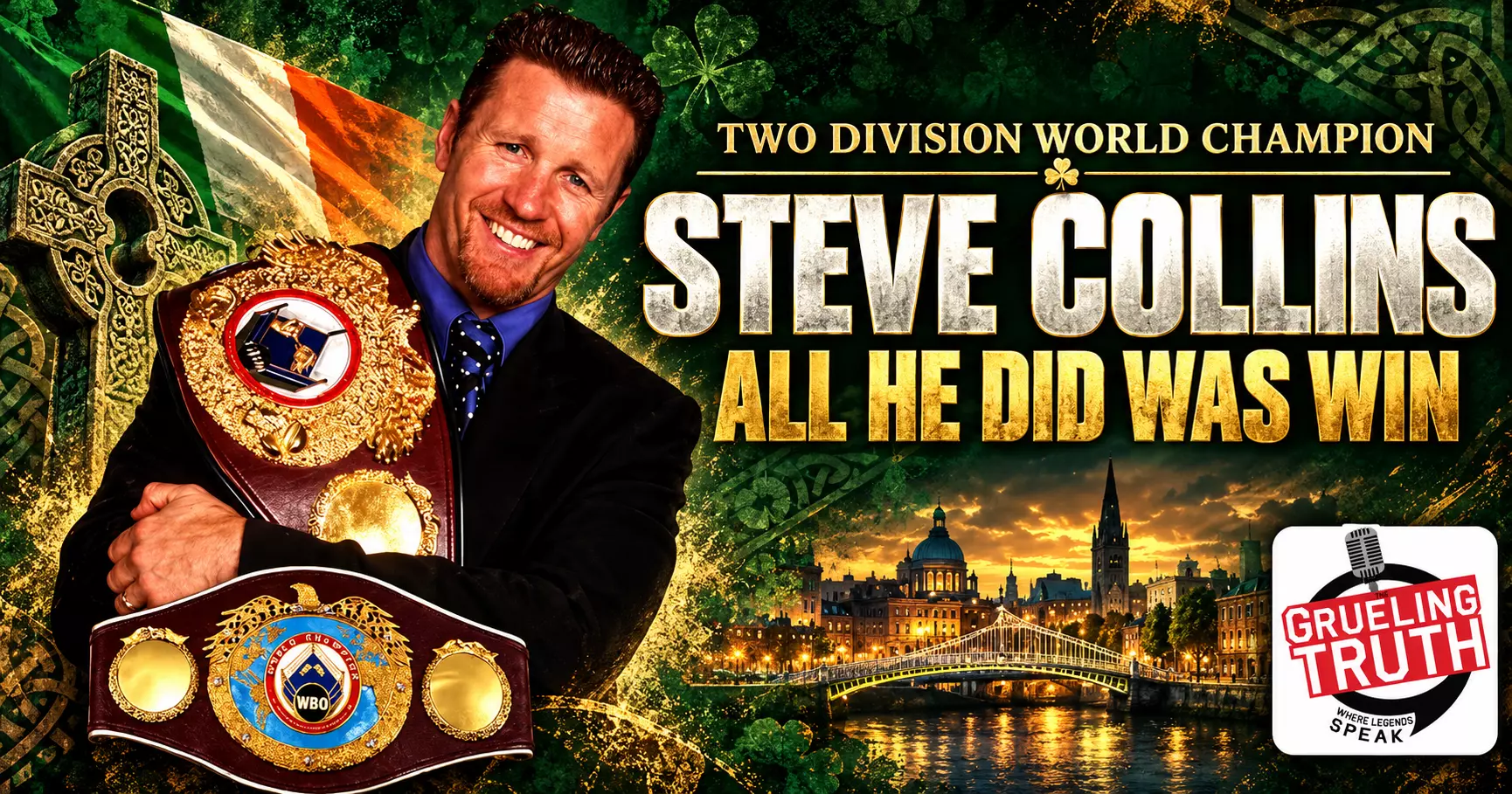
He wasn't flashy.Or fast.He could be relentless, throwing punches from several angles.Some called him an overachiever, but is that fair?
He wasn’t flashy.
Or fast.
He could be relentless, throwing punches from several angles.
Some called him an overachiever, but is that fair?
A never-say-die attitude fueled his determination.
His chin was durable.
“I have been approached by ready-mix concrete, as they are interested in sponsoring my chin,” Steve Collins once said.
Collins was born in Ireland and took to boxing as naturally as a duck to water.
Success came quickly, as did a dream.
“There was a tournament on, and they put me on. I won, and I got such a buzz that I said, ‘I’m going to be World Champion.’ My dad got a bit worried. He thought, ‘There’s something missing in that kid.’”
Not really. Collins had a dream, but did he have the talent?
His amateur career was a sparkling one. Collins captured several Irish titles while campaigning as a middleweight, light heavyweight, and junior heavyweight.
In 1986, Collins boxed for the last time in an amateur competition. He wanted to turn professional and did so soon afterward, electing to stay in the States and train in Brockton, Massachusetts, home of the legendary
Rocky Marciano.
Collins tried out at the Petronelli gym in Brockton, run by brothers Goody and Pat. The brothers liked what they saw and signed Collins to a managerial contract. Collins idolized Marvin Hagler and watched in awe as the champion trained.
His first professional fight took place in October 1986. He stopped Julio Mercado in three rounds. Collins was undefeated in seven contests when he met fellow unbeaten Irish fighter Sam Storey at Boston Garden. Collins got the better of Storey over ten fast-paced rounds.
Collins captured the USBA middleweight title, outlasting Kevin Watts. His next fight was against gritty Tony Thornton in Atlantic City. Collins entered the ring as an underdog for the second successive time.
He again emerged victorious, changing his usual mauling style to that of a boxer. He edged Thornton over 12 rounds.
Seven months later, Collins received an unexpected world-title shot against Mike McCallum.
McCallum, nicknamed “The Bodysnatcher,” was making the second defense of the middleweight belt he had captured the year before. He had previously held the junior middleweight crown for four years.
He was slick and carried considerable punching power.
Two years earlier, he had stopped Detroit whiz kids Milton McCrory and Donald Curry.
McCallum took the measure of Collins and predicted an easy win.
Collins lost the early rounds until he became more aggressive, countering the counterpuncher. He performed better as the fight progressed, but McCallum won a wide decision.
Collins considered the fight a boxing education.
“Mike had beaten some of the best fighters in the world at that point. I learned more in one fight with Mike McCallum than I did in my five previous fights combined.”
Collins won five fights in succession, the last two back in Ireland. He then faced Reggie Johnson for the vacant WBA middleweight title. It was a tight 12-round contest, but Johnson got the nod.
Road warrior Collins traveled to Italy six months later to face clever Sumbu Kalambay. Collins fought smartly, countering well against the defensive-minded Kalambay. He was the aggressor, but the judges preferred Kalambay.
Collins considered retirement after suffering the third loss of his career.
He took some time off, then traveled to America to work with former heavyweight champion Floyd Patterson. Collins wanted more power in his punches, and Patterson, who scored 40 knockouts in 55 wins, showed him how.
Collins was pushing thirty. He figured he’d stay in the UK and feast on domestic opposition. Many wondered if he’d peaked.
But Collins had a surprise in store.
The Irishman would never lose another fight.
Collins knocked out his next five opponents, showing that his work with Patterson was paying off. Finally, in 1994, he earned another title shot, this time against Chris Pyatt at Ponds Forge Arena in Sheffield.
The fight was back and forth, with Collins trailing on two of the three judges’ scorecards. His right hand had been missing—until it wasn’t in the fifth round. The blow clipped Pyatt, who spun to the canvas. He got up and battled on, bobbing and weaving until the referee decided he wasn’t doing enough and waved the fight off.
Steve Collins was a world champion.
A year later, he agreed to fight flamboyant super middleweight champion Chris Eubank Sr. The buildup was intense. Eubank was undefeated in 43 fights.
Collins spoke of being hypnotized, something he later admitted was a hoax. Entering the ring as an underdog once again, Collins started fast.
“For every punch he landed, I landed two,” Collins told
Boxing News Online
in 2021. “When he wanted to rest, I made him busy. When he wanted to move one way, I was there waiting for him.”
Collins floored Eubank in the eighth round. Eubank got up and hurt Collins with combinations.
In the tenth round, a blistering right hand sent Collins spinning to the canvas. He pulled himself up and battled back. Collins was declared the winner by unanimous decision.
A sequel was a natural next step.
Six months later, they threw hands again in Cork, Ireland. Collins, now trained by Freddie Roach, pursued Eubank relentlessly. He banked the early rounds and then had to sweat out a split-decision victory.
Many use the word “upset” when discussing Collins’ victories over Eubank. But were they? Several people felt timing was the key. Eubank had peaked, while Collins was in his prime.
Badass
Nigel Benn
waited in the wings. Collins successfully defended his title twice before facing the power-punching Benn in 1996. Both men were 32. Like Eubank, Benn was a two-time world champion. The London native had fought 45 times, winning 42 bouts, with 35 of his victories coming by knockout. His nickname, “The Dark Destroyer,” fit him like a glove.
Benn went toe-to-toe with Collins and lost. His Sunday punch was his left hook. He tagged Collins repeatedly during their encounter, but the tough Irishman hardly blinked. The fight ended prematurely when Benn twisted his ankle in the fourth round.
Collins defended his title twice more. He retired after proposed fights with Joe Calzaghe and Roy Jones Jr. failed to materialize.
Collins was 33. His record stood at 36 wins and only three losses.
He had labored long and hard to reach the top of the mountain, improving as he aged.
Collins deserves credit for getting the most out of his talent and proving the naysayers wrong.
He was the boxing version of the Las Vegas Raiders who live by the slogan: “Just win, baby.”
New Users – Get $350 in Bonus Bets when you wager $5 for 7 days
T&Cs apply
4.6/5
Gambling Problem? Call 1-800-GAMBLER or 1-800-MY-RESET. Call 1-888-789-7777 or visit ccpgg.org/chat (CT). Hope is here. GamblingHelpLineMA.org or call (800) 327-5050 for 24/7 support (MA). Visit www.mdgamblinghelp.org (MD). Call 1-877-8HOPE-NY or text HOPENY (NY). 21+ (18+ DC, WY) and present in select states (for KS, in affiliation with Kansas Star Casino). Find online real money wagering only. Min $5 wager required for 7 consecutive days. $5 free play credit. Bonus issued as non-withdrawable bonus with cash withdrawable bonus with cash withdrawable. Bonus bets which expire 7 days after receipt. Restrictions apply. See terms at sportsbook.fanduel.com. Call 1-877-770-7867 (LA).
Up To $1500 in Bonus Bets Paid Back if your First Bet Does Not Win
T&Cs apply
4.5/5
Gambling problem? Call 1-800-GAMBLER or 1-800-MY-RESET (Available in the US) 877-8-HOPENY or text HOPENY (467369) (NY) 1-800-327-5050 (MA), 1-800-BETS-OFF (IA), 1-800-981-0023 (PR). 21+ only. Please Gamble Responsibly. See BetMGM.com for Terms. First Bet Offer for new customers only (if applicable). Subject to eligibility requirements. Bonus bets are non-withdrawable. In partnership with Kansas Crossing Casino and Hotel. Promotional offers not available in Mississippi, Massachusetts, New York, Ontario, or Puerto Rico.
New DraftKings Customers: Bet $5, Get $200 + 3 Months of NBA League Pass!
T&Cs apply
4.5/5
GAMBLING PROBLEM? CALL 1-800-GAMBLER or 1-800-MY-RESET, (800) 327-5050 or visit gamblinghelplinema.org (MA). Please Gamble Responsibly. 888-789-7777/visit ccpg.org (CT), or visit www.mdgamblinghelp.org (MD), 1-800-981-0023 (PR). 21+ and present in most states. (18+ DC/NH/PR/WY). Void in CAN. Eligibility restrictions apply. On behalf of Boot Hill Casino (KS). Pass-thru of per wager tax may apply in IL. 1 per new Sportsbook customer. $5+ first-time bet req. Max. $200 issued as non-withdrawable Bonus Bets. Stake removed from payout. Reward issued as $50 in Bonus Bets every 7 days via click-to-claim for 21 days. Bonus Bets and click-to-claims expire 7 days (168hrs) after issuance. Terms: dkng.co/offer. Get 1 promo code to redeem a 3-month NBA League Pass subscription, complimentary of DraftKings. Subscription auto-renews monthly at then-current price (currently $16.99/mo); cancel anytime. Terms, restrictions, and eligibility requirements apply. Redeem League Pass by 12/19/26 at 11:59 PM ET. Addt’l terms: support.watch.nba.com/hc/en-us/articles/9165532876183-League-Pass-Terms-of-Use_. Ends 11/29/26 at 11:59 PM ET. Sponsored by DK.
Must be 21+. GAMBLING PROBLEM? CALL 1-800-GAMBLER OR CALL 1-800-MY-RESET, www.mdgamblinghelp.org (MD), (800)-327-5050 or gamblinghelplinema.org (MA), Call (877)8-HOPENY or text HOPENY (467369) (NY), (888) 789-7777 or ccpg.org (CT), morethanagame.nc.gov (NC), 1800gambler.net (WV)
Bet $1 and get double the winnings up to $25 for your next 10 bets
T&Cs apply
4.4/5
21+ New users only. Must register using eligible promo code. First bet after registration must qualify. Max. Bonus Bet: $1,000. Bonus Bet expires 14 days after receipt. Void where prohibited. See Caesars.com/promos for full terms. Gambling Problem? 1-800-GAMBLER (1-800-426-2537)
21+ and present in OH. Gambling Problem? Call 1-800-GAMBLER.
This site is using
Cloudflare
and adheres to the
Google Safe Browsing Program. We adapted
Google's Privacy Guidelines
to keep your data safe at all times.
Close
Ready to Win Big? Join the Elite with Our Sports Betting Deals!
FanDuel Promo
New Users – Get $350 in Bonus Bets when you wager $5 for 7 days
Our Favorite
T&Cs and 21+ apply
Gambling Problem? Call 1-800-GAMBLER or 1-800-MY-RESET. Call 1-888-789-7777 or visit ccpgg.org/chat (CT). Hope is here. GamblingHelpLineMA.org or call (800) 327-5050 for 24/7 support (MA). Visit www.mdgamblinghelp.org (MD). Call 1-877-8HOPE-NY or text HOPENY (NY). 21+ (18+ DC, WY) and present in select states (for KS, in affiliation with Kansas Star Casino). Find online real money wagering only. Min $5 wager required for 7 consecutive days. $5 free play credit. Bonus issued as non-withdrawable bonus with cash withdrawable bonus with cash withdrawable. Bonus bets which expire 7 days after receipt. Restrictions apply. See terms at sportsbook.fanduel.com. Call 1-877-770-7867 (LA).
Code:
Open FanDuel
Get Bonus
BetMGM Promo
Up To $1500 in Bonus Bets Paid Back if your First Bet Does Not Win
Best Slots
T&Cs and 21+ apply
Gambling problem? Call 1-800-GAMBLER or 1-800-MY-RESET (Available in the US) 877-8-HOPENY or text HOPENY (467369) (NY) 1-800-327-5050 (MA), 1-800-BETS-OFF (IA), 1-800-981-0023 (PR). 21+ only. Please Gamble Responsibly. See BetMGM.com for Terms. First Bet Offer for new customers only (if applicable). Subject to eligibility requirements. Bonus bets are non-withdrawable. In partnership with Kansas Crossing Casino and Hotel. Promotional offers not available in Mississippi, Massachusetts, New York, Ontario, or Puerto Rico.
Code:
Open BetMGM
Get Bonus
DraftKings Promo
New DraftKings Customers: Bet $5, Get $200 + 3 Months of NBA League Pass!
Newcomer
T&Cs and 21+ apply
GAMBLING PROBLEM? CALL 1-800-GAMBLER or 1-800-MY-RESET, (800) 327-5050 or visit gamblinghelplinema.org (MA). Please Gamble Responsibly. 888-789-7777/visit ccpg.org (CT), or visit www.mdgamblinghelp.org (MD), 1-800-981-0023 (PR). 21+ and present in most states. (18+ DC/NH/PR/WY). Void in CAN. Eligibility restrictions apply. On behalf of Boot Hill Casino (KS). Pass-thru of per wager tax may apply in IL. 1 per new Sportsbook customer. $5+ first-time bet req. Max. $200 issued as non-withdrawable Bonus Bets. Stake removed from payout. Reward issued as $50 in Bonus Bets every 7 days via click-to-claim for 21 days. Bonus Bets and click-to-claims expire 7 days (168hrs) after issuance. Terms: dkng.co/offer. Get 1 promo code to redeem a 3-month NBA League Pass subscription, complimentary of DraftKings. Subscription auto-renews monthly at then-current price (currently $16.99/mo); cancel anytime. Terms, restrictions, and eligibility requirements apply. Redeem League Pass by 12/19/26 at 11:59 PM ET. Addt’l terms: support.watch.nba.com/hc/en-us/articles/9165532876183-League-Pass-Terms-of-Use_. Ends 11/29/26 at 11:59 PM ET. Sponsored by DK.
Code:
Open DraftKings
Get Bonus
Find out what the legends have to say about sports this week....
New Users – Get $350 in Bonus Bets when you wager $5 for 7 days
Gambling Problem? Call 1-800-GAMBLER or 1-800-MY-RESET. Call 1-888-789-7777 or visit ccpgg.org/chat (CT). Hope is here. GamblingHelpLineMA.org or call (800) 327-5050 for 24/7 support (MA). Visit www.mdgamblinghelp.org (MD). Call 1-877-8HOPE-NY or text HOPENY (NY). 21+ (18+ DC, WY) and present in select states (for KS, in affiliation with Kansas Star Casino). Find online real money wagering only. Min $5 wager required for 7 consecutive days. $5 free play credit. Bonus issued as non-withdrawable bonus with cash withdrawable bonus with cash withdrawable. Bonus bets which expire 7 days after receipt. Restrictions apply. See terms at sportsbook.fanduel.com. Call 1-877-770-7867 (LA).