Caitlin Clark’s rise has been so fast and so influential that simply listing her statistics does not fully explain what has happened around her. Records, long-range three-pointers, packed arenas and television audiences are all part of the story, but so is the way Clark has changed the level of attention surrounding women’s basketball.
That larger story is at the center of sports journalist
Robin Lundberg’s new book,
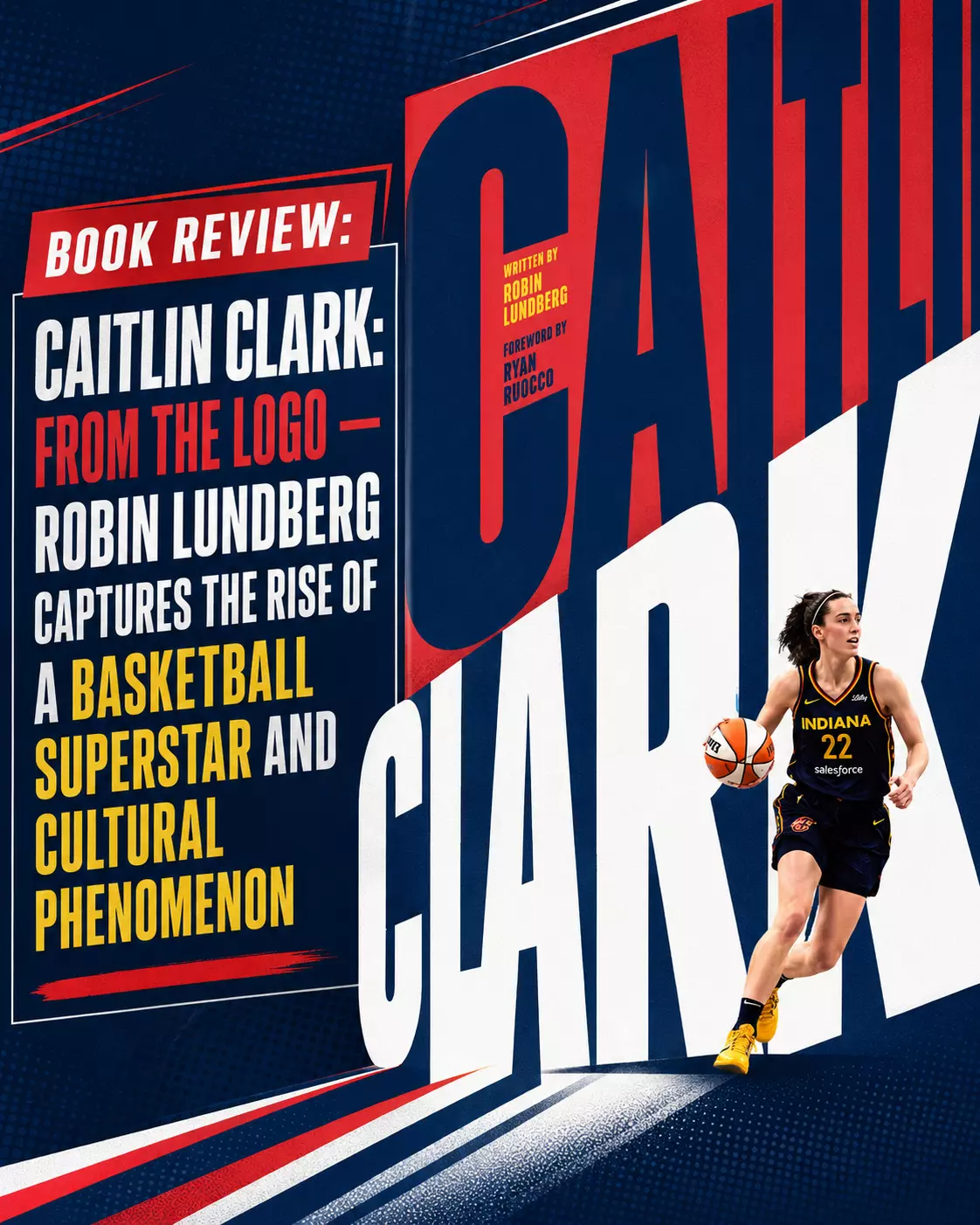
Caitlin Clark: From the Logo. Published by Insight Editions, the book combines photography, career-defining moments and Lundberg’s commentary to chronicle Clark’s journey from highly regarded high school prospect to University of Iowa superstar, No. 1 WNBA Draft pick, Rookie of the Year and one of the most recognizable athletes in American sports.
Rather than simply functioning as a statistical biography,
From the Logo
attempts to capture something more difficult: what it has felt like to watch the Caitlin Clark phenomenon unfold in real time.
Who Is Robin Lundberg?
Robin Lundberg is a veteran sports broadcaster, journalist and multimedia personality whose career has included work across television, radio and digital media.
Lundberg has been featured on major platforms including
ESPN, Sports Illustrated, CNN and Fox. His official publisher biography describes him as a senior Sports Illustrated host who analyzes major sports stories and interviews prominent athletes and personalities, while also hosting programming on SiriusXM’s Mad Dog Radio.
His background at ESPN is especially important when considering this book. Lundberg spent years working in sports talk and analysis, building a style based not simply on reporting what happened but discussing why a sports story matters.
More recently, that focus has included extensive coverage of women’s basketball, the WNBA and the
Indiana Fever. Sports Illustrated describes Lundberg as a longtime media veteran who has worked extensively with brands such as ESPN and SI and now contributes his basketball expertise to Women’s Fastbreak On SI and Indiana Fever On SI.
That experience makes him a logical writer for a Caitlin Clark book. He approaches Clark not as someone discovering the WNBA because of her popularity, but as a sports journalist familiar with the league, its players and the larger basketball landscape.
What Is
Caitlin Clark: From the Logo
About?
At its simplest,
Caitlin Clark: From the Logo
is the story of Caitlin Clark’s ascent.
But the book is really telling
two stories at the same time.
The first is Clark’s personal basketball journey—from her emergence as an elite young player through her extraordinary career at Iowa and eventually into the WNBA with the
Indiana Fever.
The second is what happened to women’s basketball around her.
The publisher describes the book as a photographic history built around Clark’s biggest moments, records and accomplishments while also examining the enormous cultural impact created by her popularity.
That distinction matters.
There are plenty of ways to produce a Caitlin Clark biography by assembling scoring totals, awards and game results. Lundberg instead appears interested in the moments that explain
why millions of people became invested in watching her play.
The book takes readers back through her college explosion at Iowa, including the spectacular NCAA Tournament performances that turned her into a national sensation. It follows Clark through becoming the No. 1 overall WNBA Draft selection and winning Rookie of the Year while also addressing the expectations, scrutiny and setbacks that came with her enormous popularity.
Photography is also a major component of the experience. Rather than being a traditional text-heavy sports biography, the book uses action photography and images from important moments to help recreate the progression of Clark’s career.
That makes
From the Logo
part biography, part basketball history and part coffee-table sports book.
More Than the Famous Long-Range Three-Pointers
The title
From the Logo
is obviously connected to Clark’s remarkable shooting range.
But Lundberg’s approach suggests that the phrase means something larger.
Clark’s deep three-pointers became her signature because they represented the confidence and unpredictability that made her must-see television. Yet reducing Clark to long-distance shooting ignores her passing ability, competitiveness, court vision and capacity for creating memorable moments.
In an excerpt published by Sports Illustrated, Lundberg argues that the Clark phenomenon ultimately has a fairly simple foundation: she brought joy and excitement to basketball. He frames her career through the collection of moments that gradually created what he calls her “logo legacy.”
That idea may be the book’s strongest theme.
Clark didn’t become important simply because she broke records. Fans wanted to see
what she might do next.
How Does It Compare to Robin Lundberg’s Previous Books?
There is an important distinction to make here.
Based on Lundberg’s official publisher biography, current author listings and his own website,
Caitlin Clark: From the Logo
appears to be his
first major traditionally published standalone book, rather than the latest entry in a long bibliography of previous sports books. His website does feature earlier multimedia projects such as
From Topps to Top Shot: The History of Trading Cards
and
From Steroids to Sticky Stuff: The History of Cheating in Baseball, but those are presented as media projects rather than previous conventional books.
So the better comparison is between this book and Lundberg’s previous
sports-media work.
The same qualities that have defined his broadcasting career are evident in the concept behind
From the Logo: accessibility, analysis and an interest in explaining why a story resonates beyond a final score.
Instead of writing an exhaustive academic biography of Clark, Lundberg has created something designed to move quickly through the moments that made her famous while using photographs and commentary to provide context.
In that sense, the book feels like an extension of Lundberg’s television, radio and digital journalism—only presented in a permanent form that fans can revisit.
What Things Are People Saying?
One of the strongest endorsements comes from prominent basketball broadcaster
Ryan Ruocco, who contributes the book’s foreword.
Ruocco says Lundberg has managed to
“celebrate, examine, and relive the moments”
that shaped Clark’s extraordinary ascent.
That description gets to the heart of what separates this project from a simple biography.
The book also incorporates perspectives from major women’s basketball voices, including
ESPN’s Holly Rowe and Hall of Famer Rebecca Lobo. Rowe describes Clark as one of the most fascinating competitors she has covered, while Lobo provides perspective on moments surrounding Clark that stood out even after decades around the WNBA.
Because the book is a new 2026 release, there is not yet the enormous body of long-term reader and critical reviews that surrounds older sports biographies. The most meaningful early praise therefore comes from basketball media figures, the insiders included in the project and the attention the book has received through author appearances and interviews. Lundberg has already appeared in media discussions specifically centered on the book and Clark’s impact on basketball.
That early response suggests that readers are responding to the book less as another collection of Clark statistics and more as a snapshot of an extraordinary sports moment.
Why Should You Read
Caitlin Clark: From the Logo?
The strongest reason to read this book is that
Caitlin Clark’s story isn’t finished.
Most sports biographies are written years after an athlete’s career has ended. Historians already know the final championships, statistics, failures and achievements.
This book is different.
Readers are experiencing Clark’s career while her ultimate legacy is still being written.
That gives
From the Logo
an unusual energy. It functions almost like a time capsule documenting the period when basketball fans realized they were watching something significant.
For longtime Iowa fans, it provides an opportunity to revisit the performances that transformed Clark into a national superstar.
For
Indiana Fever
and WNBA fans, it documents the enormous expectations accompanying her arrival in professional basketball.
For newer women’s basketball fans, Lundberg provides context for understanding why Clark became such an important figure.
And for sports collectors, the photographic presentation gives the book value beyond the written narrative. The curated images make it something readers can return to rather than simply read once and place on a shelf.
Perhaps most importantly, you don’t necessarily have to be a Caitlin Clark superfan to find the subject fascinating.
At its core, this is a book about what happens when the right athlete, the right personality, the right playing style and the right cultural moment collide.
Final Verdict
Caitlin Clark: From the Logo
succeeds because Robin Lundberg understands that Caitlin Clark’s significance cannot be explained by a box score alone.
The records matter.
The NCAA Tournament performances matter.
The logo three-pointers matter.
Being selected No. 1 overall and becoming WNBA Rookie of the Year matter.
But the real story is what happened around those accomplishments—the crowds, television audiences, debates, young fans wearing No. 22 jerseys and the enormous new spotlight placed on women’s basketball.
Lundberg’s background in sports broadcasting and journalism gives him the ability to place those moments into a broader context, while the photographic format gives the story an immediacy that a conventional biography might struggle to reproduce.
It is also refreshing that the book arrives while Clark’s career is still unfolding.
From the Logo
does not have the luxury of telling readers how her story ends.
Instead, it captures
how the story began—and how quickly everything changed.
For Caitlin Clark fans, Iowa Hawkeyes supporters, Indiana Fever followers, WNBA fans, sports historians and anyone interested in the extraordinary growth of women’s basketball,
Caitlin Clark: From the Logo
is an attractive addition to the sports bookshelf and a visual record of one of basketball’s most remarkable modern rises.
Caitlin Clark’s final place in basketball history remains to be determined.
But Robin Lundberg’s book makes a persuasive case that the era she helped create is already worth documenting.
New Users – Get $350 in Bonus Bets when you wager $5 for 7 days
T&Cs apply
4.6/5
Gambling Problem? Call 1-800-GAMBLER or 1-800-MY-RESET. Call 1-888-789-7777 or visit ccpgg.org/chat (CT). Hope is here. GamblingHelpLineMA.org or call (800) 327-5050 for 24/7 support (MA). Visit www.mdgamblinghelp.org (MD). Call 1-877-8HOPE-NY or text HOPENY (NY). 21+ (18+ DC, WY) and present in select states (for KS, in affiliation with Kansas Star Casino). Find online real money wagering only. Min $5 wager required for 7 consecutive days. $5 free play credit. Bonus issued as non-withdrawable bonus with cash withdrawable bonus with cash withdrawable. Bonus bets which expire 7 days after receipt. Restrictions apply. See terms at sportsbook.fanduel.com. Call 1-877-770-7867 (LA).
Up To $1500 in Bonus Bets Paid Back if your First Bet Does Not Win
T&Cs apply
4.5/5
Gambling problem? Call 1-800-GAMBLER or 1-800-MY-RESET (Available in the US) 877-8-HOPENY or text HOPENY (467369) (NY) 1-800-327-5050 (MA), 1-800-BETS-OFF (IA), 1-800-981-0023 (PR). 21+ only. Please Gamble Responsibly. See BetMGM.com for Terms. First Bet Offer for new customers only (if applicable). Subject to eligibility requirements. Bonus bets are non-withdrawable. In partnership with Kansas Crossing Casino and Hotel. Promotional offers not available in Mississippi, Massachusetts, New York, Ontario, or Puerto Rico.
New DraftKings Customers: Bet $5, Get $200 + 3 Months of NBA League Pass!
T&Cs apply
4.5/5
GAMBLING PROBLEM? CALL 1-800-GAMBLER or 1-800-MY-RESET, (800) 327-5050 or visit gamblinghelplinema.org (MA). Please Gamble Responsibly. 888-789-7777/visit ccpg.org (CT), or visit www.mdgamblinghelp.org (MD), 1-800-981-0023 (PR). 21+ and present in most states. (18+ DC/NH/PR/WY). Void in CAN. Eligibility restrictions apply. On behalf of Boot Hill Casino (KS). Pass-thru of per wager tax may apply in IL. 1 per new Sportsbook customer. $5+ first-time bet req. Max. $200 issued as non-withdrawable Bonus Bets. Stake removed from payout. Reward issued as $50 in Bonus Bets every 7 days via click-to-claim for 21 days. Bonus Bets and click-to-claims expire 7 days (168hrs) after issuance. Terms: dkng.co/offer. Get 1 promo code to redeem a 3-month NBA League Pass subscription, complimentary of DraftKings. Subscription auto-renews monthly at then-current price (currently $16.99/mo); cancel anytime. Terms, restrictions, and eligibility requirements apply. Redeem League Pass by 12/19/26 at 11:59 PM ET. Addt’l terms: support.watch.nba.com/hc/en-us/articles/9165532876183-League-Pass-Terms-of-Use_. Ends 11/29/26 at 11:59 PM ET. Sponsored by DK.
Must be 21+. GAMBLING PROBLEM? CALL 1-800-GAMBLER OR CALL 1-800-MY-RESET, www.mdgamblinghelp.org (MD), (800)-327-5050 or gamblinghelplinema.org (MA), Call (877)8-HOPENY or text HOPENY (467369) (NY), (888) 789-7777 or ccpg.org (CT), morethanagame.nc.gov (NC), 1800gambler.net (WV)
Bet $1 and get double the winnings up to $25 for your next 10 bets
T&Cs apply
4.4/5
21+ New users only. Must register using eligible promo code. First bet after registration must qualify. Max. Bonus Bet: $1,000. Bonus Bet expires 14 days after receipt. Void where prohibited. See Caesars.com/promos for full terms. Gambling Problem? 1-800-GAMBLER (1-800-426-2537)
21+ and present in OH. Gambling Problem? Call 1-800-GAMBLER.
This site is using
Cloudflare
and adheres to the
Google Safe Browsing Program. We adapted
Google's Privacy Guidelines
to keep your data safe at all times.
Close
Ready to Win Big? Join the Elite with Our Sports Betting Deals!
FanDuel Promo
New Users – Get $350 in Bonus Bets when you wager $5 for 7 days
Our Favorite
T&Cs and 21+ apply
Gambling Problem? Call 1-800-GAMBLER or 1-800-MY-RESET. Call 1-888-789-7777 or visit ccpgg.org/chat (CT). Hope is here. GamblingHelpLineMA.org or call (800) 327-5050 for 24/7 support (MA). Visit www.mdgamblinghelp.org (MD). Call 1-877-8HOPE-NY or text HOPENY (NY). 21+ (18+ DC, WY) and present in select states (for KS, in affiliation with Kansas Star Casino). Find online real money wagering only. Min $5 wager required for 7 consecutive days. $5 free play credit. Bonus issued as non-withdrawable bonus with cash withdrawable bonus with cash withdrawable. Bonus bets which expire 7 days after receipt. Restrictions apply. See terms at sportsbook.fanduel.com. Call 1-877-770-7867 (LA).
Code:
Open FanDuel
Get Bonus
BetMGM Promo
Up To $1500 in Bonus Bets Paid Back if your First Bet Does Not Win
Best Slots
T&Cs and 21+ apply
Gambling problem? Call 1-800-GAMBLER or 1-800-MY-RESET (Available in the US) 877-8-HOPENY or text HOPENY (467369) (NY) 1-800-327-5050 (MA), 1-800-BETS-OFF (IA), 1-800-981-0023 (PR). 21+ only. Please Gamble Responsibly. See BetMGM.com for Terms. First Bet Offer for new customers only (if applicable). Subject to eligibility requirements. Bonus bets are non-withdrawable. In partnership with Kansas Crossing Casino and Hotel. Promotional offers not available in Mississippi, Massachusetts, New York, Ontario, or Puerto Rico.
Code:
Open BetMGM
Get Bonus
DraftKings Promo
New DraftKings Customers: Bet $5, Get $200 + 3 Months of NBA League Pass!
Newcomer
T&Cs and 21+ apply
GAMBLING PROBLEM? CALL 1-800-GAMBLER or 1-800-MY-RESET, (800) 327-5050 or visit gamblinghelplinema.org (MA). Please Gamble Responsibly. 888-789-7777/visit ccpg.org (CT), or visit www.mdgamblinghelp.org (MD), 1-800-981-0023 (PR). 21+ and present in most states. (18+ DC/NH/PR/WY). Void in CAN. Eligibility restrictions apply. On behalf of Boot Hill Casino (KS). Pass-thru of per wager tax may apply in IL. 1 per new Sportsbook customer. $5+ first-time bet req. Max. $200 issued as non-withdrawable Bonus Bets. Stake removed from payout. Reward issued as $50 in Bonus Bets every 7 days via click-to-claim for 21 days. Bonus Bets and click-to-claims expire 7 days (168hrs) after issuance. Terms: dkng.co/offer. Get 1 promo code to redeem a 3-month NBA League Pass subscription, complimentary of DraftKings. Subscription auto-renews monthly at then-current price (currently $16.99/mo); cancel anytime. Terms, restrictions, and eligibility requirements apply. Redeem League Pass by 12/19/26 at 11:59 PM ET. Addt’l terms: support.watch.nba.com/hc/en-us/articles/9165532876183-League-Pass-Terms-of-Use_. Ends 11/29/26 at 11:59 PM ET. Sponsored by DK.
Code:
Open DraftKings
Get Bonus
Find out what the legends have to say about sports this week....
New Users – Get $350 in Bonus Bets when you wager $5 for 7 days
Gambling Problem? Call 1-800-GAMBLER or 1-800-MY-RESET. Call 1-888-789-7777 or visit ccpgg.org/chat (CT). Hope is here. GamblingHelpLineMA.org or call (800) 327-5050 for 24/7 support (MA). Visit www.mdgamblinghelp.org (MD). Call 1-877-8HOPE-NY or text HOPENY (NY). 21+ (18+ DC, WY) and present in select states (for KS, in affiliation with Kansas Star Casino). Find online real money wagering only. Min $5 wager required for 7 consecutive days. $5 free play credit. Bonus issued as non-withdrawable bonus with cash withdrawable bonus with cash withdrawable. Bonus bets which expire 7 days after receipt. Restrictions apply. See terms at sportsbook.fanduel.com. Call 1-877-770-7867 (LA).