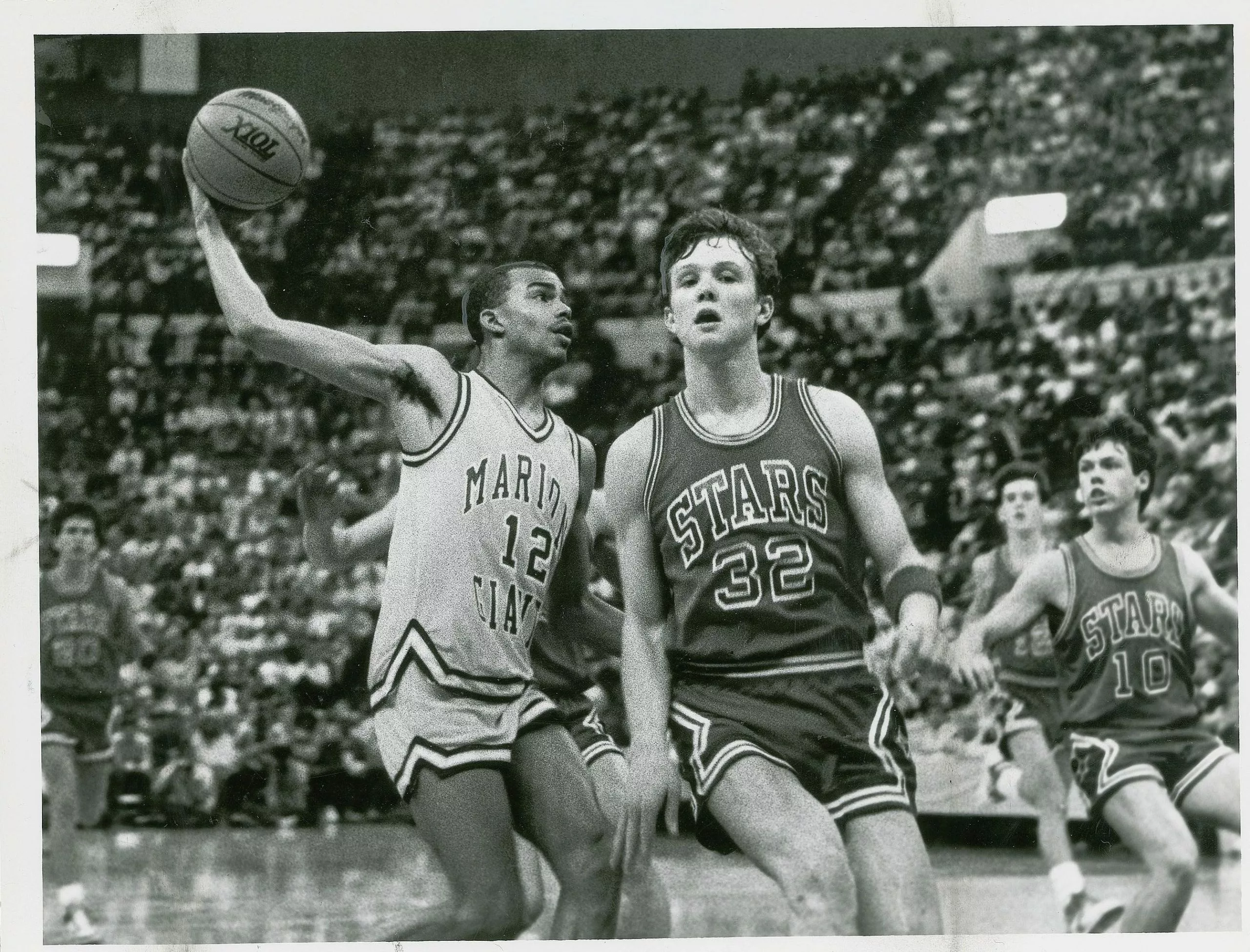
Marion's Jay Edwards (left) played in the McDonald?s All American Game in 1987. Edwards was a two-time co-MVP of the state finals and a three-year starter. He played for two seasons at Indiana. Marion 304986 Jpg
The 1980s were one of the most talent-rich decades in Indiana high school basketball history. The single-class tournament was still intact, meaning every team—large or small—competed for one state championship. That pressure created legends. Players weren’t judged by rankings or exposure—they were judged by how they performed in packed gyms and under the spotlight of March.
This list ranks the
20 greatest Indiana high school basketball players of the 1980s, based strictly on their prep careers. Individual production, team success, and historical impact all factor into the rankings. These players didn’t just put up numbers—they defined the era.
Top 10 Indiana High School Basketball Teams of All Time
20) Roger Harden – Valparaiso
Roger Harden was one of the most efficient and intelligent guards in Indiana during the early 1980s, earning
Mr. Basketball honors
in 1982. At Valparaiso, Harden controlled the game with poise, decision-making, and scoring ability that made him one of the most complete players in the state.
Harden’s strength was his ability to dictate tempo. He knew when to push the pace and when to slow things down, ensuring his team always played under control. His shooting ability made him a constant scoring threat, while his court vision allowed him to create opportunities for teammates.
What set Harden apart was his consistency. He rarely made mistakes and always seemed to be in the right place at the right time. In a decade defined by execution and fundamentals, Harden’s ability to control the game made him one of the best guards of his era.
19) Jeff Grose – Warsaw
Jeff Grose was one of the most skilled guards in Indiana during the mid-1980s, earning Mr. Basketball honors in 1985 while leading Warsaw to statewide prominence. Grose’s game was built on intelligence, scoring ability, and leadership, making him one of the most complete players in the state.
Grose had the ability to control the game from the guard position. He could score efficiently, distribute the ball, and make decisions that kept his team organized. His shooting ability made him a constant threat, while his court vision allowed him to create opportunities for teammates.
What made Grose special was his composure. In high-pressure situations, he remained calm and executed at a high level. His leadership and ability to perform in big moments make him one of the defining players of the decade.
18) Mark Jewell – Lafayette Jefferson
Mark Jewell earned Mr. Basketball honors in 1986 after a dominant career at Lafayette Jefferson, establishing himself as one of the premier guards of the decade. Jewell’s game was built on offensive versatility. He could score from anywhere on the floor—whether it was knocking down perimeter shots, attacking off the dribble, or finishing in traffic.
His ability to create his own offense made him extremely difficult to defend. Jewell didn’t need plays designed for him; he could generate scoring opportunities on his own. That skill was especially valuable in late-game situations when defenses tightened and possessions became more deliberate.
Beyond scoring, Jewell brought leadership and composure. He understood the flow of the game and made smart decisions, ensuring his team remained in control. His recognition as Mr. Basketball reflects his impact and solidifies his place among the best players of the 1980s.
17) Jim Master – Fort Wayne Harding
Jim Master set the tone for the entire decade by winning Mr. Basketball in 1980, capping off a remarkable career at Fort Wayne Harding. Master was a prolific scorer who could take over games with his offensive ability. He had a natural feel for scoring, knowing when to attack and when to pull up, making him one of the most dangerous players in the state.
His ability to perform under pressure was one of his defining traits. Master delivered in big moments, whether it was a key regular-season game or a high-stakes tournament matchup. He thrived in environments where the spotlight was brightest, which is exactly what Indiana basketball demanded.
Beyond his scoring, Master brought leadership and confidence. He set the tone for his team and carried that presence into every game. His recognition as Mr. Basketball validates his dominance and establishes him as one of the most impactful players of the decade.
16) Rick Fox – Warsaw
Rick Fox was one of the most versatile and skilled players to come out of Indiana in the 1980s, starring at Warsaw and making a name for himself with his ability to impact the game in multiple ways. Fox had a rare combination of size, athleticism, and skill that allowed him to play both inside and on the perimeter effectively.
Offensively, Fox could score at all three levels. He was comfortable posting up, attacking off the dribble, or stepping out and knocking down jump shots. His versatility made him a matchup nightmare—too skilled for bigger defenders and too strong for smaller ones. He also had a strong understanding of spacing and timing, which allowed him to operate efficiently within the offense.
Defensively, Fox brought length and effort, making him capable of guarding multiple positions. His all-around ability and adaptability set him apart from many players of his era. Even in high school, it was clear he possessed the kind of game that could translate to higher levels, and his impact at Warsaw cements his place among the best of the decade.
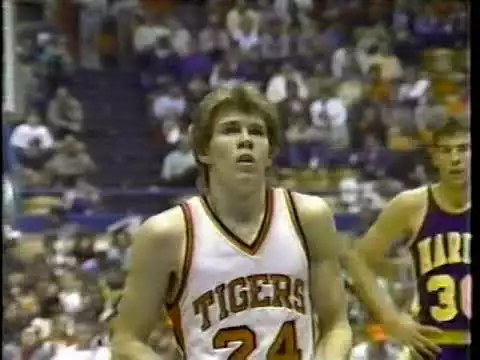
Warsaw Vs Marion 1985 Simi State Rick Fox (1)
15) Chandler Thompson – Muncie Central
Chandler Thompson was a key contributor at Muncie Central, one of Indiana’s most storied programs. Playing in an environment where expectations were always high, Thompson developed into a versatile and reliable player who could impact the game in multiple ways. His ability to contribute across the board made him a valuable piece in Muncie Central’s system.
Thompson could score, rebound, and defend, making him a complete player. He wasn’t dependent on one aspect of the game—he contributed wherever he was needed. His physical style and willingness to compete made him effective in the rugged style of 1980s basketball.
What set Thompson apart was his ability to perform under pressure. Playing for Muncie Central meant every game mattered, and he consistently rose to the occasion. His contributions helped maintain the program’s reputation and ensured they remained competitive throughout the decade.
Chandler Thompson on Muncie Central’s 1988 state championship victory
14) Delray Brooks – Michigan City Rogers
Delray Brooks shared Mr. Basketball honors in 1984 and was one of the most complete players in Indiana during the mid-1980s. At Michigan City Rogers, Brooks combined size, strength, and skill to dominate games on both ends of the floor.
Brooks was a versatile scorer who could operate inside and out. He had the physicality to battle in the post and the skill to step outside and knock down shots. That versatility made him extremely difficult to guard, as opponents struggled to match up with him effectively.
Defensively, Brooks was just as impactful. His size and athleticism allowed him to guard multiple positions and disrupt opposing offenses. His all-around game, combined with his ability to deliver consistently, makes him one of the top players of the decade.
13) Calbert Cheaney – Evansville Harrison
Calbert Cheaney
emerged at the end of the 1980s as one of the most complete players in Indiana. At Evansville Harrison, he displayed a well-rounded game that would later make him one of the greatest players in college basketball history.
Cheaney could do everything—score, rebound, defend, and create for others. His size and skill combination made him a matchup problem, while his basketball IQ allowed him to make smart decisions consistently.
Even in high school, it was clear Cheaney was special. His ability to impact every phase of the game sets him apart and places him among the best players of the decade.
12) Woody Austin – Richmond
Woody Austin was one of the most physically gifted players in Indiana during the late 1980s, starring at Richmond High School. Known for his strength, athleticism, and aggressive playing style, Austin brought an edge that made him stand out on the court. He was a player who thrived in contact and wasn’t afraid to impose his will on opponents.
Austin’s offensive game was built around attacking the basket. He could drive through defenders, finish strong at the rim, and create scoring opportunities in transition. His physicality made him difficult to guard, especially for teams that lacked size or strength. On the defensive end, he used that same physical presence to disrupt opponents.
What made Austin unique was his competitive mindset. He played with intensity every night, setting the tone for his team. His ability to combine athleticism with effort and toughness made him one of the more memorable players of the decade and a key figure in Richmond basketball history.
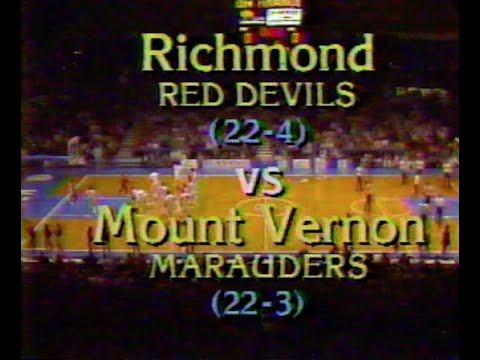
Mt Vernon Marauders vs Richmond Red Devils – 1987 Boys Basketball Ind Hinkle Semi-State Championship
11) Dan Palombizio – Michigan City Rogers
Dan Palombizio was one of the most dominant players in Indiana at the start of the 1980s, earning Mr. Basketball honors in 1981 while starring at Michigan City Rogers. A powerful forward with excellent scoring ability, Palombizio combined size and skill in a way that made him incredibly difficult to defend. He could score inside with strength but also step out and hit perimeter shots, giving him a versatile offensive arsenal.
What made Palombizio stand out was his consistency. He didn’t rely on streaky shooting or favorable matchups—he produced against everyone. In a rugged era where physical play was the norm, he thrived, using his strength to control the paint and his skill to create scoring opportunities.
Palombizio’s leadership helped elevate Michigan City Rogers into one of the top programs in the state during his time. His ability to dominate both physically and fundamentally makes him one of the defining players of the early 1980s.
10) Troy Lewis – Anderson
Troy Lewis was one of the most electrifying players in Indiana during the mid-1980s, earning Co–Mr. Basketball honors in 1984. At Anderson, Lewis became known for his scoring ability and dynamic style of play. He had the ability to take over games offensively, using his quickness and skill to create scoring opportunities in a variety of ways.
Lewis thrived in transition, attacking defenses before they could get set, but he was equally effective in half-court situations. His ability to create his own shot made him a constant threat, particularly in late-game situations when his team needed a basket.
What made Lewis stand out was his confidence. He embraced big moments and wasn’t afraid to take responsibility when the game was on the line. His ability to perform under pressure and his scoring prowess make him one of the most memorable players of the decade.
1983 IHSAA State Championship: Connersville 63, Anderson 62
9) Pat Graham – Floyd Central
Pat Graham was one of the most dominant scorers in Indiana during the late 1980s, earning Mr. Basketball honors in 1989. At Floyd Central, Graham showcased an elite offensive game that made him nearly impossible to stop.
Graham could score in a variety of ways. He had range, could create off the dribble, and was effective finishing at the rim. His ability to take over games offensively made him one of the most feared players in the state.
What separated Graham was his consistency and confidence. He delivered in big moments and thrived under pressure. His scoring dominance and ability to lead make him one of the top players of the decade.
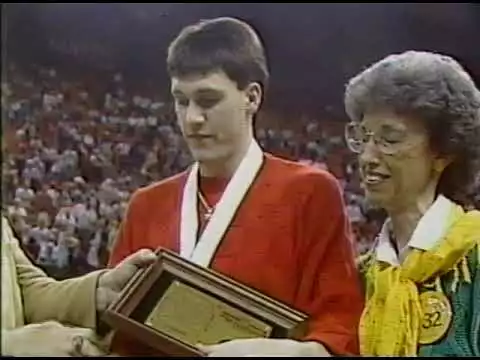
Pat Graham Trester Award Ceremony Indiana Hoosier
8) Lyndon Jones – Marion
Lyndon Jones was a key figure in one of the most dominant teams of the 1980s, helping lead Marion to sustained success. As Co–Mr. Basketball in 1987, Jones was recognized for his all-around ability and his impact on winning.
Jones was a complete player. He could score, rebound, and defend, making him a valuable contributor in every phase of the game. His ability to play within a system while still producing individually made him a perfect fit for Marion’s disciplined style.
What set Jones apart was his consistency. He delivered night after night, helping his team maintain a high level of performance. His role in Marion’s success cements his place among the best players of the decade.
Lyndon Jones Tribute
7) Eric Montross – Lawrence North
Eric Montross was one of the most physically
dominant big men
to emerge from Indiana in the late 1980s. At Lawrence North, he developed into a true interior force, using his size, strength, and presence to control the paint on both ends of the floor. Montross wasn’t just big—he knew how to use his size effectively, which made him extremely difficult to handle.
Offensively, Montross established position early and finished efficiently. He didn’t rely on flashy moves—he relied on fundamentals, strength, and consistency. Defensively, he altered shots, controlled rebounds, and made it nearly impossible for opponents to establish any rhythm inside.
What made Montross stand out was his ability to dominate physically while still playing within a system. He didn’t force the game—he imposed himself naturally. His presence alone changed how opponents approached matchups. By the time he finished his high school career, he had established himself as one of the premier big men of the decade and a foundational piece for Lawrence North’s rise.
Former NBA player and Lawrence North alum Eric Montross dies at 52
6) James Blackmon Sr. – Marion
James Blackmon Sr. stands at the top of the 1980s as the centerpiece of one of the most dominant programs in Indiana high school basketball history. At Marion, he helped define an era of excellence, combining scoring ability, leadership, and consistency to lead his team to sustained success.
Blackmon was an elite offensive player. He could score from anywhere on the floor, using his skill and confidence to take over games when needed. But what made him truly special was his ability to perform within a team structure. Marion’s success wasn’t built on individual brilliance alone—it was built on execution, and Blackmon was at the center of it.
He thrived in big moments, particularly in tournament play, where his ability to deliver under pressure set him apart. His leadership helped establish Marion as a powerhouse, and his impact on winning elevates him above most.
James Blackmon Sr Story
5) Damon Bailey – Bedford North Lawrence
Damon Bailey was more than just a player—he was a phenomenon in Indiana during the late 1980s. While he officially graduated in 1990, his impact during the 1987, 1988, and 1989 seasons was so significant that he belongs squarely in this decade’s conversation. From the moment he was recruited by Bob Knight as an eighth grader, Bailey became a statewide legend before he ever finished high school.
On the court, Bailey delivered. He was a complete player who could score, pass, and lead with remarkable composure for his age. His ability to control games and elevate his teammates made him the centerpiece of Bedford North Lawrence basketball. He thrived under pressure, consistently delivering in packed gyms where expectations were enormous.
What made Bailey unique was the combination of hype and production. He didn’t just live up to expectations—he exceeded them. By the end of the 1980s, he was already one of the most recognized and impactful players in Indiana basketball history. Bailey would be number one if his senior season and state championship had happened in the 1980s.
Marion vs Bedford North Lawrence – 3/28/1987
4) Shawn Kemp – Concord
Before he became one of the most electrifying players in the NBA, Shawn Kemp was already a force of nature at Concord High School in the late 1980s. Kemp’s combination of size, athleticism, and explosiveness was unlike anything most Indiana fans had seen at the high school level. He wasn’t just a good athlete—he was a game-changer every time he stepped on the floor.
Kemp dominated in transition, finishing with authority and turning routine plays into highlights. His rebounding ability and shot-blocking presence made him just as impactful defensively as he was offensively. Opponents simply didn’t have an answer for his physical gifts, especially in open-court situations.
What made Kemp special was how far ahead of his time he seemed. His style of play—fast, powerful, and above the rim—foreshadowed the modern game. Even in a fundamentals-driven era, Kemp stood out as a rare talent who could completely take over games with his energy and athletic dominance.
Shawn Kemp – Helicopter 360 (High School)
3) Steve Alford – New Castle
Steve Alford’s high school career at New Castle is one of the most celebrated in Indiana history. As Mr. Basketball in 1983, Alford didn’t just dominate—he became a national figure. His scoring ability, shooting touch, and leadership elevated New Castle to elite status and made him one of the most recognizable players in the country.
Alford was a pure scorer with an elite shooting stroke. He could hit from long range, create his own shot, and deliver in clutch moments. Defenses knew exactly what he wanted to do—and still couldn’t stop him. His offensive efficiency and consistency set him apart from his peers.
Beyond scoring, Alford brought leadership and confidence. He thrived in big moments and embraced the pressure that came with playing in Indiana. His high school success laid the foundation for an outstanding college career, but his prep legacy alone secures his place as one of the greatest players the state has ever produced.
Broad Ripple New Castle 1983
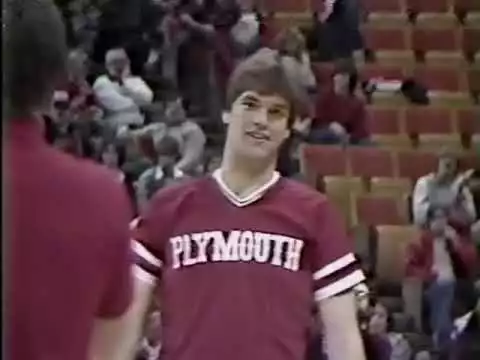
2) Scott Skiles – Plymouth
Scott Skiles authored one of the most legendary individual performances in Indiana high school basketball history during his time at Plymouth in the early 1980s. Known for his scoring ability, toughness, and fearless approach, Skiles was the kind of player who thrived in pressure-packed environments. His defining moment came in the 1982 state championship game, where he scored 39 points against heavily favored
Gary Roosevelt, including a clutch jumper that forced overtime. Plymouth would go on to win in double overtime, cementing one of the greatest upsets in state history.
Skiles was more than just a scorer—he was a complete floor leader. He controlled tempo, created opportunities for teammates, and delivered when it mattered most. His competitive fire and confidence made him a natural leader, and his ability to perform in the biggest moments set him apart.
In a state built on basketball tradition, Skiles’ performance remains one of the most iconic in Hoosier history.
Plymouth Cathedral basketball game 1982
1) Jay Edwards – Marion
Jay Edwards was one of the most naturally gifted scorers in Indiana history, earning Co–Mr. Basketball honors in 1987 alongside Lyndon Jones. At Marion, Edwards became known for his smooth shooting stroke and effortless scoring ability.
Edwards could score from anywhere on the floor. Whether it was shooting from deep, creating off the dribble, or finishing at the rim, he made it look easy. His offensive skill set was ahead of its time, and his ability to produce consistently made him one of the most dangerous players in the state.
What made Edwards special was his efficiency. He didn’t need a high volume of shots to make an impact—he scored within the flow of the game. His scoring ability and overall talent make him one of the best players of the decade.
1985 Indiana High School Basketball Final Four: Southridge vs Marion
Final Word
The 1980s were a defining era for Indiana basketball:
One class
One champion
No shortcuts
These players didn’t build their reputations through rankings or exposure—they built them in packed gyms, under pressure, when everything was on the line.
New Users – Get $350 in Bonus Bets when you wager $5 for 7 days
T&Cs apply
4.6/5
Gambling Problem? Call 1-800-GAMBLER or 1-800-MY-RESET. Call 1-888-789-7777 or visit ccpgg.org/chat (CT). Hope is here. GamblingHelpLineMA.org or call (800) 327-5050 for 24/7 support (MA). Visit www.mdgamblinghelp.org (MD). Call 1-877-8HOPE-NY or text HOPENY (NY). 21+ (18+ DC, WY) and present in select states (for KS, in affiliation with Kansas Star Casino). Find online real money wagering only. Min $5 wager required for 7 consecutive days. $5 free play credit. Bonus issued as non-withdrawable bonus with cash withdrawable bonus with cash withdrawable. Bonus bets which expire 7 days after receipt. Restrictions apply. See terms at sportsbook.fanduel.com. Call 1-877-770-7867 (LA).
Up To $1500 in Bonus Bets Paid Back if your First Bet Does Not Win
T&Cs apply
4.5/5
Gambling problem? Call 1-800-GAMBLER or 1-800-MY-RESET (Available in the US) 877-8-HOPENY or text HOPENY (467369) (NY) 1-800-327-5050 (MA), 1-800-BETS-OFF (IA), 1-800-981-0023 (PR). 21+ only. Please Gamble Responsibly. See BetMGM.com for Terms. First Bet Offer for new customers only (if applicable). Subject to eligibility requirements. Bonus bets are non-withdrawable. In partnership with Kansas Crossing Casino and Hotel. Promotional offers not available in Mississippi, Massachusetts, New York, Ontario, or Puerto Rico.
New DraftKings Customers: Bet $5, Get $200 + 3 Months of NBA League Pass!
T&Cs apply
4.5/5
GAMBLING PROBLEM? CALL 1-800-GAMBLER or 1-800-MY-RESET, (800) 327-5050 or visit gamblinghelplinema.org (MA). Please Gamble Responsibly. 888-789-7777/visit ccpg.org (CT), or visit www.mdgamblinghelp.org (MD), 1-800-981-0023 (PR). 21+ and present in most states. (18+ DC/NH/PR/WY). Void in CAN. Eligibility restrictions apply. On behalf of Boot Hill Casino (KS). Pass-thru of per wager tax may apply in IL. 1 per new Sportsbook customer. $5+ first-time bet req. Max. $200 issued as non-withdrawable Bonus Bets. Stake removed from payout. Reward issued as $50 in Bonus Bets every 7 days via click-to-claim for 21 days. Bonus Bets and click-to-claims expire 7 days (168hrs) after issuance. Terms: dkng.co/offer. Get 1 promo code to redeem a 3-month NBA League Pass subscription, complimentary of DraftKings. Subscription auto-renews monthly at then-current price (currently $16.99/mo); cancel anytime. Terms, restrictions, and eligibility requirements apply. Redeem League Pass by 12/19/26 at 11:59 PM ET. Addt’l terms: support.watch.nba.com/hc/en-us/articles/9165532876183-League-Pass-Terms-of-Use_. Ends 11/29/26 at 11:59 PM ET. Sponsored by DK.
Must be 21+. GAMBLING PROBLEM? CALL 1-800-GAMBLER OR CALL 1-800-MY-RESET, www.mdgamblinghelp.org (MD), (800)-327-5050 or gamblinghelplinema.org (MA), Call (877)8-HOPENY or text HOPENY (467369) (NY), (888) 789-7777 or ccpg.org (CT), morethanagame.nc.gov (NC), 1800gambler.net (WV)
Bet $1 and get double the winnings up to $25 for your next 10 bets
T&Cs apply
4.4/5
21+ New users only. Must register using eligible promo code. First bet after registration must qualify. Max. Bonus Bet: $1,000. Bonus Bet expires 14 days after receipt. Void where prohibited. See Caesars.com/promos for full terms. Gambling Problem? 1-800-GAMBLER (1-800-426-2537)
21+ and present in OH. Gambling Problem? Call 1-800-GAMBLER.
This site is using
Cloudflare
and adheres to the
Google Safe Browsing Program. We adapted
Google's Privacy Guidelines
to keep your data safe at all times.
Close
Ready to Win Big? Join the Elite with Our Sports Betting Deals!
FanDuel Promo
New Users – Get $350 in Bonus Bets when you wager $5 for 7 days
Our Favorite
T&Cs and 21+ apply
Gambling Problem? Call 1-800-GAMBLER or 1-800-MY-RESET. Call 1-888-789-7777 or visit ccpgg.org/chat (CT). Hope is here. GamblingHelpLineMA.org or call (800) 327-5050 for 24/7 support (MA). Visit www.mdgamblinghelp.org (MD). Call 1-877-8HOPE-NY or text HOPENY (NY). 21+ (18+ DC, WY) and present in select states (for KS, in affiliation with Kansas Star Casino). Find online real money wagering only. Min $5 wager required for 7 consecutive days. $5 free play credit. Bonus issued as non-withdrawable bonus with cash withdrawable bonus with cash withdrawable. Bonus bets which expire 7 days after receipt. Restrictions apply. See terms at sportsbook.fanduel.com. Call 1-877-770-7867 (LA).
Code:
Open FanDuel
Get Bonus
BetMGM Promo
Up To $1500 in Bonus Bets Paid Back if your First Bet Does Not Win
Best Slots
T&Cs and 21+ apply
Gambling problem? Call 1-800-GAMBLER or 1-800-MY-RESET (Available in the US) 877-8-HOPENY or text HOPENY (467369) (NY) 1-800-327-5050 (MA), 1-800-BETS-OFF (IA), 1-800-981-0023 (PR). 21+ only. Please Gamble Responsibly. See BetMGM.com for Terms. First Bet Offer for new customers only (if applicable). Subject to eligibility requirements. Bonus bets are non-withdrawable. In partnership with Kansas Crossing Casino and Hotel. Promotional offers not available in Mississippi, Massachusetts, New York, Ontario, or Puerto Rico.
Code:
Open BetMGM
Get Bonus
DraftKings Promo
New DraftKings Customers: Bet $5, Get $200 + 3 Months of NBA League Pass!
Newcomer
T&Cs and 21+ apply
GAMBLING PROBLEM? CALL 1-800-GAMBLER or 1-800-MY-RESET, (800) 327-5050 or visit gamblinghelplinema.org (MA). Please Gamble Responsibly. 888-789-7777/visit ccpg.org (CT), or visit www.mdgamblinghelp.org (MD), 1-800-981-0023 (PR). 21+ and present in most states. (18+ DC/NH/PR/WY). Void in CAN. Eligibility restrictions apply. On behalf of Boot Hill Casino (KS). Pass-thru of per wager tax may apply in IL. 1 per new Sportsbook customer. $5+ first-time bet req. Max. $200 issued as non-withdrawable Bonus Bets. Stake removed from payout. Reward issued as $50 in Bonus Bets every 7 days via click-to-claim for 21 days. Bonus Bets and click-to-claims expire 7 days (168hrs) after issuance. Terms: dkng.co/offer. Get 1 promo code to redeem a 3-month NBA League Pass subscription, complimentary of DraftKings. Subscription auto-renews monthly at then-current price (currently $16.99/mo); cancel anytime. Terms, restrictions, and eligibility requirements apply. Redeem League Pass by 12/19/26 at 11:59 PM ET. Addt’l terms: support.watch.nba.com/hc/en-us/articles/9165532876183-League-Pass-Terms-of-Use_. Ends 11/29/26 at 11:59 PM ET. Sponsored by DK.
Code:
Open DraftKings
Get Bonus
Find out what the legends have to say about sports this week....
New Users – Get $350 in Bonus Bets when you wager $5 for 7 days
Gambling Problem? Call 1-800-GAMBLER or 1-800-MY-RESET. Call 1-888-789-7777 or visit ccpgg.org/chat (CT). Hope is here. GamblingHelpLineMA.org or call (800) 327-5050 for 24/7 support (MA). Visit www.mdgamblinghelp.org (MD). Call 1-877-8HOPE-NY or text HOPENY (NY). 21+ (18+ DC, WY) and present in select states (for KS, in affiliation with Kansas Star Casino). Find online real money wagering only. Min $5 wager required for 7 consecutive days. $5 free play credit. Bonus issued as non-withdrawable bonus with cash withdrawable bonus with cash withdrawable. Bonus bets which expire 7 days after receipt. Restrictions apply. See terms at sportsbook.fanduel.com. Call 1-877-770-7867 (LA).