The Indiana Fever defeated the Seattle Storm 105–95 Tuesday night at Climate Pledge Arena, but the basketball became almost secondary
The Indiana Fever defeated the Seattle Storm 105–95 Tuesday night at Climate Pledge Arena, but the basketball became almost secondary, as it almost always does in the WNBA. That is a shame because the game—and the rest of Tuesday’s WNBA schedule—featured outstanding performances that deserved attention.
Caitlin Clark scored 32 points, Kelsey Mitchell added 28, and Indiana won its fourth consecutive game. Seattle guard Natisha Hiedeman delivered a career-high 33 points and made six three-pointers. Those should have been the stories everyone discussed Wednesday morning.
Instead, attention shifted to allegations that two young
Sophie Cunningham
supporters were cursed at by a Seattle Storm co-owner, selectively ordered to remove a sign and subjected to hostility inside the arena. Another video appears to show a Storm supporter spitting in a woman’s face after the game.
The Storm has spent years preaching inclusion, acceptance and respect. What happened Tuesday raises a straightforward question: Does that promised inclusion extend to women and girls who hold a different opinion?
Based on the events surrounding this game, the answer appears to be no.
A Storm Co-Owner Confronted Young Female Fans
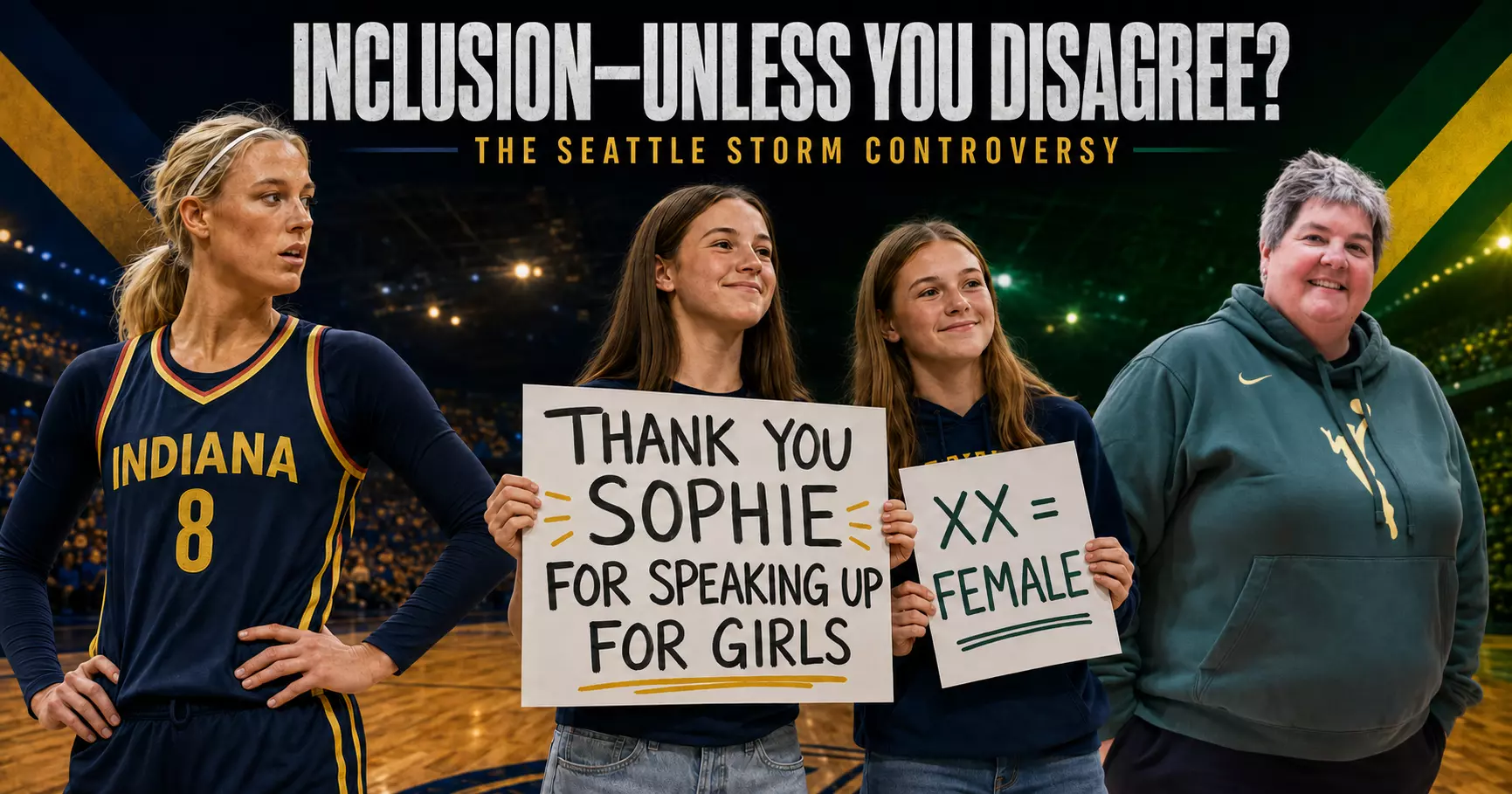
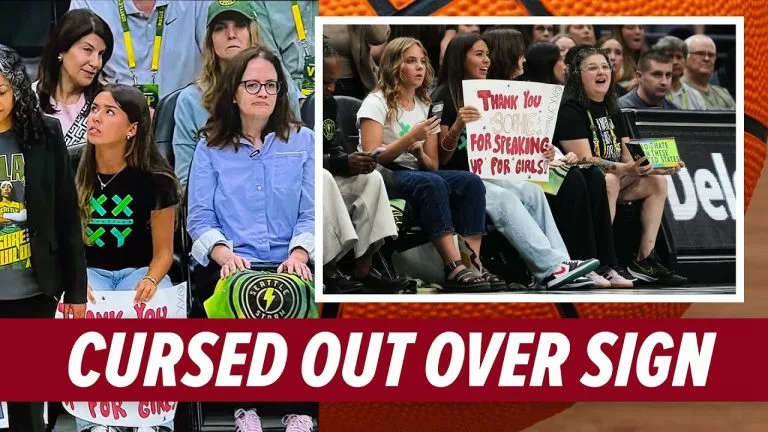
Two young women sat courtside with a sign reading:
“Thank you Sophie Cunningham for speaking up for girls.”
The message referred to Cunningham’s recent comments opposing the participation of transgender women in female sports. Cunningham has framed her position as an effort to protect fairness and safety for women and girls—not as an attack on transgender people.
According to the Girls firsthand account in an interview with
Undivided
host Brandi Kruse, a woman approached them and told them they were “f—— insane.” Kruse identified that woman as Seattle Storm minority owner Celeste Keaton.
Seattle Storm co-owner cusses out teen girls over Sophie Cunningham sign
This was not merely a dispute between two anonymous spectators. A person with an ownership interest in a professional sports franchise allegedly used profanity while confronting paying customers over a peaceful sign.
Storm majority owner Ginny Gilder subsequently issued this statement:
“We are aware one of our co-owners made comments to two fans in attendance at last night’s game. We apologize that this happened. Everyone who attends a Storm game deserves to feel welcome, and we remain committed to creating an inclusive environment where every fan is treated with respect.”
The statement is an acknowledgment that a co-owner made comments to the two fans. It does not dispute their account, identify the co-owner, explain exactly what happened or announce any disciplinary action.
That is not accountability. It is institutional damage control. That is what the WNBA always seems to be.
If the Storm genuinely believes every customer should feel welcome, it should explain what consequences an owner faces for personally confronting and cursing at fans. “Everyone deserves respect” means very little when the organization will not say how it intends to enforce that principle inside its own ownership group.
Two Signs—and Apparently Two Sets of Rules
The fans also said they were forced to put away their pro-Cunningham sign. Meanwhile, a nearby fan was reportedly permitted to display an opposing sign reading, “No hate in the United States.”
A private arena may enforce reasonable restrictions on signs. What it should not do is apply those restrictions based on which political message its employees prefer.
If one sign interfered with spectators’ views or violated an established size policy, the Storm should produce and explain that policy. If both signs were comparable but only one was removed, that looks less like neutral security enforcement and more like viewpoint discrimination.
Supporting female-only athletic categories is not an obscure extremist belief. A 2025 NBC News Stay Tuned survey of 19,682 American adults found that 75% said transgender women should not be allowed to participate in female sports.
That does not settle every ethical, legal or athletic-policy question. It does prove that Cunningham and the fans supporting her hold a position shared by a substantial majority of Americans. Labeling every person who holds that view hateful is not inclusion. It is an attempt to shut down a legitimate public debate through intimidation and social punishment.
Why would the WNBA want to hold opinions that the majority of fan stream fans think is absolutely insane? The WNBA is a welfare league that nobody cared about until the arrival of Caitlin Clark. At every turn the seem to try to disenfranchise her fans, imagine the way they would celebrate Clark if she was a lesbian? The WNBA is a league that continues to shoot itself in the foot.
Video Appears to Show a Storm Supporter Spitting in a Woman’s Face
The hostility did not end with the final buzzer.
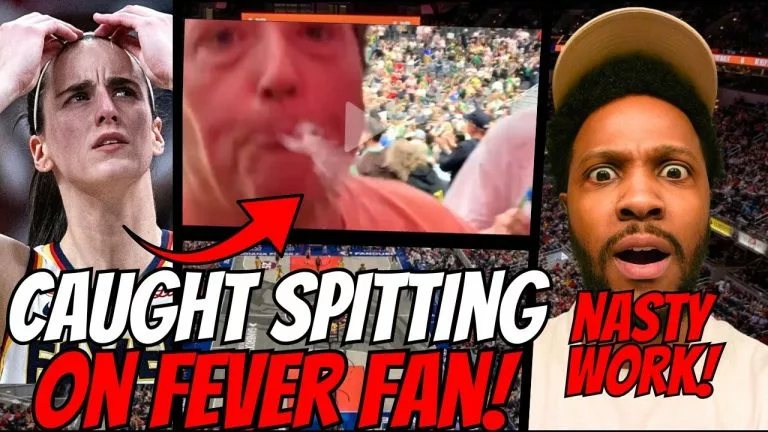
A video circulated by BrickCenter appears to show a person wearing Storm gear spitting directly in a woman’s face after Indiana’s victory. The people shown in the video have not been independently identified, but the act visible in the footage is disgraceful.
BUSTED Storm Fan Caught SPITTING ON Fever Fan In DISGUSTING Environment Caitlin SAVED From Reporter!
There is no evidence that the Storm directed or formally approved this fan’s behavior. But organizational culture is established by leadership. When a co-owner reportedly confronts and curses at young women over their beliefs, the franchise loses credibility when it portrays the hostility surrounding the game as something entirely beyond its control.
Another social-media post alleged that young Cunningham supporters wearing XX–XY Athletics shirts were cursed at, booed and intentionally tripped.
The tripping allegation and any accusation involving specific players require further independent confirmation. The co-owner confrontation, however, is supported by the fans’ interview and the Storm’s subsequent acknowledgment and apology.
Booing Is Permissible—Abuse Is Not
Storm fans had every right to boo Cunningham. Sports fans boo opposing players constantly, and political speech does not come with a right to escape criticism.
But there is an obvious difference between booing and abuse.
Spitting in someone’s face is not political expression, it’s assault. A team owner allegedly directing profanity at young fans is not ordinary arena banter. Selectively suppressing one sign while allowing the opposing message to remain is not neutral rule enforcement.
The issue is not that everyone in Seattle failed to agree with Cunningham. The issue is that dissenting women and girls were allegedly treated as enemies who did not deserve the same respect, protection and freedom of expression afforded to people supporting the franchise’s preferred position.
The Seattle Storm Crazies and Conditional “Inclusion”
The same contradiction is visible online.
Seattle Storm Crazies Facebook Page describes itself as a group committed to inclusion, although there is no evidence that it is officially operated by or formally affiliated with the Seattle Storm. Its administrators nevertheless provided another example of how quickly the language of inclusion can become a tool for silencing dissent.
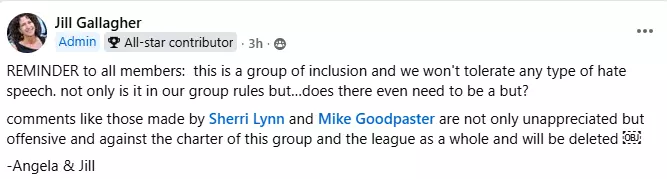
Administrator Jill Gallagher posted a public “reminder” naming Sherri Lynn and me, Mike Goodpaster. Gallagher characterized our comments as “offensive,” contrary to the group’s charter and the values of the league, and said they would be deleted.
I stated that there are
only two genders. The administrators were free to disagree with that view or enforce their group’s rules. But they deleted the comments being condemned, publicly identified the people who wrote them and prevented us from responding.
That left other members seeing an administrator’s suggestion that we had posted something hateful while denying them the context necessary to judge our actual words.
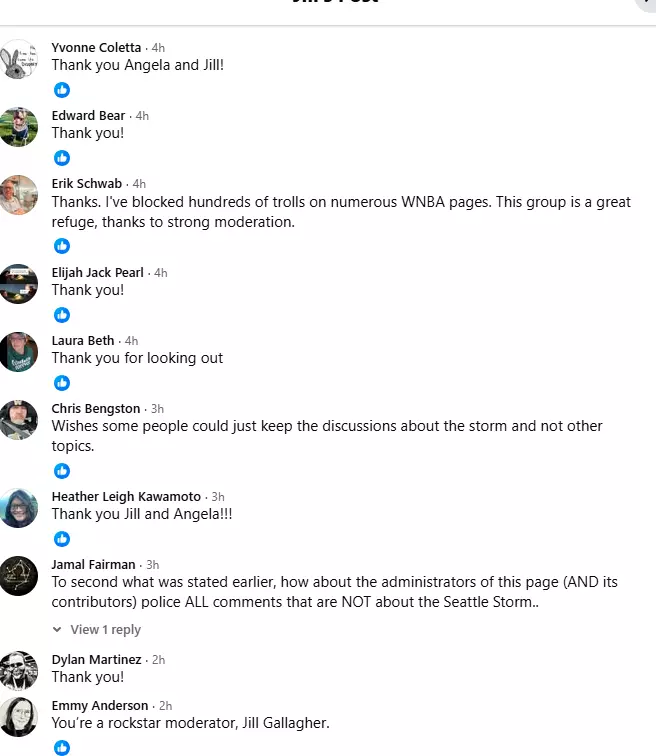
Members then thanked and praised the administrators underneath a public accusation we could not answer.
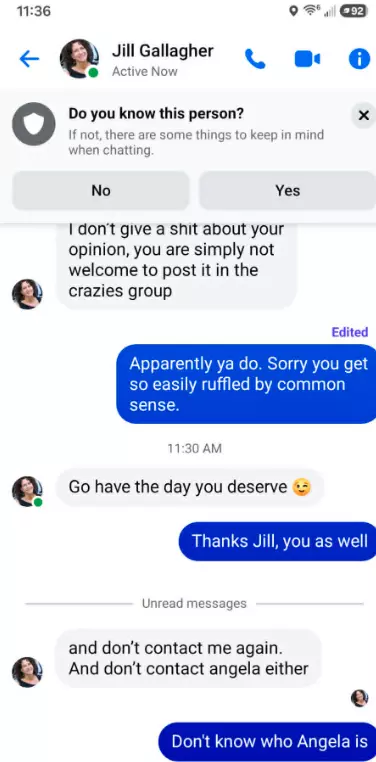
Sherri, a 45-year-old lesbian woman who has authorized the publication of her experience, also received a private message from Gallagher.
The administrator wrote:
The Facebook group has the right to establish rules and remove members. What it cannot credibly do is claim that everyone is welcome while an administrator tells a woman, “I don’t give a shit about your opinion,” publicly names her, deletes the underlying discussion and prevents her from responding.
That is not inclusion. It is ideological conformity presented in more marketable language.
Who Protects Caitlin Clark and the Fans Supporting Her?
ESPN analyst Monica McNutt recently said Caitlin Clark had room for greater “accountability and self-awareness” concerning her role in the WNBA’s “larger sisterhood.”
McNutt made those remarks after Clark described the emotional toll of media narratives surrounding her:
“When I walk out of the locker room, I shouldn’t be, not fearful, of what the conversation is gonna be. But it’s emotionally exhausting. It’s draining. It makes your shoulders tense. Because people don’t want to talk about the basketball, they just wanna stir it up and make something else.”
Clark has repeatedly condemned harassment, including abuse directed at opponents. After Alyssa Thomas received hateful messages following an incident involving Clark, the Fever star said:
“The harassment, the hate, none of that is okay. I don’t want anyone to ever experience that.”
Yet Clark is still expected to accept responsibility for strangers she does not know and behavior she does not control.
Where is the equivalent demand for accountability when Fever supporters are mistreated? Who protects Clark, Cunningham and the women and girls supporting them?
The Storm apologized for its co-owner’s comments, but no publicly announced punishment followed. The organization has not explained the reported disparity in sign enforcement. A video appearing to show one of its supporters spitting in a woman’s face became part of the game’s defining imagery.
Accountability cannot operate in only one political direction.
The Basketball Everyone Should Have Been Discussing
The greatest irony is that Tuesday produced a terrific night of WNBA basketball.
Washington defeated Connecticut 92–84 behind 22 points from Sonia Citron and a 20-point, 10-rebound performance from Kiki Iriafen.
Minnesota beat expansion Toronto 100–93. Rookie Olivia Miles scored 24 points for the league-leading Lynx, while Kayla McBride made four three-pointers. Toronto’s Marina Mabrey finished with 25 points, eight rebounds and six assists, and María Conde recorded 20 points and 10 rebounds.
Las Vegas defeated Portland 98–83 behind 28 points and 14 rebounds from A’ja Wilson and 25 points from Jackie Young. Megan DiLeo led the expansion Fire with 20 points.
New York survived Los Angeles 113–109. Breanna Stewart scored 29, Sabrina Ionescu added 27, Rae Burrell led the Sparks with 24, and Nneka Ogwumike scored 21.
Then there was Hiedeman’s career-high 33-point performance against Indiana—an achievement buried underneath a controversy created not only by social media but by the reported conduct of a Storm co-owner and people in the arena.
For decades, WNBA players have demanded more national coverage, greater respect, increased compensation and recognition of the quality of their game. They were right to demand those things. The league has tremendous players, compelling rivalries and increasingly large audiences.
But this is its moment. What is it doing with it?
Instead of welcoming new viewers and allowing basketball to lead, too much of the WNBA culture appears determined to impose a political test on its audience. Fans are welcome, apparently, provided they repeat the approved message. Women are empowered, apparently, provided they hold the correct opinion.
That approach will not grow the league. It will drive away people who might otherwise become loyal viewers, ticket buyers and supporters.
Inclusion Must Include People Who Disagree
Transgender people
should be treated with dignity and protected from threats, harassment and personal abuse; everybody should be. So should women and girls who believe female sports should remain separated by biological sex.
Those principles are not mutually exclusive.
The Storm’s owners, employees, players and fans have the right to support transgender inclusion. Sophie Cunningham and her supporters have the right to advocate for female-only athletic categories. A professional sports organization’s responsibility is to provide a safe environment in which neither side is cursed at, spat upon, threatened or subjected to selectively enforced rules.
The Seattle Storm says every fan deserves to feel welcome and be treated with respect.
Now the organization must prove that promise applies even to people who disagree with it.
New Users – Get $350 in Bonus Bets when you wager $5 for 7 days
T&Cs apply
4.6/5
Gambling Problem? Call 1-800-GAMBLER or 1-800-MY-RESET. Call 1-888-789-7777 or visit ccpgg.org/chat (CT). Hope is here. GamblingHelpLineMA.org or call (800) 327-5050 for 24/7 support (MA). Visit www.mdgamblinghelp.org (MD). Call 1-877-8HOPE-NY or text HOPENY (NY). 21+ (18+ DC, WY) and present in select states (for KS, in affiliation with Kansas Star Casino). Find online real money wagering only. Min $5 wager required for 7 consecutive days. $5 free play credit. Bonus issued as non-withdrawable bonus with cash withdrawable bonus with cash withdrawable. Bonus bets which expire 7 days after receipt. Restrictions apply. See terms at sportsbook.fanduel.com. Call 1-877-770-7867 (LA).
Up To $1500 in Bonus Bets Paid Back if your First Bet Does Not Win
T&Cs apply
4.5/5
Gambling problem? Call 1-800-GAMBLER or 1-800-MY-RESET (Available in the US) 877-8-HOPENY or text HOPENY (467369) (NY) 1-800-327-5050 (MA), 1-800-BETS-OFF (IA), 1-800-981-0023 (PR). 21+ only. Please Gamble Responsibly. See BetMGM.com for Terms. First Bet Offer for new customers only (if applicable). Subject to eligibility requirements. Bonus bets are non-withdrawable. In partnership with Kansas Crossing Casino and Hotel. Promotional offers not available in Mississippi, Massachusetts, New York, Ontario, or Puerto Rico.
New DraftKings Customers: Bet $5, Get $200 + 3 Months of NBA League Pass!
T&Cs apply
4.5/5
GAMBLING PROBLEM? CALL 1-800-GAMBLER or 1-800-MY-RESET, (800) 327-5050 or visit gamblinghelplinema.org (MA). Please Gamble Responsibly. 888-789-7777/visit ccpg.org (CT), or visit www.mdgamblinghelp.org (MD), 1-800-981-0023 (PR). 21+ and present in most states. (18+ DC/NH/PR/WY). Void in CAN. Eligibility restrictions apply. On behalf of Boot Hill Casino (KS). Pass-thru of per wager tax may apply in IL. 1 per new Sportsbook customer. $5+ first-time bet req. Max. $200 issued as non-withdrawable Bonus Bets. Stake removed from payout. Reward issued as $50 in Bonus Bets every 7 days via click-to-claim for 21 days. Bonus Bets and click-to-claims expire 7 days (168hrs) after issuance. Terms: dkng.co/offer. Get 1 promo code to redeem a 3-month NBA League Pass subscription, complimentary of DraftKings. Subscription auto-renews monthly at then-current price (currently $16.99/mo); cancel anytime. Terms, restrictions, and eligibility requirements apply. Redeem League Pass by 12/19/26 at 11:59 PM ET. Addt’l terms: support.watch.nba.com/hc/en-us/articles/9165532876183-League-Pass-Terms-of-Use_. Ends 11/29/26 at 11:59 PM ET. Sponsored by DK.
Must be 21+. GAMBLING PROBLEM? CALL 1-800-GAMBLER OR CALL 1-800-MY-RESET, www.mdgamblinghelp.org (MD), (800)-327-5050 or gamblinghelplinema.org (MA), Call (877)8-HOPENY or text HOPENY (467369) (NY), (888) 789-7777 or ccpg.org (CT), morethanagame.nc.gov (NC), 1800gambler.net (WV)
Bet $1 and get double the winnings up to $25 for your next 10 bets
T&Cs apply
4.4/5
21+ New users only. Must register using eligible promo code. First bet after registration must qualify. Max. Bonus Bet: $1,000. Bonus Bet expires 14 days after receipt. Void where prohibited. See Caesars.com/promos for full terms. Gambling Problem? 1-800-GAMBLER (1-800-426-2537)
21+ and present in OH. Gambling Problem? Call 1-800-GAMBLER.
This site is using
Cloudflare
and adheres to the
Google Safe Browsing Program. We adapted
Google's Privacy Guidelines
to keep your data safe at all times.
Close
Ready to Win Big? Join the Elite with Our Sports Betting Deals!
FanDuel Promo
New Users – Get $350 in Bonus Bets when you wager $5 for 7 days
Our Favorite
T&Cs and 21+ apply
Gambling Problem? Call 1-800-GAMBLER or 1-800-MY-RESET. Call 1-888-789-7777 or visit ccpgg.org/chat (CT). Hope is here. GamblingHelpLineMA.org or call (800) 327-5050 for 24/7 support (MA). Visit www.mdgamblinghelp.org (MD). Call 1-877-8HOPE-NY or text HOPENY (NY). 21+ (18+ DC, WY) and present in select states (for KS, in affiliation with Kansas Star Casino). Find online real money wagering only. Min $5 wager required for 7 consecutive days. $5 free play credit. Bonus issued as non-withdrawable bonus with cash withdrawable bonus with cash withdrawable. Bonus bets which expire 7 days after receipt. Restrictions apply. See terms at sportsbook.fanduel.com. Call 1-877-770-7867 (LA).
Code:
Open FanDuel
Get Bonus
BetMGM Promo
Up To $1500 in Bonus Bets Paid Back if your First Bet Does Not Win
Best Slots
T&Cs and 21+ apply
Gambling problem? Call 1-800-GAMBLER or 1-800-MY-RESET (Available in the US) 877-8-HOPENY or text HOPENY (467369) (NY) 1-800-327-5050 (MA), 1-800-BETS-OFF (IA), 1-800-981-0023 (PR). 21+ only. Please Gamble Responsibly. See BetMGM.com for Terms. First Bet Offer for new customers only (if applicable). Subject to eligibility requirements. Bonus bets are non-withdrawable. In partnership with Kansas Crossing Casino and Hotel. Promotional offers not available in Mississippi, Massachusetts, New York, Ontario, or Puerto Rico.
Code:
Open BetMGM
Get Bonus
DraftKings Promo
New DraftKings Customers: Bet $5, Get $200 + 3 Months of NBA League Pass!
Newcomer
T&Cs and 21+ apply
GAMBLING PROBLEM? CALL 1-800-GAMBLER or 1-800-MY-RESET, (800) 327-5050 or visit gamblinghelplinema.org (MA). Please Gamble Responsibly. 888-789-7777/visit ccpg.org (CT), or visit www.mdgamblinghelp.org (MD), 1-800-981-0023 (PR). 21+ and present in most states. (18+ DC/NH/PR/WY). Void in CAN. Eligibility restrictions apply. On behalf of Boot Hill Casino (KS). Pass-thru of per wager tax may apply in IL. 1 per new Sportsbook customer. $5+ first-time bet req. Max. $200 issued as non-withdrawable Bonus Bets. Stake removed from payout. Reward issued as $50 in Bonus Bets every 7 days via click-to-claim for 21 days. Bonus Bets and click-to-claims expire 7 days (168hrs) after issuance. Terms: dkng.co/offer. Get 1 promo code to redeem a 3-month NBA League Pass subscription, complimentary of DraftKings. Subscription auto-renews monthly at then-current price (currently $16.99/mo); cancel anytime. Terms, restrictions, and eligibility requirements apply. Redeem League Pass by 12/19/26 at 11:59 PM ET. Addt’l terms: support.watch.nba.com/hc/en-us/articles/9165532876183-League-Pass-Terms-of-Use_. Ends 11/29/26 at 11:59 PM ET. Sponsored by DK.
Code:
Open DraftKings
Get Bonus
Find out what the legends have to say about sports this week....
New Users – Get $350 in Bonus Bets when you wager $5 for 7 days
Gambling Problem? Call 1-800-GAMBLER or 1-800-MY-RESET. Call 1-888-789-7777 or visit ccpgg.org/chat (CT). Hope is here. GamblingHelpLineMA.org or call (800) 327-5050 for 24/7 support (MA). Visit www.mdgamblinghelp.org (MD). Call 1-877-8HOPE-NY or text HOPENY (NY). 21+ (18+ DC, WY) and present in select states (for KS, in affiliation with Kansas Star Casino). Find online real money wagering only. Min $5 wager required for 7 consecutive days. $5 free play credit. Bonus issued as non-withdrawable bonus with cash withdrawable bonus with cash withdrawable. Bonus bets which expire 7 days after receipt. Restrictions apply. See terms at sportsbook.fanduel.com. Call 1-877-770-7867 (LA).