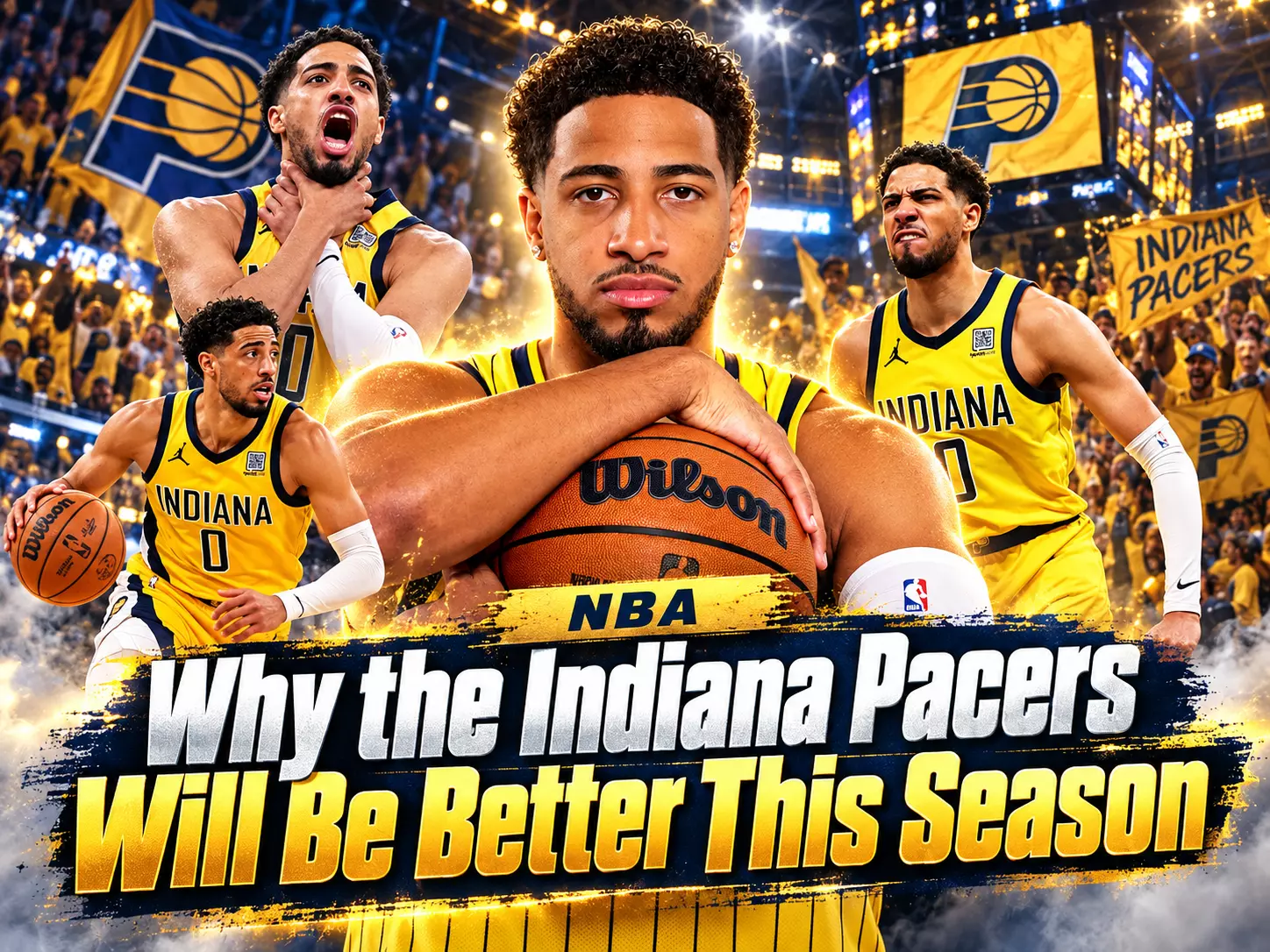
NBA Why the Indiana Pacers Will Be Better This Season
The Indiana Pacers enter the 2026–27 NBA season with one of the clearest opportunities for improvement anywhere in the league.
Indiana finished
19–63 last season, 14th in the Eastern Conference, only one year after reaching Game 7 of the 2025 NBA Finals. On the surface, that looks like an organization that collapsed.
The reality is considerably different.
The 2025–26 season was essentially a bridge year. Tyrese Haliburton missed the entire season recovering from the torn right Achilles he suffered during Game 7 of the 2025 NBA Finals. Indiana also dealt with injuries throughout the roster while giving younger players expanded responsibilities.
Now Haliburton is returning, most of the core from the Finals team remains intact, Ivica Zubac will get a full season at center, Andrew Nembhard and Jarace Walker are better players than they were two years ago, and Indiana added Kelly Oubre Jr. and Larry Nance Jr. to strengthen its depth.
The Pacers aren’t simply getting their best player back.
They may actually have a deeper and more complete roster than the one Haliburton left.
Tyrese Haliburton Changes Everything
There is no bigger reason Indiana should improve than the return of
Tyrese Haliburton.
Haliburton missed every game of the 2025–26 season after undergoing surgery on his Achilles. He has since progressed through his rehabilitation and is expected back for 2026–27. NBA.com reported that Haliburton had resumed five-on-five work and said during the summer that he felt like a healthy NBA player, although Indiana may manage his workload early in the season.
Before the injury, Haliburton averaged
18.6 points, 9.2 assists and 3.5 rebounds
in 2024–25 while shooting 38.8 percent from three-point range.
But his influence goes far beyond those numbers.
Haliburton determines how Indiana plays.
He pushes the basketball before defenses can organize. He creates open threes. He finds cutters. He gets big men easy baskets. His shooting range stretches defenses well beyond the three-point line.
Without him, Indiana was forced to manufacture offense.
With him, the Pacers dictate how opponents defend.
Indiana doesn’t necessarily need Haliburton to immediately return to his absolute peak. Even 85 or 90 percent of the pre-injury version would dramatically change the team’s offensive ceiling.
Andrew Nembhard Is Better Now
One positive development from Haliburton’s absence was the increased responsibility given to
Andrew Nembhard.
Nembhard averaged career highs of
16.9 points and 7.7 assists
across 57 games last season.
That matters enormously.
Before Haliburton’s injury, Indiana knew Nembhard could defend, shoot and function as a secondary playmaker.
Now the Pacers know he can actually run an offense.
That gives Rick Carlisle considerably more flexibility.
Haliburton doesn’t have to handle every possession. Nembhard can initiate the offense while Haliburton works away from the basketball. He can run the second unit for stretches. He can take pressure off Haliburton when opponents trap aggressively.
Indiana effectively used a disastrous season to develop another legitimate playmaker.
The Haliburton-Nembhard backcourt could consequently be better in 2026–27 than it was during Indiana’s Finals run.
Pascal Siakam Gives Indiana Stability
While much of the attention will understandably focus on Haliburton,
Pascal Siakam
remains the stabilizing force in Indiana’s lineup.
Siakam gives the Pacers something every contender needs: a veteran scorer who can create a quality shot when the normal offense breaks down.
Transition opportunities disappear in the playoffs.
Three-point shots stop falling.
Opponents blow up offensive sets.
That is when Siakam’s ability to score in the post, attack mismatches and create from the mid-range becomes especially important.
And unlike last season, Siakam shouldn’t be required to carry such a heavy burden.
Haliburton is returning.
Nembhard has developed.
Indiana has additional scoring on the wing.
That should allow Siakam to return to the role that made him so effective during the Pacers’ 2025 postseason run.
Ivica Zubac Could Transform the Frontcourt
One of the most important differences between the current Pacers and the team that reached the Finals is
Ivica Zubac.
Indiana acquired Zubac during the 2025–26 season, but he appeared in only five games for the Pacers following the trade. NBA.com’s season preview lists him as Indiana’s starting center entering 2026–27.
Zubac averaged
14.1 points and 10.6 rebounds
across 48 games last season.
His presence could solve several problems.
Indiana needs rebounding.
Zubac provides it.
Indiana needs interior defense.
Zubac provides it.
Indiana needs someone capable of setting physical screens for Haliburton and Nembhard.
Zubac provides that too.
The Haliburton-Zubac pick-and-roll could become one of the most productive actions in Indiana’s offense.
Haliburton has always been outstanding at manipulating pick-and-roll defenses. Now he gets a legitimate seven-footer who can screen, roll, finish and dominate the offensive glass.
Indiana hasn’t really had that combination during the Haliburton era.
Jarace Walker’s Development Could Be Huge
Another reason for optimism is
Jarace Walker.
The 2025–26 season became Walker’s breakout opportunity.
His numbers jumped from 6.1 points, 3.1 rebounds and 1.5 assists in 2024–25 to
11.6 points, 5.1 rebounds and 2.5 assists
last season. He also started 41 games after making only five starts over his first two NBA seasons.
Walker was allowed to play through mistakes because Indiana wasn’t operating under championship pressure.
That development could pay dividends now.
At 6-foot-7 and 235 pounds, Walker gives Carlisle another versatile forward who can rebound, handle the basketball, shoot and defend multiple positions.
Indiana doesn’t necessarily need Walker to become a star.
If he becomes a reliable two-way rotation player, the Pacers become substantially deeper.
Kelly Oubre Jr. Adds Something Different
Indiana also added
Kelly Oubre Jr.
during the offseason.
Oubre gives the Pacers another athletic 6-foot-8 wing capable of scoring independently.
That’s important because Indiana’s offense can sometimes become overly dependent on creating shots through movement.
Oubre doesn’t necessarily need an offensive system to create points.
He can attack a closeout.
He can get downhill.
He can score in transition.
He can defend bigger perimeter players.
He can create his own shot when a possession breaks down.
That gives Carlisle another option he didn’t previously have.
A second unit featuring some combination of T.J. McConnell, Oubre, Obi Toppin, Walker and Jay Huff could give Indiana considerable scoring punch.
Larry Nance Jr. Adds Veteran Depth
Larry Nance Jr.
won’t be expected to produce huge numbers, but his addition makes Indiana more flexible.
Nance can play power forward or center, defend multiple positions, rebound and provide physicality.
That’s particularly valuable during the regular season.
Instead of forcing Siakam or Zubac to play excessive minutes, Carlisle can use Nance in matchup-specific situations.
Indiana now has several different frontcourt configurations.
It can play big with Zubac.
It can space the floor with Jay Huff.
It can go small with Nance.
It can become extremely athletic with Siakam and Walker.
That versatility should help Carlisle manage an 82-game season.
Most of the Finals Core Is Still Here
This might be the most overlooked reason Indiana could rebound quickly.
The Pacers haven’t completely rebuilt their roster.
The team that went to the 2025 NBA Finals still has:
Tyrese Haliburton, Pascal Siakam, Andrew Nembhard, Aaron Nesmith, T.J. McConnell and Obi Toppin.
NBA.com’s 2026–27 season preview specifically notes that much of the Finals core returns while Indiana has added Zubac, Oubre and Nance.
These players already know how to win together.
They’ve played playoff games together.
They’ve been through close games together.
They understand Carlisle’s system.
Indiana doesn’t need to build championship-level chemistry from scratch.
The Pacers need to restore it.
Rick Carlisle Has More Options
Indiana also has one of the NBA’s most experienced coaches in
Rick Carlisle.
Carlisle now has significantly more lineup possibilities than he had last season.
Need offense?
Haliburton, Nembhard, Oubre, Siakam and Zubac.
Need defense?
Nembhard, Nesmith, Walker, Siakam and Zubac.
Need speed?
Haliburton, McConnell, Nesmith, Toppin and Siakam.
Need shooting?
Indiana can surround Haliburton with multiple floor spacers.
Need size?
Zubac gives Carlisle a legitimate interior anchor.
Carlisle’s ability to adjust from opponent to opponent becomes considerably more valuable when he has this many different player types available.
Last Season’s Record Is Misleading
The biggest mistake would be assuming Indiana is simply a 19-win team trying to improve.
It isn’t.
The Pacers were one game away from an NBA championship in June 2025.
Then their franchise point guard missed an entire season.
Indiana went
19–63 in 2025–26, but NBA.com’s draft review described the season as a “gap year” built around allowing Haliburton to rehabilitate while developing the roster.
That distinction matters.
This isn’t a traditional rebuilding team hoping several prospects suddenly develop.
Indiana already knows its core can win playoff games.
The question is whether that core can return to its previous level after Haliburton’s injury.
The Biggest Concern
There is one major reason to remain cautious.
Nobody can guarantee exactly how Haliburton will respond after an Achilles rupture.
He will be approximately 16 months removed from the injury when the regular season begins, and all indications are that he is progressing well, but Indiana may still need to manage his minutes early.
Haliburton’s quickness, conditioning and confidence could take time to completely return.
That’s why expecting Indiana to immediately look like the 2025 Finals team in October would be unrealistic.
But Indiana no longer needs Haliburton to do everything.
Nembhard has developed.
Walker has developed.
Siakam remains productive.
Zubac gives Indiana a legitimate center.
Oubre provides another scorer.
That supporting cast should allow Carlisle to gradually increase Haliburton’s responsibilities.
How Much Better Could Indiana Be?
A return from
19 wins to the mid-to-upper 40s
is realistic if Haliburton stays healthy and approaches his pre-injury level.
My projection remains:
Indiana Pacers: 47–35
That would represent a 28-win improvement.
Normally, that would sound extreme.
But Indiana’s circumstances aren’t normal.
This wasn’t a bad roster that added one superstar.
It was a former NBA Finals roster that temporarily lost the player around whom virtually everything was constructed.
Conclusion
The Indiana Pacers should be much better in 2026–27 because the team that won only 19 games isn’t really the team Indiana will put on the floor this season.
Tyrese Haliburton is coming back.
Andrew Nembhard is better.
Jarace Walker is better.
Pascal Siakam remains one of the team’s most dependable players.
Ivica Zubac gives Indiana the rebounding and interior presence it lacked.
Kelly Oubre Jr. gives Carlisle another scorer.
Larry Nance Jr. provides veteran frontcourt depth.
And most of the group that reached Game 7 of the NBA Finals remains together.
There are legitimate questions surrounding Haliburton’s recovery, and the Pacers shouldn’t be expected to immediately return to championship form.
But they also shouldn’t be judged by last season’s 19–63 record.
The 2025–26 Pacers were a team trying to survive without their franchise player. The 2026–27 Pacers once again have the pieces to compete.
If Haliburton stays healthy and the young players build on what they learned during last year’s difficult season, Indiana won’t simply be better.
The Pacers could once again become one of the most dangerous teams in the Eastern Conference.
New Users – Get $350 in Bonus Bets when you wager $5 for 7 days
T&Cs apply
4.6/5
Gambling Problem? Call 1-800-GAMBLER or 1-800-MY-RESET. Call 1-888-789-7777 or visit ccpgg.org/chat (CT). Hope is here. GamblingHelpLineMA.org or call (800) 327-5050 for 24/7 support (MA). Visit www.mdgamblinghelp.org (MD). Call 1-877-8HOPE-NY or text HOPENY (NY). 21+ (18+ DC, WY) and present in select states (for KS, in affiliation with Kansas Star Casino). Find online real money wagering only. Min $5 wager required for 7 consecutive days. $5 free play credit. Bonus issued as non-withdrawable bonus with cash withdrawable bonus with cash withdrawable. Bonus bets which expire 7 days after receipt. Restrictions apply. See terms at sportsbook.fanduel.com. Call 1-877-770-7867 (LA).
Up To $1500 in Bonus Bets Paid Back if your First Bet Does Not Win
T&Cs apply
4.5/5
Gambling problem? Call 1-800-GAMBLER or 1-800-MY-RESET (Available in the US) 877-8-HOPENY or text HOPENY (467369) (NY) 1-800-327-5050 (MA), 1-800-BETS-OFF (IA), 1-800-981-0023 (PR). 21+ only. Please Gamble Responsibly. See BetMGM.com for Terms. First Bet Offer for new customers only (if applicable). Subject to eligibility requirements. Bonus bets are non-withdrawable. In partnership with Kansas Crossing Casino and Hotel. Promotional offers not available in Mississippi, Massachusetts, New York, Ontario, or Puerto Rico.
New DraftKings Customers: Bet $5, Get $200 + 3 Months of NBA League Pass!
T&Cs apply
4.5/5
GAMBLING PROBLEM? CALL 1-800-GAMBLER or 1-800-MY-RESET, (800) 327-5050 or visit gamblinghelplinema.org (MA). Please Gamble Responsibly. 888-789-7777/visit ccpg.org (CT), or visit www.mdgamblinghelp.org (MD), 1-800-981-0023 (PR). 21+ and present in most states. (18+ DC/NH/PR/WY). Void in CAN. Eligibility restrictions apply. On behalf of Boot Hill Casino (KS). Pass-thru of per wager tax may apply in IL. 1 per new Sportsbook customer. $5+ first-time bet req. Max. $200 issued as non-withdrawable Bonus Bets. Stake removed from payout. Reward issued as $50 in Bonus Bets every 7 days via click-to-claim for 21 days. Bonus Bets and click-to-claims expire 7 days (168hrs) after issuance. Terms: dkng.co/offer. Get 1 promo code to redeem a 3-month NBA League Pass subscription, complimentary of DraftKings. Subscription auto-renews monthly at then-current price (currently $16.99/mo); cancel anytime. Terms, restrictions, and eligibility requirements apply. Redeem League Pass by 12/19/26 at 11:59 PM ET. Addt’l terms: support.watch.nba.com/hc/en-us/articles/9165532876183-League-Pass-Terms-of-Use_. Ends 11/29/26 at 11:59 PM ET. Sponsored by DK.
Must be 21+. GAMBLING PROBLEM? CALL 1-800-GAMBLER OR CALL 1-800-MY-RESET, www.mdgamblinghelp.org (MD), (800)-327-5050 or gamblinghelplinema.org (MA), Call (877)8-HOPENY or text HOPENY (467369) (NY), (888) 789-7777 or ccpg.org (CT), morethanagame.nc.gov (NC), 1800gambler.net (WV)
Bet $1 and get double the winnings up to $25 for your next 10 bets
T&Cs apply
4.4/5
21+ New users only. Must register using eligible promo code. First bet after registration must qualify. Max. Bonus Bet: $1,000. Bonus Bet expires 14 days after receipt. Void where prohibited. See Caesars.com/promos for full terms. Gambling Problem? 1-800-GAMBLER (1-800-426-2537)
21+ and present in OH. Gambling Problem? Call 1-800-GAMBLER.
This site is using
Cloudflare
and adheres to the
Google Safe Browsing Program. We adapted
Google's Privacy Guidelines
to keep your data safe at all times.
Close
Ready to Win Big? Join the Elite with Our Sports Betting Deals!
FanDuel Promo
New Users – Get $350 in Bonus Bets when you wager $5 for 7 days
Our Favorite
T&Cs and 21+ apply
Gambling Problem? Call 1-800-GAMBLER or 1-800-MY-RESET. Call 1-888-789-7777 or visit ccpgg.org/chat (CT). Hope is here. GamblingHelpLineMA.org or call (800) 327-5050 for 24/7 support (MA). Visit www.mdgamblinghelp.org (MD). Call 1-877-8HOPE-NY or text HOPENY (NY). 21+ (18+ DC, WY) and present in select states (for KS, in affiliation with Kansas Star Casino). Find online real money wagering only. Min $5 wager required for 7 consecutive days. $5 free play credit. Bonus issued as non-withdrawable bonus with cash withdrawable bonus with cash withdrawable. Bonus bets which expire 7 days after receipt. Restrictions apply. See terms at sportsbook.fanduel.com. Call 1-877-770-7867 (LA).
Code:
Open FanDuel
Get Bonus
BetMGM Promo
Up To $1500 in Bonus Bets Paid Back if your First Bet Does Not Win
Best Slots
T&Cs and 21+ apply
Gambling problem? Call 1-800-GAMBLER or 1-800-MY-RESET (Available in the US) 877-8-HOPENY or text HOPENY (467369) (NY) 1-800-327-5050 (MA), 1-800-BETS-OFF (IA), 1-800-981-0023 (PR). 21+ only. Please Gamble Responsibly. See BetMGM.com for Terms. First Bet Offer for new customers only (if applicable). Subject to eligibility requirements. Bonus bets are non-withdrawable. In partnership with Kansas Crossing Casino and Hotel. Promotional offers not available in Mississippi, Massachusetts, New York, Ontario, or Puerto Rico.
Code:
Open BetMGM
Get Bonus
DraftKings Promo
New DraftKings Customers: Bet $5, Get $200 + 3 Months of NBA League Pass!
Newcomer
T&Cs and 21+ apply
GAMBLING PROBLEM? CALL 1-800-GAMBLER or 1-800-MY-RESET, (800) 327-5050 or visit gamblinghelplinema.org (MA). Please Gamble Responsibly. 888-789-7777/visit ccpg.org (CT), or visit www.mdgamblinghelp.org (MD), 1-800-981-0023 (PR). 21+ and present in most states. (18+ DC/NH/PR/WY). Void in CAN. Eligibility restrictions apply. On behalf of Boot Hill Casino (KS). Pass-thru of per wager tax may apply in IL. 1 per new Sportsbook customer. $5+ first-time bet req. Max. $200 issued as non-withdrawable Bonus Bets. Stake removed from payout. Reward issued as $50 in Bonus Bets every 7 days via click-to-claim for 21 days. Bonus Bets and click-to-claims expire 7 days (168hrs) after issuance. Terms: dkng.co/offer. Get 1 promo code to redeem a 3-month NBA League Pass subscription, complimentary of DraftKings. Subscription auto-renews monthly at then-current price (currently $16.99/mo); cancel anytime. Terms, restrictions, and eligibility requirements apply. Redeem League Pass by 12/19/26 at 11:59 PM ET. Addt’l terms: support.watch.nba.com/hc/en-us/articles/9165532876183-League-Pass-Terms-of-Use_. Ends 11/29/26 at 11:59 PM ET. Sponsored by DK.
Code:
Open DraftKings
Get Bonus
Find out what the legends have to say about sports this week....
New Users – Get $350 in Bonus Bets when you wager $5 for 7 days
Gambling Problem? Call 1-800-GAMBLER or 1-800-MY-RESET. Call 1-888-789-7777 or visit ccpgg.org/chat (CT). Hope is here. GamblingHelpLineMA.org or call (800) 327-5050 for 24/7 support (MA). Visit www.mdgamblinghelp.org (MD). Call 1-877-8HOPE-NY or text HOPENY (NY). 21+ (18+ DC, WY) and present in select states (for KS, in affiliation with Kansas Star Casino). Find online real money wagering only. Min $5 wager required for 7 consecutive days. $5 free play credit. Bonus issued as non-withdrawable bonus with cash withdrawable bonus with cash withdrawable. Bonus bets which expire 7 days after receipt. Restrictions apply. See terms at sportsbook.fanduel.com. Call 1-877-770-7867 (LA).