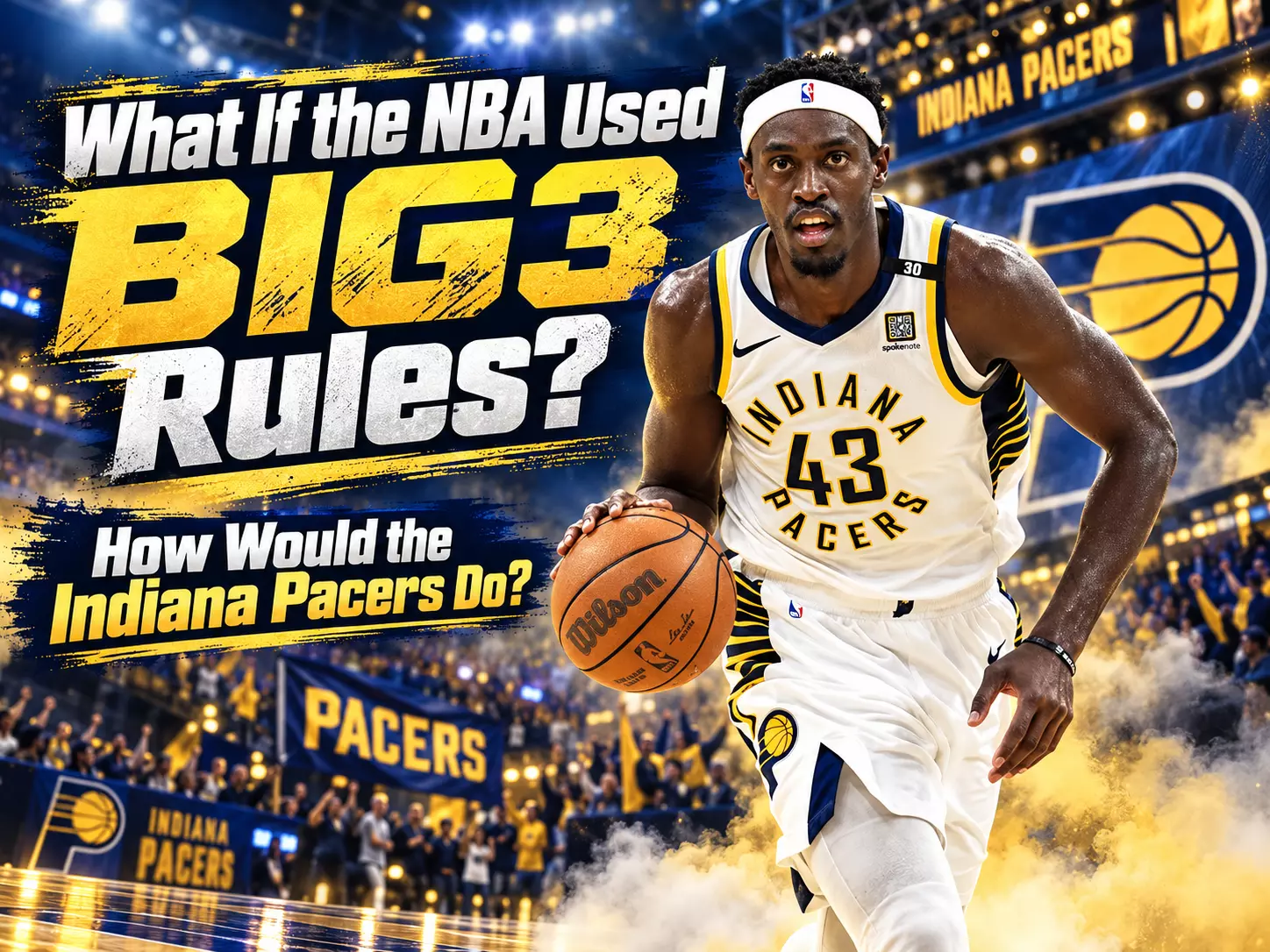
What If the NBA Used BIG3 Rules? How Would the Indiana Pacers Do?
The Indiana Pacers are built for speed, ball movement and depth in the traditional NBA. But what would happen if the NBA suddenly adopted the rules and style of the BIG3?
It would fundamentally change how Rick Carlisle constructed his team.
BIG3 basketball is
3-on-3 and half-court, games are played to
50 points with a win-by-two requirement, possessions use a
14-second shot clock, and players can score four points from designated circles roughly 30 feet from the basket. The league also uses its “Bring the Fire” rule to settle certain foul challenges with one-on-one basketball.
Those rules would reduce the importance of depth, transition offense and traditional positions while dramatically increasing the value of:
Isolation scoring
Size
Strength
Rebounding
Switching defensively
Three-level shot creation
Long-range shooting
Post scoring
One-on-one defense
That creates both opportunities and problems for Indiana.
The Biggest Change for the Pacers
Indiana’s biggest strength under normal NBA rules is its ability to play quickly.
Tyrese Haliburton pushes the basketball before defenses are organized. Indiana moves the ball, runs the floor and uses several players on each possession.
BIG3 rules would eliminate much of that advantage.
There would be no traditional full-court transition attack because the game is played in the half court.
Instead of five defenders being forced to chase Indiana’s constant cutting and passing, there would be only three offensive players and three defenders.
Suddenly the question becomes:
Can you beat your defender one-on-one?
That changes who becomes most valuable to the Pacers.
Who Would Indiana Keep?
Indiana currently has Haliburton, Pascal Siakam, Andrew Nembhard, Ivica Zubac, Aaron Nesmith, Kelly Oubre Jr., Jarace Walker, Obi Toppin, T.J. McConnell, Larry Nance Jr., Jay Huff and several younger players on its roster.
If I were building a compact Pacers roster specifically for BIG3 basketball, these would be my seven players.
1. Pascal Siakam
Absolutely untouchable.
Siakam might actually become
more valuable under BIG3 rules than he is in the NBA.
At 6-foot-8 and roughly 245 pounds, Siakam has nearly the perfect body type for three-on-three basketball.
He can:
score in the post,
face up,
attack slower big men,
shoot over smaller defenders,
handle the basketball,
rebound,
switch defensively,
and create his own shot late in possessions.
With significantly more space on the court, defending Siakam one-on-one would become extremely difficult.
Against a guard, Indiana could post him.
Against a center, Siakam could attack from the perimeter.
Against another forward, Carlisle could simply allow Siakam to create.
Siakam would be Indiana’s No. 1 BIG3 player.
2. Tyrese Haliburton
Haliburton stays, but his role changes.
His current NBA value comes partly from his ability to orchestrate a five-man offense, push the pace and find teammates in transition.
Some of those advantages disappear in half-court 3-on-3.
But Haliburton would gain something else:
space.
With only six players occupying the half court, it would become extremely difficult to trap him without surrendering an easy basket.
Haliburton could use high screens from Siakam or Zubac and have dramatically more room to operate.
His shooting range also becomes particularly valuable because BIG3’s four-point circles reward players capable of shooting around 30 feet.
Haliburton has the type of range that would make defenses respect him from those distances.
His weakness would be defense.
Opponents would repeatedly attempt to isolate him against stronger scorers.
Carlisle would therefore have to decide whether Haliburton’s offense outweighed the defensive matchup problems.
Most nights it would.
BIG3 Pacers ranking: No. 2.
3. Andrew Nembhard
Nembhard might be Indiana’s biggest surprise under BIG3 rules.
His role would become more important because there is nowhere for a weak defender to hide in three-on-three basketball.
Nembhard gives Indiana:
on-ball defense,
ball handling,
mid-range shooting,
strength,
pick-and-roll creation,
and secondary scoring.
At 6-foot-4, he is big enough to defend many guards while possessing enough offensive skill to punish opponents who ignore him.
In certain matchups, I would actually play Nembhard
instead of Haliburton late in games
because he provides more defensive resistance.
Haliburton is unquestionably the greater NBA player.
But BIG3 rules narrow the gap between them because individual defense becomes so important.
4. Ivica Zubac
Some might assume BIG3 basketball would eliminate traditional centers.
It doesn’t.
Current BIG3 production shows that powerful interior players can thrive. Montrezl Harrell, Greg Monroe and Dwight Howard have all been prominent rebounders or scorers in the current competition.
That makes Zubac extremely valuable.
At 7-foot and 240 pounds, Indiana could simply feed him against smaller teams.
He would:
set crushing screens,
control the defensive glass,
protect the basket,
score against switches,
and punish smaller defenders.
Imagine a 6-foot-5 defender switching onto Zubac.
Indiana wouldn’t need an elaborate offensive system.
Throw him the basketball.
The concern would be defensively when quicker players pull him away from the basket.
Against teams featuring three perimeter creators, Carlisle might replace Zubac with Siakam or Walker at center.
5. Kelly Oubre Jr.
Oubre becomes considerably more valuable in this format.
At 6-foot-8 with athleticism, length and the ability to create his own shot, his skill set translates naturally to three-on-three basketball. Indiana’s current roster lists him as a 6-foot-8 forward/guard.
Oubre could defend multiple positions and attack isolated defenders.
His occasional tendency to play individual basketball can sometimes work against a five-man NBA offense.
Under BIG3 rules?
Individual scoring is exactly what Indiana would need.
Oubre could become one of Carlisle’s primary bench scorers.
6. Aaron Nesmith
Nesmith stays because every successful BIG3 roster needs someone willing to defend the opponent’s toughest perimeter scorer.
He might not have Siakam’s offensive creation or Haliburton’s passing ability, but his combination of:
strength,
physical defense,
spot-up shooting,
rebounding,
and toughness
would be extremely useful.
Against teams with elite scoring wings, Nesmith could become one of Indiana’s most important players.
7. Jarace Walker
Walker would be my final roster choice.
His
6-foot-7, 235-pound frame
is almost designed for positionless three-on-three basketball.
He could potentially defend guards, wings and some centers.
That versatility would allow Carlisle to play an extremely switchable lineup such as:
Nembhard — Walker — Siakam
Every player could handle the basketball.
Every player could defend multiple positions.
Nobody would be particularly easy to attack.
Walker could eventually become one of Indiana’s most valuable BIG3 players if his offensive game continues developing.
Who Would Lose Playing Time?
Several good NBA players become less valuable under this format.
T.J. McConnell
McConnell’s competitiveness and ball handling would still have value, but his 6-foot-1 size becomes a serious issue.
Opponents would hunt him relentlessly.
There is virtually nowhere to hide defensively in three-on-three.
His limited deep shooting would also reduce his four-point threat.
Obi Toppin
Toppin would be useful, but BIG3 eliminates one of his greatest weapons:
transition basketball.
There would be fewer opportunities for Toppin to sprint ahead of defenses for dunks.
He could still be valuable as an athletic screener and finisher, but Oubre, Walker and Nesmith provide more defensive versatility.
Jay Huff
Huff’s shooting makes him intriguing.
A seven-footer who can stretch the floor could absolutely have a role.
But Indiana already has Zubac as its primary true center, and roster spots become significantly more valuable when only three players are on the court.
Larry Nance Jr.
Nance could easily replace Walker or Nesmith in certain matchups.
His strength and versatility would work well, but Indiana would probably prioritize its younger, more perimeter-oriented players.
Indiana’s Best Starting Three
My standard starting group would be:
Tyrese Haliburton
Pascal Siakam
Ivica Zubac
This group provides almost everything.
Haliburton supplies shooting and playmaking.
Siakam provides isolation scoring and defensive versatility.
Zubac controls the paint and rebounds.
The basic offensive action would be extremely difficult to defend.
Haliburton-Zubac pick-and-roll with Siakam spacing.
Switch it?
Zubac posts the smaller defender.
Drop coverage?
Haliburton shoots.
Help from Siakam?
Siakam attacks the closeout.
Trapping Haliburton becomes incredibly dangerous because only three defenders are available.
Indiana’s Best Defensive Three
When Indiana needs a stop:
Andrew Nembhard
Jarace Walker
Pascal Siakam
This would be Carlisle’s switch-everything lineup.
Siakam provides size.
Walker provides strength.
Nembhard handles the quickest guards.
There would be almost no obvious defensive target.
Indiana’s Best Offensive Three
When Indiana needs a basket:
Tyrese Haliburton
Kelly Oubre Jr.
Pascal Siakam
This lineup maximizes shot creation and spacing.
Haliburton creates.
Oubre attacks.
Siakam becomes the matchup problem.
Indiana’s Best Player Under BIG3 Rules
No. 1 — Pascal Siakam
This format would be tailor-made for Siakam.
Current BIG3 results demonstrate how valuable bigger players capable of creating their own offense can become. Michael Beasley, a 6-foot-9 multi-level scorer, has been one of the league’s dominant players and won consecutive BIG3 MVP awards in 2024 and 2025.
Siakam has many of the same attributes that make players like that difficult to defend in three-on-three:
size,
ball handling,
post scoring,
mobility,
rebounding,
and shooting touch.
There would rarely be a perfect defender for him.
My Pacers BIG3 Player Ranking
1. Pascal Siakam
2. Tyrese Haliburton
3. Andrew Nembhard
4. Ivica Zubac
5. Kelly Oubre Jr.
6. Aaron Nesmith
7. Jarace Walker
Would Rick Carlisle Be Good at BIG3 Basketball?
Absolutely.
It would require Carlisle to abandon some of his favorite concepts, but his history suggests he would adapt.
The offense would contain fewer complex five-man actions and more:
high pick-and-rolls,
pick-and-pops,
post mismatches,
isolation attacks,
screen switches,
and matchup hunting.
Carlisle’s biggest advantage might be his willingness to change combinations.
Instead of thinking about positions, he could choose three players specifically for the opponent.
Against a huge team:
Haliburton — Siakam — Zubac
Against perimeter scorers:
Nembhard — Nesmith — Siakam
Against a switching defense:
Haliburton — Oubre — Siakam
Against a dominant center:
Nembhard — Siakam — Zubac
That flexibility would make Indiana difficult to prepare for.
How Would Indiana Compare With the Rest of the NBA?
Here’s where things become interesting.
Indiana would be good.
But I don’t believe BIG3 rules would turn the Pacers into the best team in basketball.
In fact, the rules would favor several other NBA rosters even more.
Teams That Would Be Extremely Difficult for Indiana
Oklahoma City Thunder
A trio built around
Shai Gilgeous-Alexander, Jalen Williams and Chet Holmgren
is almost perfect for three-on-three.
All three can create offense, and their combination of length, shooting and defensive versatility would be extremely difficult to exploit.
San Antonio Spurs
Victor Wembanyama could become the single most difficult player in an NBA-BIG3 league.
San Antonio could surround the 7-foot-4 Wembanyama with players such as De’Aaron Fox, Dylan Harper and Stephon Castle.
The amount of open space available to Wembanyama would be frightening.
Denver Nuggets
Nikola Jokić might become even harder to defend.
Give Jokić half a court with only three defenders and surround him with Jamal Murray and Aaron Gordon—or even DeMar DeRozan—and every defensive choice becomes dangerous. Denver’s current core still centers on Jokić, Murray and Gordon.
Miami Heat
Miami would be a nightmare.
The Heat now have
Giannis Antetokounmpo and Bam Adebayo, plus perimeter options including Klay Thompson and Andrew Wiggins.
Imagine defending Giannis with an entire half court available and only three defenders.
Indiana would have enormous difficulty keeping him away from the basket.
Philadelphia 76ers
Philadelphia’s current talent would translate almost unfairly to this format.
The 76ers enter 2026–27 with
Joel Embiid, Tyrese Maxey, Jaylen Brown and LeBron James
among their primary players.
They could field several different combinations featuring elite size and isolation scoring.
New York Knicks
Jalen Brunson’s isolation game would become even more valuable.
New York could surround him with Karl-Anthony Towns, OG Anunoby and Mikal Bridges.
That combination of scoring, shooting and defense would fit the format exceptionally well.
Where Would Indiana Finish?
If every NBA team played an entire season using BIG3 rules, my projection would be:
Indiana Pacers: approximately 8th–10th best team in the NBA
Eastern Conference: approximately 4th–5th
Equivalent 82-game projection: roughly 48–34 to 50–32
I would put Indiana in the second tier rather than the championship-favorite tier.
Championship Tier
Teams built around players such as:
San Antonio/Wembanyama,
Oklahoma City/Gilgeous-Alexander,
Denver/Jokić,
Miami/Giannis,
Philadelphia/Embiid-Brown-James-Maxey,
and possibly New York
would have extraordinary BIG3 personnel.
Indiana would fall immediately behind that group.
Why Indiana Would Still Be Dangerous
The Pacers wouldn’t have the best individual player in the hypothetical league.
But they might have one of its deepest collections of players who actually fit the format.
Siakam is an outstanding 3-on-3 player.
Haliburton supplies elite playmaking.
Nembhard provides two-way guard play.
Zubac gives them size.
Oubre provides isolation scoring.
Nesmith provides shooting and defense.
Walker supplies switchability.
Indiana could completely change styles depending on the opponent.
That would matter considerably over a season.
The Four-Point Shot Could Change Everything
Indiana also possesses a potentially enormous weapon:
Tyrese Haliburton’s range.
BIG3’s four-point circles are about 30 feet from the basket.
That creates a strange mathematical problem for opponents.
A normal two-point basket is worth two.
One Haliburton four-pointer equals
two successful interior possessions.
A team playing to 50 cannot ignore that.
If Haliburton became a consistent four-point threat, defenders would have to pick him up unusually far from the basket.
That creates massive amounts of space behind them for Siakam and Zubac.
The four-point line could therefore restore some of the offensive advantage Haliburton loses when transition basketball disappears.
Biggest Strength
Versatility.
Indiana could build completely different combinations without sacrificing much talent.
Carlisle could use size one game and speed the next.
Biggest Weakness
Lack of an unstoppable isolation superstar.
When compared with teams featuring Giannis, Jokić, Wembanyama, Gilgeous-Alexander, Luka Dončić or Embiid, Indiana does not have quite the same level of individual one-on-one dominance.
That matters more in BIG3 basketball than it does in the normal NBA.
The Pacers compensate through balance, but three-on-three basketball inherently magnifies superstar talent.
Final Prediction
Projected BIG3-Style Pacers Roster
Pascal Siakam Tyrese Haliburton Andrew Nembhard Ivica Zubac Kelly Oubre Jr. Aaron Nesmith Jarace Walker
Starting Three
Tyrese Haliburton Pascal Siakam Ivica Zubac
Best Player
Pascal Siakam
Most Important Player
Tyrese Haliburton
Biggest BIG3 Breakout Candidate
Andrew Nembhard
Best Defensive Player for the Format
Pascal Siakam
Most Valuable Big Man
Ivica Zubac
Projected NBA Ranking Under BIG3 Rules
8th–10th overall
Projected Eastern Conference Ranking
4th–5th
Championship Outlook
Legitimate contender, but not the favorite
Conclusion
Changing the NBA to BIG3 rules would fundamentally change the Indiana Pacers.
Their greatest traditional strength—speed—would become less important.
Their depth would matter less.
Their transition attack would nearly disappear.
But something interesting would happen in its place.
Pascal Siakam could become even more valuable.
The additional space would allow Siakam to attack mismatches repeatedly. Haliburton’s extreme shooting range could turn him into a dangerous four-point weapon. Zubac would punish smaller teams around the basket, while Nembhard could emerge as one of Indiana’s most important players because of his ability to contribute on both ends.
Indiana would also have enough versatile wings to adjust to almost every opponent.
I don’t believe BIG3 rules would make the Pacers the best team in basketball. Teams featuring Wembanyama, Jokić, Giannis, Gilgeous-Alexander and other dominant isolation players would benefit even more from the open floor.
But Indiana would remain very good.
My projection would put the Pacers somewhere around No. 8 to No. 10 overall in a 30-team NBA operating under BIG3 rules, with enough versatility to upset one of the elite teams in a postseason tournament.
And the biggest transformation would be this:
Under normal NBA rules, the Pacers are
Tyrese Haliburton’s team.
Under BIG3 rules, they might become
Pascal Siakam’s team.
New Users – Get $350 in Bonus Bets when you wager $5 for 7 days
T&Cs apply
4.6/5
Gambling Problem? Call 1-800-GAMBLER or 1-800-MY-RESET. Call 1-888-789-7777 or visit ccpgg.org/chat (CT). Hope is here. GamblingHelpLineMA.org or call (800) 327-5050 for 24/7 support (MA). Visit www.mdgamblinghelp.org (MD). Call 1-877-8HOPE-NY or text HOPENY (NY). 21+ (18+ DC, WY) and present in select states (for KS, in affiliation with Kansas Star Casino). Find online real money wagering only. Min $5 wager required for 7 consecutive days. $5 free play credit. Bonus issued as non-withdrawable bonus with cash withdrawable bonus with cash withdrawable. Bonus bets which expire 7 days after receipt. Restrictions apply. See terms at sportsbook.fanduel.com. Call 1-877-770-7867 (LA).
Up To $1500 in Bonus Bets Paid Back if your First Bet Does Not Win
T&Cs apply
4.5/5
Gambling problem? Call 1-800-GAMBLER or 1-800-MY-RESET (Available in the US) 877-8-HOPENY or text HOPENY (467369) (NY) 1-800-327-5050 (MA), 1-800-BETS-OFF (IA), 1-800-981-0023 (PR). 21+ only. Please Gamble Responsibly. See BetMGM.com for Terms. First Bet Offer for new customers only (if applicable). Subject to eligibility requirements. Bonus bets are non-withdrawable. In partnership with Kansas Crossing Casino and Hotel. Promotional offers not available in Mississippi, Massachusetts, New York, Ontario, or Puerto Rico.
New DraftKings Customers: Bet $5, Get $200 + 3 Months of NBA League Pass!
T&Cs apply
4.5/5
GAMBLING PROBLEM? CALL 1-800-GAMBLER or 1-800-MY-RESET, (800) 327-5050 or visit gamblinghelplinema.org (MA). Please Gamble Responsibly. 888-789-7777/visit ccpg.org (CT), or visit www.mdgamblinghelp.org (MD), 1-800-981-0023 (PR). 21+ and present in most states. (18+ DC/NH/PR/WY). Void in CAN. Eligibility restrictions apply. On behalf of Boot Hill Casino (KS). Pass-thru of per wager tax may apply in IL. 1 per new Sportsbook customer. $5+ first-time bet req. Max. $200 issued as non-withdrawable Bonus Bets. Stake removed from payout. Reward issued as $50 in Bonus Bets every 7 days via click-to-claim for 21 days. Bonus Bets and click-to-claims expire 7 days (168hrs) after issuance. Terms: dkng.co/offer. Get 1 promo code to redeem a 3-month NBA League Pass subscription, complimentary of DraftKings. Subscription auto-renews monthly at then-current price (currently $16.99/mo); cancel anytime. Terms, restrictions, and eligibility requirements apply. Redeem League Pass by 12/19/26 at 11:59 PM ET. Addt’l terms: support.watch.nba.com/hc/en-us/articles/9165532876183-League-Pass-Terms-of-Use_. Ends 11/29/26 at 11:59 PM ET. Sponsored by DK.
Must be 21+. GAMBLING PROBLEM? CALL 1-800-GAMBLER OR CALL 1-800-MY-RESET, www.mdgamblinghelp.org (MD), (800)-327-5050 or gamblinghelplinema.org (MA), Call (877)8-HOPENY or text HOPENY (467369) (NY), (888) 789-7777 or ccpg.org (CT), morethanagame.nc.gov (NC), 1800gambler.net (WV)
Bet $1 and get double the winnings up to $25 for your next 10 bets
T&Cs apply
4.4/5
21+ New users only. Must register using eligible promo code. First bet after registration must qualify. Max. Bonus Bet: $1,000. Bonus Bet expires 14 days after receipt. Void where prohibited. See Caesars.com/promos for full terms. Gambling Problem? 1-800-GAMBLER (1-800-426-2537)
21+ and present in OH. Gambling Problem? Call 1-800-GAMBLER.
This site is using
Cloudflare
and adheres to the
Google Safe Browsing Program. We adapted
Google's Privacy Guidelines
to keep your data safe at all times.
Close
Ready to Win Big? Join the Elite with Our Sports Betting Deals!
FanDuel Promo
New Users – Get $350 in Bonus Bets when you wager $5 for 7 days
Our Favorite
T&Cs and 21+ apply
Gambling Problem? Call 1-800-GAMBLER or 1-800-MY-RESET. Call 1-888-789-7777 or visit ccpgg.org/chat (CT). Hope is here. GamblingHelpLineMA.org or call (800) 327-5050 for 24/7 support (MA). Visit www.mdgamblinghelp.org (MD). Call 1-877-8HOPE-NY or text HOPENY (NY). 21+ (18+ DC, WY) and present in select states (for KS, in affiliation with Kansas Star Casino). Find online real money wagering only. Min $5 wager required for 7 consecutive days. $5 free play credit. Bonus issued as non-withdrawable bonus with cash withdrawable bonus with cash withdrawable. Bonus bets which expire 7 days after receipt. Restrictions apply. See terms at sportsbook.fanduel.com. Call 1-877-770-7867 (LA).
Code:
Open FanDuel
Get Bonus
BetMGM Promo
Up To $1500 in Bonus Bets Paid Back if your First Bet Does Not Win
Best Slots
T&Cs and 21+ apply
Gambling problem? Call 1-800-GAMBLER or 1-800-MY-RESET (Available in the US) 877-8-HOPENY or text HOPENY (467369) (NY) 1-800-327-5050 (MA), 1-800-BETS-OFF (IA), 1-800-981-0023 (PR). 21+ only. Please Gamble Responsibly. See BetMGM.com for Terms. First Bet Offer for new customers only (if applicable). Subject to eligibility requirements. Bonus bets are non-withdrawable. In partnership with Kansas Crossing Casino and Hotel. Promotional offers not available in Mississippi, Massachusetts, New York, Ontario, or Puerto Rico.
Code:
Open BetMGM
Get Bonus
DraftKings Promo
New DraftKings Customers: Bet $5, Get $200 + 3 Months of NBA League Pass!
Newcomer
T&Cs and 21+ apply
GAMBLING PROBLEM? CALL 1-800-GAMBLER or 1-800-MY-RESET, (800) 327-5050 or visit gamblinghelplinema.org (MA). Please Gamble Responsibly. 888-789-7777/visit ccpg.org (CT), or visit www.mdgamblinghelp.org (MD), 1-800-981-0023 (PR). 21+ and present in most states. (18+ DC/NH/PR/WY). Void in CAN. Eligibility restrictions apply. On behalf of Boot Hill Casino (KS). Pass-thru of per wager tax may apply in IL. 1 per new Sportsbook customer. $5+ first-time bet req. Max. $200 issued as non-withdrawable Bonus Bets. Stake removed from payout. Reward issued as $50 in Bonus Bets every 7 days via click-to-claim for 21 days. Bonus Bets and click-to-claims expire 7 days (168hrs) after issuance. Terms: dkng.co/offer. Get 1 promo code to redeem a 3-month NBA League Pass subscription, complimentary of DraftKings. Subscription auto-renews monthly at then-current price (currently $16.99/mo); cancel anytime. Terms, restrictions, and eligibility requirements apply. Redeem League Pass by 12/19/26 at 11:59 PM ET. Addt’l terms: support.watch.nba.com/hc/en-us/articles/9165532876183-League-Pass-Terms-of-Use_. Ends 11/29/26 at 11:59 PM ET. Sponsored by DK.
Code:
Open DraftKings
Get Bonus
Find out what the legends have to say about sports this week....
New Users – Get $350 in Bonus Bets when you wager $5 for 7 days
Gambling Problem? Call 1-800-GAMBLER or 1-800-MY-RESET. Call 1-888-789-7777 or visit ccpgg.org/chat (CT). Hope is here. GamblingHelpLineMA.org or call (800) 327-5050 for 24/7 support (MA). Visit www.mdgamblinghelp.org (MD). Call 1-877-8HOPE-NY or text HOPENY (NY). 21+ (18+ DC, WY) and present in select states (for KS, in affiliation with Kansas Star Casino). Find online real money wagering only. Min $5 wager required for 7 consecutive days. $5 free play credit. Bonus issued as non-withdrawable bonus with cash withdrawable bonus with cash withdrawable. Bonus bets which expire 7 days after receipt. Restrictions apply. See terms at sportsbook.fanduel.com. Call 1-877-770-7867 (LA).