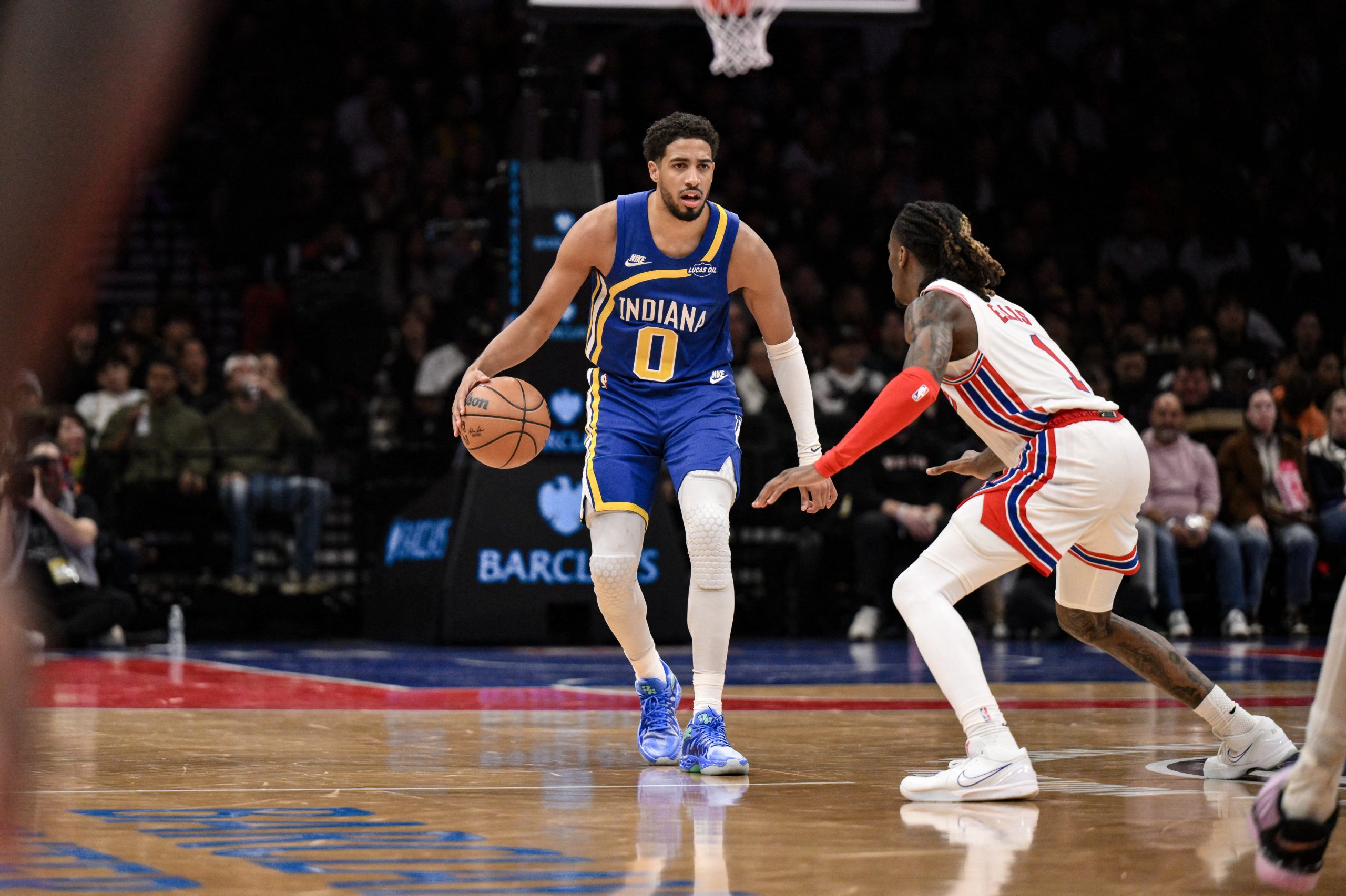
Oct 25, 2026; Brooklyn, New York, USA; Indiana Pacers guard Tyrese Haliburton (0) sets the play while defended by Brooklyn Nets guard Keon Ellis (1) during the second half at Barclays Center. Mandatory Credit: John Jones-Imagn Images
The numbers were encouraging. The implications for Indiana were bigger.
Tyrese Haliburton delivered
24 points and 10 assists
as the Pacers defeated Brooklyn
136–109 on Sunday, offering an early reminder of how much their offense changes when its primary creator can both organize possessions and finish them.
For a player returning after a torn right Achilles tendon cost him the entire 2025–26 season, this was a meaningful performance. Haliburton scored 20 of his 24 points after halftime, helping Indiana turn a competitive opening into a convincing victory.
It was an encouraging step, with the usual limits attached to one October game. Brooklyn cannot answer every question about Indiana’s ceiling, and a productive night cannot establish that every physical challenge of Haliburton’s comeback is behind him.
But the basketball significance was clear: Indiana has a different range of offensive possibilities when Haliburton is directing the action.
Haliburton Gives Indiana Purpose at Speed
Pace is often discussed as though it simply means running faster.
For Indiana, the more valuable version involves recognizing an advantage before the defense can remove it. A teammate gets ahead of the ball. A defender loses track of a shooter. A big man retreats toward the basket and leaves space elsewhere.
Haliburton’s value
is his ability to identify those situations and deliver the ball while the opening still exists.
That changes the responsibility of everyone around him. Wings have a reason to sprint. Big men can run toward the rim knowing an early pass is possible. Shooters can occupy space away from the ball rather than coming toward it to help manufacture an offense.
His presence also makes a fast team more organized. Indiana can push for an immediate opportunity while retaining the ability to move into another action if the first chance disappears.
That balance matters. Speed without recognition can create rushed shots and turnovers. Haliburton gives the Pacers a player whose passing can turn movement into a useful possession.
His Scoring Makes the Passing More Dangerous
Against Brooklyn, Haliburton made
eight of 13 shots, including
four of seven three-pointers, and finished with just
two turnovers
alongside his 10 assists.
The shooting is central to the larger offensive picture.
A defense that respects his passing but feels comfortable conceding his shot can retreat into passing lanes. Defenders can stay closer to cutters and rollers, forcing him to prove he will score.
When Haliburton is a credible scoring threat, that calculation becomes more difficult.
The defender guarding the ball must remain engaged. The opposing big man has less freedom to sit back. Help defenders must decide whether stepping toward Haliburton is worth creating space for someone else.
This is the tactical value of a night like Sunday. His scoring and passing reinforce each other. The shot draws attention; the pass punishes where that attention goes.
Indiana does not need four made threes from him every game. It does need opponents to believe giving him space carries a cost.
The Whole Offense Benefits From an Earlier Advantage
Indiana’s team production reflected more than one player finding his shot.
The Pacers finished with
34 assists, made
21 three-pointers
and shot
57.6% from the field
against the Nets.
Those numbers should not all be credited to Haliburton. Teammates still have to make shots, deliver the next pass and execute their own assignments.
His influence is that he can make those jobs simpler.
A player receiving the ball against a moving defense has a different task from one catching it against five set defenders. The first may only need to shoot, drive through an opening or make an immediate pass. The second may have to create the entire advantage himself.
Haliburton helps Indiana generate more of the first situation.
That is particularly important over a long season. An offense becomes more dependable when several players can contribute through actions that suit them, rather than repeatedly asking someone to manufacture a difficult attempt late in the clock.
The Dunk Was a Moment to Enjoy, Not a Medical Verdict
Haliburton’s third-quarter fast-break dunk supplied the night’s most memorable image. It was a striking moment in a comeback that has required considerable patience.
It also deserves the right interpretation.
Fans can enjoy the confidence and spontaneity of that play without treating it as a complete assessment of his recovery. One explosive movement cannot tell anyone how a player will respond to repeated games, fatigue, contact and a demanding travel schedule.
The more useful basketball questions extend beyond the highlight.
Can he consistently create separation? Can he change direction effectively late in a game? Does his decision-making remain sharp as the workload accumulates? Can he maintain his influence on nights when the jumper is less reliable?
Those answers will develop through a larger body of work.
Sunday provided a positive example. It did not eliminate the need to keep watching.
Monday Added Perspective Without Erasing the Progress
Indiana’s next game supplied an immediate reminder that Haliburton’s production and the team’s results will not always move together.
The Pacers lost
110–102 at Milwaukee on Monday, despite Haliburton contributing
22 points and nine assists.
That result does not undo what he showed in Brooklyn. It reinforces the distinction between getting an important player back and building a consistently successful team around him.
Haliburton can improve the quality of Indiana’s offense. He cannot independently settle every defensive possession, secure every rebound or guarantee that teammates convert the opportunities available to them.
For the Pacers, the next stage is making his influence part of a more complete performance.
Indiana Has Its Offensive Organizer Back
The strongest reason for optimism is the range of decisions Haliburton makes possible.
He can advance the ball before the defense settles, make defenders respect his own scoring and find teammates as coverage shifts. Those skills can give Indiana pace with purpose and spacing that produces actual opportunities.
Brooklyn offered an encouraging glimpse of that combination.
The Pacers
should take confidence from it while allowing the comeback to unfold over time. Haliburton does not have to prove everything in one night. He needs to keep adding productive performances, adapting to the workload and helping Indiana establish a more reliable identity.
His return gives the Pacers a clearer way to play. Turning that into sustained winning remains the work ahead.
New Users – Get $350 in Bonus Bets when you wager $5 for 7 days
T&Cs apply
4.6/5
Gambling Problem? Call 1-800-GAMBLER or 1-800-MY-RESET. Call 1-888-789-7777 or visit ccpgg.org/chat (CT). Hope is here. GamblingHelpLineMA.org or call (800) 327-5050 for 24/7 support (MA). Visit www.mdgamblinghelp.org (MD). Call 1-877-8HOPE-NY or text HOPENY (NY). 21+ (18+ DC, WY) and present in select states (for KS, in affiliation with Kansas Star Casino). Find online real money wagering only. Min $5 wager required for 7 consecutive days. $5 free play credit. Bonus issued as non-withdrawable bonus with cash withdrawable bonus with cash withdrawable. Bonus bets which expire 7 days after receipt. Restrictions apply. See terms at sportsbook.fanduel.com. Call 1-877-770-7867 (LA).
Get Up to $1,000 Back in Bonus Bets Over Your First 10 Days
T&Cs apply
4.5/5
Gambling problem? Call 1-800-GAMBLER or 1-800-MY-RESET (Available in the US) 877-8-HOPENY or text HOPENY (467369) (NY) 1-800-327-5050 (MA), 1-800-BETS-OFF (IA), 21+ only. Please Gamble Responsibly. Visit mdgamblinghelp.org (MD). See BetMGM.com for Terms. New Player Offer for new players only. Subject to eligibility requirements. Bonus bets are non-withdrawable. In partnership with Kansas Crossing Casino and Hotel. This promotional offer is not available in NJ, MA, MI, NV, NY, ON, PA, PR, and WV.
New DraftKings Customers: Bet $5, Get $200 + 3 Months of NBA League Pass!
T&Cs apply
4.5/5
GAMBLING PROBLEM? CALL 1-800-GAMBLER or 1-800-MY-RESET, (800) 327-5050 or visit gamblinghelplinema.org (MA). Please Gamble Responsibly. 888-789-7777/visit ccpg.org (CT), or visit www.mdgamblinghelp.org (MD), 1-800-981-0023 (PR). 21+ and present in most states. (18+ DC/NH/PR/WY). Void in CAN. Eligibility restrictions apply. On behalf of Boot Hill Casino (KS). Pass-thru of per wager tax may apply in IL. 1 per new Sportsbook customer. $5+ first-time bet req. Max. $200 issued as non-withdrawable Bonus Bets. Stake removed from payout. Reward issued as $50 in Bonus Bets every 7 days via click-to-claim for 21 days. Bonus Bets and click-to-claims expire 7 days (168hrs) after issuance. Terms: dkng.co/offer. Get 1 promo code to redeem a 3-month NBA League Pass subscription, complimentary of DraftKings. Subscription auto-renews monthly at then-current price (currently $16.99/mo); cancel anytime. Terms, restrictions, and eligibility requirements apply. Redeem League Pass by 12/19/26 at 11:59 PM ET. Addt’l terms: support.watch.nba.com/hc/en-us/articles/9165532876183-League-Pass-Terms-of-Use_. Ends 11/29/26 at 11:59 PM ET. Sponsored by DK.
Must be 21+. GAMBLING PROBLEM? CALL 1-800-GAMBLER OR CALL 1-800-MY-RESET, www.mdgamblinghelp.org (MD), (800)-327-5050 or gamblinghelplinema.org (MA), Call (877)8-HOPENY or text HOPENY (467369) (NY), (888) 789-7777 or ccpg.org (CT), morethanagame.nc.gov (NC), 1800gambler.net (WV)
Bet $1 and get double the winnings up to $25 for your next 10 bets
T&Cs apply
4.4/5
21+ New users only. Must register using eligible promo code. First bet after registration must qualify. Max. Bonus Bet: $1,000. Bonus Bet expires 14 days after receipt. Void where prohibited. See Caesars.com/promos for full terms. Gambling Problem? 1-800-GAMBLER (1-800-426-2537)
21+ and present in OH. Gambling Problem? Call 1-800-GAMBLER.
This site is using
Cloudflare
and adheres to the
Google Safe Browsing Program. We adapted
Google's Privacy Guidelines
to keep your data safe at all times.
Close
Ready to Win Big? Join the Elite with Our Sports Betting Deals!
FanDuel Promo
New Users – Get $350 in Bonus Bets when you wager $5 for 7 days
Our Favorite
T&Cs and 21+ apply
Gambling Problem? Call 1-800-GAMBLER or 1-800-MY-RESET. Call 1-888-789-7777 or visit ccpgg.org/chat (CT). Hope is here. GamblingHelpLineMA.org or call (800) 327-5050 for 24/7 support (MA). Visit www.mdgamblinghelp.org (MD). Call 1-877-8HOPE-NY or text HOPENY (NY). 21+ (18+ DC, WY) and present in select states (for KS, in affiliation with Kansas Star Casino). Find online real money wagering only. Min $5 wager required for 7 consecutive days. $5 free play credit. Bonus issued as non-withdrawable bonus with cash withdrawable bonus with cash withdrawable. Bonus bets which expire 7 days after receipt. Restrictions apply. See terms at sportsbook.fanduel.com. Call 1-877-770-7867 (LA).
Code:
Open FanDuel
Get Bonus
BetMGM Promo
Get Up to $1,000 Back in Bonus Bets Over Your First 10 Days
Best Slots
T&Cs and 21+ apply
Gambling problem? Call 1-800-GAMBLER or 1-800-MY-RESET (Available in the US) 877-8-HOPENY or text HOPENY (467369) (NY) 1-800-327-5050 (MA), 1-800-BETS-OFF (IA), 21+ only. Please Gamble Responsibly. Visit mdgamblinghelp.org (MD). See BetMGM.com for Terms. New Player Offer for new players only. Subject to eligibility requirements. Bonus bets are non-withdrawable. In partnership with Kansas Crossing Casino and Hotel. This promotional offer is not available in NJ, MA, MI, NV, NY, ON, PA, PR, and WV.
Code:
Open BetMGM
Get Bonus
DraftKings Promo
New DraftKings Customers: Bet $5, Get $200 + 3 Months of NBA League Pass!
Newcomer
T&Cs and 21+ apply
GAMBLING PROBLEM? CALL 1-800-GAMBLER or 1-800-MY-RESET, (800) 327-5050 or visit gamblinghelplinema.org (MA). Please Gamble Responsibly. 888-789-7777/visit ccpg.org (CT), or visit www.mdgamblinghelp.org (MD), 1-800-981-0023 (PR). 21+ and present in most states. (18+ DC/NH/PR/WY). Void in CAN. Eligibility restrictions apply. On behalf of Boot Hill Casino (KS). Pass-thru of per wager tax may apply in IL. 1 per new Sportsbook customer. $5+ first-time bet req. Max. $200 issued as non-withdrawable Bonus Bets. Stake removed from payout. Reward issued as $50 in Bonus Bets every 7 days via click-to-claim for 21 days. Bonus Bets and click-to-claims expire 7 days (168hrs) after issuance. Terms: dkng.co/offer. Get 1 promo code to redeem a 3-month NBA League Pass subscription, complimentary of DraftKings. Subscription auto-renews monthly at then-current price (currently $16.99/mo); cancel anytime. Terms, restrictions, and eligibility requirements apply. Redeem League Pass by 12/19/26 at 11:59 PM ET. Addt’l terms: support.watch.nba.com/hc/en-us/articles/9165532876183-League-Pass-Terms-of-Use_. Ends 11/29/26 at 11:59 PM ET. Sponsored by DK.
Code:
Open DraftKings
Get Bonus
Find out what the legends have to say about sports this week....
New Users – Get $350 in Bonus Bets when you wager $5 for 7 days
Gambling Problem? Call 1-800-GAMBLER or 1-800-MY-RESET. Call 1-888-789-7777 or visit ccpgg.org/chat (CT). Hope is here. GamblingHelpLineMA.org or call (800) 327-5050 for 24/7 support (MA). Visit www.mdgamblinghelp.org (MD). Call 1-877-8HOPE-NY or text HOPENY (NY). 21+ (18+ DC, WY) and present in select states (for KS, in affiliation with Kansas Star Casino). Find online real money wagering only. Min $5 wager required for 7 consecutive days. $5 free play credit. Bonus issued as non-withdrawable bonus with cash withdrawable bonus with cash withdrawable. Bonus bets which expire 7 days after receipt. Restrictions apply. See terms at sportsbook.fanduel.com. Call 1-877-770-7867 (LA).