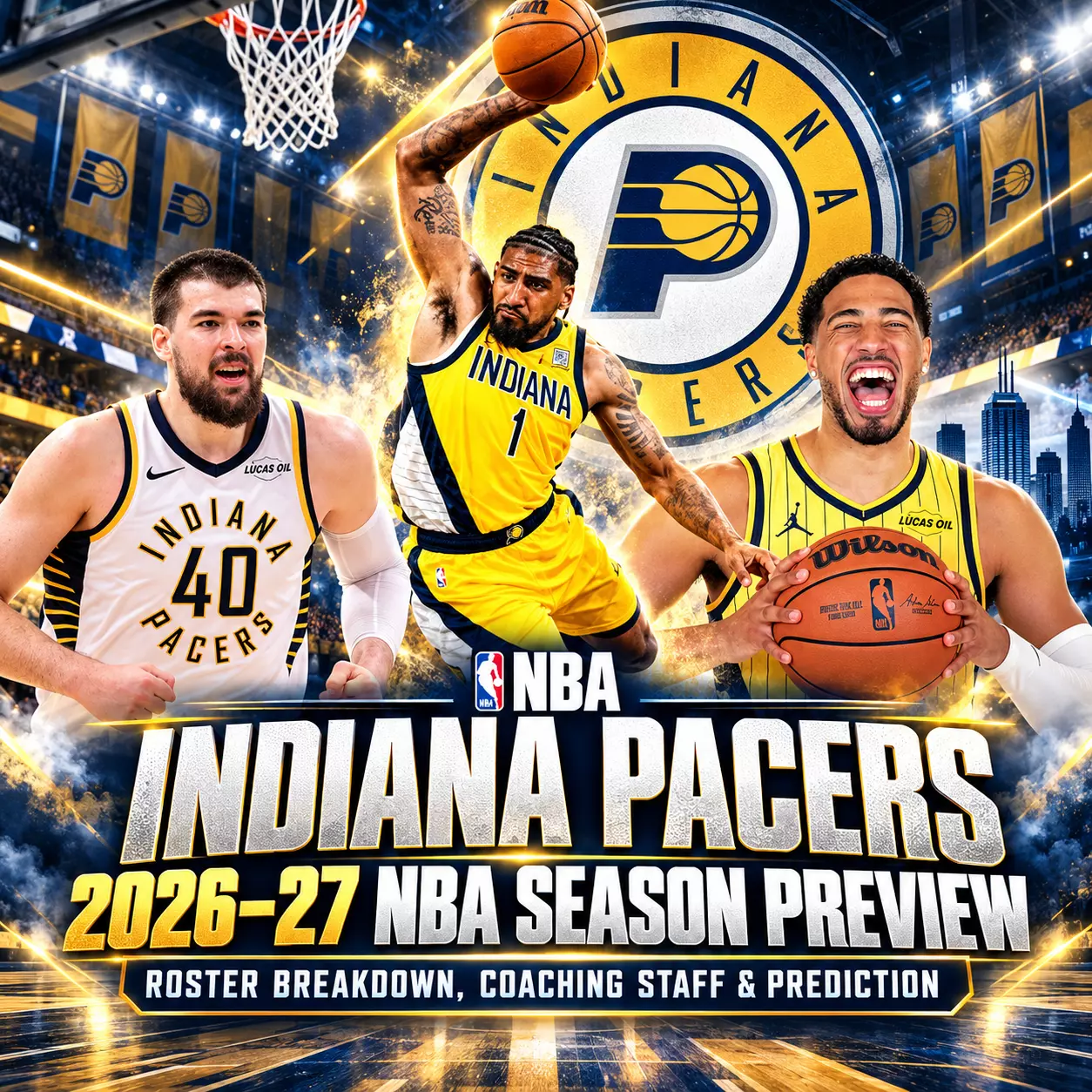
NBA Indiana Pacers 2026–27 NBA Season Preview: Roster Breakdown, Coaching Staff & Prediction
The Indiana Pacers enter the 2026–27 NBA season as one of the Eastern Conference’s most intriguing turnaround candidates.
Indiana finished just
19–63 last season and 14th in the Eastern Conference, but the record requires context. Tyrese Haliburton missed the entire season recovering from the torn Achilles he suffered during Game 7 of the 2025 NBA Finals. With Haliburton fully cleared for training camp and expected to be available when the season begins, the Pacers essentially get their franchise player back after spending an entire year without him.
The roster surrounding Haliburton still includes Pascal Siakam, Andrew Nembhard, Aaron Nesmith, T.J. McConnell and Obi Toppin from the team that reached the 2025 NBA Finals. Indiana has also added a legitimate rebounding and interior presence in Ivica Zubac along with veteran depth from Kelly Oubre Jr. and Larry Nance Jr.
The result should look considerably different from the team that struggled throughout 2025–26.
Coaching Staff
Head Coach: Rick Carlisle
Rick Carlisle remains the centerpiece of Indiana’s coaching staff. Few coaches in the NBA are better suited to the Pacers’ personnel and preferred style of basketball. Carlisle wants his teams to play quickly, move the ball and make defenses defend multiple actions during the same possession.
Even during last season’s struggles, Indiana remained committed to ball movement. The Pacers averaged
27.7 assists per game, ranking 12th in the league despite missing their best passer for the entire season. Their offense finished only 27th at 112.4 points per game, but Haliburton’s return should dramatically improve the team’s ability to convert that movement into efficient scoring.
Carlisle’s lead assistant is
Lloyd Pierce, with
Jim Boylen and Jenny Boucek
also serving as assistant coaches. Jannero Pargo, Maurice Baker and Isaac Yacob work in player development.
Carlisle’s biggest challenge will be balancing expectations with Haliburton’s recovery. Haliburton has been cleared for camp, but Indiana could manage his workload early in the year, particularly during back-to-back games.
Centers
Ivica Zubac
The biggest difference between this Pacers roster and the team that reached the 2025 Finals is at center.
Indiana acquired
Ivica Zubac
from the Los Angeles Clippers at the 2026 trade deadline in a deal that sent Bennedict Mathurin and Isaiah Jackson to Los Angeles. Zubac averaged
14.1 points and 10.6 rebounds
across 48 games last season and is expected to open the year as Indiana’s starting center.
Zubac gives Indiana something it has occasionally lacked: a powerful traditional center who can control the defensive glass, protect the paint and create pressure around the basket.
His potential pick-and-roll partnership with Haliburton should be particularly interesting. Haliburton excels at manipulating defenders and creating opportunities for rolling big men. Zubac doesn’t need offensive plays called for him to have an impact.
Indiana may also benefit defensively. Last year’s Pacers ranked only 25th in rebounding at 41.9 per game while allowing 120.4 points per contest. Zubac should immediately help stabilize the interior.
Jay Huff
Jay Huff
gives Carlisle a completely different style at backup center. At 7-foot-1, Huff can protect the rim while providing more perimeter shooting than Zubac.
That contrast gives Indiana flexibility. Carlisle can play traditionally with Zubac or spread the floor with Huff depending on the matchup.
Larry Nance Jr.
The veteran
Larry Nance Jr.
can play either power forward or small-ball center. Indiana signed him during the offseason, adding another experienced defender, rebounder and versatile frontcourt piece.
Training-camp big men
Keba Keita and Rienk Mast
also give Indiana additional depth and competition heading into the preseason.
Center outlook:
Significantly improved. Zubac could become one of the most important additions Indiana has made in years because his skill set complements the Pacers’ perimeter-oriented offense.
Forwards
Pascal Siakam
Pascal Siakam
remains Indiana’s most dependable frontcourt scorer and arguably the player best equipped to carry the offense whenever Haliburton sits.
Siakam averaged
24.0 points, 6.6 rebounds and 3.8 assists
last season. His combination of transition scoring, post play, mid-range creation and versatility makes him exceptionally valuable alongside Haliburton.
The Pacers don’t need Siakam to dominate the basketball every night. They need him to punish mismatches, attack switches and provide consistent offense when opponents slow Indiana’s transition game.
A Haliburton-Siakam-Zubac core gives Indiana three dramatically different offensive weapons.
Aaron Nesmith
Aaron Nesmith
should remain one of the Pacers’ most important two-way players.
His ability to defend wings while spacing the floor allows Carlisle to keep offensive lineups balanced. When Haliburton is creating open perimeter opportunities, Nesmith becomes especially dangerous as a catch-and-shoot option.
Indiana will need Nesmith’s shooting to rebound after an inconsistent 2025–26 season. NBA.com’s season preview specifically highlighted improved shooting as an important factor in Indiana restoring its offense.
Jarace Walker
Jarace Walker
could be the breakout player on this roster.
Walker took advantage of increased playing time last season and averaged career highs of
11.6 points, 5.1 rebounds and 2.5 assists
while shooting 37.4 percent from three-point range. After the All-Star break, he increased his production to 14.4 points and 6.8 rebounds while making 39.2 percent of his threes over his final 22 games.
At 23 years old, Walker could give Carlisle another versatile forward capable of shooting, rebounding, defending and handling the basketball.
Obi Toppin
Obi Toppin
remains an ideal player for Indiana’s transition-heavy style.
Haliburton’s return should help Toppin as much as almost anyone on the roster. His athleticism, ability to run the floor and cutting instincts fit perfectly alongside an elite passer.
Toppin can also give Indiana energy and scoring without requiring heavy usage.
Kelly Oubre Jr.
The addition of
Kelly Oubre Jr.
gives the Pacers another proven scorer on the wing.
Oubre averaged
14.1 points and 5.0 rebounds
last season with Philadelphia before signing a two-year deal with Indiana.
He adds athleticism, scoring and defensive length to a second unit that could be among the deeper groups in the East.
Larry Nance Jr., Kobe Brown, Jalen Slawson and veteran James Johnson provide additional frontcourt depth.
Forward outlook:
Deep, athletic and versatile. Siakam is the star, but Walker’s continued development could dramatically raise Indiana’s ceiling.
Guards
Tyrese Haliburton
Everything starts with
Tyrese Haliburton.
Before his Achilles injury, Haliburton had established himself as one of the NBA’s premier playmakers. During the 2024–25 regular season he averaged
18.6 points and 9.2 assists while shooting 38.8 percent from three-point range.
His presence changes the geometry of Indiana’s offense.
Haliburton pushes the pace, advances the ball quickly and consistently creates high-percentage opportunities before defenses can get organized. His ability to shoot from well beyond the three-point line also stretches defenses vertically and horizontally.
Indiana does not necessarily need Haliburton to immediately return to peak form. If he can gradually work his way back while staying healthy, the Pacers have enough secondary creation to keep pressure off him.
Andrew Nembhard
Andrew Nembhard
may have benefited more than anyone from Haliburton’s absence.
Nembhard averaged career highs of
16.9 points and 7.7 assists
last season, proving he can handle significantly more offensive responsibility.
Now Carlisle has two legitimate playmakers in the starting backcourt.
Nembhard can initiate the offense when Haliburton plays away from the ball, defend opposing guards and run the team whenever Haliburton rests.
That development makes Indiana considerably more difficult to defend than it was before Haliburton’s injury.
T.J. McConnell
Few backup point guards influence games quite like
T.J. McConnell.
McConnell averaged 9.4 points and 5.1 assists last season and continues to provide pressure at the point of attack, change of pace, ball handling and leadership.
A second unit featuring McConnell, Oubre, Toppin and Walker could create chaos in transition.
Guard Depth
Ben Sheppard
provides size, shooting and defense.
Johnny Furphy
remains an intriguing developmental wing at 6-foot-8, while
Quenton Jackson
provides additional guard depth.
Rookie
Braden Smith, acquired after being selected 38th overall in the 2026 NBA Draft, is another player worth monitoring. The former Purdue point guard gives Indiana another natural distributor to develop behind Haliburton and McConnell.
Guard outlook:
Potentially one of Indiana’s biggest strengths. Haliburton’s health is the key, but Nembhard’s development means Indiana no longer has to rely exclusively on its star point guard for playmaking.
Projected Starting Lineup
PG — Tyrese Haliburton SG — Andrew Nembhard SF — Aaron Nesmith PF — Pascal Siakam C — Ivica Zubac
That lineup offers shooting, passing, defensive versatility and significantly more rebounding than some recent Pacers teams.
The bench could include T.J. McConnell, Kelly Oubre Jr., Obi Toppin, Jarace Walker, Larry Nance Jr., Jay Huff and Ben Sheppard, giving Carlisle numerous ways to construct his rotation.
Biggest Question: How Close Is Haliburton to His Previous Form?
Indiana’s season ultimately comes down to one question.
How close is Haliburton to the player who led Indiana to the NBA Finals?
He has been cleared to participate in training camp and is expected to be available at the beginning of the season, but recovering from an Achilles rupture is a significant challenge. Indiana would be wise to manage his workload rather than chasing short-term wins in October and November.
The encouraging part is that Indiana should not need Haliburton to carry an enormous workload.
Siakam can score. Nembhard can create. McConnell can run the second unit. Zubac gives Indiana a reliable interior option. Walker appears ready for a larger role.
That depth should allow Carlisle to bring his star along carefully.
Expecting Indiana to immediately return to the NBA Finals would be aggressive considering Haliburton’s long layoff, but expecting another 19-win season would be equally unrealistic.
This remains a roster containing many of the players who reached Game 7 of the 2025 NBA Finals. Nembhard and Walker are better players now than they were during that run, Zubac strengthens the center position, and Oubre and Nance add experienced depth.
Indiana’s offense should return toward the league’s upper tier if Haliburton remains healthy. The bigger question is defense. Zubac should improve the rebounding and interior defense, but the Pacers will need consistent perimeter resistance from Nembhard, Nesmith and their wing rotation.
A 47-win season would represent a massive 28-win improvement but would also reflect how unusual the injury circumstances surrounding last year’s 19–63 finish were.
Conclusion
The Indiana Pacers may be one of the NBA’s most difficult teams to evaluate entering 2026–27.
Their previous season says they were one of basketball’s worst teams.
Their roster says something completely different.
Haliburton returns to a team featuring Siakam, Nembhard, Nesmith, McConnell and Toppin — major pieces from the 2025 Eastern Conference championship roster. Zubac gives them an established starting center. Walker appears ready to take another step. Oubre and Nance strengthen an already deep rotation.
Most importantly, Rick Carlisle once again has the type of roster that fits his preferred style: multiple ball handlers, athletic forwards, shooters and players capable of running.
Indiana’s ceiling will depend on Haliburton’s health, but the Pacers have enough talent that they should return to the postseason conversation immediately.
Prediction: Indiana finishes 47–35, earns a top-six Eastern Conference playoff seed and has enough depth and postseason experience to reach the second round — with a higher ceiling if Haliburton returns to his pre-injury form.
New Users – Get $350 in Bonus Bets when you wager $5 for 7 days
T&Cs apply
4.6/5
Gambling Problem? Call 1-800-GAMBLER or 1-800-MY-RESET. Call 1-888-789-7777 or visit ccpgg.org/chat (CT). Hope is here. GamblingHelpLineMA.org or call (800) 327-5050 for 24/7 support (MA). Visit www.mdgamblinghelp.org (MD). Call 1-877-8HOPE-NY or text HOPENY (NY). 21+ (18+ DC, WY) and present in select states (for KS, in affiliation with Kansas Star Casino). Find online real money wagering only. Min $5 wager required for 7 consecutive days. $5 free play credit. Bonus issued as non-withdrawable bonus with cash withdrawable bonus with cash withdrawable. Bonus bets which expire 7 days after receipt. Restrictions apply. See terms at sportsbook.fanduel.com. Call 1-877-770-7867 (LA).
Up To $1500 in Bonus Bets Paid Back if your First Bet Does Not Win
T&Cs apply
4.5/5
Gambling problem? Call 1-800-GAMBLER or 1-800-MY-RESET (Available in the US) 877-8-HOPENY or text HOPENY (467369) (NY) 1-800-327-5050 (MA), 1-800-BETS-OFF (IA), 1-800-981-0023 (PR). 21+ only. Please Gamble Responsibly. See BetMGM.com for Terms. First Bet Offer for new customers only (if applicable). Subject to eligibility requirements. Bonus bets are non-withdrawable. In partnership with Kansas Crossing Casino and Hotel. Promotional offers not available in Mississippi, Massachusetts, New York, Ontario, or Puerto Rico.
New DraftKings Customers: Bet $5, Get $200 + 3 Months of NBA League Pass!
T&Cs apply
4.5/5
GAMBLING PROBLEM? CALL 1-800-GAMBLER or 1-800-MY-RESET, (800) 327-5050 or visit gamblinghelplinema.org (MA). Please Gamble Responsibly. 888-789-7777/visit ccpg.org (CT), or visit www.mdgamblinghelp.org (MD), 1-800-981-0023 (PR). 21+ and present in most states. (18+ DC/NH/PR/WY). Void in CAN. Eligibility restrictions apply. On behalf of Boot Hill Casino (KS). Pass-thru of per wager tax may apply in IL. 1 per new Sportsbook customer. $5+ first-time bet req. Max. $200 issued as non-withdrawable Bonus Bets. Stake removed from payout. Reward issued as $50 in Bonus Bets every 7 days via click-to-claim for 21 days. Bonus Bets and click-to-claims expire 7 days (168hrs) after issuance. Terms: dkng.co/offer. Get 1 promo code to redeem a 3-month NBA League Pass subscription, complimentary of DraftKings. Subscription auto-renews monthly at then-current price (currently $16.99/mo); cancel anytime. Terms, restrictions, and eligibility requirements apply. Redeem League Pass by 12/19/26 at 11:59 PM ET. Addt’l terms: support.watch.nba.com/hc/en-us/articles/9165532876183-League-Pass-Terms-of-Use_. Ends 11/29/26 at 11:59 PM ET. Sponsored by DK.
Must be 21+. GAMBLING PROBLEM? CALL 1-800-GAMBLER OR CALL 1-800-MY-RESET, www.mdgamblinghelp.org (MD), (800)-327-5050 or gamblinghelplinema.org (MA), Call (877)8-HOPENY or text HOPENY (467369) (NY), (888) 789-7777 or ccpg.org (CT), morethanagame.nc.gov (NC), 1800gambler.net (WV)
Bet $1 and get double the winnings up to $25 for your next 10 bets
T&Cs apply
4.4/5
21+ New users only. Must register using eligible promo code. First bet after registration must qualify. Max. Bonus Bet: $1,000. Bonus Bet expires 14 days after receipt. Void where prohibited. See Caesars.com/promos for full terms. Gambling Problem? 1-800-GAMBLER (1-800-426-2537)
21+ and present in OH. Gambling Problem? Call 1-800-GAMBLER.
This site is using
Cloudflare
and adheres to the
Google Safe Browsing Program. We adapted
Google's Privacy Guidelines
to keep your data safe at all times.
Close
Ready to Win Big? Join the Elite with Our Sports Betting Deals!
FanDuel Promo
New Users – Get $350 in Bonus Bets when you wager $5 for 7 days
Our Favorite
T&Cs and 21+ apply
Gambling Problem? Call 1-800-GAMBLER or 1-800-MY-RESET. Call 1-888-789-7777 or visit ccpgg.org/chat (CT). Hope is here. GamblingHelpLineMA.org or call (800) 327-5050 for 24/7 support (MA). Visit www.mdgamblinghelp.org (MD). Call 1-877-8HOPE-NY or text HOPENY (NY). 21+ (18+ DC, WY) and present in select states (for KS, in affiliation with Kansas Star Casino). Find online real money wagering only. Min $5 wager required for 7 consecutive days. $5 free play credit. Bonus issued as non-withdrawable bonus with cash withdrawable bonus with cash withdrawable. Bonus bets which expire 7 days after receipt. Restrictions apply. See terms at sportsbook.fanduel.com. Call 1-877-770-7867 (LA).
Code:
Open FanDuel
Get Bonus
BetMGM Promo
Up To $1500 in Bonus Bets Paid Back if your First Bet Does Not Win
Best Slots
T&Cs and 21+ apply
Gambling problem? Call 1-800-GAMBLER or 1-800-MY-RESET (Available in the US) 877-8-HOPENY or text HOPENY (467369) (NY) 1-800-327-5050 (MA), 1-800-BETS-OFF (IA), 1-800-981-0023 (PR). 21+ only. Please Gamble Responsibly. See BetMGM.com for Terms. First Bet Offer for new customers only (if applicable). Subject to eligibility requirements. Bonus bets are non-withdrawable. In partnership with Kansas Crossing Casino and Hotel. Promotional offers not available in Mississippi, Massachusetts, New York, Ontario, or Puerto Rico.
Code:
Open BetMGM
Get Bonus
DraftKings Promo
New DraftKings Customers: Bet $5, Get $200 + 3 Months of NBA League Pass!
Newcomer
T&Cs and 21+ apply
GAMBLING PROBLEM? CALL 1-800-GAMBLER or 1-800-MY-RESET, (800) 327-5050 or visit gamblinghelplinema.org (MA). Please Gamble Responsibly. 888-789-7777/visit ccpg.org (CT), or visit www.mdgamblinghelp.org (MD), 1-800-981-0023 (PR). 21+ and present in most states. (18+ DC/NH/PR/WY). Void in CAN. Eligibility restrictions apply. On behalf of Boot Hill Casino (KS). Pass-thru of per wager tax may apply in IL. 1 per new Sportsbook customer. $5+ first-time bet req. Max. $200 issued as non-withdrawable Bonus Bets. Stake removed from payout. Reward issued as $50 in Bonus Bets every 7 days via click-to-claim for 21 days. Bonus Bets and click-to-claims expire 7 days (168hrs) after issuance. Terms: dkng.co/offer. Get 1 promo code to redeem a 3-month NBA League Pass subscription, complimentary of DraftKings. Subscription auto-renews monthly at then-current price (currently $16.99/mo); cancel anytime. Terms, restrictions, and eligibility requirements apply. Redeem League Pass by 12/19/26 at 11:59 PM ET. Addt’l terms: support.watch.nba.com/hc/en-us/articles/9165532876183-League-Pass-Terms-of-Use_. Ends 11/29/26 at 11:59 PM ET. Sponsored by DK.
Code:
Open DraftKings
Get Bonus
Find out what the legends have to say about sports this week....
New Users – Get $350 in Bonus Bets when you wager $5 for 7 days
Gambling Problem? Call 1-800-GAMBLER or 1-800-MY-RESET. Call 1-888-789-7777 or visit ccpgg.org/chat (CT). Hope is here. GamblingHelpLineMA.org or call (800) 327-5050 for 24/7 support (MA). Visit www.mdgamblinghelp.org (MD). Call 1-877-8HOPE-NY or text HOPENY (NY). 21+ (18+ DC, WY) and present in select states (for KS, in affiliation with Kansas Star Casino). Find online real money wagering only. Min $5 wager required for 7 consecutive days. $5 free play credit. Bonus issued as non-withdrawable bonus with cash withdrawable bonus with cash withdrawable. Bonus bets which expire 7 days after receipt. Restrictions apply. See terms at sportsbook.fanduel.com. Call 1-877-770-7867 (LA).