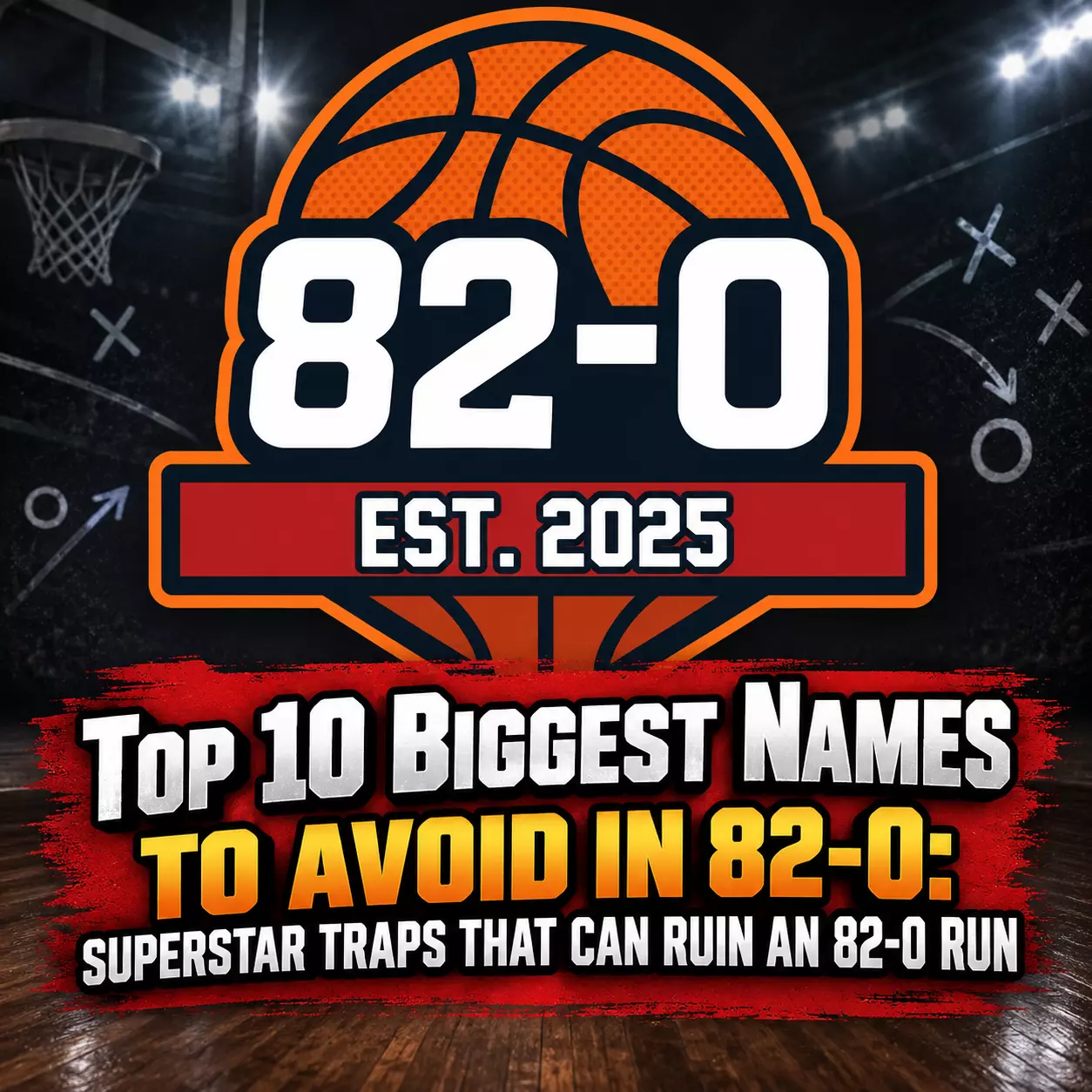
Top 10 Biggest Names to Avoid in 82-0: Superstar Traps That Can Ruin an 82-0 Run
One of the hardest habits to break in
82-0
is drafting based on reputation.
You see Stephen Curry.
You take Stephen Curry.
You see Kobe Bryant.
You take Kobe Bryant.
You see Kevin Durant.
Decision over.
Except that’s not necessarily how 82-0 works.
The game’s official explanation says its simulation focuses on five raw statistical categories:
Points, rebounds, assists, steals and blocks.
It doesn’t give extra credit for championships, shooting efficiency, three-point gravity, clutch reputation or cultural impact.
That creates some enormous traps.
The following players are all basketball legends. Some remain very good 82-0 selections.
But they’re also
10 of the biggest names you should avoid automatically drafting.
1. Stephen Curry
The Ultimate 82-0 Reputation Trap
This might be the most controversial name on the list.
Stephen Curry is arguably the greatest shooter basketball has ever seen.
Unfortunately, 82-0 doesn’t appear to award an extra category for being the greatest shooter ever.
Why You Should Avoid Him
Curry’s biggest advantage in actual basketball—three-point shooting and the defensive attention his shooting creates—isn’t one of the five categories the game says it uses.
Meanwhile, other guards can produce enormous numbers in:
Rebounds
Assists
Steals
Russell Westbrook can give you double-digit rebounds and assists.
Oscar Robertson can give you nearly a triple-double.
Luka Dončić can provide around 30 points with nine rebounds and nine assists.
Curry simply has a harder time matching that total raw-stat production.
Players discussing 82-0 have specifically pointed to Curry as a superstar who doesn’t help nearly as much as expected under this particular simulation.
When You Should Take Him
Take Curry when your roster already dominates rebounds and defensive statistics and you need scoring and assists.
But don’t take him merely because you see his name.
Trap Level: 10/10
2. Kobe Bryant
Kobe may be the easiest player to overvalue emotionally.
He’s one of basketball’s most famous players.
But 82-0 doesn’t measure Mamba Mentality.
Why You Should Avoid Him
The unofficial 82-0 Guide rates
2000s Lakers Kobe at 19.59, compared with
22.76 for Shaquille O’Neal
on the same team/decade combination.
Kobe’s approximate numbers:
28.2 PPG5.8 RPG5.3 APG1.7 SPG0.6 BPG
Those are excellent basketball numbers.
They’re just not elite 82-0 numbers compared with the game’s statistical monsters.
The 2010s Lakers version is an even bigger trap. The guide rates that Kobe combination only
B tier at 16.73, behind LeBron James, Dwight Howard and Pau Gasol on the same franchise/decade spin.
When You Should Take Him
Kobe still makes sense if SG is empty and your team already has huge rebounding and assists.
But:
2000s Lakers → take Shaq over Kobe in most situations.
2010s Lakers → definitely don’t automatically take Kobe.
Trap Level: 9.5/10
3. Kyrie Irving
Kyrie’s highlights can make him extremely tempting.
82-0 is less impressed.
Why You Should Avoid Him
For
2020s Brooklyn, the unofficial guide gives Kyrie an
18.57 value, behind:
James Harden — 22.82
and
Kevin Durant — 21.01.
For
2020s Dallas, Kyrie is rated just
17.66, compared with:
Luka Dončić — 24.14
and
Anthony Davis — 22.45.
That’s a huge difference.
Kyrie’s scoring is excellent, but he doesn’t produce the enormous rebounds, assists or defensive numbers that 82-0 rewards.
When You Should Take Him
If Luka, Harden or the stronger option can’t fit your remaining position, Kyrie becomes useful.
Otherwise, don’t let the name fool you.
Trap Level: 9/10
4. Allen Iverson
This one hurts.
Few players were more entertaining than Allen Iverson.
And approximately
30 points per game
sounds fantastic.
But look deeper.
The guide’s 2000s Philadelphia Iverson:
29.9 PPG3.9 RPG6.1 APG2.4 SPG0.2 BPG
Value:
19.77 — A Tier.
Why You Should Avoid Him
Iverson gives you scoring and steals.
But fewer than four rebounds and almost no blocks lower the total value.
Compare him with Washington Westbrook:
Westbrook sacrifices some scoring but gives you roughly:
11.5 rebounds and 11.7 assists.
That’s the kind of difference that matters in 82-0.
When You Should Take Him
If your roster is already stacked with Wilt-level rebounding and needs perimeter scoring and steals, Iverson can work.
He’s good.
He’s just not nearly as automatic as his reputation suggests.
Trap Level: 8.5/10
5. Chris Paul
Chris Paul is one of basketball’s greatest point guards.
But there is an important distinction between
great point guard
and
great 82-0 statistical profile.
Why You Should Avoid Him
The unofficial guide lists the 2010s New Orleans version of Chris Paul at approximately
17.46, only B tier.
On that franchise/decade combination, he sits well behind:
DeMarcus Cousins — 23.38
and
Anthony Davis — 21.04.
Paul gives you assists and steals.
But he doesn’t provide the massive rebounding totals that turn Westbrook, Oscar and Luka into elite 82-0 guards.
When You Should Take Him
If assists are your glaring weakness, Paul still has value.
But don’t pass on Cousins or Davis simply because CP3 is the bigger guard name.
Trap Level: 8/10
6. Kevin Durant
This requires an important disclaimer:
Kevin Durant is still a very good 82-0 player.
The trap is treating him like an automatic selection.
Why You Should Avoid Him
Look at several Durant versions.
OKC, 2010s: 20.62
Russell Westbrook on the same spin:
20.65
Practically identical.
Brooklyn Durant:
21.01
Brooklyn Harden:
22.82
Golden State Durant:
20.20.
Durant’s scoring is fantastic.
But 82-0 often favors players who sacrifice a few points while producing significantly more assists or rebounds.
When You Should Take Him
If your roster already has Westbrook, Oscar, Jokić or another massive assist producer, Durant’s scoring becomes extremely attractive.
The mistake isn’t taking Durant.
The mistake is
never considering the alternative.
Trap Level: 7.5/10
7. Tim Duncan
Tim Duncan may be the greatest power forward ever.
That’s exactly why he’s dangerous in 82-0.
People assume the answer must be Duncan.
Sometimes it isn’t.
Why You Should Avoid Him
The guide rates 2000s San Antonio Duncan:
20.92 — A+
with approximately:
21.4 PPG11.7 RPG3.3 APG0.8 SPG2.3 BPG.
Those are very good numbers.
But look at 1990s San Antonio:
David Robinson — 23.50
Tim Duncan — 20.69.
Robinson is the much stronger statistical selection on that particular spin.
There’s another problem.
Duncan is C/PF eligible.
Putting him at center can cost you the opportunity to land Wilt, Kareem or Jokić later.
When You Should Take Him
Put Duncan at PF if you take him.
And if the spin gives you prime David Robinson versus Duncan:
Take Robinson.
Trap Level: 7/10
8. Damian Lillard
Damian Lillard is another player whose real-world greatness is partially built around something 82-0 doesn’t fully reward:
elite long-range shooting.
Why You Should Avoid Him
Lillard provides points and assists.
But compared with the game’s elite PG options, he generally won’t produce:
10+ rebounds like Westbrook.
8-9 rebounds like Luka.
The massive all-around production of Giannis.
Or Oscar Robertson’s triple-double-level combination.
That makes him much more dependent on the other four players.
When You Should Take Him
If your team already has overwhelming rebounding and defensive statistics, Lillard’s scoring/playmaking can fit nicely.
But if you’re choosing between Dame and a triple-double-level guard:
Take the statistical monster.
Trap Level: 6.5/10
9. Carmelo Anthony
Carmelo Anthony illustrates one of the most important lessons in the entire game:
Scoring isn’t enough.
Why You Should Avoid Him
Melo was an elite scorer.
But his game wasn’t built around producing enormous assist, steal or block numbers.
In real basketball, an unstoppable 30-point scorer is priceless.
In 82-0, another player could score five fewer points while giving you:
Five more rebounds.
Five more assists.
Two more defensive statistics.
That second player may be considerably more valuable to the simulator.
When You Should Take Him
If your lineup already includes an elite center, rebound-heavy PF and huge-assist guard, Carmelo can fill a pure scoring role.
But he shouldn’t be one of your first foundational selections.
Trap Level: 6/10
10. Jayson Tatum
This is the modern-name trap.
Tatum is one of the biggest basketball stars of the 2020s.
He’s also good in 82-0.
But good isn’t the same as elite.
The current unofficial guide lists 2020s Boston Tatum at:
19.74 — A Tier
with approximately:
26.5 PPG8.5 RPG4.9 APG1.1 SPG0.5 BPG.
Why You Should Avoid Him
Those numbers are balanced.
But compare them with:
Giannis.
LeBron.
Luka.
Garnett.
McAdoo.
Even some forgotten older stars provide much larger statistical totals.
That’s why Tatum can feel stronger than he actually is inside the 82-0 formula.
When You Should Take Him
If you need SF/PF and the rest of your team is elite, Tatum is perfectly playable.
Just don’t confuse modern superstar status with S-tier 82-0 value.
Trap Level: 5.5/10
The Top 10 Biggest-Name Traps
My ranking:
1. Stephen Curry
2. Kobe Bryant
3. Kyrie Irving
4. Allen Iverson
5. Chris Paul
6. Kevin Durant
7. Tim Duncan
8. Damian Lillard
9. Carmelo Anthony
10. Jayson Tatum
Notice who’s
not
on the list.
Michael Jordan isn’t a trap because his scoring, steals, assists and rebounding make his best versions genuinely elite.
LeBron isn’t a trap because his all-around production and positional flexibility are enormously valuable.
Giannis isn’t a trap.
Jokić isn’t a trap.
And Wilt certainly isn’t a trap.
The current unofficial guide has Warriors 1960s Wilt at
31.96, the highest value in its database, and community strategy discussions repeatedly describe building around Wilt as one of the strongest paths toward perfection.
Conclusion: Don’t Let the Name Make the Pick
82-0 teaches a strange basketball lesson.
Sometimes
Stephen Curry isn’t the answer.
Sometimes you should choose Russell Westbrook.
Sometimes Kobe Bryant isn’t the answer.
Sometimes you should choose Shaq.
Sometimes Kevin Durant isn’t the answer.
Sometimes Harden or Westbrook fits the formula better.
Sometimes Tim Duncan isn’t even the best San Antonio big man sitting in front of you.
That’s because 82-0 isn’t asking:
Who had the greatest career?
It isn’t asking:
Who would I want taking the final shot?
And it isn’t asking:
Who has the most championships?
It’s asking:
Which five players can produce enough points, rebounds, assists, steals and blocks to break the simulation?
That’s a completely different question.
The official rules make clear that weakness in even one of those five categories can prevent a perfect season.
So when a superstar appears, don’t immediately hit his name.
Look at the numbers.
Look at your roster.
Look at the other players available.
And remember the most important rule of 82-0:
Draft production, not reputation.
Because the player whose poster hung on your wall might help you finish 76-6.
The player you’ve barely heard of might be the one who gets you to:
New Users – Get $350 in Bonus Bets when you wager $5 for 7 days
T&Cs apply
4.6/5
Gambling Problem? Call 1-800-GAMBLER or 1-800-MY-RESET. Call 1-888-789-7777 or visit ccpgg.org/chat (CT). Hope is here. GamblingHelpLineMA.org or call (800) 327-5050 for 24/7 support (MA). Visit www.mdgamblinghelp.org (MD). Call 1-877-8HOPE-NY or text HOPENY (NY). 21+ (18+ DC, WY) and present in select states (for KS, in affiliation with Kansas Star Casino). Find online real money wagering only. Min $5 wager required for 7 consecutive days. $5 free play credit. Bonus issued as non-withdrawable bonus with cash withdrawable bonus with cash withdrawable. Bonus bets which expire 7 days after receipt. Restrictions apply. See terms at sportsbook.fanduel.com. Call 1-877-770-7867 (LA).
Up To $1500 in Bonus Bets Paid Back if your First Bet Does Not Win
T&Cs apply
4.5/5
Gambling problem? Call 1-800-GAMBLER or 1-800-MY-RESET (Available in the US) 877-8-HOPENY or text HOPENY (467369) (NY) 1-800-327-5050 (MA), 1-800-BETS-OFF (IA), 1-800-981-0023 (PR). 21+ only. Please Gamble Responsibly. See BetMGM.com for Terms. First Bet Offer for new customers only (if applicable). Subject to eligibility requirements. Bonus bets are non-withdrawable. In partnership with Kansas Crossing Casino and Hotel. Promotional offers not available in Mississippi, Massachusetts, New York, Ontario, or Puerto Rico.
New DraftKings Customers: Bet $5, Get $200 + 3 Months of NBA League Pass!
T&Cs apply
4.5/5
GAMBLING PROBLEM? CALL 1-800-GAMBLER or 1-800-MY-RESET, (800) 327-5050 or visit gamblinghelplinema.org (MA). Please Gamble Responsibly. 888-789-7777/visit ccpg.org (CT), or visit www.mdgamblinghelp.org (MD), 1-800-981-0023 (PR). 21+ and present in most states. (18+ DC/NH/PR/WY). Void in CAN. Eligibility restrictions apply. On behalf of Boot Hill Casino (KS). Pass-thru of per wager tax may apply in IL. 1 per new Sportsbook customer. $5+ first-time bet req. Max. $200 issued as non-withdrawable Bonus Bets. Stake removed from payout. Reward issued as $50 in Bonus Bets every 7 days via click-to-claim for 21 days. Bonus Bets and click-to-claims expire 7 days (168hrs) after issuance. Terms: dkng.co/offer. Get 1 promo code to redeem a 3-month NBA League Pass subscription, complimentary of DraftKings. Subscription auto-renews monthly at then-current price (currently $16.99/mo); cancel anytime. Terms, restrictions, and eligibility requirements apply. Redeem League Pass by 12/19/26 at 11:59 PM ET. Addt’l terms: support.watch.nba.com/hc/en-us/articles/9165532876183-League-Pass-Terms-of-Use_. Ends 11/29/26 at 11:59 PM ET. Sponsored by DK.
Must be 21+. GAMBLING PROBLEM? CALL 1-800-GAMBLER OR CALL 1-800-MY-RESET, www.mdgamblinghelp.org (MD), (800)-327-5050 or gamblinghelplinema.org (MA), Call (877)8-HOPENY or text HOPENY (467369) (NY), (888) 789-7777 or ccpg.org (CT), morethanagame.nc.gov (NC), 1800gambler.net (WV)
Bet $1 and get double the winnings up to $25 for your next 10 bets
T&Cs apply
4.4/5
21+ New users only. Must register using eligible promo code. First bet after registration must qualify. Max. Bonus Bet: $1,000. Bonus Bet expires 14 days after receipt. Void where prohibited. See Caesars.com/promos for full terms. Gambling Problem? 1-800-GAMBLER (1-800-426-2537)
21+ and present in OH. Gambling Problem? Call 1-800-GAMBLER.
This site is using
Cloudflare
and adheres to the
Google Safe Browsing Program. We adapted
Google's Privacy Guidelines
to keep your data safe at all times.
Close
Ready to Win Big? Join the Elite with Our Sports Betting Deals!
FanDuel Promo
New Users – Get $350 in Bonus Bets when you wager $5 for 7 days
Our Favorite
T&Cs and 21+ apply
Gambling Problem? Call 1-800-GAMBLER or 1-800-MY-RESET. Call 1-888-789-7777 or visit ccpgg.org/chat (CT). Hope is here. GamblingHelpLineMA.org or call (800) 327-5050 for 24/7 support (MA). Visit www.mdgamblinghelp.org (MD). Call 1-877-8HOPE-NY or text HOPENY (NY). 21+ (18+ DC, WY) and present in select states (for KS, in affiliation with Kansas Star Casino). Find online real money wagering only. Min $5 wager required for 7 consecutive days. $5 free play credit. Bonus issued as non-withdrawable bonus with cash withdrawable bonus with cash withdrawable. Bonus bets which expire 7 days after receipt. Restrictions apply. See terms at sportsbook.fanduel.com. Call 1-877-770-7867 (LA).
Code:
Open FanDuel
Get Bonus
BetMGM Promo
Up To $1500 in Bonus Bets Paid Back if your First Bet Does Not Win
Best Slots
T&Cs and 21+ apply
Gambling problem? Call 1-800-GAMBLER or 1-800-MY-RESET (Available in the US) 877-8-HOPENY or text HOPENY (467369) (NY) 1-800-327-5050 (MA), 1-800-BETS-OFF (IA), 1-800-981-0023 (PR). 21+ only. Please Gamble Responsibly. See BetMGM.com for Terms. First Bet Offer for new customers only (if applicable). Subject to eligibility requirements. Bonus bets are non-withdrawable. In partnership with Kansas Crossing Casino and Hotel. Promotional offers not available in Mississippi, Massachusetts, New York, Ontario, or Puerto Rico.
Code:
Open BetMGM
Get Bonus
DraftKings Promo
New DraftKings Customers: Bet $5, Get $200 + 3 Months of NBA League Pass!
Newcomer
T&Cs and 21+ apply
GAMBLING PROBLEM? CALL 1-800-GAMBLER or 1-800-MY-RESET, (800) 327-5050 or visit gamblinghelplinema.org (MA). Please Gamble Responsibly. 888-789-7777/visit ccpg.org (CT), or visit www.mdgamblinghelp.org (MD), 1-800-981-0023 (PR). 21+ and present in most states. (18+ DC/NH/PR/WY). Void in CAN. Eligibility restrictions apply. On behalf of Boot Hill Casino (KS). Pass-thru of per wager tax may apply in IL. 1 per new Sportsbook customer. $5+ first-time bet req. Max. $200 issued as non-withdrawable Bonus Bets. Stake removed from payout. Reward issued as $50 in Bonus Bets every 7 days via click-to-claim for 21 days. Bonus Bets and click-to-claims expire 7 days (168hrs) after issuance. Terms: dkng.co/offer. Get 1 promo code to redeem a 3-month NBA League Pass subscription, complimentary of DraftKings. Subscription auto-renews monthly at then-current price (currently $16.99/mo); cancel anytime. Terms, restrictions, and eligibility requirements apply. Redeem League Pass by 12/19/26 at 11:59 PM ET. Addt’l terms: support.watch.nba.com/hc/en-us/articles/9165532876183-League-Pass-Terms-of-Use_. Ends 11/29/26 at 11:59 PM ET. Sponsored by DK.
Code:
Open DraftKings
Get Bonus
Find out what the legends have to say about sports this week....
New Users – Get $350 in Bonus Bets when you wager $5 for 7 days
Gambling Problem? Call 1-800-GAMBLER or 1-800-MY-RESET. Call 1-888-789-7777 or visit ccpgg.org/chat (CT). Hope is here. GamblingHelpLineMA.org or call (800) 327-5050 for 24/7 support (MA). Visit www.mdgamblinghelp.org (MD). Call 1-877-8HOPE-NY or text HOPENY (NY). 21+ (18+ DC, WY) and present in select states (for KS, in affiliation with Kansas Star Casino). Find online real money wagering only. Min $5 wager required for 7 consecutive days. $5 free play credit. Bonus issued as non-withdrawable bonus with cash withdrawable bonus with cash withdrawable. Bonus bets which expire 7 days after receipt. Restrictions apply. See terms at sportsbook.fanduel.com. Call 1-877-770-7867 (LA).