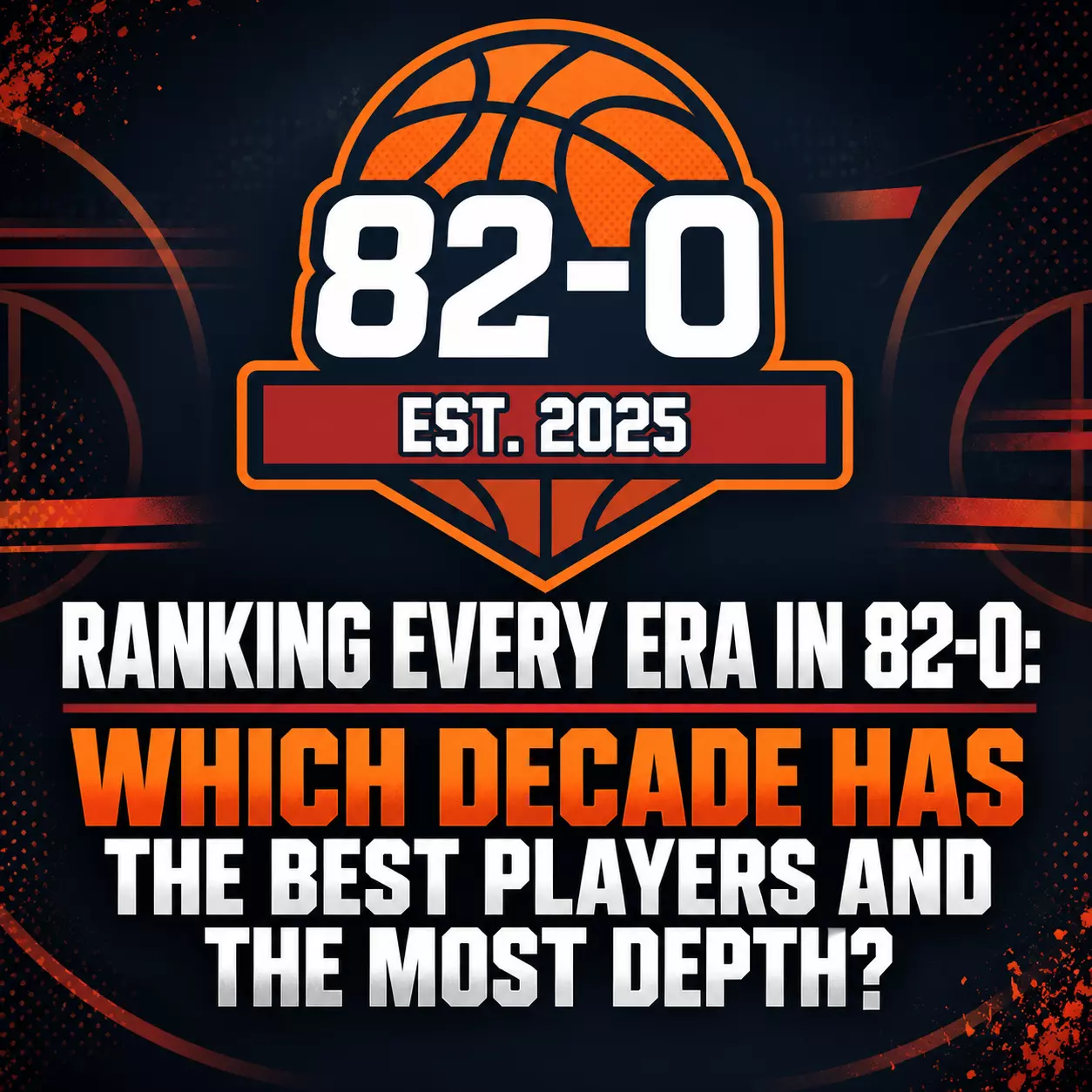
add this information to the image "Ranking Every Era in 82-0: Which Decade Has the Best Players and the Most Depth?"
When the slot machine in
82-0
lands on a decade, your reaction can be almost as important as the NBA franchise that appears next to it.
Getting the 1960s can mean Wilt Chamberlain.
Getting the 1970s can mean Kareem Abdul-Jabbar or one of the game’s many hidden statistical monsters.
Getting the 2020s can give you Nikola Jokić, Giannis Antetokounmpo, Luka Dončić or a triple-double version of Russell Westbrook.
But which decade is actually the best?
The answer depends on what we’re measuring.
There are really three different questions:
Which era has the greatest individual players?
Which era has the most depth?
Which era would I most want to see appear during an 82-0 run?
According to 82-0’s official explanation, the simulation uses points, rebounds, assists, steals and blocks rather than subjective all-time rankings. The 1950s are not currently included, leaving seven playable decades from the 1960s through the 2020s.
Using those rules and the current rankings from the unofficial 82-0 Guide, here’s how I rank all seven eras.
Overall 82-0 Era Rankings
1. 1970s
Best overall era and best depth
2. 2020s
Best modern era and best positional versatility
3. 1990s
Best collection of dominant two-way big men
4. 1960s
Highest individual ceiling because of Wilt
5. 2010s
Excellent all-around stars and playmakers
6. 2000s
Strong superstar tier but less overwhelming depth
7. 1980s
Great elite options but surprisingly thin by 82-0 standards
This isn’t a ranking of which decade played the best basketball.
It’s a ranking specifically for
winning the game 82-0.
1. 1970s
The Best Overall Era in 82-0
If I could choose one decade to appear repeatedly during an 82-0 draft, I’d take the:
1970s
The decade combines an incredible ceiling with tremendous depth.
The unofficial guide currently has
21 different 1970s player/team combinations in its top 100, the most of any era.
Even more impressively, the 1970s own two of the four S+ combinations in the entire database:
Kareem Abdul-Jabbar — Milwaukee: 28.45
Kareem Abdul-Jabbar — Lakers: 26.68
Only the two 1960s Wilt combinations rank higher.
But Kareem is only the beginning.
Elite 1970s Options Include
Kareem Abdul-Jabbar
Bob McAdoo
Nate Thurmond
Elvin Hayes
Jerry West
Bob Lanier
Bill Walton
Dave Cowens
Artis Gilmore
Spencer Haywood
George McGinnis
Billy Cunningham
Adrian Dantley
Moses Malone
Wilt Chamberlain
That’s ridiculous depth.
Why the 1970s Are So Powerful
This decade is absolutely loaded with players who accumulated huge numbers in several categories.
Most importantly:
Rebounding is everywhere.
Kareem can give you 15 rebounds.
Thurmond approaches 16.
Elvin Hayes can reach 16.
Wilt is around 19 in his Lakers version.
Many of these players also supply blocks.
That makes the 1970s particularly useful for building the statistical foundation of an 82-0 lineup.
Biggest Strength
Elite big men and tremendous depth.
Biggest Weakness
The decade is considerably stronger in the frontcourt than at guard.
Era Grade: A+
If you’re considering using a decade skip and the slot says
1970s, think very carefully before touching it.
2. 2020s
The Most Versatile Era in the Game
The 2020s nearly take the No. 1 spot.
In fact, if your roster already has its dominant center, I might prefer the 2020s over the 1970s.
Why?
The versatility is incredible.
Look at the current overall rankings:
#5 Nikola Jokić
#6 Giannis Antetokounmpo
#7 Russell Westbrook
#8 Luka Dončić
And another Lakers version of Luka sits at
#11.
The 2020s have
20 entries in the current top 100, only one fewer than the 1970s.
Elite 2020s Options Include
Nikola Jokić
Giannis Antetokounmpo
Luka Dončić
Russell Westbrook
Victor Wembanyama
James Harden
Anthony Davis
Joel Embiid
LeBron James
Kevin Durant
Domantas Sabonis
Shai Gilgeous-Alexander
Jayson Tatum
Karl-Anthony Towns
That’s extraordinary.
Why the 2020s Are Different
Modern stars frequently accumulate statistics across multiple categories.
Jokić isn’t merely a center.
He gives you nearly:
27 points12 rebounds9 assists
Giannis gives you scoring, rebounding, assists, steals and blocks.
Luka produces almost:
31 points9 rebounds9 assists
Washington Westbrook provides approximately:
22 points11.5 rebounds11.7 assists.
That is exactly what 82-0 rewards.
Biggest Strength
Versatility and assists from unexpected positions.
Biggest Weakness
Modern rebounding averages generally can’t compete with Wilt-era or 1970s extremes.
Era Grade: A+
The 2020s may be the easiest decade for constructing a balanced roster.
3. 1990s
The Two-Way Big-Man Era
If you need blocks, this may be the decade you want.
The 1990s put
17 combinations in the current top 100, third among the seven decades.
And look at the top of the group:
Hakeem Olajuwon — 23.78
David Robinson — 23.50
Shaquille O’Neal — 23.13
Chris Webber — 22.18
Then you have another Shaq, Michael Jordan, Patrick Ewing, Charles Barkley, Karl Malone, Tim Duncan and others.
Why the 1990s Are So Valuable
The decade provides outstanding defensive statistics without sacrificing offense.
Hakeem:
23.9 PPG11.6 RPG1.8 SPG3.5 BPG
David Robinson:
24.4 PPG11.5 RPG1.6 SPG3.4 BPG
Those are phenomenal 82-0 numbers.
Then Add the Wings
You also have:
Michael Jordan
Charles Barkley
Larry Bird
Grant Hill
and late-career Magic Johnson.
This gives the 1990s much better positional balance than many people realize.
Biggest Strength
Blocks, steals and elite centers.
Biggest Weakness
The decade lacks a truly game-breaking 28-plus-value option such as Warriors Wilt or Milwaukee Kareem.
Era Grade: A
If you need defensive statistics, the 1990s might actually be No. 1.
4. 1960s
The Era With the Best Player in 82-0
Here’s the strange thing about the 1960s:
They rank only fourth overall.
But they have the game’s two most valuable player combinations.
Warriors Wilt Chamberlain
31.96 value
41.5 PPG25.1 RPG3.0 APG
Philadelphia Wilt Chamberlain
28.78 value
27.6 PPG24.0 RPG6.8 APG
Those are currently the No. 1 and No. 2 combinations in the entire unofficial database.
So which era has the
best player?
Easy.
The 1960s.
And Wilt Isn’t Alone
The decade also gives you:
Bob Pettit
Oscar Robertson
Bill Russell
Elvin Hayes
Jerry Lucas
Elgin Baylor
Walt Bellamy
Those are tremendous statistical players.
Oscar Robertson is particularly valuable because approximately:
29.7 points8.7 rebounds10.5 assists
from PG is extraordinary.
So Why Isn’t the 1960s No. 1?
Depth.
Only
10 1960s combinations appear in the current top 100, compared with 21 from the 1970s and 20 from the 2020s.
There’s also another major issue.
Steals and blocks weren’t officially recorded for much of this period.
That creates zeros or unavailable statistics in categories that matter to 82-0.
You need modern players around those older stars to compensate.
Biggest Strength
The greatest statistical ceiling in the game.
Biggest Weakness
Uneven depth and missing defensive-stat data.
Era Grade: A
The 1960s are the ultimate boom-or-bust era.
If you hit the correct team:
Fantastic.
If you don’t:
You may be reaching for that decade skip.
5. 2010s
The Versatile Superstar Era
The 2010s are extremely good without being quite as statistically absurd as the decades above them.
There are currently
14 2010s combinations among the top 100.
The decade is led by:
LeBron James — Lakers: 23.54
DeMarcus Cousins — New Orleans: 23.38
LeBron James — Cleveland: 23.08
LeBron James — Miami: 22.31
Then come:
Dwight Howard
James Harden
Anthony Davis
Joel Embiid
Russell Westbrook
Kevin Durant
Karl-Anthony Towns
Kevin Love.
Why the 2010s Work
This decade is excellent for fixing roster deficiencies.
Need assists?
Westbrook or Harden.
Need all-around production?
LeBron.
Need rebounds and blocks?
Dwight or Davis.
Need scoring?
Durant.
Need an underrated statistical monster?
DeMarcus Cousins.
Biggest Strength
Excellent roster balance.
Biggest Weakness
There isn’t a Wilt/Kareem/Jokić-level centerpiece sitting at the top.
Era Grade: A-
This is a very safe era.
You’ll rarely hate seeing the 2010s.
6. 2000s
Great Stars, Less Depth
The 2000s have some tremendous 82-0 options.
At the top:
Kevin Garnett — 23.21
Shaquille O’Neal — 22.76
LeBron James — 22.48
Chris Webber — 21.54
Then:
Tim Duncan
Tracy McGrady
Allen Iverson
Kobe Bryant
Dwyane Wade
Elton Brand.
There are
10 2000s combinations in the current top 100.
And his positional flexibility makes him even better.
Why the Era Falls Behind
This is where 82-0 differs dramatically from an all-time NBA debate.
Kobe Bryant and Allen Iverson were enormous superstars.
But the game is based on raw statistical totals.
Players from earlier decades can provide much bigger rebounding numbers, while players such as modern Jokić, Luka and Westbrook accumulate more assists and rebounds simultaneously.
Biggest Strength
Excellent all-around superstar options.
Biggest Weakness
Not enough overwhelming statistical monsters below the top tier.
Era Grade: B+
Very good.
Just not as good as its real-world star power might suggest.
7. 1980s
The Most Surprising Last-Place Era
This is probably the most controversial ranking.
How could the decade of Michael Jordan, Magic Johnson and Larry Bird finish last?
Because we’re ranking the
82-0 database, not basketball history.
The current top 100 contains only
eight 1980s combinations, fewer than any other playable decade.
Those eight are excellent:
Michael Jordan — 23.82
Moses Malone — 23.14
Hakeem Olajuwon — 22.94
Larry Bird — 22.28
Magic Johnson — 21.84
Charles Barkley — 21.09
Moses Malone — Philadelphia: 20.55
Patrick Ewing — 19.43.
That’s a tremendous top eight.
The problem is what happens after them.
Why the 1980s Still Have Huge Upside
1980s Jordan may be the best non-center selection from an older era.
Magic’s 11-plus assists are also incredibly valuable.
Bird provides double-digit rebounding with six assists.
Why It Ranks Last
Depth.
You absolutely want certain 1980s team combinations.
But compared with the 1970s, 1990s or 2020s, there are fewer truly high-value answers across the entire franchise pool.
Biggest Strength
Historic superstars at multiple positions.
Biggest Weakness
Elite talent falls off quickly.
Era Grade: B+
Don’t mistake seventh place for bad.
It simply means the decade is more dependent on getting the right team.
Which Era Has the Best Players?
There are two answers.
Best Individual Player: 1960s
The 1960s win because of
Wilt Chamberlain.
Warriors Wilt currently carries a
31.96 value, while Philadelphia Wilt sits at 28.78.
No other player/team/era combination reaches either number.
If the question is:
“Which era gives me the biggest possible advantage with one pick?”
The answer is:
1960s.
Which Era Has the Best Collection of Elite Players?
2020s
Look at four consecutive spots near the top:
#5 Jokić
#6 Giannis
#7 Westbrook
#8 Luka
Then another Luka combination is No. 11.
That’s an astonishing concentration of modern multi-category production.
So if “best players” means
the broadest group of elite superstars at different positions, I give the edge to:
2020s.
Which Era Has the Best Depth?
1970s
This one is the clearest answer.
Counting the current unofficial guide’s top 100:
1970s — 21
2020s — 20
1990s — 17
2010s — 14
1960s — 10
2000s — 10
1980s — 8
Those totals are my count from the guide’s current top-100 ranking rather than an official 82-0 statistic, but they’re a useful way to measure how many premium options each era supplies.
The winner:
1970s.
And depth matters tremendously.
You aren’t guaranteed Milwaukee Kareem.
But if you miss Kareem, the era can still offer McAdoo, Thurmond, Hayes, Lanier, Cowens, Walton, Gilmore, Haywood, McGinnis and plenty of others.
That’s why the 1970s are my No. 1 era overall.
Era Rankings by Top-100 Depth
1. 1970s — 21
2. 2020s — 20
3. 1990s — 17
4. 2010s — 14
T-5. 1960s — 10
T-5. 2000s — 10
7. 1980s — 8
Which Era Should You Skip?
This is where the ranking becomes useful during an actual game.
If you’re holding your one decade skip:
1970s
Almost never skip it blindly.
Too much depth.
2020s
Keep it.
Excellent guards, wings and centers.
1990s
Usually keep it, especially if you still need defense.
1960s
Look carefully at the franchise.
The difference between
Warriors + 1960s
and a weak 1960s team can be enormous.
This may actually be the decade where your
team skip
becomes particularly valuable.
2010s
Usually playable.
Evaluate the franchise and your roster.
2000s
More situational.
If the franchise doesn’t have one of the era’s major stars, a skip becomes reasonable.
1980s
This would be my most aggressive decade-skip candidate when the franchise is poor.
But if the team is Chicago, Boston, Los Angeles or Houston:
Don’t touch that button.
The Perfect Era Combination
If I could choose one player from five different decades, I’d try to exploit each era’s particular strength.
Something like:
1960s — Wilt Chamberlain
Use the era’s absurd rebounding/scoring ceiling.
1970s — Kareem Abdul-Jabbar or Bob McAdoo
Use the decade’s extraordinary frontcourt production.
Conclusion: The 1970s Are the Best Overall Era in 82-0
If we have to crown one decade:
The 1970s win.
They combine an elite ceiling with the deepest collection of high-value players in the current unofficial rankings.
The
1960s have the greatest individual weapon
in Warriors Wilt Chamberlain.
The
2020s have the greatest versatility
and perhaps the best collection of multi-category guards and forwards.
The
1990s dominate defensive big-man production
with Hakeem, Robinson, Shaq and Ewing.
The
2010s offer tremendous balance.
The
2000s contain great superstars but somewhat less statistical depth.
And the
1980s have an outstanding top tier but the thinnest representation in the current top 100.
So my final rankings are:
1. 1970s
Best combination of quality and depth.
2. 2020s
Best versatility and modern statistical production.
3. 1990s
Elite big men and defensive production.
4. 1960s
Best player in the entire game but less depth.
5. 2010s
Very balanced and consistently useful.
6. 2000s
Strong stars, slightly weaker depth.
7. 1980s
Fantastic elite options but more franchise-dependent than the other decades.
The lesson is the same one that keeps appearing throughout 82-0:
Don’t judge by reputation. Judge by production.
The 1980s may have Jordan, Bird and Magic.
The 2000s may have Kobe, Shaq, Duncan and Iverson.
But when a game is driven by raw points, rebounds, assists, steals and blocks, the enormous statistical output of the 1960s and 1970s—and the all-around production of today’s stars—changes everything.
Know which decades have the highest ceiling.
Know which ones have the most depth.
And most importantly, know when
not to waste your skip.
Because the difference between a forgettable spin and your next perfect roster could be only one decision away from:
New Users – Get $350 in Bonus Bets when you wager $5 for 7 days
T&Cs apply
4.6/5
Gambling Problem? Call 1-800-GAMBLER or 1-800-MY-RESET. Call 1-888-789-7777 or visit ccpgg.org/chat (CT). Hope is here. GamblingHelpLineMA.org or call (800) 327-5050 for 24/7 support (MA). Visit www.mdgamblinghelp.org (MD). Call 1-877-8HOPE-NY or text HOPENY (NY). 21+ (18+ DC, WY) and present in select states (for KS, in affiliation with Kansas Star Casino). Find online real money wagering only. Min $5 wager required for 7 consecutive days. $5 free play credit. Bonus issued as non-withdrawable bonus with cash withdrawable bonus with cash withdrawable. Bonus bets which expire 7 days after receipt. Restrictions apply. See terms at sportsbook.fanduel.com. Call 1-877-770-7867 (LA).
Up To $1500 in Bonus Bets Paid Back if your First Bet Does Not Win
T&Cs apply
4.5/5
Gambling problem? Call 1-800-GAMBLER or 1-800-MY-RESET (Available in the US) 877-8-HOPENY or text HOPENY (467369) (NY) 1-800-327-5050 (MA), 1-800-BETS-OFF (IA), 1-800-981-0023 (PR). 21+ only. Please Gamble Responsibly. See BetMGM.com for Terms. First Bet Offer for new customers only (if applicable). Subject to eligibility requirements. Bonus bets are non-withdrawable. In partnership with Kansas Crossing Casino and Hotel. Promotional offers not available in Mississippi, Massachusetts, New York, Ontario, or Puerto Rico.
New DraftKings Customers: Bet $5, Get $200 + 3 Months of NBA League Pass!
T&Cs apply
4.5/5
GAMBLING PROBLEM? CALL 1-800-GAMBLER or 1-800-MY-RESET, (800) 327-5050 or visit gamblinghelplinema.org (MA). Please Gamble Responsibly. 888-789-7777/visit ccpg.org (CT), or visit www.mdgamblinghelp.org (MD), 1-800-981-0023 (PR). 21+ and present in most states. (18+ DC/NH/PR/WY). Void in CAN. Eligibility restrictions apply. On behalf of Boot Hill Casino (KS). Pass-thru of per wager tax may apply in IL. 1 per new Sportsbook customer. $5+ first-time bet req. Max. $200 issued as non-withdrawable Bonus Bets. Stake removed from payout. Reward issued as $50 in Bonus Bets every 7 days via click-to-claim for 21 days. Bonus Bets and click-to-claims expire 7 days (168hrs) after issuance. Terms: dkng.co/offer. Get 1 promo code to redeem a 3-month NBA League Pass subscription, complimentary of DraftKings. Subscription auto-renews monthly at then-current price (currently $16.99/mo); cancel anytime. Terms, restrictions, and eligibility requirements apply. Redeem League Pass by 12/19/26 at 11:59 PM ET. Addt’l terms: support.watch.nba.com/hc/en-us/articles/9165532876183-League-Pass-Terms-of-Use_. Ends 11/29/26 at 11:59 PM ET. Sponsored by DK.
Must be 21+. GAMBLING PROBLEM? CALL 1-800-GAMBLER OR CALL 1-800-MY-RESET, www.mdgamblinghelp.org (MD), (800)-327-5050 or gamblinghelplinema.org (MA), Call (877)8-HOPENY or text HOPENY (467369) (NY), (888) 789-7777 or ccpg.org (CT), morethanagame.nc.gov (NC), 1800gambler.net (WV)
Bet $1 and get double the winnings up to $25 for your next 10 bets
T&Cs apply
4.4/5
21+ New users only. Must register using eligible promo code. First bet after registration must qualify. Max. Bonus Bet: $1,000. Bonus Bet expires 14 days after receipt. Void where prohibited. See Caesars.com/promos for full terms. Gambling Problem? 1-800-GAMBLER (1-800-426-2537)
21+ and present in OH. Gambling Problem? Call 1-800-GAMBLER.
This site is using
Cloudflare
and adheres to the
Google Safe Browsing Program. We adapted
Google's Privacy Guidelines
to keep your data safe at all times.
Close
Ready to Win Big? Join the Elite with Our Sports Betting Deals!
FanDuel Promo
New Users – Get $350 in Bonus Bets when you wager $5 for 7 days
Our Favorite
T&Cs and 21+ apply
Gambling Problem? Call 1-800-GAMBLER or 1-800-MY-RESET. Call 1-888-789-7777 or visit ccpgg.org/chat (CT). Hope is here. GamblingHelpLineMA.org or call (800) 327-5050 for 24/7 support (MA). Visit www.mdgamblinghelp.org (MD). Call 1-877-8HOPE-NY or text HOPENY (NY). 21+ (18+ DC, WY) and present in select states (for KS, in affiliation with Kansas Star Casino). Find online real money wagering only. Min $5 wager required for 7 consecutive days. $5 free play credit. Bonus issued as non-withdrawable bonus with cash withdrawable bonus with cash withdrawable. Bonus bets which expire 7 days after receipt. Restrictions apply. See terms at sportsbook.fanduel.com. Call 1-877-770-7867 (LA).
Code:
Open FanDuel
Get Bonus
BetMGM Promo
Up To $1500 in Bonus Bets Paid Back if your First Bet Does Not Win
Best Slots
T&Cs and 21+ apply
Gambling problem? Call 1-800-GAMBLER or 1-800-MY-RESET (Available in the US) 877-8-HOPENY or text HOPENY (467369) (NY) 1-800-327-5050 (MA), 1-800-BETS-OFF (IA), 1-800-981-0023 (PR). 21+ only. Please Gamble Responsibly. See BetMGM.com for Terms. First Bet Offer for new customers only (if applicable). Subject to eligibility requirements. Bonus bets are non-withdrawable. In partnership with Kansas Crossing Casino and Hotel. Promotional offers not available in Mississippi, Massachusetts, New York, Ontario, or Puerto Rico.
Code:
Open BetMGM
Get Bonus
DraftKings Promo
New DraftKings Customers: Bet $5, Get $200 + 3 Months of NBA League Pass!
Newcomer
T&Cs and 21+ apply
GAMBLING PROBLEM? CALL 1-800-GAMBLER or 1-800-MY-RESET, (800) 327-5050 or visit gamblinghelplinema.org (MA). Please Gamble Responsibly. 888-789-7777/visit ccpg.org (CT), or visit www.mdgamblinghelp.org (MD), 1-800-981-0023 (PR). 21+ and present in most states. (18+ DC/NH/PR/WY). Void in CAN. Eligibility restrictions apply. On behalf of Boot Hill Casino (KS). Pass-thru of per wager tax may apply in IL. 1 per new Sportsbook customer. $5+ first-time bet req. Max. $200 issued as non-withdrawable Bonus Bets. Stake removed from payout. Reward issued as $50 in Bonus Bets every 7 days via click-to-claim for 21 days. Bonus Bets and click-to-claims expire 7 days (168hrs) after issuance. Terms: dkng.co/offer. Get 1 promo code to redeem a 3-month NBA League Pass subscription, complimentary of DraftKings. Subscription auto-renews monthly at then-current price (currently $16.99/mo); cancel anytime. Terms, restrictions, and eligibility requirements apply. Redeem League Pass by 12/19/26 at 11:59 PM ET. Addt’l terms: support.watch.nba.com/hc/en-us/articles/9165532876183-League-Pass-Terms-of-Use_. Ends 11/29/26 at 11:59 PM ET. Sponsored by DK.
Code:
Open DraftKings
Get Bonus
Find out what the legends have to say about sports this week....
New Users – Get $350 in Bonus Bets when you wager $5 for 7 days
Gambling Problem? Call 1-800-GAMBLER or 1-800-MY-RESET. Call 1-888-789-7777 or visit ccpgg.org/chat (CT). Hope is here. GamblingHelpLineMA.org or call (800) 327-5050 for 24/7 support (MA). Visit www.mdgamblinghelp.org (MD). Call 1-877-8HOPE-NY or text HOPENY (NY). 21+ (18+ DC, WY) and present in select states (for KS, in affiliation with Kansas Star Casino). Find online real money wagering only. Min $5 wager required for 7 consecutive days. $5 free play credit. Bonus issued as non-withdrawable bonus with cash withdrawable bonus with cash withdrawable. Bonus bets which expire 7 days after receipt. Restrictions apply. See terms at sportsbook.fanduel.com. Call 1-877-770-7867 (LA).