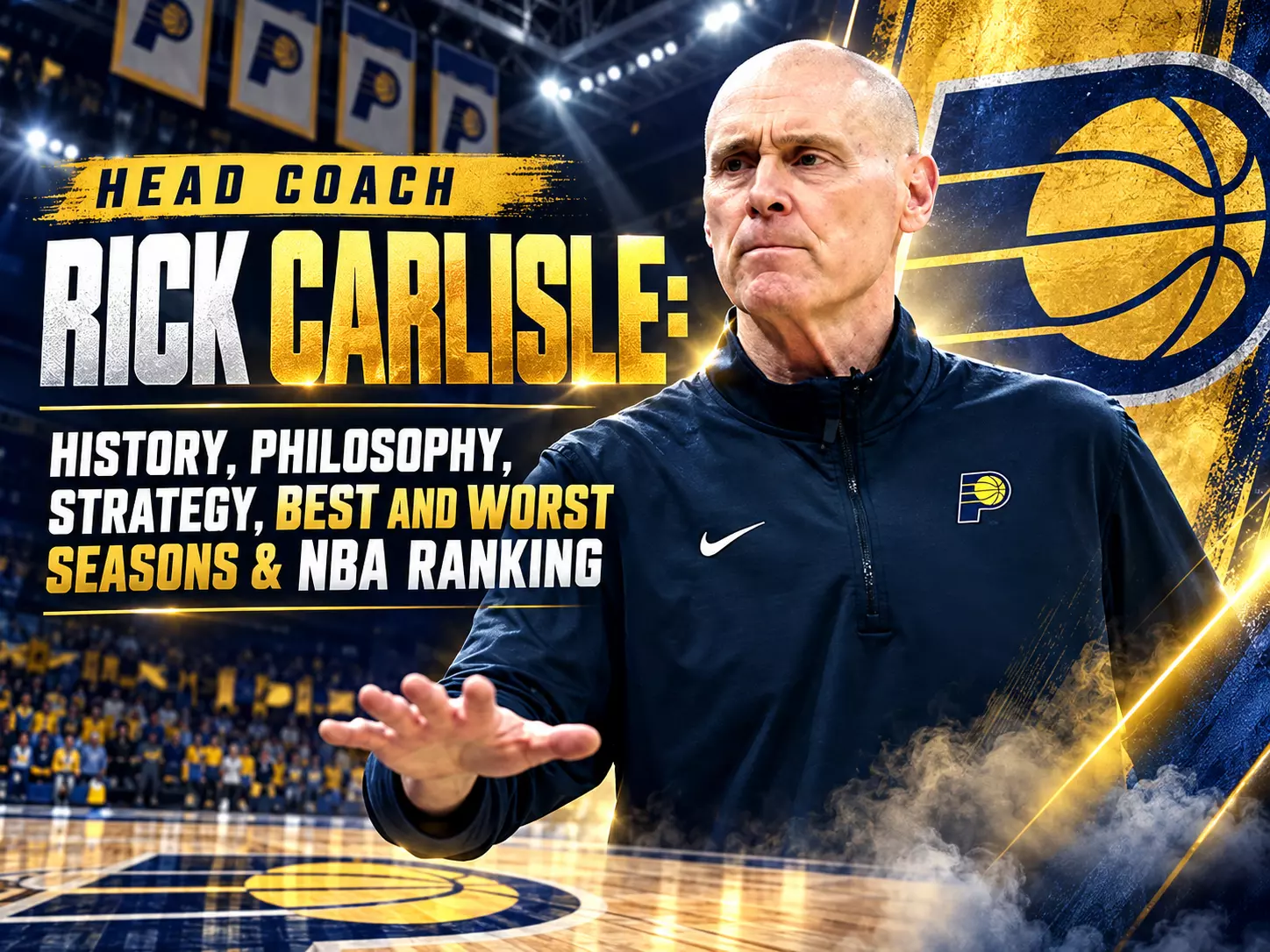
Head Coach Rick Carlisle: History, Philosophy, Strategy, Best and Worst Seasons & NBA Ranking
Rick Carlisle enters the 2026–27 season as one of the most experienced and accomplished head coaches in the NBA.
Across 24 seasons as an NBA head coach, Carlisle has won
1,012 regular-season games, making him the
11th-winningest head coach in NBA history
through the conclusion of the 2025–26 season. Among active coaches, only Milwaukee’s Doc Rivers has more career victories.
But Carlisle’s résumé goes beyond longevity. He has been an NBA champion as both a player and head coach, won NBA Coach of the Year, taken two different franchises to the NBA Finals and continually reinvented his system to fit dramatically different generations of basketball.
That ability to change may be the defining characteristic of his coaching career.
After playing at Maine and transferring to Virginia, Carlisle was co-captain of the Cavaliers team that reached the 1984 Final Four. He entered the NBA with the Boston Celtics in 1984 and spent three seasons with Boston, including the Celtics’
1986 NBA championship season.
He later played for the New York Knicks and New Jersey Nets before transitioning directly into coaching.
Carlisle began his coaching career in
1989 as an assistant with the New Jersey Nets, where he worked under Hall of Fame coaches Bill Fitch and Chuck Daly. He spent five seasons with New Jersey before serving three years as an assistant with Portland.
His relationship with the Pacers began in 1997.
Indiana Pacers Assistant: 1997–2000
Carlisle joined Larry Bird’s Indiana coaching staff and essentially became the team’s offensive coordinator while Dick Harter handled much of the defense.
Indiana reached the Eastern Conference Finals in all three seasons Carlisle was on Bird’s staff and reached the
2000 NBA Finals.
The experience gave Carlisle an early education in managing veteran players, playoff preparation and postseason adjustments.
Detroit Pistons: 2001–03
Carlisle received his first NBA head-coaching opportunity with Detroit in 2001.
The Pistons immediately went
50–32 in consecutive seasons. Carlisle won
NBA Coach of the Year in 2001–02, his rookie season as an NBA head coach.
Those Detroit teams reflected the younger Carlisle’s philosophy.
They were structured, physical and defense-oriented. Carlisle controlled games from the sideline, called plays frequently and demanded precise execution.
That version of Carlisle was considerably different from the coach Pacers fans see today.
Indiana Pacers: 2003–07
Carlisle returned to Indiana as head coach in 2003 and immediately produced one of the greatest regular seasons in franchise history.
The
2003–04 Pacers finished 61–21, the best record in the Eastern Conference and the highest win total in the franchise’s NBA history.
Indiana ranked third defensively and reached the Eastern Conference Finals before losing to the eventual champion Detroit Pistons.
Carlisle went
181–147
during his first four-season stint as Pacers head coach.
Dallas Mavericks: 2008–21
Carlisle’s longest coaching tenure came in Dallas.
He coached the Mavericks for
13 seasons, winning 555 regular-season games and taking Dallas to the playoffs 10 times.
His defining accomplishment came in 2011.
Behind Dirk Nowitzki, Jason Kidd, Jason Terry, Tyson Chandler and Shawn Marion, Carlisle coached Dallas through Portland, the defending champion Los Angeles Lakers and Oklahoma City before meeting LeBron James, Dwyane Wade, Chris Bosh and the Miami Heat in the NBA Finals.
Dallas defeated Miami in six games.
Carlisle’s tactical adjustments became a major part of the series. Among them was moving J.J. Barea into the starting lineup beginning with Game 4. Dallas won the final three games to capture the championship.
That championship established Carlisle as one of his generation’s elite playoff tacticians.
Indiana Pacers: 2021–Present
Carlisle returned to Indiana in 2021.
After rebuilding seasons of 25 and 35 wins, Indiana’s emergence accelerated around Tyrese Haliburton.
The Pacers reached the
2024 Eastern Conference Finals, then took another major step in 2024–25, winning 50 games and reaching the NBA Finals.
Indiana pushed Oklahoma City to Game 7 before losing a series in which Haliburton suffered a ruptured Achilles in the deciding game.
The 2025–26 season became essentially a developmental year without Haliburton. Indiana finished
19–63, but Carlisle reached another personal milestone when he recorded his
1,000th career victory on January 8, 2026.
He finished the season with 1,012 career wins.
Carlisle’s Coaching Philosophy
1. Adapt to the Personnel
Perhaps Carlisle’s greatest strength is that he does not insist on playing one style regardless of personnel.
His early Detroit and Indiana teams were slower, structured and defense-oriented.
His Dallas offenses increasingly emphasized spacing, pick-and-roll basketball, shooting and Nowitzki’s unique offensive abilities.
His current Pacers teams play dramatically faster.
Carlisle has evolved from a coach who once controlled nearly every possession from the sideline into one who gives his lead guards significantly more freedom.
That transformation has been particularly noticeable with Haliburton. Carlisle recognized that controlling every possession would limit what makes Haliburton special.
The modern version of Carlisle establishes principles and spacing, then gives his guards freedom to read the defense.
That adaptability is a major reason he has remained relevant for more than two decades.
2. Play Fast
Indiana’s identity with Haliburton is built around speed.
The Pacers want to advance the basketball before the defense can organize.
That does not simply mean fast breaks following steals.
Indiana will attack following made baskets, missed baskets and virtually any opportunity to create an advantage before the defense is completely set.
During the 2025 postseason, Indiana ranked among the league leaders in pace while consistently covering more ground than its opponents.
Carlisle views conditioning and depth as offensive weapons.
If Indiana can force an opponent to defend movement for 48 minutes, fatigue eventually creates mistakes.
3. Move the Basketball
The Pacers don’t simply play fast. They move the basketball extremely quickly.
During the 2024–25 regular season, Indiana averaged
398 passes per 24 minutes of possession, the most in the NBA.
During the playoffs, the Pacers ranked second in passing and first in player movement.
Carlisle’s offense generally prefers:
quick decisions,
multiple ball handlers,
early pick-and-rolls,
dribble handoffs,
back cuts,
off-ball screens,
drive-and-kick opportunities,
and extra passes to create open threes.
The goal is not necessarily for one superstar to attack repeatedly in isolation.
It’s to force five defenders to continuously communicate and rotate.
Eventually, someone makes a mistake.
4. Attack the Weakest Defender
Carlisle has always been an outstanding matchup coach.
During Indiana’s 2025 playoff run, for example, the Pacers repeatedly involved New York’s weaker defenders in screening actions.
Against Jalen Brunson and Karl-Anthony Towns, Indiana used numerous ball screens to force New York into uncomfortable defensive decisions.
Carlisle isn’t necessarily looking for one player to score every time a mismatch appears.
Often the first screen simply begins a chain reaction.
Force one rotation.
Move the basketball.
Force another rotation.
Then attack the opening created by the original action.
5. Multiple Playmakers
Another Carlisle preference is having several players capable of making decisions.
Rather than relying exclusively on Haliburton, Indiana can use Andrew Nembhard, T.J. McConnell, Pascal Siakam and others to initiate offense.
That makes the Pacers harder to pressure.
Teams cannot simply trap one point guard and assume Indiana’s offense will collapse.
It’s also why Carlisle values basketball intelligence so highly. Players must understand spacing, timing and what happens after the first action is defended.
Defensive Philosophy
Carlisle actually began his head-coaching career with defense as his calling card.
His philosophy has evolved, but defense remains essential to how he views championship basketball.
Indiana’s 2023–24 team was brilliant offensively but ranked
24th defensively.
The following year, Carlisle and his staff deliberately sacrificed some offensive efficiency to become more balanced. Indiana moved from second to ninth offensively but improved from 24th to
14th defensively
on the way to the 2025 NBA Finals.
Carlisle wants his teams to pressure the basketball, contest passing lanes and create defensive possessions that immediately become transition opportunities.
During the 2025 postseason, Indiana frequently pressured opponents for virtually the entire 94-foot floor.
Rebounding is also important because Carlisle understands that a defensive stop isn’t complete until his team possesses the ball.
That was one reason Indiana’s acquisition of Ivica Zubac ahead of 2026–27 made sense schematically.
Rotation Strategy
Carlisle generally trusts deeper rotations than many NBA coaches.
With the right roster, he will play nine or ten players meaningful minutes rather than forcing his stars to carry every possession.
That approach fits Indiana particularly well.
The Pacers’ 2025 postseason depth allowed Carlisle to constantly bring fresh players into games, maintaining pressure and pace. NBA.com’s Finals retrospective described stretches where Carlisle substituted players almost like hockey line changes.
That depth accomplishes several things:
It keeps players fresh.
It allows Indiana to maintain defensive pressure.
It makes the pace difficult for opponents to match.
It gives Carlisle more matchup combinations.
It also creates competition within the roster.
In the playoffs, however, Carlisle has demonstrated that he will change rotations quickly when necessary.
The 2011 decision to start Barea in the Finals remains one of the best-known examples.
Playoff Adjustments
This may be Carlisle’s strongest coaching trait.
Regular-season coaches have months to establish systems.
Playoff coaches sometimes have 48 hours to solve a completely different problem.
Carlisle has repeatedly demonstrated the ability to do that.
He will change defensive coverages, alter matchups, introduce zone defenses, change starters, shorten or expand rotations and repeatedly attack a specific defensive weakness.
Dallas’ use of zone concepts during the 2011 Finals became one of the strategic elements of its upset of Miami.
Against Cleveland’s zone during Indiana’s 2025 playoff run, Carlisle again demonstrated his reputation as a coach who enjoys solving tactical problems.
His willingness to change separates him from coaches who simply continue running their preferred system regardless of what happens.
Rick Carlisle’s Best Season
There are two different answers.
Best Regular Season: 2003–04 Indiana Pacers
Record: 61–21
Eastern Conference: 1st
Playoff Result: Eastern Conference Finals
The 61 victories remain the highest total of Carlisle’s head-coaching career.
Indiana finished with the Eastern Conference’s best record, ranked third defensively and posted a +6.5 net rating.
Jermaine O’Neal finished third in MVP voting, while Ron Artest won Defensive Player of the Year.
From a regular-season standpoint, this was Carlisle’s most dominant team.
If the playoffs are included, 2010–11 is unquestionably Carlisle’s greatest season.
Dallas defeated Portland, swept Kobe Bryant’s defending champion Lakers, beat Kevin Durant’s Oklahoma City Thunder and then defeated Miami’s LeBron James-Wade-Bosh superteam.
Carlisle finished that postseason
16–5.
The combination of opponent quality, tactical adjustments and championship result makes 2011 the defining season of Carlisle’s career.
Rick Carlisle’s Worst Season
2025–26 Indiana Pacers
Record: 19–63
Statistically, this was Carlisle’s worst season as an NBA head coach.
His previous low was
24–58 with Dallas in 2017–18.
However, the 19–63 record requires considerable context.
Indiana entered the year knowing Haliburton would miss the entire season while recovering from his Achilles injury. The Pacers subsequently dealt with additional roster and injury problems and treated much of the season as a bridge toward Haliburton’s 2026–27 return.
It was unquestionably Carlisle’s worst year by wins and losses.
It was not necessarily his worst coaching performance.
Those are two different things.
Where Does Rick Carlisle Rank Among Current NBA Coaches?
Career Résumé: Top Three
Based strictly on career accomplishments among active coaches, Carlisle belongs near the top.
He has:
1,012 career victories
No. 11 all-time in regular-season coaching wins
No. 2 among active coaches in victories
1 NBA championship
1 NBA Coach of the Year award
2 NBA Finals appearances as a head coach
2024 Eastern Conference Finals appearance
2025 Eastern Conference championship
17 playoff appearances
Only Doc Rivers currently has more regular-season victories among active head coaches.
Overall Current Coaching Ranking: No. 4
Taking résumé, tactical ability, adaptability, player development, playoff success and recent performance together, I would place Carlisle
No. 4 among current NBA head coaches entering 2026–27.
A reasonable top group would include coaches such as
Erik Spoelstra, Steve Kerr, Tyronn Lue and Carlisle, with others including Nick Nurse and younger championship-caliber coaches also deserving consideration.
Carlisle’s strongest argument comes from adaptability.
Very few coaches have successfully coached such different basketball styles.
He won with defense-first teams in Detroit and Indiana.
He coached an isolation and pick-and-roll superstar in Nowitzki.
Then, more than two decades after becoming a head coach, he constructed one of basketball’s fastest and most movement-oriented offenses around Haliburton.
His 2025 Finals appearance reinforces that his reputation isn’t based solely on accomplishments from 15 or 20 years ago.
He is still doing it.
My ranking entering 2026–27: No. 4 among current NBA head coaches.
Carlisle’s Greatest Strength
Adaptability.
Carlisle is not married to one offensive system.
He coaches the roster he has rather than demanding that every roster conform to the same philosophy.
A slow veteran roster?
He can play half-court basketball.
An elite post scorer?
He can build around him.
A dynamic transition point guard?
He’ll push the pace.
A deep roster?
He’ll use waves of substitutions.
A playoff opponent changes coverage?
He’ll change something too.
That adaptability is why Carlisle has remained successful while the NBA has transformed dramatically around him.
Biggest Criticism
Carlisle’s intensity has occasionally been both an asset and a weakness.
Earlier in his career, his demanding personality and desire to control games sometimes produced friction.
Carlisle himself has evolved in this area.
The modern Carlisle delegates more authority to his assistants and gives players more freedom than he did during his Detroit or first Indiana tenure. The evolution from confrontation toward collaboration has been one of the biggest changes in his coaching style.
That evolution may be every bit as important as his tactical adjustments.
Conclusion
Rick Carlisle’s career can almost be divided into several different coaches.
There was the defensive disciplinarian who took over Detroit in 2001.
There was the structured coach who led Indiana to 61 victories in 2003–04.
There was the tactical problem-solver who constructed a championship formula around Dirk Nowitzki in Dallas.
And now there is the fast-paced, collaborative coach who has turned Haliburton and the Pacers into one of the NBA’s most distinctive offensive teams.
The common denominator is winning.
Carlisle enters 2026–27 with
1,012 career victories, an NBA championship, a Coach of the Year award and trips to the NBA Finals with two different franchises.
His 19–63 record in 2025–26 represents the worst statistical season of his career, but it came during an unusual season without Haliburton following Indiana’s run to Game 7 of the NBA Finals.
Now the challenge changes again.
Haliburton returns. Indiana expects to contend again. Carlisle must integrate a different frontcourt, restore one of the league’s fastest offenses and maintain the defensive improvement that helped take the Pacers to the 2025 Finals.
At this stage of his career, Carlisle doesn’t need to prove that he can coach.
The 2026–27 season gives him another opportunity to demonstrate what has made his career remarkable in the first place:
his ability to change with the game while continuing to win.
Up To $1500 in Bonus Bets Paid Back if your First Bet Does Not Win
T&Cs apply
4.5/5
Gambling problem? Call 1-800-GAMBLER or 1-800-MY-RESET (Available in the US) 877-8-HOPENY or text HOPENY (467369) (NY) 1-800-327-5050 (MA), 1-800-BETS-OFF (IA), 1-800-981-0023 (PR). 21+ only. Please Gamble Responsibly. See BetMGM.com for Terms. First Bet Offer for new customers only (if applicable). Subject to eligibility requirements. Bonus bets are non-withdrawable. In partnership with Kansas Crossing Casino and Hotel. Promotional offers not available in Mississippi, Massachusetts, New York, Ontario, or Puerto Rico.
New DraftKings Customers: Spend $5+ Get $150 in Bonuses
T&Cs apply
4.5/5
GAMBLING PROBLEM? CALL 1-800-GAMBLER or 1-800-MY-RESET, (800) 327-5050 or visit gamblinghelplinema.org (MA). Please Gamble Responsibly. 888-789-7777/visit ccpg.org (CT), or visit www.mdgamblinghelp.org (MD), 1-800-981-0023 (PR). 21+ and present in most states. (18+ DC/NH/PR/WY). Void in CAN. Eligibility restrictions apply. On behalf of Boot Hill Casino (KS). Pass-thru of per wager tax may apply in IL. 1 per new DraftKings customer. $5+ first-time bet req. Max. $150 issued as non-withdrawable Bonus Bets. Stake removed from payout. Reward issued as $50 in Bonus Bets every 7 days via click-to-claim for 14 days. Bonus Bets and click-to-claims expire 7 days (168hrs) after issuance. Terms: sportsbook.draftkings.com/promos. Ends 10/11/26 at 11:59 PM ET. Sponsored by DK.
Must be 21+. GAMBLING PROBLEM? CALL 1-800-GAMBLER OR CALL 1-800-MY-RESET, www.mdgamblinghelp.org (MD), (800)-327-5050 or gamblinghelplinema.org (MA), Call (877)8-HOPENY or text HOPENY (467369) (NY), (888) 789-7777 or ccpg.org (CT), morethanagame.nc.gov (NC), 1800gambler.net (WV)
Bet $1 and get double the winnings up to $25 for your next 10 bets
T&Cs apply
4.4/5
21+ New users only. Must register using eligible promo code. First bet after registration must qualify. Max. Bonus Bet: $1,000. Bonus Bet expires 14 days after receipt. Void where prohibited. See Caesars.com/promos for full terms. Gambling Problem? 1-800-GAMBLER (1-800-426-2537)
21+ and present in OH. Gambling Problem? Call 1-800-GAMBLER.
This site is using
Cloudflare
and adheres to the
Google Safe Browsing Program. We adapted
Google's Privacy Guidelines
to keep your data safe at all times.
Close
Ready to Win Big? Join the Elite with Our Sports Betting Deals!
FanDuel Promo
New Users – Get $250 in Bonus Bets when you wager $5 for 5 days
Up To $1500 in Bonus Bets Paid Back if your First Bet Does Not Win
Best Slots
T&Cs and 21+ apply
Gambling problem? Call 1-800-GAMBLER or 1-800-MY-RESET (Available in the US) 877-8-HOPENY or text HOPENY (467369) (NY) 1-800-327-5050 (MA), 1-800-BETS-OFF (IA), 1-800-981-0023 (PR). 21+ only. Please Gamble Responsibly. See BetMGM.com for Terms. First Bet Offer for new customers only (if applicable). Subject to eligibility requirements. Bonus bets are non-withdrawable. In partnership with Kansas Crossing Casino and Hotel. Promotional offers not available in Mississippi, Massachusetts, New York, Ontario, or Puerto Rico.
Code:
Open BetMGM
Get Bonus
DraftKings Promo
New DraftKings Customers: Spend $5+ Get $150 in Bonuses
Newcomer
T&Cs and 21+ apply
GAMBLING PROBLEM? CALL 1-800-GAMBLER or 1-800-MY-RESET, (800) 327-5050 or visit gamblinghelplinema.org (MA). Please Gamble Responsibly. 888-789-7777/visit ccpg.org (CT), or visit www.mdgamblinghelp.org (MD), 1-800-981-0023 (PR). 21+ and present in most states. (18+ DC/NH/PR/WY). Void in CAN. Eligibility restrictions apply. On behalf of Boot Hill Casino (KS). Pass-thru of per wager tax may apply in IL. 1 per new DraftKings customer. $5+ first-time bet req. Max. $150 issued as non-withdrawable Bonus Bets. Stake removed from payout. Reward issued as $50 in Bonus Bets every 7 days via click-to-claim for 14 days. Bonus Bets and click-to-claims expire 7 days (168hrs) after issuance. Terms: sportsbook.draftkings.com/promos. Ends 10/11/26 at 11:59 PM ET. Sponsored by DK.
Code:
Open DraftKings
Get Bonus
Find out what the legends have to say about sports this week....