Kentucky’s annual Pro Day offered another October reminder of why the Wildcats remain one of college basketball’s most compelling programs.
Kentucky’s annual Pro Day offered another October reminder of why the Wildcats remain one of college basketball’s most compelling programs.
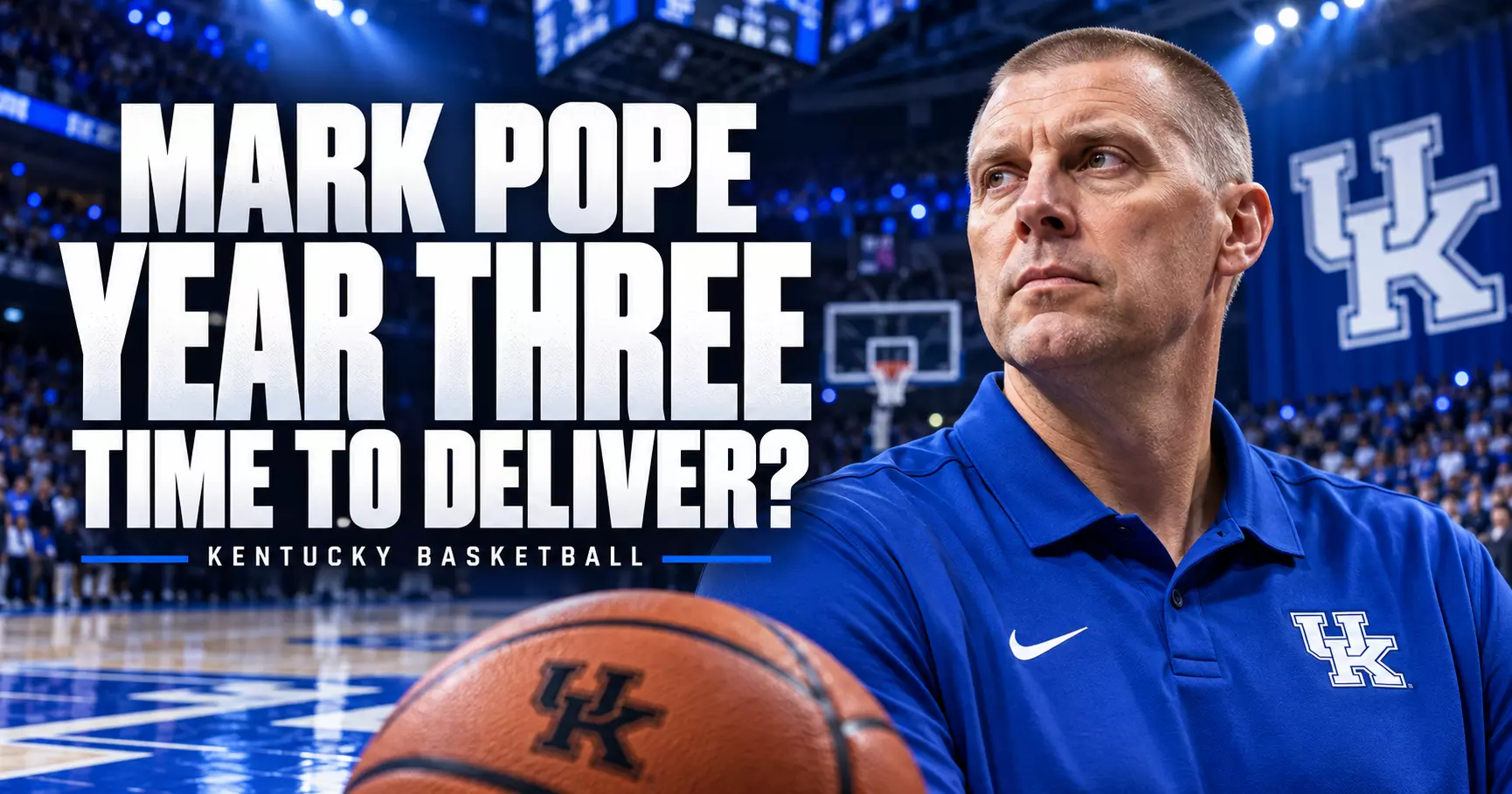
There was shooting, athleticism and enough intriguing talent to give fans reasons to believe. Tuesday’s event at Rupp Arena also provided a closer look at the roster Mark Pope will take into his third season in Lexington.
But Kentucky has reached the point where an encouraging preseason appearance cannot carry the conversation.
The question is whether Pope is building a team that can consistently compete for championships—and whether the guards on this roster can make his vision work when the games become difficult.
Year three should provide a clearer answer. Pope has had time to establish his priorities, evaluate what his system needs and assemble players around those requirements.
Now Kentucky needs to demonstrate that the pieces produce something dependable.
Kentucky Needs an Identity That Survives a Bad Shooting Night
Pope’s first
Kentucky season
produced a 24–12 record and a Sweet 16 appearance. That was a meaningful opening statement for a coach taking over one of the sport’s most demanding jobs.
The next step is establishing a standard that Kentucky can sustain.
A team can look excellent when the ball moves freely and the three-pointers fall. The more revealing possessions come when an opponent disrupts the first action, takes away the preferred shooter and forces somebody to make a decision with the shot clock running down.
Can Kentucky still reach the paint? Can it manufacture a good attempt without forcing a difficult pass? Can it get a stop after an empty possession?
Those are the questions that separate an entertaining offense from a serious contender.
Kentucky should have stretches of beautiful basketball this season. Meaningful progress requires becoming more reliable during the stretches that look nothing like the preseason highlights.
Zoom Diallo and Alex Wilkins Carry the Biggest Responsibility
The backcourt gives Pope legitimate reasons for optimism.
Washington transfer Zoom Diallo averaged 15.7 points and 4.5 assists last season. Alex Wilkins arrives from Furman after averaging 17.8 points and 4.7 assists. Both bring evidence that they can generate offense.
Their value will depend on how effectively they turn that ability into productive possessions for Kentucky.
A lead guard has to understand when to push, when to organize and when a promising opening has disappeared. Driving into traffic is useful if it forces a rotation and creates an advantage. It becomes damaging when the guard commits to a play after the defense has already closed it down.
Pope needs his guards to make those distinctions consistently.
Having two creators should provide flexibility. Kentucky can put pressure on a defense from different positions and avoid asking one player to initiate everything.
But sharing the floor requires coordination. Diallo and Wilkins must learn how to remain useful when the other has the ball, how to attack a rotating defense and how to deliver the next pass without interrupting the possession.
That partnership could determine how far Kentucky goes.
Turnovers Are the Backcourt’s Most Important Test
The concern is straightforward: Diallo averaged 2.5 turnovers last season, while Wilkins averaged 3.8. Those figures deserve attention as they enter a new system together.
Some turnovers come with the responsibility of creating offense. A guard asked to handle difficult possessions will make mistakes.
The damaging ones are the giveaways that accomplish nothing: a rushed pass against pressure, a drive into a crowded lane or an attempt to force an opening that never existed.
Live-ball turnovers are especially costly because they can turn Kentucky’s offensive mistake into an easy basket at the other end.
Pope cannot eliminate all risk without also limiting his guards’ creativity. His job is to help them recognize which risks are worth taking.
The Wildcats need aggression with purpose. If their guards can preserve their playmaking while reducing careless possessions, the offense becomes considerably more threatening.
The Supporting Pieces Give the Guards a Chance
Kentucky has personnel capable of rewarding good decisions.
Milan Momcilovic averaged 16.9 points and shot 48.7% from three-point range at Iowa State last season. Returning center Malachi Moreno averaged 7.8 points, 6.3 rebounds and 1.5 blocks as a freshman.
Momcilovic’s shooting should demand defensive attention. Moreno gives the Wildcats an interior presence who can benefit when the guards draw help.
The opportunity is clear. If a defender stays attached to a shooter, a driving lane may open. If the defense collapses toward the ball, Kentucky should have passing options.
Pope’s offense has to make those choices difficult for opponents.
Moreno’s development also matters beyond his scoring. Better screening, more secure rebounding and quicker decisions can improve possessions without appearing prominently in a box score.
For Kentucky to advance as a program, returning players need to become more complete players. That development is part of what year three should reveal.
Pope’s Defensive Vision Has to Become Visible
At Kentucky’s media day, Pope emphasized creation, shooting, physicality and length. He specifically identified Diallo and freshman Mason Williams as physical backcourt players.
Those qualities provide a foundation. They still have to become effective team defense.
Length helps when players arrive on time and understand their assignments. Physicality helps when it is controlled enough to avoid unnecessary fouls.
The Wildcats must contain the ball, communicate through screens and finish stops with rebounds. Otherwise, impressive individual tools will have limited value.
Pro Day coverage highlighted Diallo’s defensive energy and Williams’ encouraging play. That is useful early evidence, although practice and short scrimmages leave plenty unresolved.
The standard should be whether Kentucky can defend well enough to win when its offense is ordinary.
What Should Count as Meaningful Progress?
For me,
Kentucky
should judge this season through three connected expectations.
First, the Wildcats should be competitive near the top of the SEC. They need sustained conference performance that establishes them as a serious threat.
Second, their ball security and defense should become dependable. Fans should be able to identify what Kentucky does well even after a loss.
Third, the team should enter March with a credible chance to advance beyond the opening weekend. A Sweet 16 appearance is a reasonable benchmark; an Elite Eight run would offer stronger evidence that Pope’s program is moving forward.
Tournament results carry volatility, so one game should not erase everything that happened before it. But Kentucky also cannot indefinitely separate its ambitions from its postseason performance.
Pope has assembled a roster with promising answers. His guards have scoring and playmaking experience. His supporting pieces offer shooting and interior potential.
The uncertainty lies in how consistently those strengths will appear against quality opposition.
Kentucky’s third season under Pope needs to show that his approach can produce reliable winning basketball. Diallo and Wilkins will have enormous influence over that verdict—and Pope will be responsible for helping them deliver it.
New Users – Get $350 in Bonus Bets when you wager $5 for 7 days
T&Cs apply
4.6/5
Gambling Problem? Call 1-800-GAMBLER or 1-800-MY-RESET. Call 1-888-789-7777 or visit ccpgg.org/chat (CT). Hope is here. GamblingHelpLineMA.org or call (800) 327-5050 for 24/7 support (MA). Visit www.mdgamblinghelp.org (MD). Call 1-877-8HOPE-NY or text HOPENY (NY). 21+ (18+ DC, WY) and present in select states (for KS, in affiliation with Kansas Star Casino). Find online real money wagering only. Min $5 wager required for 7 consecutive days. $5 free play credit. Bonus issued as non-withdrawable bonus with cash withdrawable bonus with cash withdrawable. Bonus bets which expire 7 days after receipt. Restrictions apply. See terms at sportsbook.fanduel.com. Call 1-877-770-7867 (LA).
Up To $1500 in Bonus Bets Paid Back if your First Bet Does Not Win
T&Cs apply
4.5/5
Gambling problem? Call 1-800-GAMBLER or 1-800-MY-RESET (Available in the US) 877-8-HOPENY or text HOPENY (467369) (NY) 1-800-327-5050 (MA), 1-800-BETS-OFF (IA), 1-800-981-0023 (PR). 21+ only. Please Gamble Responsibly. See BetMGM.com for Terms. First Bet Offer for new customers only (if applicable). Subject to eligibility requirements. Bonus bets are non-withdrawable. In partnership with Kansas Crossing Casino and Hotel. Promotional offers not available in Mississippi, Massachusetts, New York, Ontario, or Puerto Rico.
New DraftKings Customers: Bet $5, Get $200 + 3 Months of NBA League Pass!
T&Cs apply
4.5/5
GAMBLING PROBLEM? CALL 1-800-GAMBLER or 1-800-MY-RESET, (800) 327-5050 or visit gamblinghelplinema.org (MA). Please Gamble Responsibly. 888-789-7777/visit ccpg.org (CT), or visit www.mdgamblinghelp.org (MD), 1-800-981-0023 (PR). 21+ and present in most states. (18+ DC/NH/PR/WY). Void in CAN. Eligibility restrictions apply. On behalf of Boot Hill Casino (KS). Pass-thru of per wager tax may apply in IL. 1 per new Sportsbook customer. $5+ first-time bet req. Max. $200 issued as non-withdrawable Bonus Bets. Stake removed from payout. Reward issued as $50 in Bonus Bets every 7 days via click-to-claim for 21 days. Bonus Bets and click-to-claims expire 7 days (168hrs) after issuance. Terms: dkng.co/offer. Get 1 promo code to redeem a 3-month NBA League Pass subscription, complimentary of DraftKings. Subscription auto-renews monthly at then-current price (currently $16.99/mo); cancel anytime. Terms, restrictions, and eligibility requirements apply. Redeem League Pass by 12/19/26 at 11:59 PM ET. Addt’l terms: support.watch.nba.com/hc/en-us/articles/9165532876183-League-Pass-Terms-of-Use_. Ends 11/29/26 at 11:59 PM ET. Sponsored by DK.
Must be 21+. GAMBLING PROBLEM? CALL 1-800-GAMBLER OR CALL 1-800-MY-RESET, www.mdgamblinghelp.org (MD), (800)-327-5050 or gamblinghelplinema.org (MA), Call (877)8-HOPENY or text HOPENY (467369) (NY), (888) 789-7777 or ccpg.org (CT), morethanagame.nc.gov (NC), 1800gambler.net (WV)
Bet $1 and get double the winnings up to $25 for your next 10 bets
T&Cs apply
4.4/5
21+ New users only. Must register using eligible promo code. First bet after registration must qualify. Max. Bonus Bet: $1,000. Bonus Bet expires 14 days after receipt. Void where prohibited. See Caesars.com/promos for full terms. Gambling Problem? 1-800-GAMBLER (1-800-426-2537)
21+ and present in OH. Gambling Problem? Call 1-800-GAMBLER.
This site is using
Cloudflare
and adheres to the
Google Safe Browsing Program. We adapted
Google's Privacy Guidelines
to keep your data safe at all times.
Close
Ready to Win Big? Join the Elite with Our Sports Betting Deals!
FanDuel Promo
New Users – Get $350 in Bonus Bets when you wager $5 for 7 days
Our Favorite
T&Cs and 21+ apply
Gambling Problem? Call 1-800-GAMBLER or 1-800-MY-RESET. Call 1-888-789-7777 or visit ccpgg.org/chat (CT). Hope is here. GamblingHelpLineMA.org or call (800) 327-5050 for 24/7 support (MA). Visit www.mdgamblinghelp.org (MD). Call 1-877-8HOPE-NY or text HOPENY (NY). 21+ (18+ DC, WY) and present in select states (for KS, in affiliation with Kansas Star Casino). Find online real money wagering only. Min $5 wager required for 7 consecutive days. $5 free play credit. Bonus issued as non-withdrawable bonus with cash withdrawable bonus with cash withdrawable. Bonus bets which expire 7 days after receipt. Restrictions apply. See terms at sportsbook.fanduel.com. Call 1-877-770-7867 (LA).
Code:
Open FanDuel
Get Bonus
BetMGM Promo
Up To $1500 in Bonus Bets Paid Back if your First Bet Does Not Win
Best Slots
T&Cs and 21+ apply
Gambling problem? Call 1-800-GAMBLER or 1-800-MY-RESET (Available in the US) 877-8-HOPENY or text HOPENY (467369) (NY) 1-800-327-5050 (MA), 1-800-BETS-OFF (IA), 1-800-981-0023 (PR). 21+ only. Please Gamble Responsibly. See BetMGM.com for Terms. First Bet Offer for new customers only (if applicable). Subject to eligibility requirements. Bonus bets are non-withdrawable. In partnership with Kansas Crossing Casino and Hotel. Promotional offers not available in Mississippi, Massachusetts, New York, Ontario, or Puerto Rico.
Code:
Open BetMGM
Get Bonus
DraftKings Promo
New DraftKings Customers: Bet $5, Get $200 + 3 Months of NBA League Pass!
Newcomer
T&Cs and 21+ apply
GAMBLING PROBLEM? CALL 1-800-GAMBLER or 1-800-MY-RESET, (800) 327-5050 or visit gamblinghelplinema.org (MA). Please Gamble Responsibly. 888-789-7777/visit ccpg.org (CT), or visit www.mdgamblinghelp.org (MD), 1-800-981-0023 (PR). 21+ and present in most states. (18+ DC/NH/PR/WY). Void in CAN. Eligibility restrictions apply. On behalf of Boot Hill Casino (KS). Pass-thru of per wager tax may apply in IL. 1 per new Sportsbook customer. $5+ first-time bet req. Max. $200 issued as non-withdrawable Bonus Bets. Stake removed from payout. Reward issued as $50 in Bonus Bets every 7 days via click-to-claim for 21 days. Bonus Bets and click-to-claims expire 7 days (168hrs) after issuance. Terms: dkng.co/offer. Get 1 promo code to redeem a 3-month NBA League Pass subscription, complimentary of DraftKings. Subscription auto-renews monthly at then-current price (currently $16.99/mo); cancel anytime. Terms, restrictions, and eligibility requirements apply. Redeem League Pass by 12/19/26 at 11:59 PM ET. Addt’l terms: support.watch.nba.com/hc/en-us/articles/9165532876183-League-Pass-Terms-of-Use_. Ends 11/29/26 at 11:59 PM ET. Sponsored by DK.
Code:
Open DraftKings
Get Bonus
Find out what the legends have to say about sports this week....
New Users – Get $350 in Bonus Bets when you wager $5 for 7 days
Gambling Problem? Call 1-800-GAMBLER or 1-800-MY-RESET. Call 1-888-789-7777 or visit ccpgg.org/chat (CT). Hope is here. GamblingHelpLineMA.org or call (800) 327-5050 for 24/7 support (MA). Visit www.mdgamblinghelp.org (MD). Call 1-877-8HOPE-NY or text HOPENY (NY). 21+ (18+ DC, WY) and present in select states (for KS, in affiliation with Kansas Star Casino). Find online real money wagering only. Min $5 wager required for 7 consecutive days. $5 free play credit. Bonus issued as non-withdrawable bonus with cash withdrawable bonus with cash withdrawable. Bonus bets which expire 7 days after receipt. Restrictions apply. See terms at sportsbook.fanduel.com. Call 1-877-770-7867 (LA).