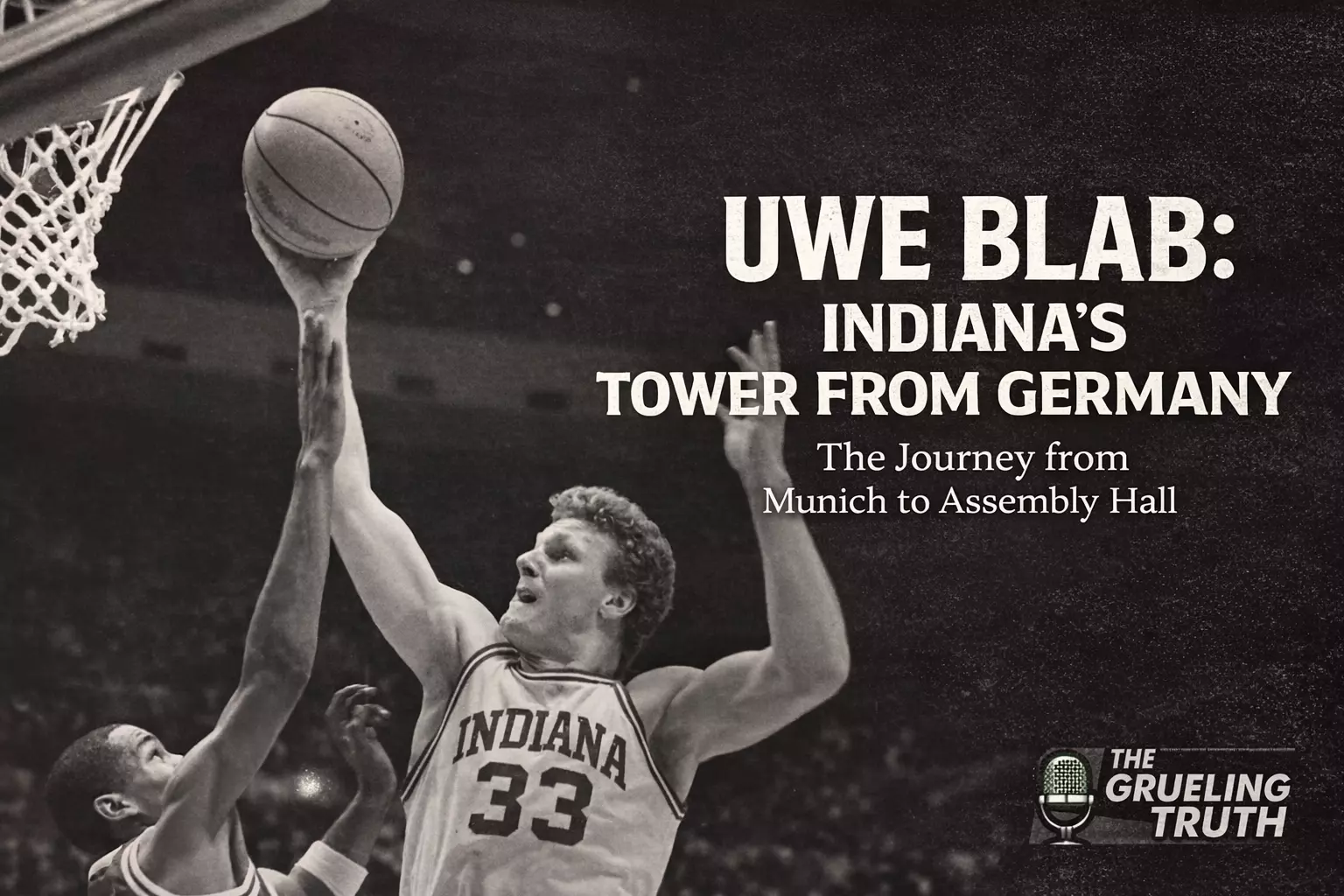
Uwa Blab is one of the strangest stories in Indiana Hoosier history, he came from Germany and became a very good player!
Long before Indiana fans became used to international players in college basketball, Uwe Blab felt like something out of another world. He was 7-foot-2, from Munich, West Germany, red-haired, raw, and unlike almost any player
Bob Knight
had ever brought into Bloomington. By the time his Indiana career ended in 1985, Blab had become a first-team All-Big Ten center, a 1,000-point scorer, an NBA first-round draft pick, and one of the most distinctive big men of the Knight era. His story is not just about basketball. It is about distance, adaptation, discipline, and a life that took him from Munich to Effingham, from Assembly Hall to the Olympics, and eventually into a second career in Texas.
From Munich to the Midwest
Blab was born Uwe Konstantin Blab on March 26, 1962, in Munich, West Germany. Olympedia lists him at 218 cm and 110 kg, and identifies his early affiliations with Indiana and later ALBA Berlin. That matters because his story began as a European one, not an Indiana one. He was not the product of Indiana gyms or the normal pipelines that fed Knight’s program. He came out of a completely different basketball culture and, by his own later recollection, did not even grow up with basketball as the center of his life. In a later interview, Blab said he only really began playing because of his height, and that as a teenager in Munich he was playing club ball only sparingly.
What changed his life was a chance connection that sounds almost too unlikely to be real. In Blab’s own account, he met the man who became his American father after a game in Germany, when an American-connected team had traveled through Europe. Blab said he was asked whether he would like to come to the United States for a year, and he immediately knew the answer was yes. Blab’s story covers his path “from Munich, Germany to Effingham, Illinois” and specifically his transition with the Keller host family. That move to Effingham changed everything. It turned a tall German teenager into a Midwestern high school star and, eventually, an Indiana recruit, and first round NBA Draft pick.
Effingham made him visible
Before Indiana, there was Effingham High School in Illinois. That stop is crucial, because it gave American coaches a chance to see Blab up close, and it gave Blab a year inside the American basketball system. Multiple summaries of his career note that he attended Effingham High School, and contemporaneous newspaper material from Indiana’s state archive notes that after completing high school in Effingham he had been recruited by Bob Knight. By then he was no longer just a curiosity from Germany. He was a legitimate 7-foot-2 prospect with size college basketball could not ignore.
That year in Illinois also mattered culturally. Blab was learning the language, the rhythms of Midwestern life, and the far more structured, intensely coached version of basketball that existed in the United States. That period was not merely a basketball stop, but a transition into a new life with the Kellers. For a player who had grown up in Munich and had not been immersed in American basketball mythology, that adjustment was enormous. He was not arriving in college as a polished prodigy. He was arriving as a giant project with unusual intelligence, unusual size, and a life story unlike anyone else on the roster.
How Bob Knight got him
The recruiting story is one of the most interesting parts of Blab’s life because Indiana was not his only option. In a later interview, Blab said he originally visited Duke, liked it, and even committed there. He explained that his American father wanted him closer and was skeptical of Mike Krzyzewski’s credentials at that early stage, which led him to reconsider. Blab said the other school he looked at was Indiana, and that he liked it just as much as Duke. Most tellingly, he also admitted he knew essentially nothing about Bob Knight at the time. He did not choose Indiana because he had grown up dreaming of Knight. He chose Indiana because it felt right when he visited.
That detail says a lot about both men. Knight saw something he could mold. Blab, meanwhile, stepped into one of the most demanding environments in the sport without really understanding the full weight of what that meant. Indiana under Knight was not a relaxed place for a developing center. It was detail-heavy, physical, exacting, and often unforgiving. For a player from Munich still relatively new to serious basketball, it was either going to break him or make him. In the long run, it clearly made him into a far more complete player.
Indiana career: the slow build
Blab’s Indiana statistics show a classic development curve. As a freshman in 1981-82, he played 24 games, started 10, averaged 7.5 points, and shot .556 from the field. As a sophomore in 1982-83, he increased to 9.4 points per game on .518 shooting. As a junior in 1983-84, he jumped to 11.8 points, and as a senior in 1984-85 he peaked at 16.0 points per game while shooting .565 from the floor and .714 from the line. Over 118 career games, he scored 1,357 points, shot .543 from the field, and averaged 11.5 points, 5.4 rebounds, and 1.7 blocks per game. Those numbers are the statistical version of what Knight’s staff did with him: they turned a fascinating athlete into a real Big Ten center.
His freshman season placed him on an Indiana team still stocked with veteran talent. He was learning around players in the post-title period, and by 1982-83 he had become part of a strong Hoosier team that finished 24-6, went 13-5 in the Big Ten, and won the conference championship under Knight. Indiana was the Big Ten champions, fifth in the final AP poll, and one of the better defensive teams in the country. Blab was not yet the focal point, but he was becoming a real part of Indiana’s structure.
Playing alongside Indiana stars
One reason Blab’s Indiana years matter is the company he kept. On the 1982-83 team, the roster included Ted Kitchel, Randy Wittman, Jim Thomas, Dan Dakich, Cam Cameron, and others. By 1984-85, the supporting cast around Blab had changed, and he was sharing the floor with Steve Alford, Dan Dakich, Daryl Thomas, Delray Brooks, Stew Robinson, and Todd Meier. That means Blab’s career bridged two different Indiana chapters: the veteran, old-guard Knight teams of the early 1980s and the younger Alford-led teams that would define the middle of the decade.
That bridge matters because Blab often gets remembered only as “the big German center,” when in truth he was a major figure in a transitional period for Indiana basketball. As a sophomore, he was a useful rotation big on a conference champion. As a junior, he became a more central weapon. As a senior, he was one of the clear pillars of the team. He was not merely a novelty or a project by the end. He had become one of Knight’s primary inside options and a player good enough to be recognized nationally and by the NBA.
The 1982-83 season: Big Ten champion
The first really important year in Blab’s Indiana story was 1982-83. Indiana finished 24-6 overall and 13-5 in the Big Ten, good enough to claim the conference title. Blab averaged 9.4 points that season, nearly two full points better than his freshman year, and started 19 games. On a Knight team that still relied heavily on older perimeter pieces, that production mattered. It showed that Indiana was beginning to trust him with larger minutes and more responsibility.
This was also the year when Indiana fans began to see what he could become. He was still more functional than polished, but the size was real, the finishing around the basket was improving, and Knight had taught him enough about positioning that he could help Indiana on both ends. He was never the kind of player who would move like a wing, but that was not the point. Knight needed him to occupy space, finish efficiently, protect the rim, rebound, and force opponents to deal with real size. In the Big Ten, where
post play
still mattered enormously, that had value.
The 1983-84 season: his biggest Indiana moment
If one season defines Blab as a Hoosier, it is 1983-84. Indiana finished 22-9 and 13-5 in the Big Ten, then made a run to the Elite Eight. Blab scored 11.8 points and amassed 6.1 rebounds per game that season. That was the year he truly looked like a high-level college center rather than merely a very tall one.
The tournament run is why his Indiana career still carries some emotional weight. That Hoosier team made one of the great surprise runs of the Knight era, beating Richmond and then knocking off No. 1 seed North Carolina to reach the regional final before losing to Virginia. Indiana’s starting lineup included Mike Giomi, Uwe Blab, Marty Simmons, Steve Alford, and Dan Dakich. To beat a Dean Smith team loaded with Michael Jordan, Sam Perkins, Brad Daugherty, and Kenny Smith remains one of the most memorable NCAA wins in
Indiana history, and Blab was the starting center in the middle of it.
That run also gave him stature beyond Bloomington. A 7-foot-2 center who helped Indiana to the Elite Eight was always going to interest scouts, but now there was tournament proof. He could function on a big stage, absorb the tactical demands of Knight, and contribute on a team that could beat elite talent. He was not a dominant college superstar in the Patrick Ewing mold, but he was becoming exactly the kind of player NBA teams talked themselves into drafting high: huge, experienced, and clearly improved every year.
The senior year: Uwe as a finished product
Statistically, Blab saved his best for last. In 1984-85, he started 31 of 33 games and averaged 16.0 points, 6.3 rebounds, and 2.2 blocks per game, while shooting .565 from the floor and .714 at the line. Indiana’s official roster page shows 529 points in 33 games, comfortably his best offensive season.
What is notable is that this peak came on a disappointing team. Indiana finished just 19-14 overall and 7-11 in the Big Ten. In other words, Blab individually had his strongest season while the team around him fell short of Indiana standards. That can sometimes distort a player’s memory. Fans remember the team’s frustration more than the individual growth. But Blab’s senior year is important because it showed how far he had come under Knight. He had gone from a raw exchange-student big man into a center who could carry real offense in the Big Ten.
He also finished his Indiana career with numbers that deserve more respect than he usually gets. Indiana’s official stats list him with 634 rebounds and 196 blocks, alongside those 1,357 points. He was not just tall. He was productive for a long time in one of the toughest leagues in the country. And because Knight demanded so much of his centers, that production says something about Blab’s coachability and resilience. Plenty of players with his size never become this effective. He did.
What kind of player was he?
Blab was never a flashy Indiana player, and that is part of why his reputation can get flattened over time. He was a true center in the old sense: big target, interior finisher, rebounder, shot blocker, and post defender. He was not the player Indiana ran the whole offense through in the way some later teams revolved around perimeter stars. But he was central to balance. He gave the Hoosiers size, efficiency, and a rim presence they badly needed during his era. His shooting percentages stayed strong all four years, which tells you he understood his game and generally took the right kinds of shots.
His career arc also makes him a classic Knight development story. Knight did not recruit a finished product from Munich. He recruited a frame, a mind, and a possibility. By the end, Blab had become good enough to make All-Big Ten, play in the Olympics, and go in the first round of the NBA draft. Whether fans loved every part of his game or not, the development itself is undeniable.
Blab represented West Germany at the 1984 Los Angeles Olympics, where the team finished eighth, and then represented unified Germany at the 1992 Barcelona Olympics, where the team finished seventh. FIBA’s EuroBasket 1985 page credits him with 13.6 points per game in that tournament, confirming that he was not just an Indiana player who dipped into national-team duty; he was a meaningful part of West Germany’s basketball program in the 1980s.
After Indiana: NBA, and Europe
Blab’s life after Indiana was substantial.
In 1985, the Dallas Mavericks selected him with the 17th overall pick in the first round of the NBA draft. NBA stops for Blab were Dallas from 1985-89, Golden State in 1989, and San Antonio in 1990. His NBA career did not turn into stardom, but reaching the league at all was a major achievement for a player who had started late and had come from Munich through an exchange-student path.
Blab himself later spoke candidly about why his NBA career did not become more. In a long retrospective interview, he said basketball was never fully in his heart the way soccer or handball had been, and he regretted one offseason in particular when he felt he did not prepare as well as he should have. That honesty is part of what makes his story different from the standard athlete myth. He did not pretend basketball had always been his lifelong obsession. He was grateful for it, but he was also unusually frank that it was not his deepest passion.
After the NBA, he played in Europe again. He played in Napoli in Italy from 1990-91 and ALBA Berlin from 1991-93. In the same retrospective interview, Blab said playing in Europe was enjoyable in a different way because he was a major player there rather than a role player, and he remembered his final Berlin season fondly, especially because he got to play with his brother. That matters in telling the full story: after Indiana and the NBA, he found a version of basketball life that fit him better.
Life after basketball
One of the most striking details about Blab is how normal and grounded his second life became. After his playing career he moved to Texas with his family and became a software engineer. In his own recollection, he had long been interested in computers and even did COBOL programming work for Texas Instruments while he was still with the Mavericks. That means his post-basketball life was not improvised. The interest had been there all along. In a way, the software career makes his whole story feel even more unusual: giant Indiana center, Olympian, NBA player, then tech professional.
His later life also included profound tragedy as he lost a son in a 2010 brawl in San Marcos, Texas. Obituary and news coverage from that period identify the son as Christopher Johannes Blab, age 19. It is not the defining fact of Uwe Blab’s life, but it is part of the life after basketball the user asked about, and it reminds you that the story of an athlete does not freeze when the games end. The person keeps living, loving, working, and enduring grief like anyone else.
His Indiana legacy
At Indiana, Blab is easy to misremember because he does not fit the usual Hoosier archetype. He was not an Indiana-born gym rat, not a silky scorer, not a title-winning folk hero like players from other eras. He was something rarer: an imported giant whom Bob Knight turned into a serious Big Ten center. He helped win a Big Ten title in 1983, helped power an Elite Eight run in 1984, made first-team All-Big Ten in 1985, scored 1,357 career points, and became an
NBA first-round pick. That is a far more substantial Indiana career than he is often given credit for.
More than that, Blab represents something fascinating in Indiana history: Bob Knight, the most demanding traditionalist in the sport, taking a towering teenager from Munich who did not even know his legend and making him into a Hoosier. That is a story about talent, yes, but also about adaptation and trust. Uwe Blab came to America for a year. He ended up becoming part of Indiana basketball history.
Up To $1500 in Bonus Bets Paid Back if your First Bet Does Not Win
T&Cs apply
4.5/5
Gambling problem? Call 1-800-GAMBLER or 1-800-MY-RESET (Available in the US) 877-8-HOPENY or text HOPENY (467369) (NY) 1-800-327-5050 (MA), 1-800-BETS-OFF (IA), 1-800-981-0023 (PR). 21+ only. Please Gamble Responsibly. See BetMGM.com for Terms. First Bet Offer for new customers only (if applicable). Subject to eligibility requirements. Bonus bets are non-withdrawable. In partnership with Kansas Crossing Casino and Hotel. Promotional offers not available in Mississippi, Massachusetts, New York, Ontario, or Puerto Rico.
New DraftKings Customers: Spend $5+ Get $150 in Bonuses
T&Cs apply
4.5/5
GAMBLING PROBLEM? CALL 1-800-GAMBLER or 1-800-MY-RESET, (800) 327-5050 or visit gamblinghelplinema.org (MA). Please Gamble Responsibly. 888-789-7777/visit ccpg.org (CT), or visit www.mdgamblinghelp.org (MD), 1-800-981-0023 (PR). 21+ and present in most states. (18+ DC/NH/PR/WY). Void in CAN. Eligibility restrictions apply. On behalf of Boot Hill Casino (KS). Pass-thru of per wager tax may apply in IL. 1 per new DraftKings customer. $5+ first-time bet req. Max. $150 issued as non-withdrawable Bonus Bets. Stake removed from payout. Reward issued as $50 in Bonus Bets every 7 days via click-to-claim for 14 days. Bonus Bets and click-to-claims expire 7 days (168hrs) after issuance. Terms: sportsbook.draftkings.com/promos. Ends 10/11/26 at 11:59 PM ET. Sponsored by DK.
Must be 21+. GAMBLING PROBLEM? CALL 1-800-GAMBLER OR CALL 1-800-MY-RESET, www.mdgamblinghelp.org (MD), (800)-327-5050 or gamblinghelplinema.org (MA), Call (877)8-HOPENY or text HOPENY (467369) (NY), (888) 789-7777 or ccpg.org (CT), morethanagame.nc.gov (NC), 1800gambler.net (WV)
Bet $1 and get double the winnings up to $25 for your next 10 bets
T&Cs apply
4.4/5
21+ New users only. Must register using eligible promo code. First bet after registration must qualify. Max. Bonus Bet: $1,000. Bonus Bet expires 14 days after receipt. Void where prohibited. See Caesars.com/promos for full terms. Gambling Problem? 1-800-GAMBLER (1-800-426-2537)
21+ and present in OH. Gambling Problem? Call 1-800-GAMBLER.
This site is using
Cloudflare
and adheres to the
Google Safe Browsing Program. We adapted
Google's Privacy Guidelines
to keep your data safe at all times.
Close
Ready to Win Big? Join the Elite with Our Sports Betting Deals!
FanDuel Promo
New Users – Get $250 in Bonus Bets when you wager $5 for 5 days
Up To $1500 in Bonus Bets Paid Back if your First Bet Does Not Win
Best Slots
T&Cs and 21+ apply
Gambling problem? Call 1-800-GAMBLER or 1-800-MY-RESET (Available in the US) 877-8-HOPENY or text HOPENY (467369) (NY) 1-800-327-5050 (MA), 1-800-BETS-OFF (IA), 1-800-981-0023 (PR). 21+ only. Please Gamble Responsibly. See BetMGM.com for Terms. First Bet Offer for new customers only (if applicable). Subject to eligibility requirements. Bonus bets are non-withdrawable. In partnership with Kansas Crossing Casino and Hotel. Promotional offers not available in Mississippi, Massachusetts, New York, Ontario, or Puerto Rico.
Code:
Open BetMGM
Get Bonus
DraftKings Promo
New DraftKings Customers: Spend $5+ Get $150 in Bonuses
Newcomer
T&Cs and 21+ apply
GAMBLING PROBLEM? CALL 1-800-GAMBLER or 1-800-MY-RESET, (800) 327-5050 or visit gamblinghelplinema.org (MA). Please Gamble Responsibly. 888-789-7777/visit ccpg.org (CT), or visit www.mdgamblinghelp.org (MD), 1-800-981-0023 (PR). 21+ and present in most states. (18+ DC/NH/PR/WY). Void in CAN. Eligibility restrictions apply. On behalf of Boot Hill Casino (KS). Pass-thru of per wager tax may apply in IL. 1 per new DraftKings customer. $5+ first-time bet req. Max. $150 issued as non-withdrawable Bonus Bets. Stake removed from payout. Reward issued as $50 in Bonus Bets every 7 days via click-to-claim for 14 days. Bonus Bets and click-to-claims expire 7 days (168hrs) after issuance. Terms: sportsbook.draftkings.com/promos. Ends 10/11/26 at 11:59 PM ET. Sponsored by DK.
Code:
Open DraftKings
Get Bonus
Find out what the legends have to say about sports this week....