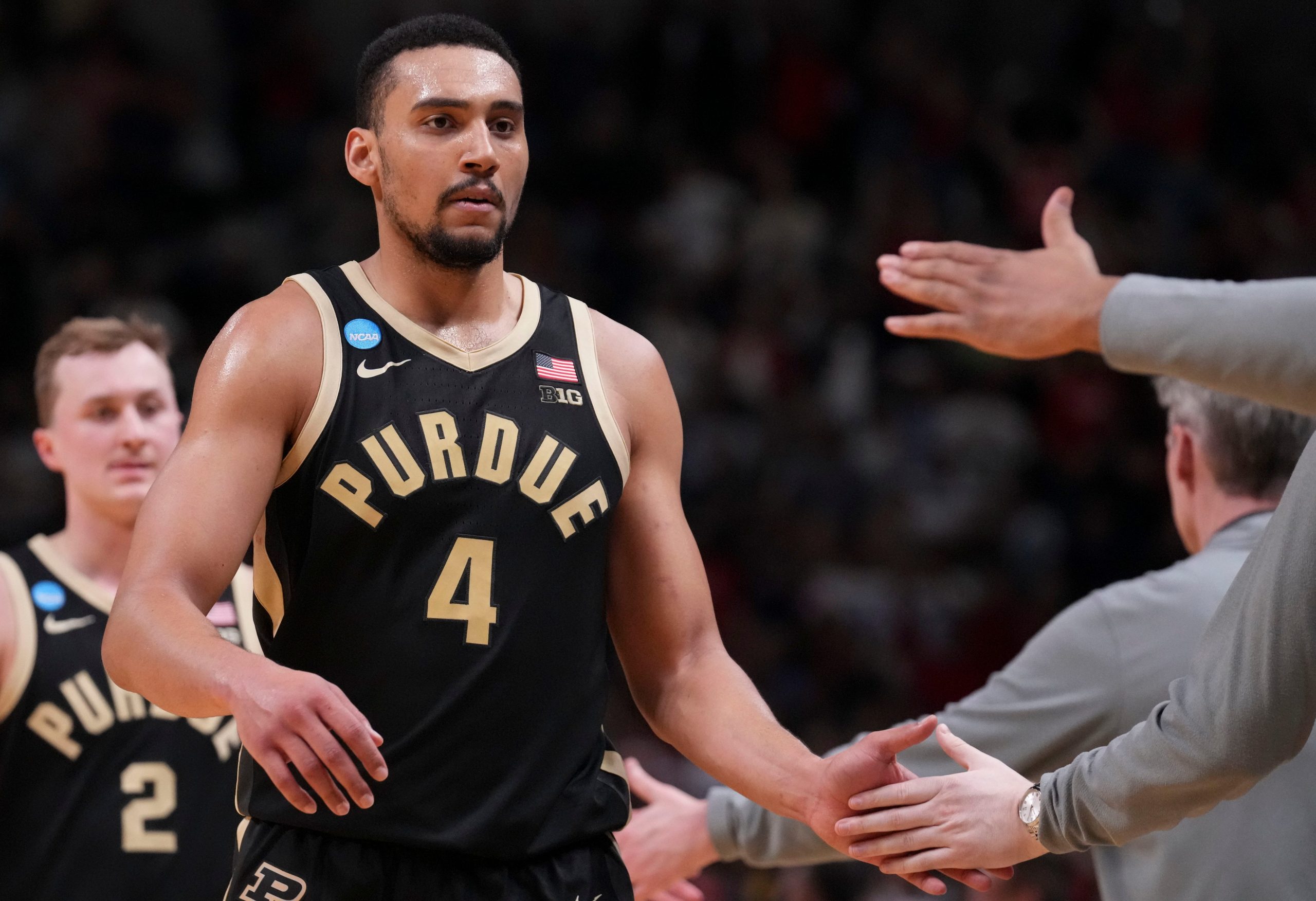
Purdue Boilermakers forward Trey Kaufman-Renn (4) leaves the court as the seconds count down in a NCAA Tournament game against the Arizona Wildcats on Saturday, March 28, 2026 at SAP Center in San Jose, Calif. Purdue fell to Arizona 79-64.
Kansas has added a proven college basketball scorer to its frontcourt. Whether that addition comes with lasting eligibility certainty is a separate question.
Former Purdue standout Trey Kaufman-Renn has joined the Jayhawks, enrolled in classes and begun practicing with Bill Self’s team. Kansas announced his arrival Monday, giving the program an experienced interior option shortly before the regular season begins.
His participation depends on court relief in an ongoing eligibility challenge. According to the Lawrence Journal-World, Kaufman-Renn received an injunction in Clark County, Indiana, on October 9 that makes him eligible for the 2026–27 season under its terms. That is meaningful authorization to participate. It should not be confused with a final judgment resolving the underlying dispute.
That distinction defines this story.
Kansas
has a player who could materially improve its basketball team. Kaufman-Renn has another opportunity to compete while pursuing his case. Both are operating in circumstances where a roster announcement provides more certainty about the present than the future.
Sixth Year in College, Fifth Season on the Court
The language surrounding Kaufman-Renn’s situation can become confusing quickly.
He spent five years at Purdue but competed in four seasons. He redshirted during the 2021–22 academic year following a knee injury. His effort to play in 2026–27 therefore concerns a sixth year in college and a fifth season of competition—not a sixth season of playing games.
That difference deserves careful treatment.
“Seeking a sixth year” can sound like an athlete asking to play six full seasons. It does not accurately describe Kaufman-Renn’s history. At the same time, identifying an unused season does not, by itself, establish a right to another year.
His case concerns whether he can compete again under the circumstances presented to the court. The injunction has practical consequences now, while the larger dispute remains unresolved.
Joining Kansas and Winning the Case Are Different Events
Three developments should be kept separate.
First, Kansas has formally added Kaufman-Renn. Second, he has received preliminary legal relief supporting his participation. Third, a final resolution of his eligibility challenge would settle the merits more conclusively.
The first two have been reported. They do not establish the third.
The Journal-World reported October 19 that the NCAA had not yet appealed his injunction. It also noted that the full text of that ruling was not available on the Indiana court-records website when its article was published. Those reporting limits matter: the precise scope of an order should not be embellished beyond what has been established.
For fans, the most accurate description is that Kaufman-Renn has joined Kansas and has court-backed eligibility under the reported injunction, with the litigation still ongoing.
Describing him as merely waiting for permission to participate understates the relief he has obtained. Calling his situation permanently settled overstates it.
Kansas Has a Clear Basketball Reason to Welcome Him
The attraction for Self is straightforward.
Kaufman-Renn averaged 14.2 points, 8.3 rebounds and 2.5 assists at Purdue last season while shooting
57.8% from the field. He recorded 11 double-doubles. During the previous season, he averaged 20.1 points and 6.5 rebounds.
That is substantial production to add this late in the calendar.
His potential value begins with giving Kansas another player capable of producing offense around the basket. A dependable interior scorer can create opportunities when perimeter actions fail, force defensive help and give teammates a target against pressure.
His rebounding also offers a way to contribute without requiring every possession to run through him.
Those possibilities do not guarantee the same statistics in a different offense. They do give Kansas a credible reason to believe he can help immediately.
His Experience Could Ease a Difficult Transition
Late additions face a demanding adjustment.
A player must learn terminology, understand teammates’ tendencies and establish his place in a rotation that has already spent months preparing together. Physical ability does not eliminate those challenges.
Self nevertheless expressed confidence in Kaufman-Renn’s ability to adapt, citing his basketball intelligence and the preparation he received at Purdue.
That assessment makes sense as a basketball projection.
An experienced player may recognize familiar concepts even when the terminology changes. He may understand when to screen, where to establish position and how to respond when a defense takes away the first option.
The adjustment still has to happen on the floor. Kansas cannot assume that an accomplished player automatically produces an accomplished lineup.
Self’s task is to identify where Kaufman-Renn complements the existing personnel and where combinations require more work.
The Frontcourt Gains Flexibility—and New Decisions
Kaufman-Renn’s
arrival creates choices about how Kansas wants to play.
One possibility is using him as an interior scoring option alongside a larger center. Another is deploying him at center in selected combinations, prioritizing offensive skill and experience.
Each approach carries different demands.
Playing two interior-oriented players together requires enough spacing elsewhere to prevent the defense from crowding the lane. Using a smaller center changes rebounding and defensive responsibilities, particularly against opponents with size.
The useful addition is the choice itself. Kansas can explore another answer rather than depend on a single frontcourt configuration.
But the staff must evaluate those combinations through execution, not reputation. The best lineup will be the one that functions at both ends, rather than the one containing the most recognizable names.
The NBA Draft Adds Another Layer
Kaufman-Renn’s route back to college also included the professional basketball process.
Minnesota selected him 59th overall in the 2026 NBA Draft, but he did not sign a professional playing contract. He appeared in Summer League before joining Kansas.
Those facts help explain why the story attracts attention. A player can be drafted, explore a professional opportunity and still pursue a contested route back to college.
However, the absence of a professional contract should not be presented as automatically resolving every eligibility question. His remaining seasons of competition and the legal challenge are separate issues.
Treating one fact as a complete answer would obscure the very uncertainty that makes this case significant.
The Larger Problem Is Planning Without a Settled Answer
For Kansas, the immediate benefit is access to another productive player.
The broader difficulty is building a season around availability that remains connected to litigation. Coaches must allocate practice repetitions, develop combinations and communicate roles while accounting for circumstances beyond the court.
For the player, uncertainty has a different cost. Training, education and career decisions must proceed even when the governing dispute has not reached its conclusion.
This is why clear reporting matters. Fans deserve to know what has happened, what currently permits participation and what remains open.
Kaufman-Renn’s arrival could strengthen Kansas considerably. His history suggests he brings scoring, rebounding and experience that Self can use.
But his signing and his legal case should remain distinct in the discussion. Kansas has secured a potentially important basketball addition. The reported injunction provides a present basis for him to participate. A final eligibility resolution is another development—and should be reported as one only when it occurs.
New Users – Get $350 in Bonus Bets when you wager $5 for 7 days
T&Cs apply
4.6/5
Gambling Problem? Call 1-800-GAMBLER or 1-800-MY-RESET. Call 1-888-789-7777 or visit ccpgg.org/chat (CT). Hope is here. GamblingHelpLineMA.org or call (800) 327-5050 for 24/7 support (MA). Visit www.mdgamblinghelp.org (MD). Call 1-877-8HOPE-NY or text HOPENY (NY). 21+ (18+ DC, WY) and present in select states (for KS, in affiliation with Kansas Star Casino). Find online real money wagering only. Min $5 wager required for 7 consecutive days. $5 free play credit. Bonus issued as non-withdrawable bonus with cash withdrawable bonus with cash withdrawable. Bonus bets which expire 7 days after receipt. Restrictions apply. See terms at sportsbook.fanduel.com. Call 1-877-770-7867 (LA).
Up To $1500 in Bonus Bets Paid Back if your First Bet Does Not Win
T&Cs apply
4.5/5
Gambling problem? Call 1-800-GAMBLER or 1-800-MY-RESET (Available in the US) 877-8-HOPENY or text HOPENY (467369) (NY) 1-800-327-5050 (MA), 1-800-BETS-OFF (IA), 1-800-981-0023 (PR). 21+ only. Please Gamble Responsibly. See BetMGM.com for Terms. First Bet Offer for new customers only (if applicable). Subject to eligibility requirements. Bonus bets are non-withdrawable. In partnership with Kansas Crossing Casino and Hotel. Promotional offers not available in Mississippi, Massachusetts, New York, Ontario, or Puerto Rico.
New DraftKings Customers: Bet $5, Get $200 + 3 Months of NBA League Pass!
T&Cs apply
4.5/5
GAMBLING PROBLEM? CALL 1-800-GAMBLER or 1-800-MY-RESET, (800) 327-5050 or visit gamblinghelplinema.org (MA). Please Gamble Responsibly. 888-789-7777/visit ccpg.org (CT), or visit www.mdgamblinghelp.org (MD), 1-800-981-0023 (PR). 21+ and present in most states. (18+ DC/NH/PR/WY). Void in CAN. Eligibility restrictions apply. On behalf of Boot Hill Casino (KS). Pass-thru of per wager tax may apply in IL. 1 per new Sportsbook customer. $5+ first-time bet req. Max. $200 issued as non-withdrawable Bonus Bets. Stake removed from payout. Reward issued as $50 in Bonus Bets every 7 days via click-to-claim for 21 days. Bonus Bets and click-to-claims expire 7 days (168hrs) after issuance. Terms: dkng.co/offer. Get 1 promo code to redeem a 3-month NBA League Pass subscription, complimentary of DraftKings. Subscription auto-renews monthly at then-current price (currently $16.99/mo); cancel anytime. Terms, restrictions, and eligibility requirements apply. Redeem League Pass by 12/19/26 at 11:59 PM ET. Addt’l terms: support.watch.nba.com/hc/en-us/articles/9165532876183-League-Pass-Terms-of-Use_. Ends 11/29/26 at 11:59 PM ET. Sponsored by DK.
Must be 21+. GAMBLING PROBLEM? CALL 1-800-GAMBLER OR CALL 1-800-MY-RESET, www.mdgamblinghelp.org (MD), (800)-327-5050 or gamblinghelplinema.org (MA), Call (877)8-HOPENY or text HOPENY (467369) (NY), (888) 789-7777 or ccpg.org (CT), morethanagame.nc.gov (NC), 1800gambler.net (WV)
Bet $1 and get double the winnings up to $25 for your next 10 bets
T&Cs apply
4.4/5
21+ New users only. Must register using eligible promo code. First bet after registration must qualify. Max. Bonus Bet: $1,000. Bonus Bet expires 14 days after receipt. Void where prohibited. See Caesars.com/promos for full terms. Gambling Problem? 1-800-GAMBLER (1-800-426-2537)
21+ and present in OH. Gambling Problem? Call 1-800-GAMBLER.
This site is using
Cloudflare
and adheres to the
Google Safe Browsing Program. We adapted
Google's Privacy Guidelines
to keep your data safe at all times.
Close
Ready to Win Big? Join the Elite with Our Sports Betting Deals!
FanDuel Promo
New Users – Get $350 in Bonus Bets when you wager $5 for 7 days
Our Favorite
T&Cs and 21+ apply
Gambling Problem? Call 1-800-GAMBLER or 1-800-MY-RESET. Call 1-888-789-7777 or visit ccpgg.org/chat (CT). Hope is here. GamblingHelpLineMA.org or call (800) 327-5050 for 24/7 support (MA). Visit www.mdgamblinghelp.org (MD). Call 1-877-8HOPE-NY or text HOPENY (NY). 21+ (18+ DC, WY) and present in select states (for KS, in affiliation with Kansas Star Casino). Find online real money wagering only. Min $5 wager required for 7 consecutive days. $5 free play credit. Bonus issued as non-withdrawable bonus with cash withdrawable bonus with cash withdrawable. Bonus bets which expire 7 days after receipt. Restrictions apply. See terms at sportsbook.fanduel.com. Call 1-877-770-7867 (LA).
Code:
Open FanDuel
Get Bonus
BetMGM Promo
Up To $1500 in Bonus Bets Paid Back if your First Bet Does Not Win
Best Slots
T&Cs and 21+ apply
Gambling problem? Call 1-800-GAMBLER or 1-800-MY-RESET (Available in the US) 877-8-HOPENY or text HOPENY (467369) (NY) 1-800-327-5050 (MA), 1-800-BETS-OFF (IA), 1-800-981-0023 (PR). 21+ only. Please Gamble Responsibly. See BetMGM.com for Terms. First Bet Offer for new customers only (if applicable). Subject to eligibility requirements. Bonus bets are non-withdrawable. In partnership with Kansas Crossing Casino and Hotel. Promotional offers not available in Mississippi, Massachusetts, New York, Ontario, or Puerto Rico.
Code:
Open BetMGM
Get Bonus
DraftKings Promo
New DraftKings Customers: Bet $5, Get $200 + 3 Months of NBA League Pass!
Newcomer
T&Cs and 21+ apply
GAMBLING PROBLEM? CALL 1-800-GAMBLER or 1-800-MY-RESET, (800) 327-5050 or visit gamblinghelplinema.org (MA). Please Gamble Responsibly. 888-789-7777/visit ccpg.org (CT), or visit www.mdgamblinghelp.org (MD), 1-800-981-0023 (PR). 21+ and present in most states. (18+ DC/NH/PR/WY). Void in CAN. Eligibility restrictions apply. On behalf of Boot Hill Casino (KS). Pass-thru of per wager tax may apply in IL. 1 per new Sportsbook customer. $5+ first-time bet req. Max. $200 issued as non-withdrawable Bonus Bets. Stake removed from payout. Reward issued as $50 in Bonus Bets every 7 days via click-to-claim for 21 days. Bonus Bets and click-to-claims expire 7 days (168hrs) after issuance. Terms: dkng.co/offer. Get 1 promo code to redeem a 3-month NBA League Pass subscription, complimentary of DraftKings. Subscription auto-renews monthly at then-current price (currently $16.99/mo); cancel anytime. Terms, restrictions, and eligibility requirements apply. Redeem League Pass by 12/19/26 at 11:59 PM ET. Addt’l terms: support.watch.nba.com/hc/en-us/articles/9165532876183-League-Pass-Terms-of-Use_. Ends 11/29/26 at 11:59 PM ET. Sponsored by DK.
Code:
Open DraftKings
Get Bonus
Find out what the legends have to say about sports this week....
New Users – Get $350 in Bonus Bets when you wager $5 for 7 days
Gambling Problem? Call 1-800-GAMBLER or 1-800-MY-RESET. Call 1-888-789-7777 or visit ccpgg.org/chat (CT). Hope is here. GamblingHelpLineMA.org or call (800) 327-5050 for 24/7 support (MA). Visit www.mdgamblinghelp.org (MD). Call 1-877-8HOPE-NY or text HOPENY (NY). 21+ (18+ DC, WY) and present in select states (for KS, in affiliation with Kansas Star Casino). Find online real money wagering only. Min $5 wager required for 7 consecutive days. $5 free play credit. Bonus issued as non-withdrawable bonus with cash withdrawable bonus with cash withdrawable. Bonus bets which expire 7 days after receipt. Restrictions apply. See terms at sportsbook.fanduel.com. Call 1-877-770-7867 (LA).