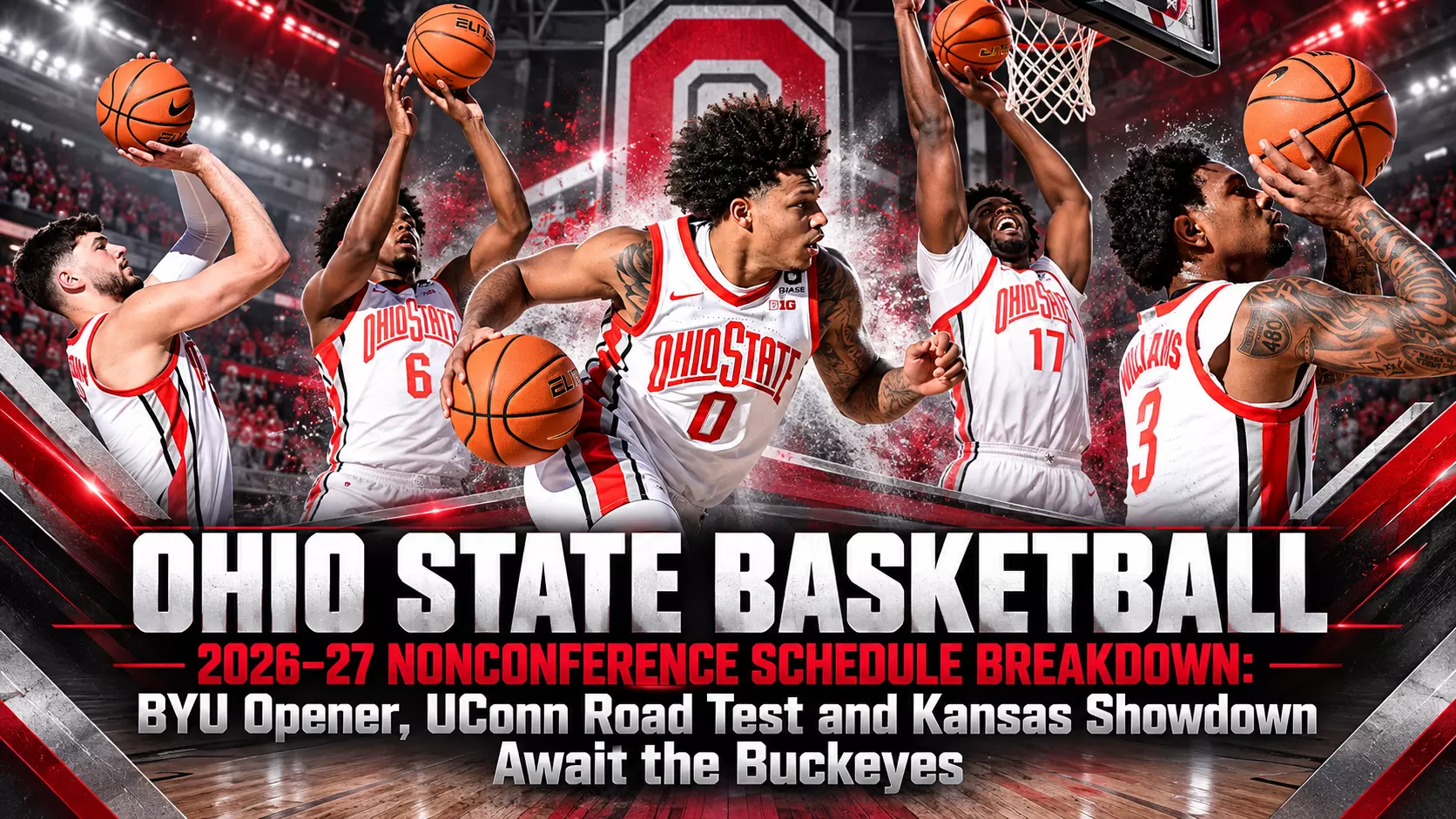
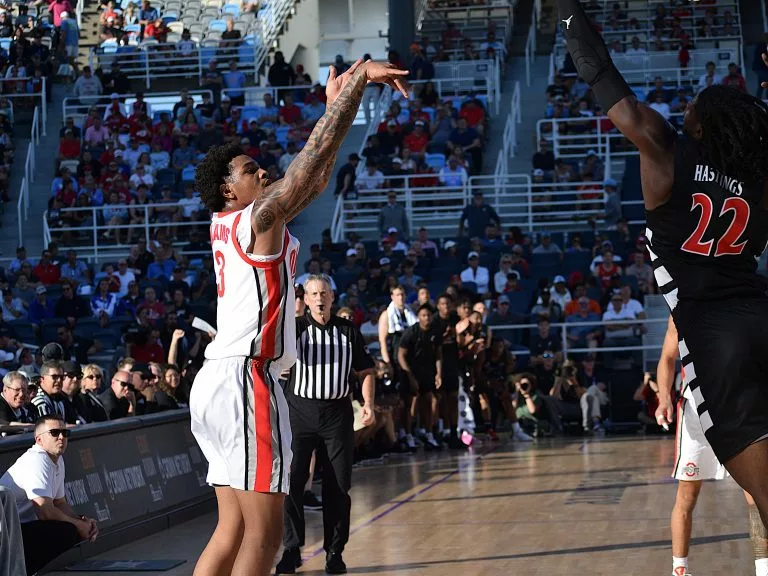
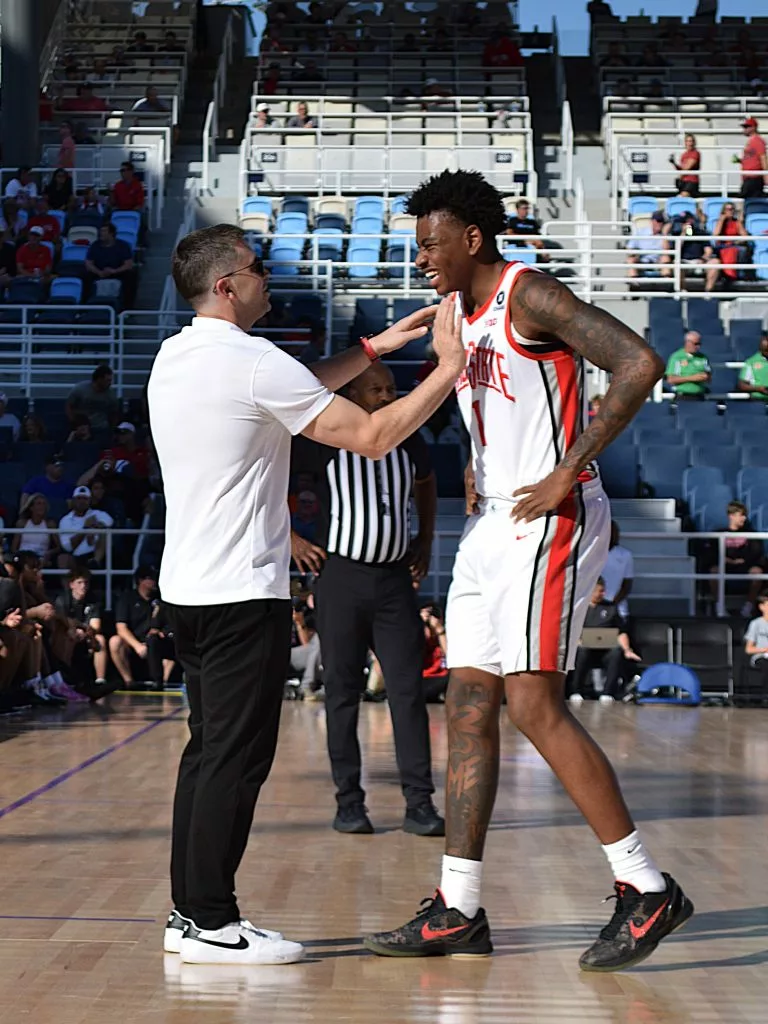
Ohio State Basketball 2026–27 Nonconference Schedule Breakdown: BYU Opener, UConn Road Test and Kansas Showdown Await the Buckeyes
Ohio State’s 2026–27 men’s basketball nonconference schedule gives the Buckeyes several opportunities to establish themselves before the heart of Big Ten play. With games against BYU, UConn, Vanderbilt, Notre Dame and Kansas, the schedule demands more than simply collecting wins at home.
The Buckeyes return starters
John Mobley Jr. and Amare Bynum while welcoming eight newcomers, making the early season an important period for developing chemistry. A challenging opener and two significant road assignments should quickly reveal where Ohio State is ready—and where it needs improvement.
Ohio State has
12 regular-season nonconference games: eight at home, two on the road and two at neutral sites.
The Nonconference Schedule
Date Opponent Site Time
November 2 BYU Neutral — Salt Lake City, Utah 9 p.m.
November 6 Youngstown State Schottenstein Center 6:30 p.m.
November 9 Marshall Schottenstein Center 6 p.m.
November 13 UConn Away — Storrs, Connecticut 7:30 p.m.
November 16 Prairie View A&M Schottenstein Center 6:30 p.m.
November 19 UMBC Schottenstein Center 7 p.m.
November 24 Vanderbilt Schottenstein Center 7 p.m.
November 29 Lipscomb Schottenstein Center 5:30 p.m.
December 12 Notre Dame Away — South Bend, Indiana TBA
December 15 Stony Brook Schottenstein Center 6 p.m.
December 19 Kansas Neutral — Madison Square Garden Noon
December 22 Mississippi Valley State Schottenstein Center4 p.m.
All times Eastern. Dates and times reflect Ohio State’s current published schedule and are subject to change.
Exhibition Games: Early Lessons Before a Demanding Opener
Ohio State
began its exhibition schedule with a
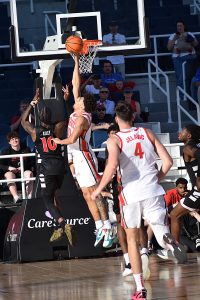
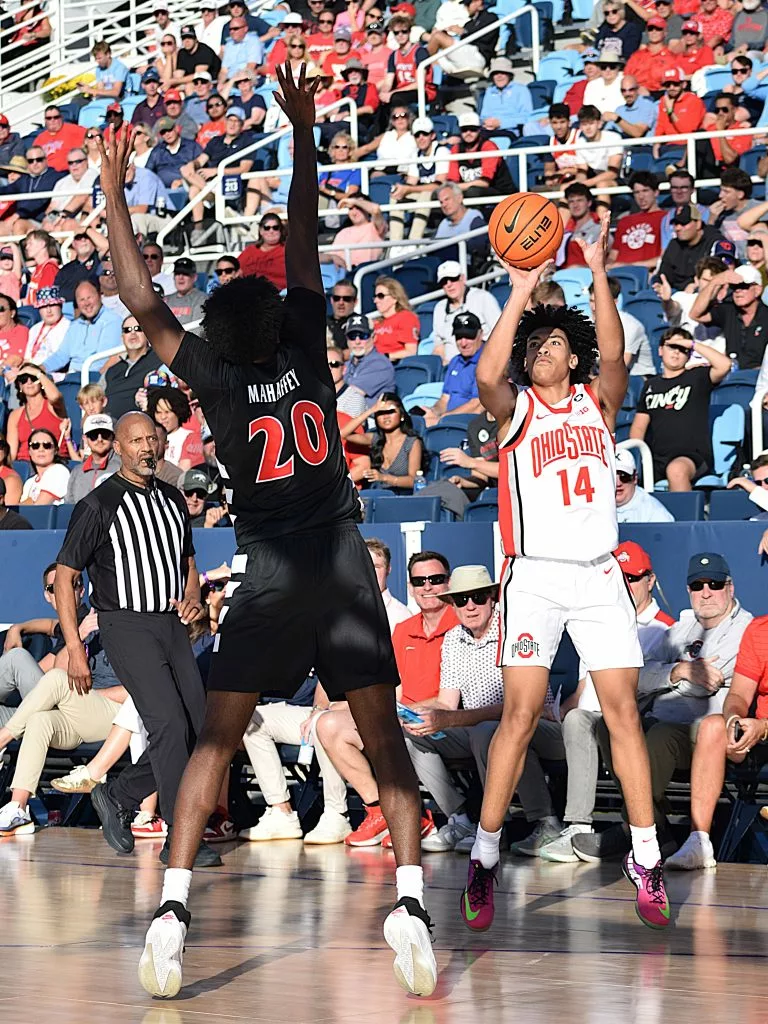
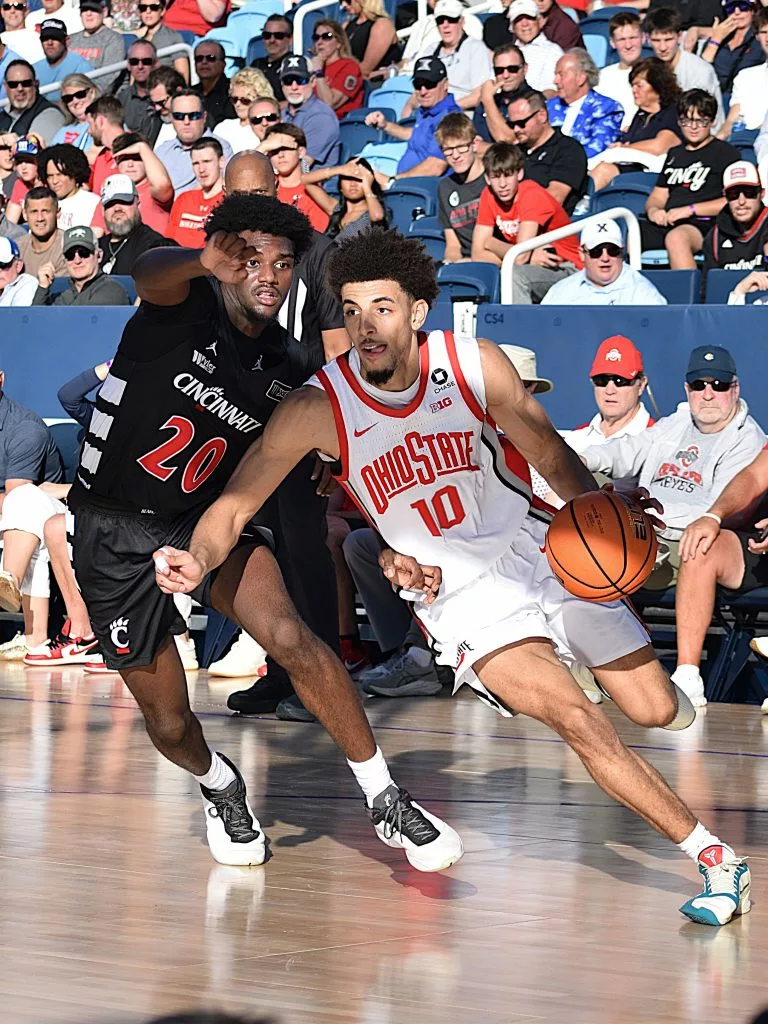
79–68 loss to Cincinnati
at the CareSource Invitational in Mason on October 7. The Buckeyes will also host Butler on October 25 at 2 p.m.
The Cincinnati result gives Ohio State a starting point for evaluation. Exhibition games allow coaches to test combinations, identify communication problems and determine which players can handle expanded responsibilities.
Butler provides another opportunity to make those adjustments before the results count. With BYU waiting immediately, the Buckeyes have reason to approach that exhibition as a meaningful preparation date.
The priority should be establishing dependable possessions at both ends: generating good shots, avoiding unnecessary turnovers and finishing defensive stops with rebounds.
BYU: An Immediate Test Away From Home
Opening against BYU in Salt Lake City gives Ohio State a significant challenge from the first night. It will be the programs’ first meeting since 1997.
Although officially a neutral-site game, its Utah location makes it reasonable to anticipate substantial BYU support. Ohio State must be prepared to communicate and execute in an environment that could feel different from a balanced neutral crowd.
The opener should provide an early look at how the Buckeyes respond when their preferred offensive options are disrupted. Can they create a quality second opportunity within a possession? Can they avoid allowing one mistake to become a scoring run?
A victory would provide immediate momentum. A competitive, organized performance would also offer useful evidence of how quickly the roster is coming together.
Youngstown State and Marshall: Turning Lessons Into Progress
The first two home games give
Ohio State
an opportunity to apply what it learns from the opener.
Against Youngstown State and Marshall, the Buckeyes should aim to establish control through execution and sustained effort. These are opportunities to develop the rotation, but that development should come with clear expectations for defensive positioning, rebounding and ball movement.
For Mobley, the challenge will include helping the offense function when opponents make his shooting a priority. Ohio State needs multiple reliable ways to score so that difficult shooting stretches do not derail entire games.
UConn: The Most Revealing Early Road Assignment
The visit to UConn begins a home-and-home series, with the Huskies scheduled to return to Columbus the following season.
This matchup should be one of the clearest early examinations of Ohio State’s composure. Road games against prominent programs place pressure on the details: defensive communication, shot selection, transition coverage and execution after timeouts.
The Buckeyes cannot depend on difficult jump shots to solve every possession. They will need purposeful movement, strong decisions and enough interior production to keep the offense balanced.
For the coaching staff, this game should help identify which combinations remain dependable under pressure.
The November Homestand: Vanderbilt Leads a Four-Game Stretch
Prairie View A&M, UMBC, Vanderbilt and Lipscomb give
Ohio State
four consecutive home opportunities after the UConn trip.
Vanderbilt is the most prominent matchup in that group. The game also starts a home-and-home arrangement, with Ohio State scheduled to visit Nashville next season.
The Vanderbilt contest offers a chance to earn a meaningful home victory, but the surrounding games deserve equal preparation. Prairie View A&M and UMBC provide opportunities to correct weaknesses exposed on the road. Lipscomb then tests whether the Buckeyes can maintain their concentration following the Vanderbilt matchup.
The value of this stretch lies in repetition. Ohio State should have enough practice and game evidence by then to sharpen its rotation and establish more consistent responsibilities.
December: Conference Play Arrives Before the Nonconference Finish
Ohio State opens Big Ten play at Nebraska on December 2 and hosts Maryland on December 6 before returning to its remaining nonconference games.
That ordering gives the December
nonconference
schedule added value. The Buckeyes can use those games to address problems exposed by their first two league opponents.
Notre Dame supplies another true road examination. By that point, Ohio State should be better equipped to handle an opposing crowd and execute through difficult stretches than it was in November.
Stony Brook falls between Notre Dame and Kansas, making focus especially important. The Buckeyes need a productive performance without looking ahead to New York.
Kansas at Madison Square Garden: A National Showcase
Ohio State faces Kansas at
noon on December 19 in the CBS Sports Classic at Madison Square Garden.
This is the nonconference schedule’s most prominent December showcase. It gives the Buckeyes an opportunity to demonstrate how much they have improved since the BYU opener.
The key will be maintaining offensive and defensive discipline throughout the game. Ohio State needs to limit empty possessions, compete on the glass and prevent mistakes from becoming easy points.
A strong performance would carry weight beyond the immediate result, offering evidence that the Buckeyes can execute against a major opponent on a national stage.
What Would Make This Schedule a Success?
My assessment is that
9–3 would represent a strong nonconference target, with the quality of those victories determining how impressive that record ultimately looks. That is a schedule benchmark, rather than a game-by-game forecast.
Ohio State should aim to protect its home court while earning meaningful wins from the BYU, UConn, Vanderbilt, Notre Dame and Kansas group. The schedule provides opportunities to build a postseason résumé without leaving every important result to Big Ten play.
Just as important is the team’s development. By the final
nonconference
game, Ohio State should have a settled rotation, dependable support around its returning starters and a clearer response to defensive pressure. Those qualities would give the Buckeyes a stronger foundation for the conference season.
New Users – Get $350 in Bonus Bets when you wager $5 for 7 days
T&Cs apply
4.6/5
Gambling Problem? Call 1-800-GAMBLER or 1-800-MY-RESET. Call 1-888-789-7777 or visit ccpgg.org/chat (CT). Hope is here. GamblingHelpLineMA.org or call (800) 327-5050 for 24/7 support (MA). Visit www.mdgamblinghelp.org (MD). Call 1-877-8HOPE-NY or text HOPENY (NY). 21+ (18+ DC, WY) and present in select states (for KS, in affiliation with Kansas Star Casino). Find online real money wagering only. Min $5 wager required for 7 consecutive days. $5 free play credit. Bonus issued as non-withdrawable bonus with cash withdrawable bonus with cash withdrawable. Bonus bets which expire 7 days after receipt. Restrictions apply. See terms at sportsbook.fanduel.com. Call 1-877-770-7867 (LA).
Up To $1500 in Bonus Bets Paid Back if your First Bet Does Not Win
T&Cs apply
4.5/5
Gambling problem? Call 1-800-GAMBLER or 1-800-MY-RESET (Available in the US) 877-8-HOPENY or text HOPENY (467369) (NY) 1-800-327-5050 (MA), 1-800-BETS-OFF (IA), 1-800-981-0023 (PR). 21+ only. Please Gamble Responsibly. See BetMGM.com for Terms. First Bet Offer for new customers only (if applicable). Subject to eligibility requirements. Bonus bets are non-withdrawable. In partnership with Kansas Crossing Casino and Hotel. Promotional offers not available in Mississippi, Massachusetts, New York, Ontario, or Puerto Rico.
New DraftKings Customers: Bet $5, Get $200 + 3 Months of NBA League Pass!
T&Cs apply
4.5/5
GAMBLING PROBLEM? CALL 1-800-GAMBLER or 1-800-MY-RESET, (800) 327-5050 or visit gamblinghelplinema.org (MA). Please Gamble Responsibly. 888-789-7777/visit ccpg.org (CT), or visit www.mdgamblinghelp.org (MD), 1-800-981-0023 (PR). 21+ and present in most states. (18+ DC/NH/PR/WY). Void in CAN. Eligibility restrictions apply. On behalf of Boot Hill Casino (KS). Pass-thru of per wager tax may apply in IL. 1 per new Sportsbook customer. $5+ first-time bet req. Max. $200 issued as non-withdrawable Bonus Bets. Stake removed from payout. Reward issued as $50 in Bonus Bets every 7 days via click-to-claim for 21 days. Bonus Bets and click-to-claims expire 7 days (168hrs) after issuance. Terms: dkng.co/offer. Get 1 promo code to redeem a 3-month NBA League Pass subscription, complimentary of DraftKings. Subscription auto-renews monthly at then-current price (currently $16.99/mo); cancel anytime. Terms, restrictions, and eligibility requirements apply. Redeem League Pass by 12/19/26 at 11:59 PM ET. Addt’l terms: support.watch.nba.com/hc/en-us/articles/9165532876183-League-Pass-Terms-of-Use_. Ends 11/29/26 at 11:59 PM ET. Sponsored by DK.
Must be 21+. GAMBLING PROBLEM? CALL 1-800-GAMBLER OR CALL 1-800-MY-RESET, www.mdgamblinghelp.org (MD), (800)-327-5050 or gamblinghelplinema.org (MA), Call (877)8-HOPENY or text HOPENY (467369) (NY), (888) 789-7777 or ccpg.org (CT), morethanagame.nc.gov (NC), 1800gambler.net (WV)
Bet $1 and get double the winnings up to $25 for your next 10 bets
T&Cs apply
4.4/5
21+ New users only. Must register using eligible promo code. First bet after registration must qualify. Max. Bonus Bet: $1,000. Bonus Bet expires 14 days after receipt. Void where prohibited. See Caesars.com/promos for full terms. Gambling Problem? 1-800-GAMBLER (1-800-426-2537)
21+ and present in OH. Gambling Problem? Call 1-800-GAMBLER.
This site is using
Cloudflare
and adheres to the
Google Safe Browsing Program. We adapted
Google's Privacy Guidelines
to keep your data safe at all times.
Close
Ready to Win Big? Join the Elite with Our Sports Betting Deals!
FanDuel Promo
New Users – Get $350 in Bonus Bets when you wager $5 for 7 days
Our Favorite
T&Cs and 21+ apply
Gambling Problem? Call 1-800-GAMBLER or 1-800-MY-RESET. Call 1-888-789-7777 or visit ccpgg.org/chat (CT). Hope is here. GamblingHelpLineMA.org or call (800) 327-5050 for 24/7 support (MA). Visit www.mdgamblinghelp.org (MD). Call 1-877-8HOPE-NY or text HOPENY (NY). 21+ (18+ DC, WY) and present in select states (for KS, in affiliation with Kansas Star Casino). Find online real money wagering only. Min $5 wager required for 7 consecutive days. $5 free play credit. Bonus issued as non-withdrawable bonus with cash withdrawable bonus with cash withdrawable. Bonus bets which expire 7 days after receipt. Restrictions apply. See terms at sportsbook.fanduel.com. Call 1-877-770-7867 (LA).
Code:
Open FanDuel
Get Bonus
BetMGM Promo
Up To $1500 in Bonus Bets Paid Back if your First Bet Does Not Win
Best Slots
T&Cs and 21+ apply
Gambling problem? Call 1-800-GAMBLER or 1-800-MY-RESET (Available in the US) 877-8-HOPENY or text HOPENY (467369) (NY) 1-800-327-5050 (MA), 1-800-BETS-OFF (IA), 1-800-981-0023 (PR). 21+ only. Please Gamble Responsibly. See BetMGM.com for Terms. First Bet Offer for new customers only (if applicable). Subject to eligibility requirements. Bonus bets are non-withdrawable. In partnership with Kansas Crossing Casino and Hotel. Promotional offers not available in Mississippi, Massachusetts, New York, Ontario, or Puerto Rico.
Code:
Open BetMGM
Get Bonus
DraftKings Promo
New DraftKings Customers: Bet $5, Get $200 + 3 Months of NBA League Pass!
Newcomer
T&Cs and 21+ apply
GAMBLING PROBLEM? CALL 1-800-GAMBLER or 1-800-MY-RESET, (800) 327-5050 or visit gamblinghelplinema.org (MA). Please Gamble Responsibly. 888-789-7777/visit ccpg.org (CT), or visit www.mdgamblinghelp.org (MD), 1-800-981-0023 (PR). 21+ and present in most states. (18+ DC/NH/PR/WY). Void in CAN. Eligibility restrictions apply. On behalf of Boot Hill Casino (KS). Pass-thru of per wager tax may apply in IL. 1 per new Sportsbook customer. $5+ first-time bet req. Max. $200 issued as non-withdrawable Bonus Bets. Stake removed from payout. Reward issued as $50 in Bonus Bets every 7 days via click-to-claim for 21 days. Bonus Bets and click-to-claims expire 7 days (168hrs) after issuance. Terms: dkng.co/offer. Get 1 promo code to redeem a 3-month NBA League Pass subscription, complimentary of DraftKings. Subscription auto-renews monthly at then-current price (currently $16.99/mo); cancel anytime. Terms, restrictions, and eligibility requirements apply. Redeem League Pass by 12/19/26 at 11:59 PM ET. Addt’l terms: support.watch.nba.com/hc/en-us/articles/9165532876183-League-Pass-Terms-of-Use_. Ends 11/29/26 at 11:59 PM ET. Sponsored by DK.
Code:
Open DraftKings
Get Bonus
Find out what the legends have to say about sports this week....
New Users – Get $350 in Bonus Bets when you wager $5 for 7 days
Gambling Problem? Call 1-800-GAMBLER or 1-800-MY-RESET. Call 1-888-789-7777 or visit ccpgg.org/chat (CT). Hope is here. GamblingHelpLineMA.org or call (800) 327-5050 for 24/7 support (MA). Visit www.mdgamblinghelp.org (MD). Call 1-877-8HOPE-NY or text HOPENY (NY). 21+ (18+ DC, WY) and present in select states (for KS, in affiliation with Kansas Star Casino). Find online real money wagering only. Min $5 wager required for 7 consecutive days. $5 free play credit. Bonus issued as non-withdrawable bonus with cash withdrawable bonus with cash withdrawable. Bonus bets which expire 7 days after receipt. Restrictions apply. See terms at sportsbook.fanduel.com. Call 1-877-770-7867 (LA).