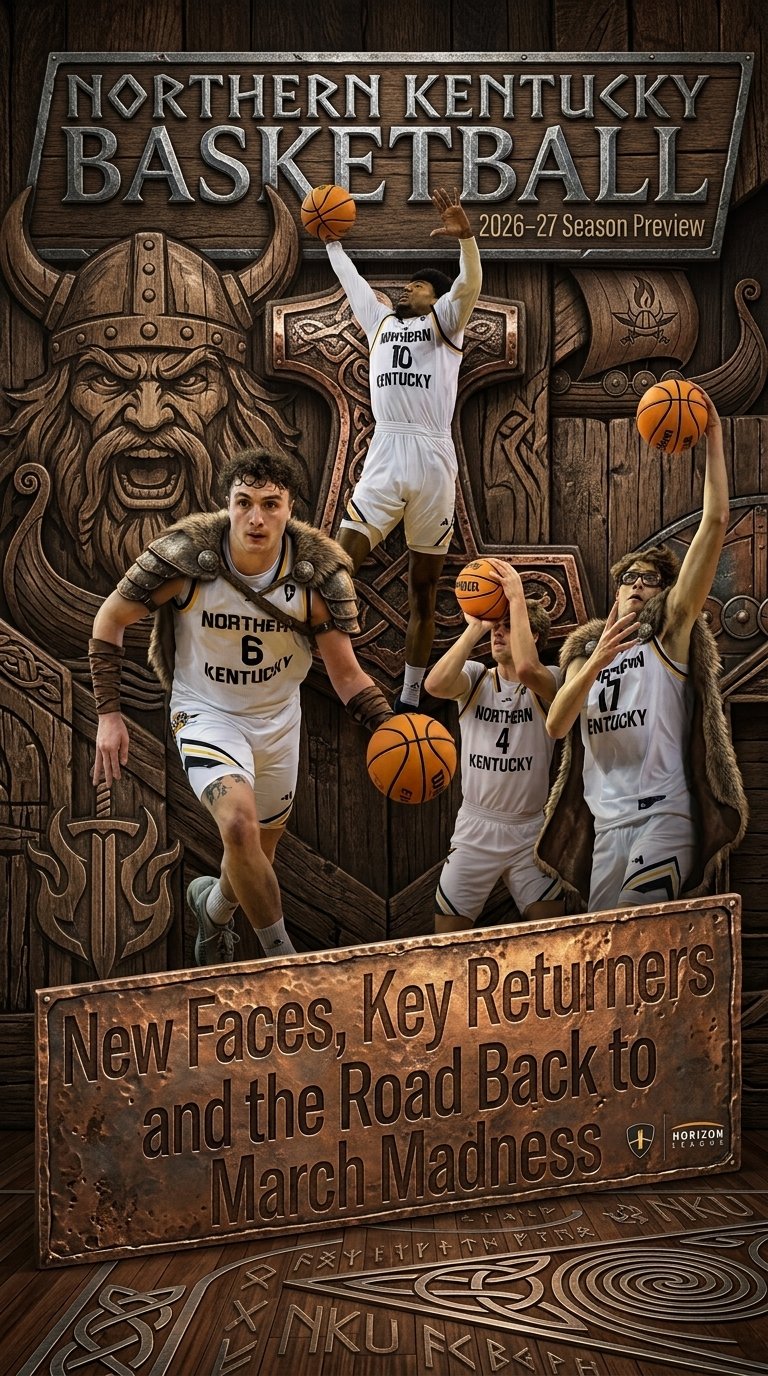
Northern Kentucky Basketball 2026–27 Season Preview: New Faces, Key Returners and the Road Back to March Madness
Northern Kentucky enters the 2026–27 men’s basketball season with a familiar goal and a different cast of players. Coming off a 20-win campaign, the Norse must replace substantial scoring while developing a roster that combines experienced transfers with promising young talent.
Darrin Horn’s challenge is to turn those pieces into a team capable of competing near the top of the Horizon League. Returning point guard Ethan Elliott provides continuity, while newcomers Noah Pagotto, Will Shortt and Eric Acker offer experience at positions where NKU needs immediate contributions.
How Did NKU Do Last Season?
Northern Kentucky finished
20–14 overall and 10–10 in Horizon League play
in 2025–26. The Norse went 12–5 at home and reached 20 victories for the first time since 2022–23. Their season ended with a
103–90 loss to Wright State in the Horizon League Tournament semifinals.
Scoring was a strength. NKU averaged
83.1 points, made
9.4 three-pointers per game, and generated
8.6 steals per contest. However, opponents averaged 77.5 points, and the Norse’s rebounding margin was only plus-0.6. Those numbers point toward two priorities: more consistent defensive stops and better control of the glass.
The biggest offseason challenge is replacing last season’s five leading scorers: Donovan O’Day, Dan Gherezgher, LJ Wells, Kael Robinson and Tae Dozier. All five are absent from the current roster. O’Day led NKU with 18.6 points per game, while Wells contributed 15.0 points and a team-leading 7.3 rebounds. This team will need a new offensive hierarchy.
Coaching Staff Breakdown
Darrin Horn — Head Coach:
Entering his eighth season at NKU, Horn brings familiarity with the demands of winning in the Horizon League. He reached his 300th career coaching victory in February 2026. This season will test his ability to establish dependable scoring options while improving defensive consistency.
Simon McCormack — Associate Head Coach:
McCormack’s responsibilities include directing the offense and working with the big men. That makes his role especially significant as NKU integrates a rebuilt frontcourt and determines how its newcomers fit together.
David Harris — Associate Head Coach:
Harris remains part of Horn’s senior coaching staff, providing continuity as the Norse introduce new players and assistant coaches.
David Watkins — Assistant Coach:
Watkins joined NKU during summer 2026 after coaching at Radford. His previous work included serving as defensive coordinator at Daytona State, where his teams consistently forced turnovers. That background could help NKU turn defensive pressure into productive possessions.
Ben Sisson — Assistant Coach/Player Development:
A Fort Thomas native and former Highlands standout, Sisson arrived after three seasons at Morehead State. His development role will be important for a roster asking several younger players to handle greater responsibility.
Centers and Interior Play
NKU’s official roster lists its frontcourt players as forwards, with
no designated center. The following interior roles are projections, rather than an announced depth chart.
Will Shortt
looks like a strong candidate to handle substantial minutes around the basket. The 6-foot-8, 230-pound Niagara transfer averaged
6.5 points, 4.4 rebounds and 0.9 blocks
last season while shooting
60.5%. His production improved late in the year, suggesting room for growth with additional opportunity.
Shortt’s value should come through finishing, screening, rebounding and defending the paint. NKU does not necessarily need him to become a featured scorer, but it needs reliable interior possessions.
Patrick Otto Mäe, a 6-foot-9 freshman, and
Juanma Ruiz, a 6-foot-9 sophomore, provide additional size. Both are candidates for frontcourt minutes, although their places in the rotation remain unsettled. Their development could determine how comfortably Horn manages foul trouble and larger opposing lineups.
Forwards Breakdown
Noah Pagotto
brings the strongest recent college scoring résumé among NKU’s incoming forwards. The East Texas A&M transfer averaged
10.4 points and 5.7 rebounds, shooting
55.1% overall and 37.3% from three-point range.
At 6-foot-8, Pagotto offers a potential combination of rebounding, interior scoring and floor spacing. His perimeter percentage came on modest volume, so expecting him to become a high-volume outside scorer would be premature. Still, his versatility gives Horn options when pairing frontcourt players.
Donovan Rakotonanahary
returns after averaging
3.0 points and 2.3 rebounds
in 32 appearances. He shot
70.2% from the field, demonstrating efficiency in a limited offensive role. The next question is whether he can maintain that effectiveness while playing more minutes and taking on additional responsibility.
Ryan Tolliver, a 6-foot-7 sophomore, adds another returning option. After limited minutes last season, he has an opportunity to compete for a larger role through rebounding, defensive reliability and efficient decisions.
Guards Breakdown
Ethan Elliott
is the clearest source of continuity. He started 31 games last season and averaged
5.1 points and 4.6 assists, finishing with a
3.32 assist-to-turnover ratio.
His passing gives NKU a dependable foundation. Improving his shooting is the next step: Elliott made 25.6% of his three-pointers last season. A more credible perimeter threat would make it harder for defenders to retreat into passing lanes and crowd his teammates.
Eric Acker
arrives from La Salle with experience as both a scorer and distributor. Earlier in his career at Long Island, he averaged
12.7 points and 3.8 assists
and earned NEC All-Freshman recognition. His production was lower across his two La Salle seasons, making him a candidate to regain a larger offensive role at NKU.
BJ Davis-Ray, a 6-foot-6 transfer from SMU, offers intriguing size on the perimeter. He appeared in 32 games last season but averaged only 1.3 points in limited minutes. A larger opportunity could unlock more production, although he enters as a developmental possibility rather than a proven college scoring leader.
Senior
Bryce Darbyshire
supplies returning experience. Sophomore
JJ Apathjang
and freshmen
Willie Foster
and
Gabrielius Jokubauskas
round out the backcourt, giving Horn several options as he evaluates shooting, ballhandling and defensive matchups.
Prediction for the 2026–27 Season
My projection is
18–20 overall victories and a fourth- to sixth-place Horizon League finish, with NKU capable of challenging for a tournament semifinal berth.
The Norse have enough experience at point guard and enough incoming frontcourt production to remain competitive. However, replacing their leading scorers makes another 20-win season something to earn rather than assume.
Three developments would raise their ceiling: Elliott becoming a more efficient scorer, Pagotto establishing himself as a dependable offensive option, and Shortt helping NKU defend and rebound more consistently. A breakthrough from Davis-Ray or another young guard would further strengthen the outlook.
An NCAA Tournament appearance is a plausible upside scenario through a Horizon League Tournament championship, but it is not my preseason expectation.
Conclusion
Northern Kentucky has the ingredients for another competitive season, though its identity must take shape around a largely rebuilt scoring rotation. Elliott’s playmaking provides a starting point, Pagotto brings proven production, and Shortt offers needed interior help.
For fans at Truist Arena, the most compelling story will be watching which players turn opportunity into dependable performance. If the Norse develop balanced scoring and make meaningful defensive progress, they can become a difficult opponent when the Horizon League race reaches March.
Up To $1500 in Bonus Bets Paid Back if your First Bet Does Not Win
T&Cs apply
4.5/5
Gambling problem? Call 1-800-GAMBLER or 1-800-MY-RESET (Available in the US) 877-8-HOPENY or text HOPENY (467369) (NY) 1-800-327-5050 (MA), 1-800-BETS-OFF (IA), 1-800-981-0023 (PR). 21+ only. Please Gamble Responsibly. See BetMGM.com for Terms. First Bet Offer for new customers only (if applicable). Subject to eligibility requirements. Bonus bets are non-withdrawable. In partnership with Kansas Crossing Casino and Hotel. Promotional offers not available in Mississippi, Massachusetts, New York, Ontario, or Puerto Rico.
New DraftKings Customers: Spend $5+ Get $150 in Bonuses
T&Cs apply
4.5/5
GAMBLING PROBLEM? CALL 1-800-GAMBLER or 1-800-MY-RESET, (800) 327-5050 or visit gamblinghelplinema.org (MA). Please Gamble Responsibly. 888-789-7777/visit ccpg.org (CT), or visit www.mdgamblinghelp.org (MD), 1-800-981-0023 (PR). 21+ and present in most states. (18+ DC/NH/PR/WY). Void in CAN. Eligibility restrictions apply. On behalf of Boot Hill Casino (KS). Pass-thru of per wager tax may apply in IL. 1 per new DraftKings customer. $5+ first-time bet req. Max. $150 issued as non-withdrawable Bonus Bets. Stake removed from payout. Reward issued as $50 in Bonus Bets every 7 days via click-to-claim for 14 days. Bonus Bets and click-to-claims expire 7 days (168hrs) after issuance. Terms: sportsbook.draftkings.com/promos. Ends 10/11/26 at 11:59 PM ET. Sponsored by DK.
Must be 21+. GAMBLING PROBLEM? CALL 1-800-GAMBLER OR CALL 1-800-MY-RESET, www.mdgamblinghelp.org (MD), (800)-327-5050 or gamblinghelplinema.org (MA), Call (877)8-HOPENY or text HOPENY (467369) (NY), (888) 789-7777 or ccpg.org (CT), morethanagame.nc.gov (NC), 1800gambler.net (WV)
Bet $1 and get double the winnings up to $25 for your next 10 bets
T&Cs apply
4.4/5
21+ New users only. Must register using eligible promo code. First bet after registration must qualify. Max. Bonus Bet: $1,000. Bonus Bet expires 14 days after receipt. Void where prohibited. See Caesars.com/promos for full terms. Gambling Problem? 1-800-GAMBLER (1-800-426-2537)
21+ and present in OH. Gambling Problem? Call 1-800-GAMBLER.
This site is using
Cloudflare
and adheres to the
Google Safe Browsing Program. We adapted
Google's Privacy Guidelines
to keep your data safe at all times.
Close
Ready to Win Big? Join the Elite with Our Sports Betting Deals!
FanDuel Promo
New Users – Get $250 in Bonus Bets when you wager $5 for 5 days
Up To $1500 in Bonus Bets Paid Back if your First Bet Does Not Win
Best Slots
T&Cs and 21+ apply
Gambling problem? Call 1-800-GAMBLER or 1-800-MY-RESET (Available in the US) 877-8-HOPENY or text HOPENY (467369) (NY) 1-800-327-5050 (MA), 1-800-BETS-OFF (IA), 1-800-981-0023 (PR). 21+ only. Please Gamble Responsibly. See BetMGM.com for Terms. First Bet Offer for new customers only (if applicable). Subject to eligibility requirements. Bonus bets are non-withdrawable. In partnership with Kansas Crossing Casino and Hotel. Promotional offers not available in Mississippi, Massachusetts, New York, Ontario, or Puerto Rico.
Code:
Open BetMGM
Get Bonus
DraftKings Promo
New DraftKings Customers: Spend $5+ Get $150 in Bonuses
Newcomer
T&Cs and 21+ apply
GAMBLING PROBLEM? CALL 1-800-GAMBLER or 1-800-MY-RESET, (800) 327-5050 or visit gamblinghelplinema.org (MA). Please Gamble Responsibly. 888-789-7777/visit ccpg.org (CT), or visit www.mdgamblinghelp.org (MD), 1-800-981-0023 (PR). 21+ and present in most states. (18+ DC/NH/PR/WY). Void in CAN. Eligibility restrictions apply. On behalf of Boot Hill Casino (KS). Pass-thru of per wager tax may apply in IL. 1 per new DraftKings customer. $5+ first-time bet req. Max. $150 issued as non-withdrawable Bonus Bets. Stake removed from payout. Reward issued as $50 in Bonus Bets every 7 days via click-to-claim for 14 days. Bonus Bets and click-to-claims expire 7 days (168hrs) after issuance. Terms: sportsbook.draftkings.com/promos. Ends 10/11/26 at 11:59 PM ET. Sponsored by DK.
Code:
Open DraftKings
Get Bonus
Find out what the legends have to say about sports this week....